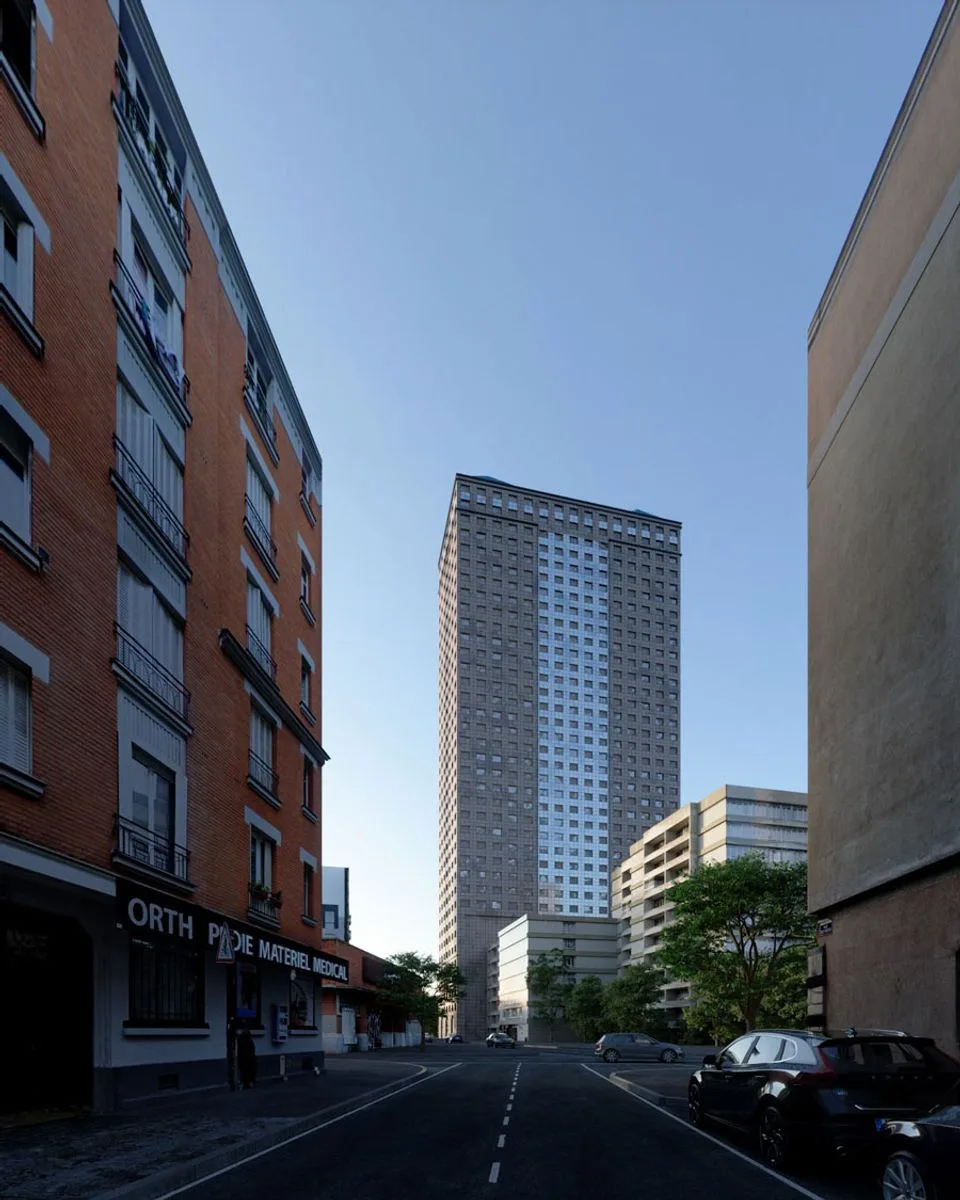
Tour Grand Angle
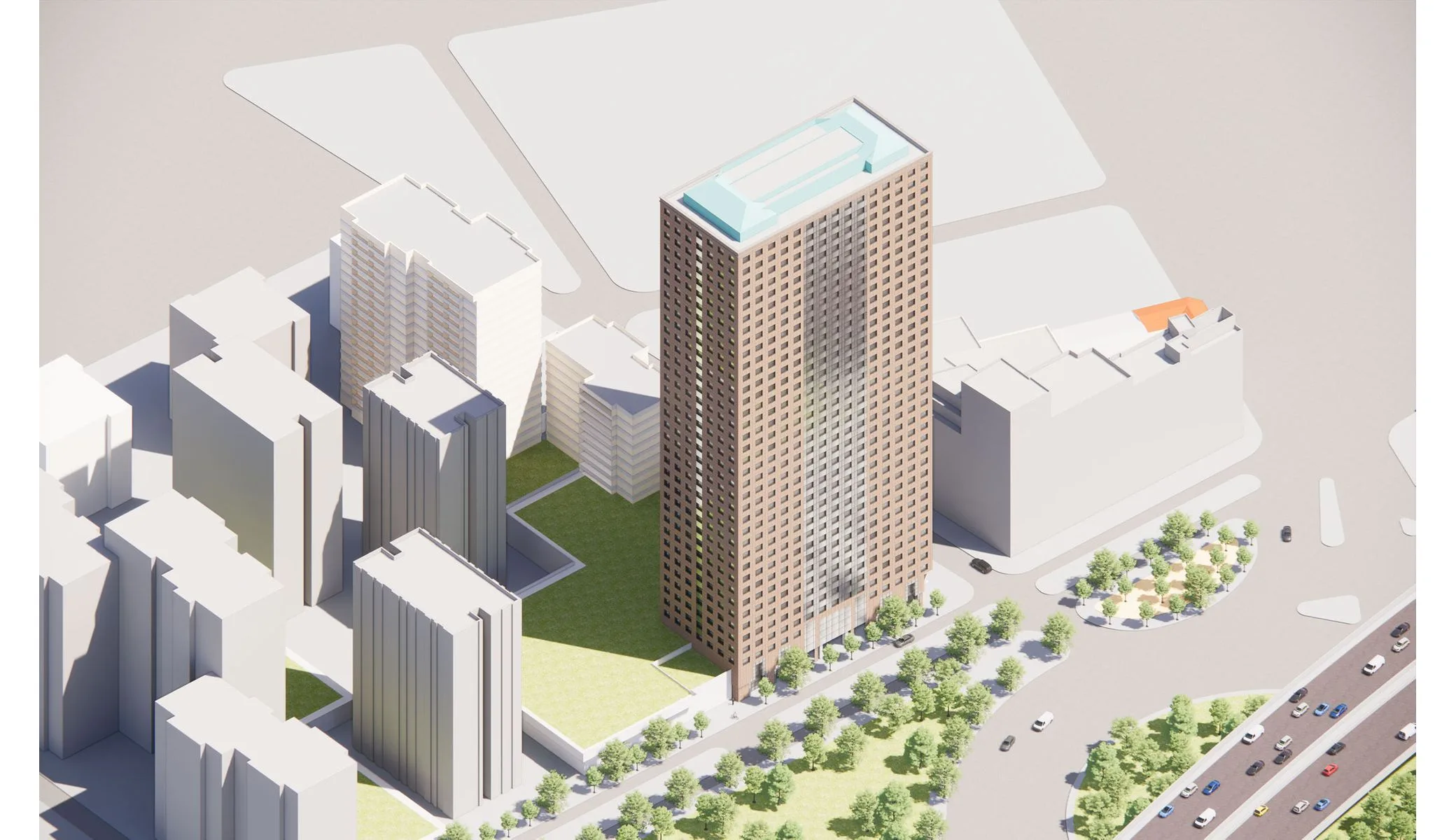
The "Tour Grand Angle" offers new life to the famous "Tour la Villette," also known as "Tour Daewoo," "Tour Périphérique," "Tour Pariferic," or "Tour Olympe." Our project proposes an attractive and committed renewal for this building of infinite lives.
We approached the Tour Grand Angle with the awareness of intervening on an edifice that bears several names, several histories. Tour la Villette, Tour Daewoo, Tour Périphérique, Tour Pariferic, Tour Olympe: so many appellations that testify to an eventful architectural life, made of successive transformations, changes of owners and uses. This **multiplicity of identities** is not a handicap, it becomes on the contrary the starting point of our reflection. Rather than erasing the past, we sought to offer this tower a new chapter, a new urban and social relevance, while assuming its status as a vertical landmark in the Aubervilliers landscape.
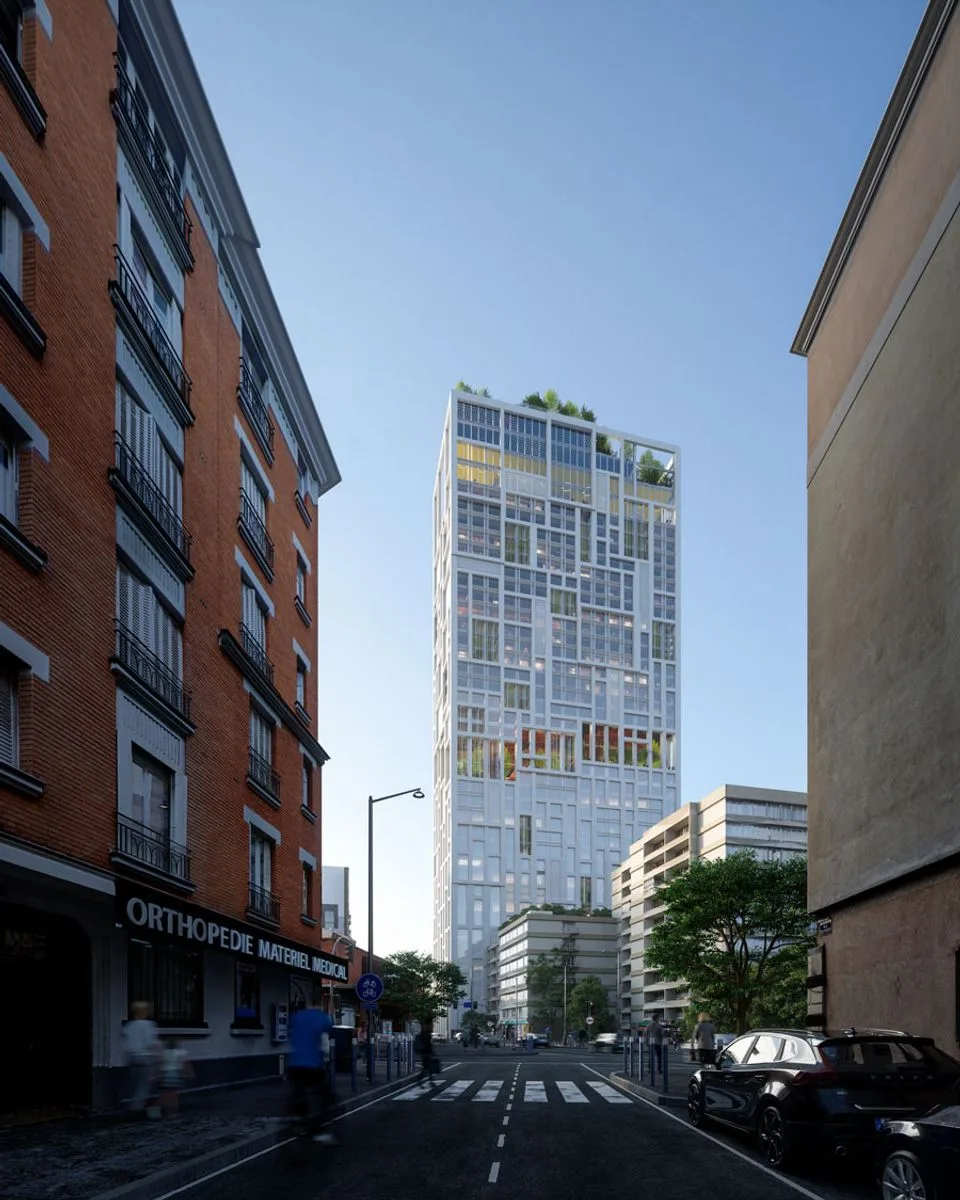
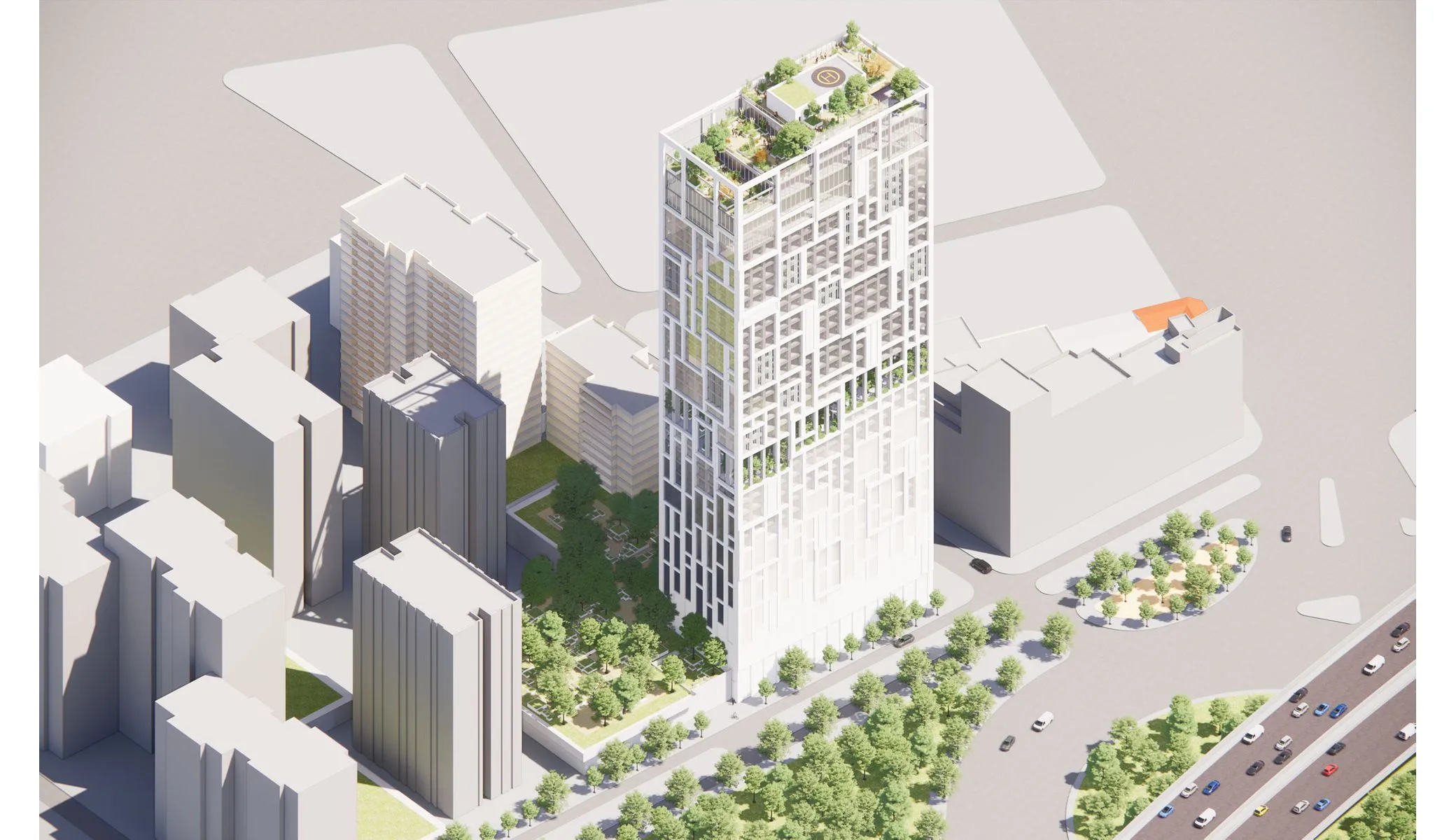
The site is strategic, almost obvious in its legibility. At the entrance to the commune of Aubervilliers, between the 19th arrondissement of Paris and the Boulevard Périphérique, the tower occupies a threshold position, a passage between two territories. Second tallest skyscraper in Seine-Saint-Denis, it benefits from **undeniable visibility**, but this visibility is not solely technical or visual data. It engages an architectural responsibility: that of producing an urban signal that does not merely content itself with being seen, but that actively participates in the transformation of a neighborhood in mutation. Aubervilliers has experienced for several years an intense dynamic of urban renewal, driven by the arrival of new transportation infrastructures, mixed-use programs, cultural and sports facilities. In this context, our project could not be limited to a simple technical rehabilitation. We had to imagine a **new urban signal**, capable of dialoguing with this city in the making.
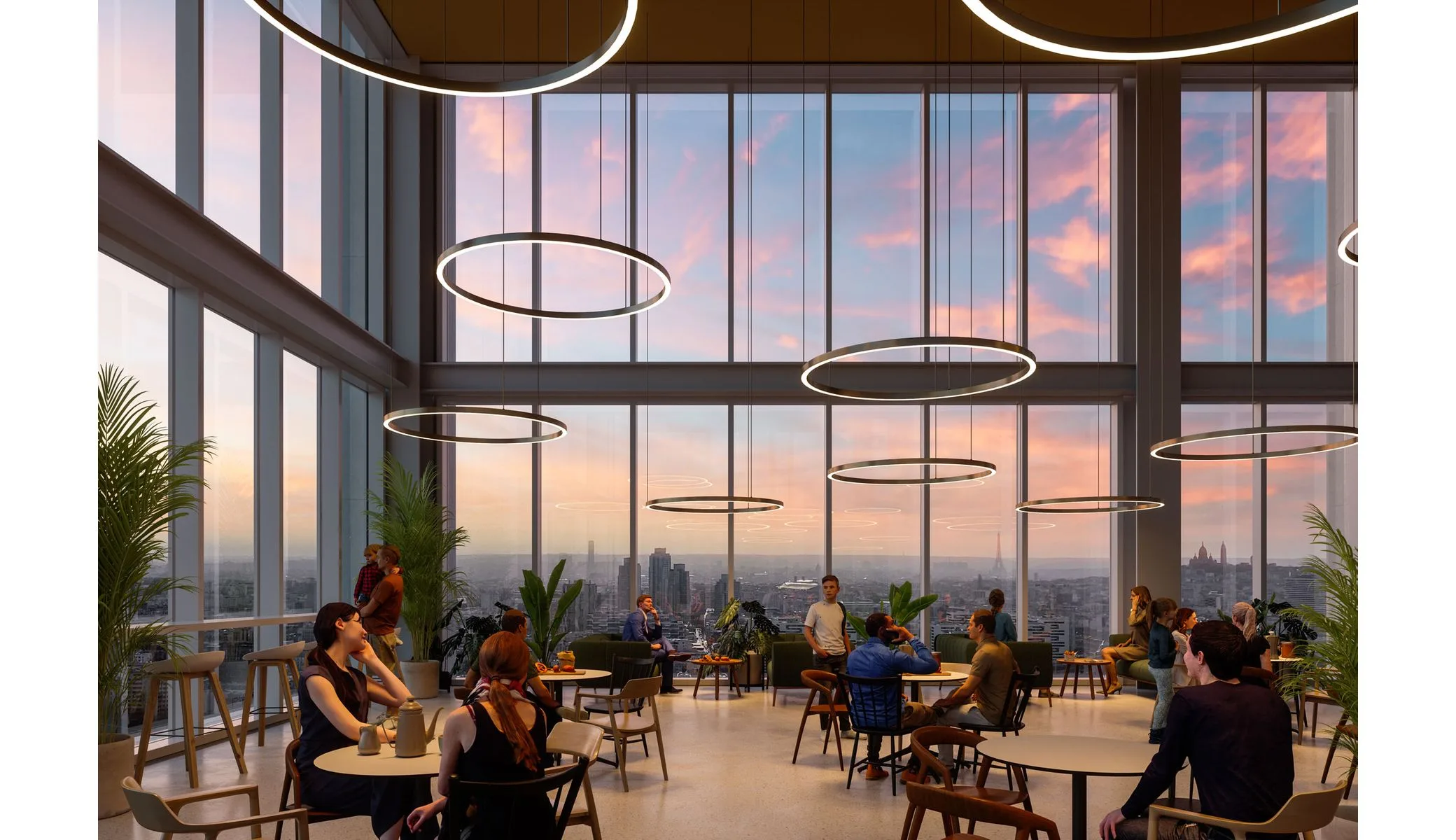
The program we developed rests on an **assumed and generous mix of uses**. We propose to accommodate housing, offices, a student residence, a hotel, and a restaurant. This programmatic diversity is not a functional juxtaposition, it is at the heart of our approach. By blending residence, work, temporary accommodation, and dining, we seek to create a living place that escapes the mono-functionality often criticized in towers of the 1970s and 1980s. The Tour Grand Angle thus becomes a **space of cohabitation**, where rhythms and temporalities intersect, where the resident encounters the traveler, where the worker meets the student. This mix of uses favors continuous animation of the building, day and night, and participates in the emergence of a richer vertical urbanity, denser in human interactions.
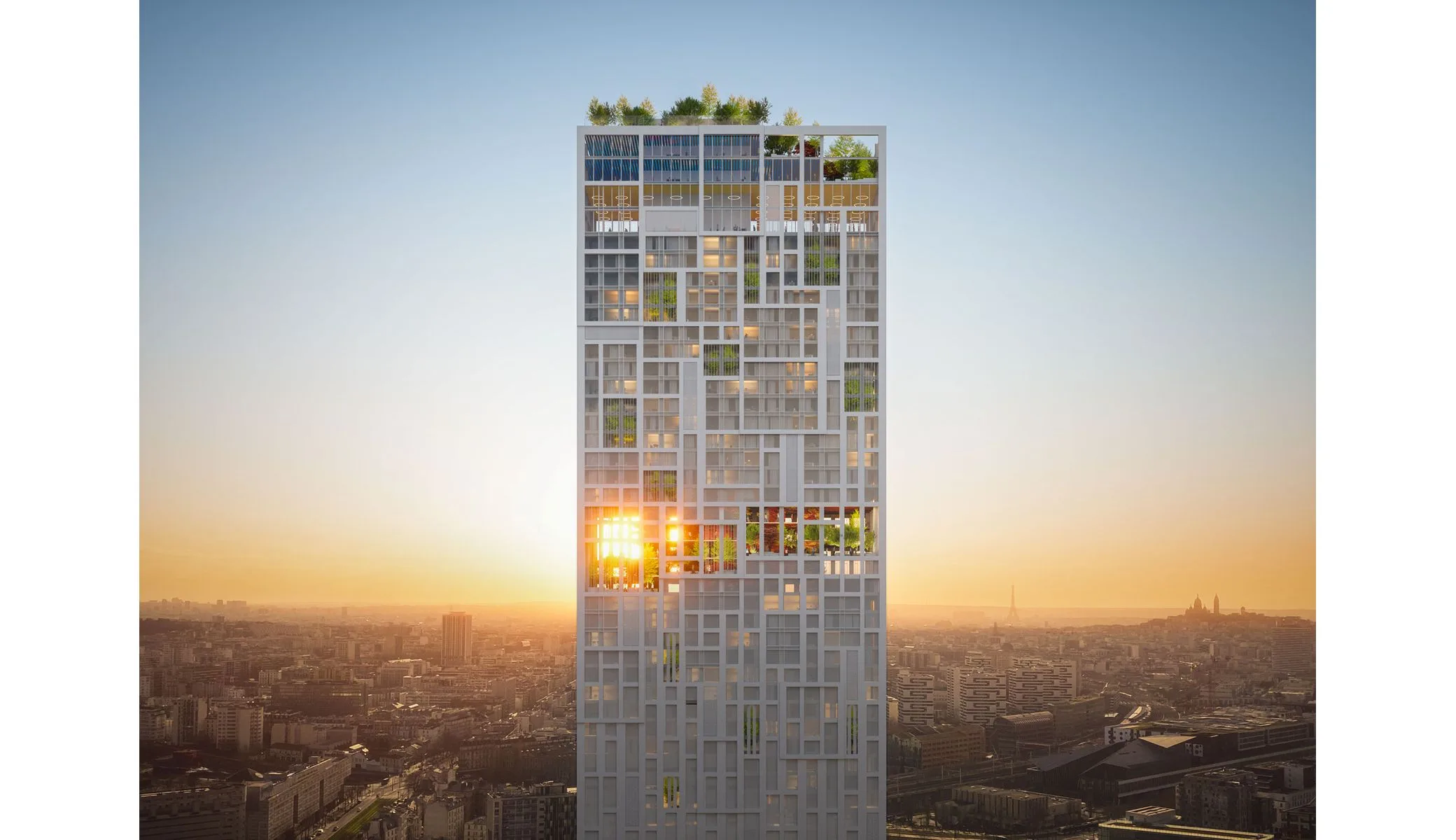
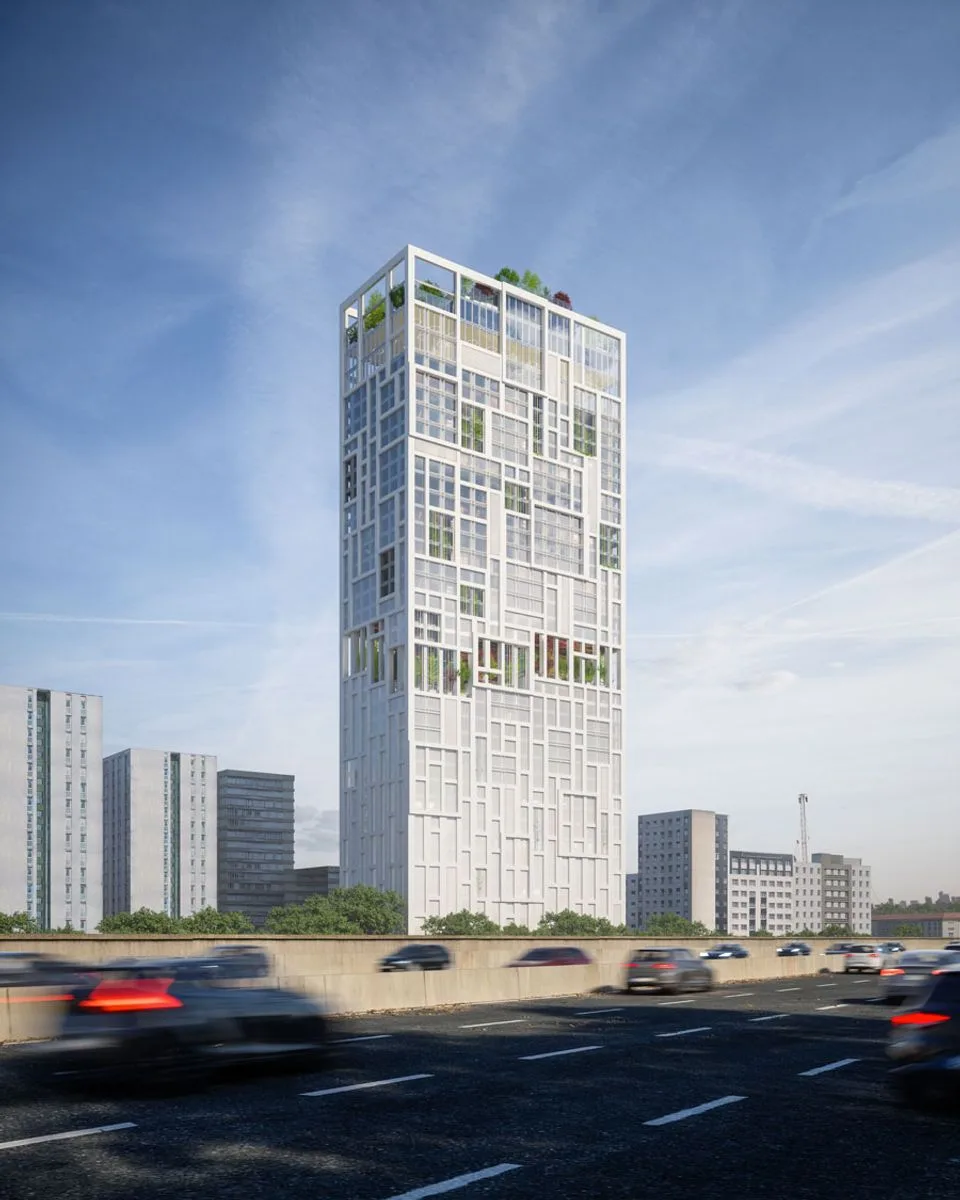
Our architectural approach rests on a **gesture of global transformation** that respects the existing structure while asserting a new identity. We worked from the tower's general volumetry, reinterpreting its facade and introducing setbacks, terraces, variations in the treatment of glazed surfaces. The objective was twofold: to improve the building's thermal and environmental performance, and to produce a **contemporary image** capable of requalifying the entire sector. We imagined an active facade, made of plays of transparency and opacity, where glass alternates with opaque panels treated in soft nuances, in subtle gradations that capture the changing light of the Île-de-France sky. This **evolving chromatic palette** gives the tower a changing presence according to the hours of day, the seasons, the weather conditions. It becomes a sensitive screen, a moving landmark in the urban landscape.
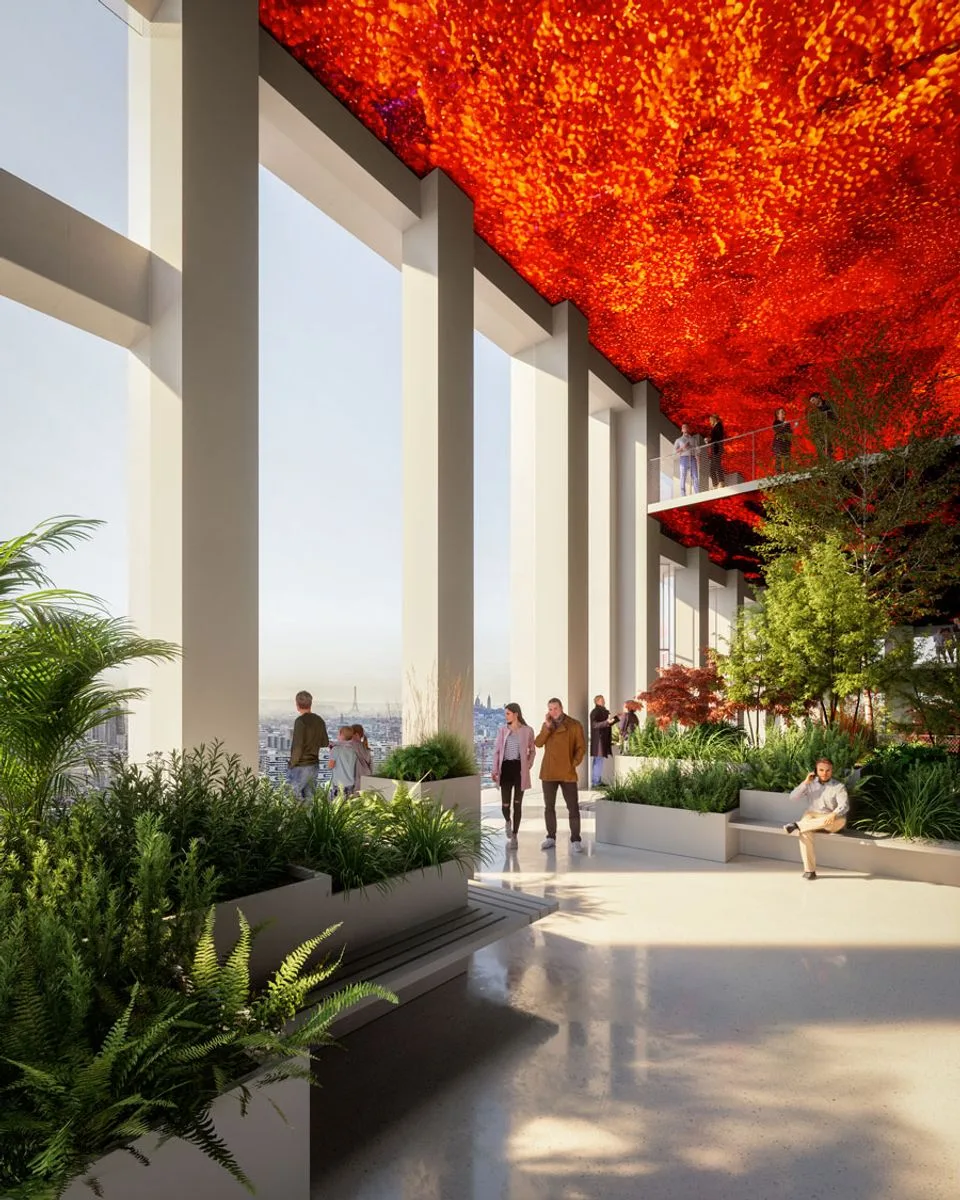
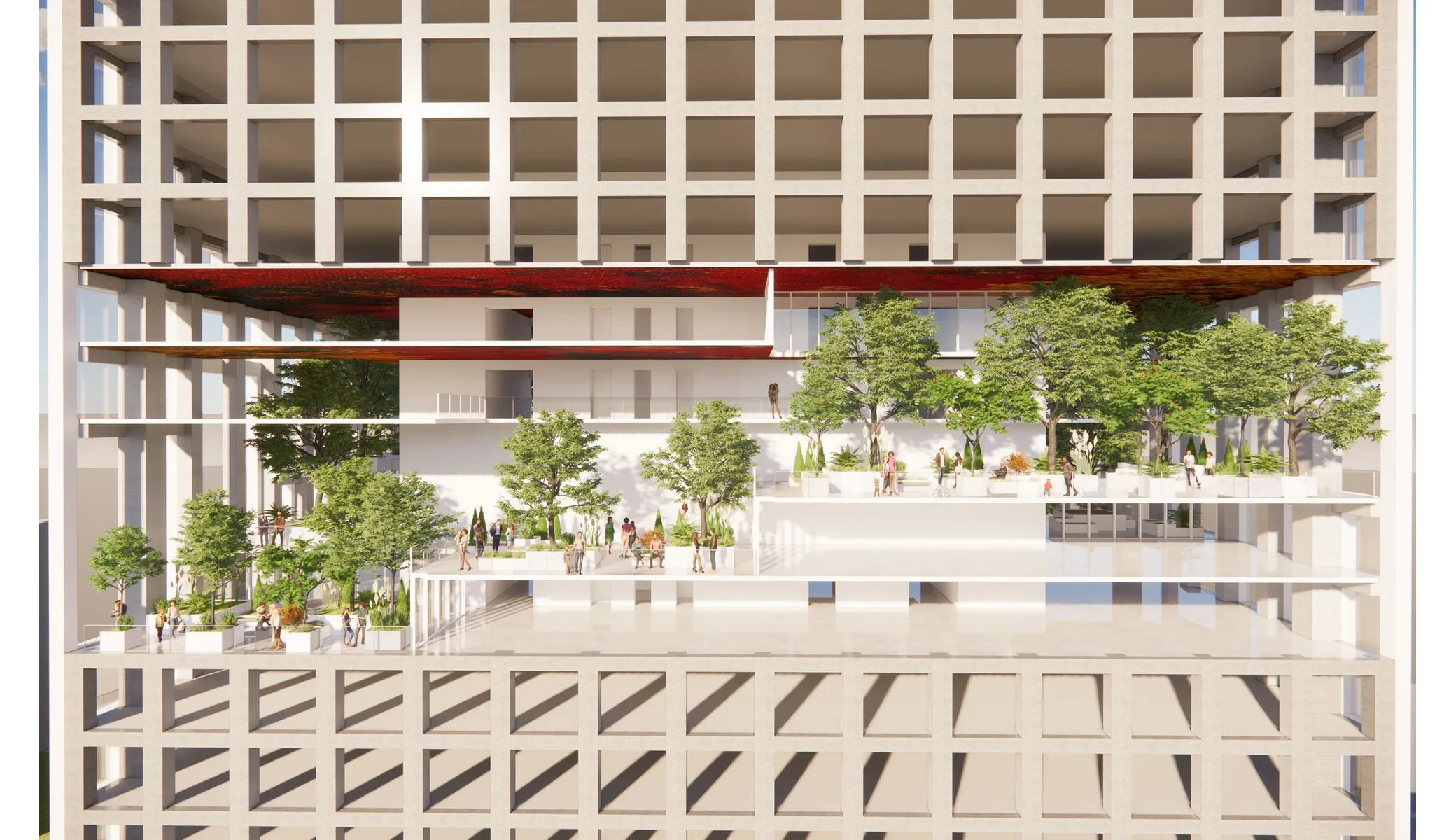
The question of **materiality** was central to our reflection. We sought to avoid the smooth uniformity of standardized curtain walls. By introducing variations in tones, depths, textures in the facade panels, we wanted to give the tower a **visual thickness** that dialogues with the site's complexity. The setbacks in the upper part of the building allow for accessible terraces, private or collective outdoor spaces that enrich the experience of residents and users. These terraces are not decorative appendages, they fully participate in the quality of the tower's use, offering exterior extensions to the housing units, coworking spaces, meeting rooms. They create **vertical respirations**, moments of pause in the building's ascension.
The environmental approach is intrinsically linked to the rehabilitation project. We integrated from the feasibility phase a reflection on the **energy optimization** of the existing building. The improvement of the envelope, treatment of thermal bridges, installation of assisted natural ventilation systems, rainwater recovery, terrace greening: so many strategies that allow for significantly reducing the tower's carbon footprint. We also worked on the **reversibility of spaces**, imagining modular floor plates capable of accommodating different types of programs over time. This programmatic flexibility is a form of long-term sustainability, it allows the building to adapt to evolving uses, lifestyles, economic and social needs.
The ground floor was the object of particular attention. We sought to open the tower to public space, to create **visual and physical porosities** between interior and exterior. The restaurant and reception spaces are conceived as transition places, welcoming thresholds that invite entering, crossing, stopping. The idea is to make the tower not a closed object unto itself, but a place of passage, an **urban node** that participates in the neighborhood's life. The immediate surroundings were rethought to improve pedestrian circulation, create rest spaces, plant trees. We wanted the Tour Grand Angle not only to be a vertical object, but to contribute to the quality of the public space that surrounds it.
In working on this project, we were struck by buildings' capacity to be reborn, to reinvent themselves. The Tour Grand Angle illustrates this **infinite life** of architectures, their aptitude to traverse eras, to absorb urban transformations, to bear new functions. Our intervention does not pretend to definitively fix this tower's identity, but to offer it a new **respiration**, a new breath capable of fully inscribing it in the present and future of Aubervilliers. It thus becomes a manifesto for an architecture of transformation, attentive to inheritances, engaged in ecological transition, generous in its uses, and resolutely anchored in its territory.
The site is strategic, almost obvious in its legibility. At the entrance to the commune of Aubervilliers, between the 19th arrondissement of Paris and the Boulevard Périphérique, the tower occupies a threshold position, a passage between two territories. Second tallest skyscraper in Seine-Saint-Denis, it benefits from **undeniable visibility**, but this visibility is not solely technical or visual data. It engages an architectural responsibility: that of producing an urban signal that does not merely content itself with being seen, but that actively participates in the transformation of a neighborhood in mutation. Aubervilliers has experienced for several years an intense dynamic of urban renewal, driven by the arrival of new transportation infrastructures, mixed-use programs, cultural and sports facilities. In this context, our project could not be limited to a simple technical rehabilitation. We had to imagine a **new urban signal**, capable of dialoguing with this city in the making.
The program we developed rests on an **assumed and generous mix of uses**. We propose to accommodate housing, offices, a student residence, a hotel, and a restaurant. This programmatic diversity is not a functional juxtaposition, it is at the heart of our approach. By blending residence, work, temporary accommodation, and dining, we seek to create a living place that escapes the mono-functionality often criticized in towers of the 1970s and 1980s. The Tour Grand Angle thus becomes a **space of cohabitation**, where rhythms and temporalities intersect, where the resident encounters the traveler, where the worker meets the student. This mix of uses favors continuous animation of the building, day and night, and participates in the emergence of a richer vertical urbanity, denser in human interactions.
Our architectural approach rests on a **gesture of global transformation** that respects the existing structure while asserting a new identity. We worked from the tower's general volumetry, reinterpreting its facade and introducing setbacks, terraces, variations in the treatment of glazed surfaces. The objective was twofold: to improve the building's thermal and environmental performance, and to produce a **contemporary image** capable of requalifying the entire sector. We imagined an active facade, made of plays of transparency and opacity, where glass alternates with opaque panels treated in soft nuances, in subtle gradations that capture the changing light of the Île-de-France sky. This **evolving chromatic palette** gives the tower a changing presence according to the hours of day, the seasons, the weather conditions. It becomes a sensitive screen, a moving landmark in the urban landscape.
The question of **materiality** was central to our reflection. We sought to avoid the smooth uniformity of standardized curtain walls. By introducing variations in tones, depths, textures in the facade panels, we wanted to give the tower a **visual thickness** that dialogues with the site's complexity. The setbacks in the upper part of the building allow for accessible terraces, private or collective outdoor spaces that enrich the experience of residents and users. These terraces are not decorative appendages, they fully participate in the quality of the tower's use, offering exterior extensions to the housing units, coworking spaces, meeting rooms. They create **vertical respirations**, moments of pause in the building's ascension.
The environmental approach is intrinsically linked to the rehabilitation project. We integrated from the feasibility phase a reflection on the **energy optimization** of the existing building. The improvement of the envelope, treatment of thermal bridges, installation of assisted natural ventilation systems, rainwater recovery, terrace greening: so many strategies that allow for significantly reducing the tower's carbon footprint. We also worked on the **reversibility of spaces**, imagining modular floor plates capable of accommodating different types of programs over time. This programmatic flexibility is a form of long-term sustainability, it allows the building to adapt to evolving uses, lifestyles, economic and social needs.
The ground floor was the object of particular attention. We sought to open the tower to public space, to create **visual and physical porosities** between interior and exterior. The restaurant and reception spaces are conceived as transition places, welcoming thresholds that invite entering, crossing, stopping. The idea is to make the tower not a closed object unto itself, but a place of passage, an **urban node** that participates in the neighborhood's life. The immediate surroundings were rethought to improve pedestrian circulation, create rest spaces, plant trees. We wanted the Tour Grand Angle not only to be a vertical object, but to contribute to the quality of the public space that surrounds it.
In working on this project, we were struck by buildings' capacity to be reborn, to reinvent themselves. The Tour Grand Angle illustrates this **infinite life** of architectures, their aptitude to traverse eras, to absorb urban transformations, to bear new functions. Our intervention does not pretend to definitively fix this tower's identity, but to offer it a new **respiration**, a new breath capable of fully inscribing it in the present and future of Aubervilliers. It thus becomes a manifesto for an architecture of transformation, attentive to inheritances, engaged in ecological transition, generous in its uses, and resolutely anchored in its territory.
- Lieu
- Aubervilliers, France
- Nature
- Logements
- Surface
- 41 787 m²
- Budget
- Confidentiel
- Concours
- 2021
- MOA
- Confidentiel