Sainte-Adresse
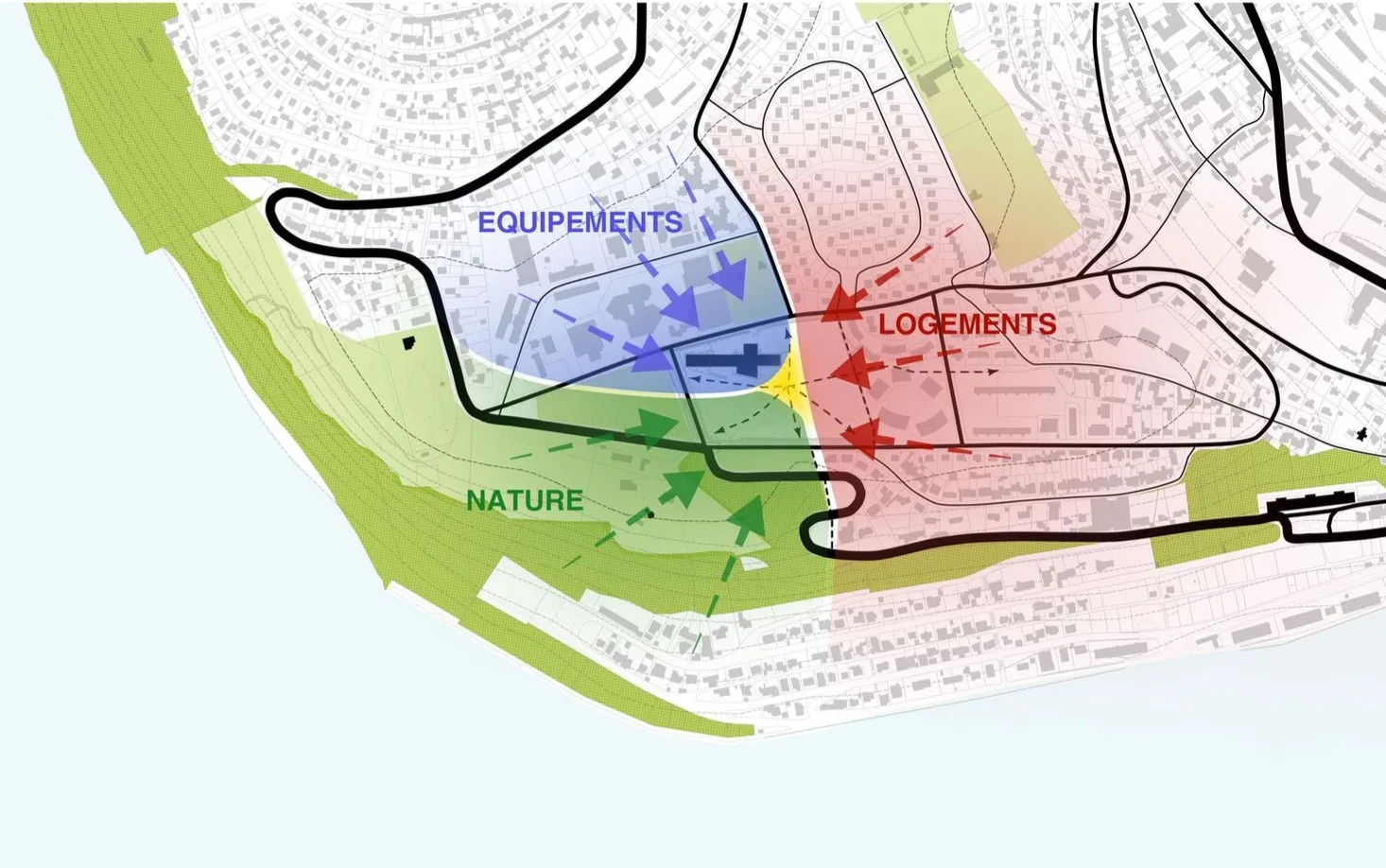
The site of the former ENSM, in its urban scale, is a true anchoring point, a place that aspires to become a stopover between the cliffs, the cape promenade and the surrounding urban fabric. It is in this very particular context, between nature and urbanity, that we aim to offer a new neighborhood life to the Hève plateau, through the creation of a flexible and dynamic "village square," associated with a park conducive to calm and contemplation, a true refuge for local biodiversity.
In Sainte-Adresse, the former site of the École nationale supérieure maritime marchande (ENSM) occupies a geographical position of rare intensity. Perched on the Hève plateau, it overlooks both the beaches of Saint-Denis to the south, the wild coast to the west, and the surrounding residential fabric. From the Batterie de Dollemard to the Église Saint-Joseph, horizons follow one another without interruption. When the school left its premises in 2014, it left behind the complex designed by Roger Hummel, notably the dormitory, a landmark building that accompanied the daily life of many residents. This departure opened a blank page, but one that must be written with awareness of a **collective heritage**, a strong local memory. We wanted to transform this vacancy into an opportunity, imagining a new neighborhood capable of dialoguing with this past while responding to contemporary challenges of sobriety, programmatic diversity, and respect for the living world.
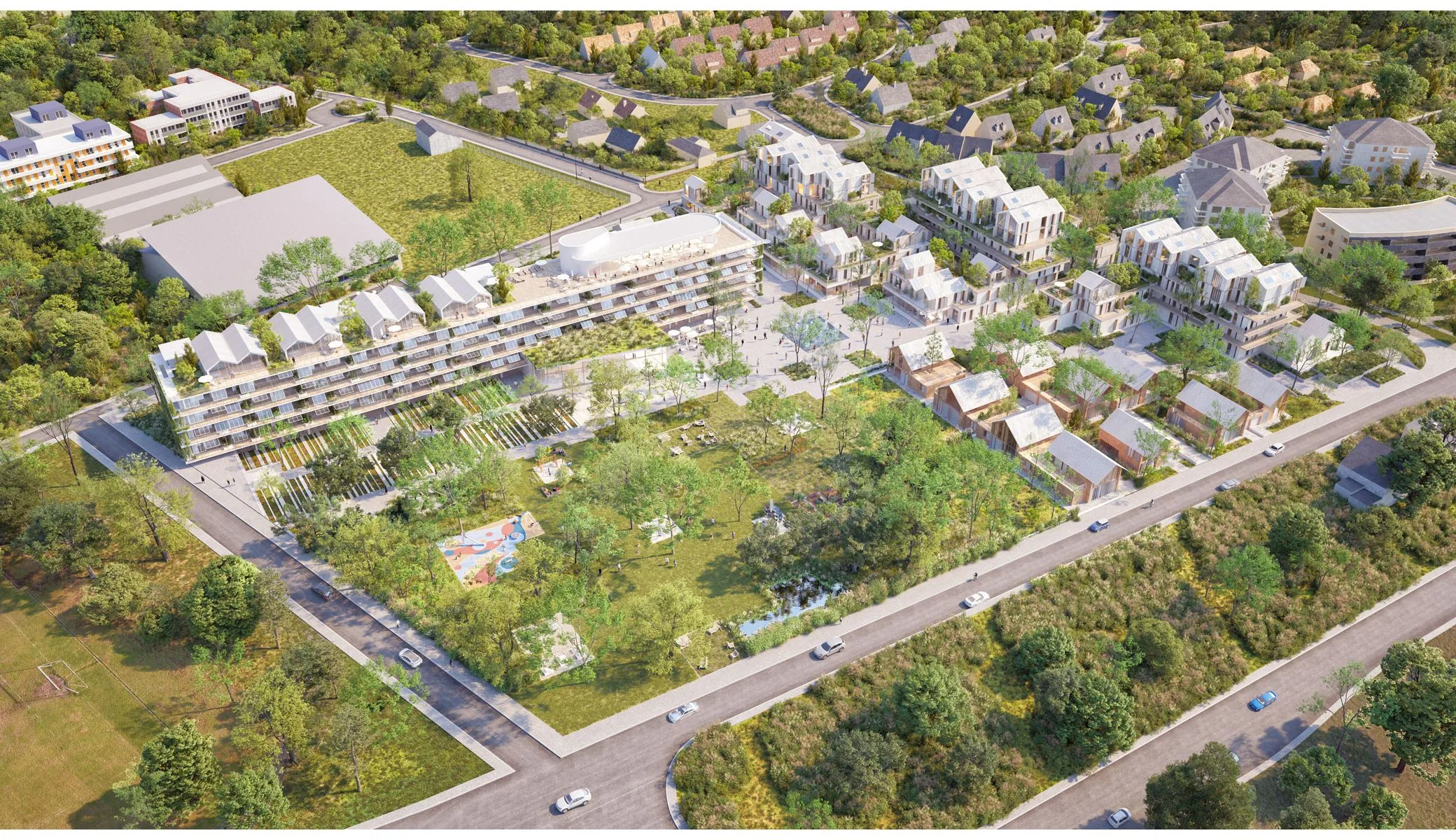
Our approach rests on a fundamental principle: **finding the right balance between memory and invention**. We do not seek to erase the history of the place, nor to freeze it in sterile nostalgia. On the contrary, we want to make this history resonate through new forms, current uses, a renewed relationship with the site. The existing dormitory possesses undeniable contextual and constructive qualities. Rather than starting from scratch, we envision its rehabilitation as an anchoring point for the project, a narrative foundation from which a broader urban composition articulates itself. Around it, we propose creating a **flexible and dynamic village square**, a shared living space, as well as a **park conducive to calm and contemplation**, a true refuge for local biodiversity. This duality between urban animation and contemplative retreat structures the entire project.
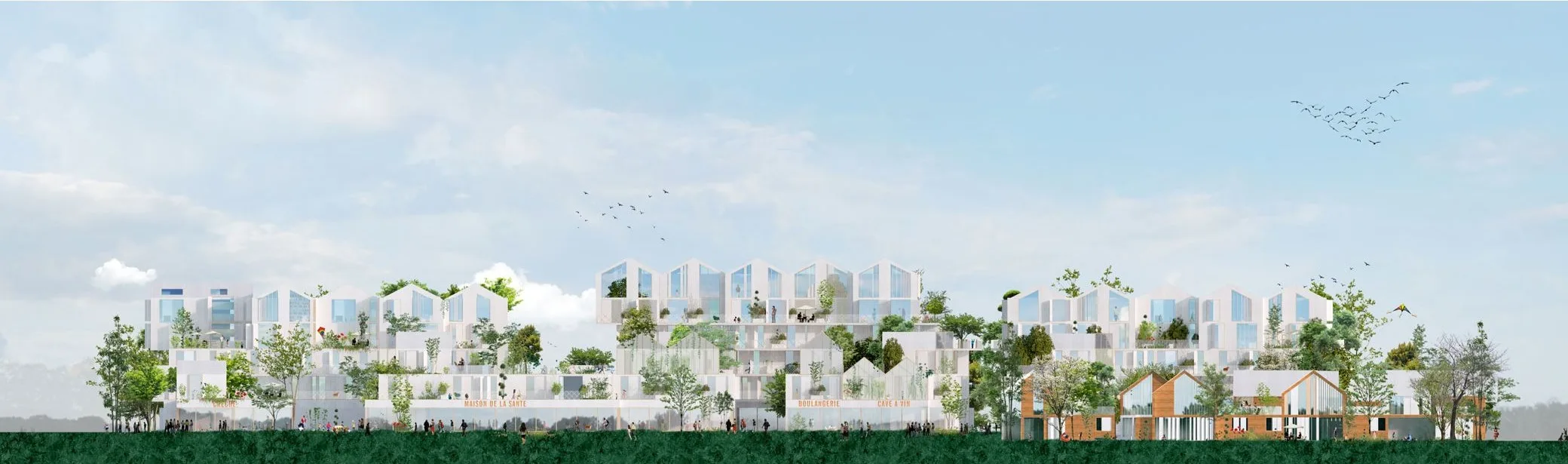
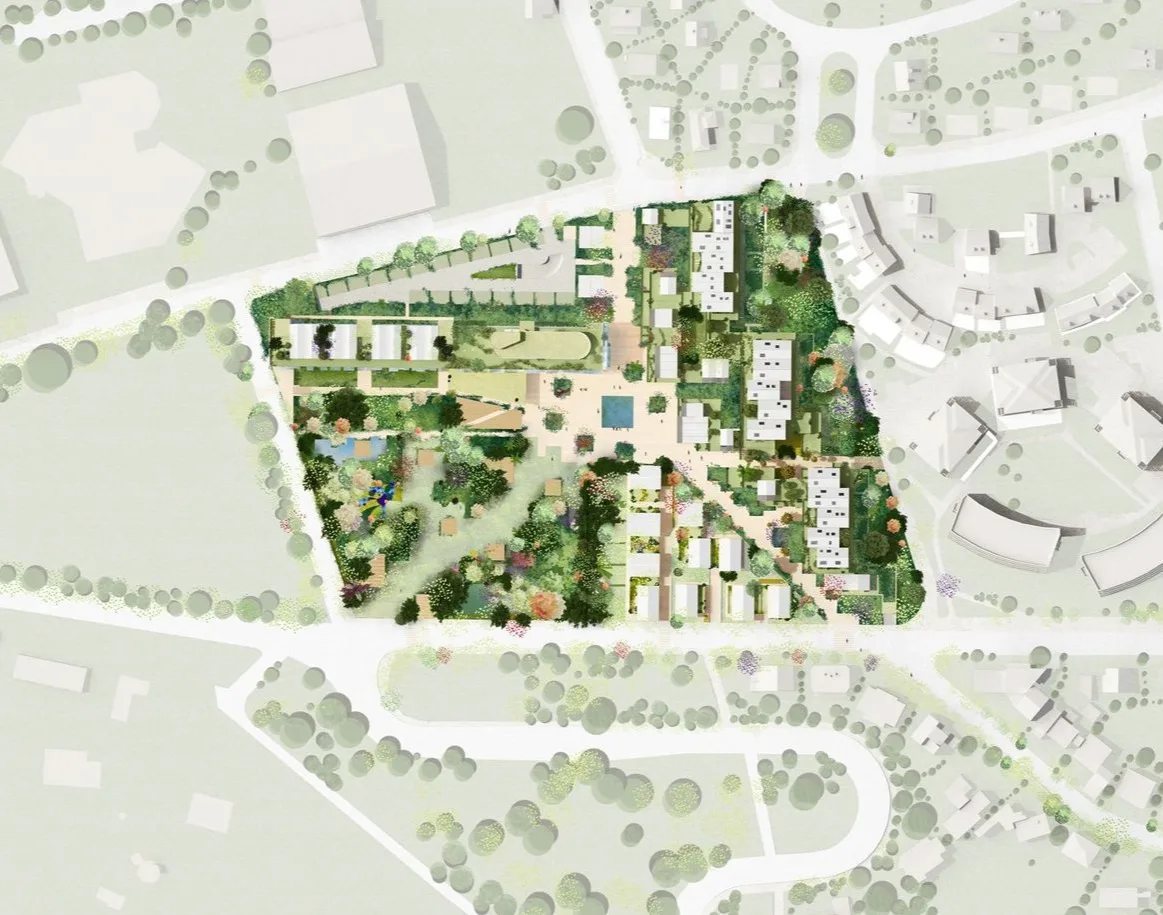
The site stands at the junction between two worlds: the dense urbanity of Le Havre on one side, the protected nature of the cap de la Hève on the other. This very particular context, between **nature and urbanity**, demands careful attention to transitions. We imagined the project as a **stopover**, a breathing space where one can pause, look up, grasp the power of the landscape. The new housing, ground-floor shops, and public spaces are organized to offer views at different levels, accessible to all, permanent residents and occasional strollers alike. Each building is positioned so as not to obstruct perspectives, to create visual openings toward the sea, the cliffs, the open water. This desire to **share the landscape** guides the entire composition.
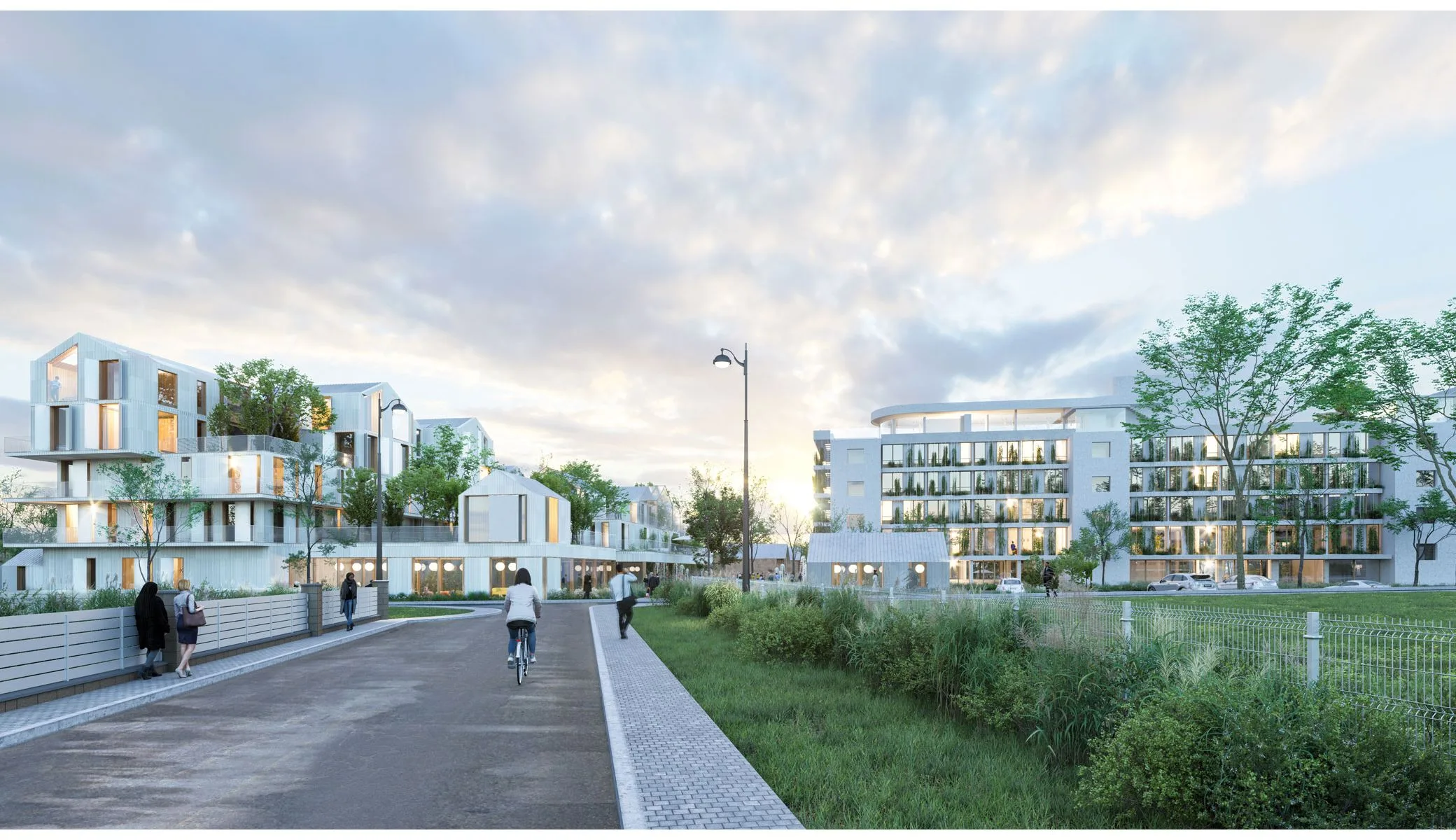
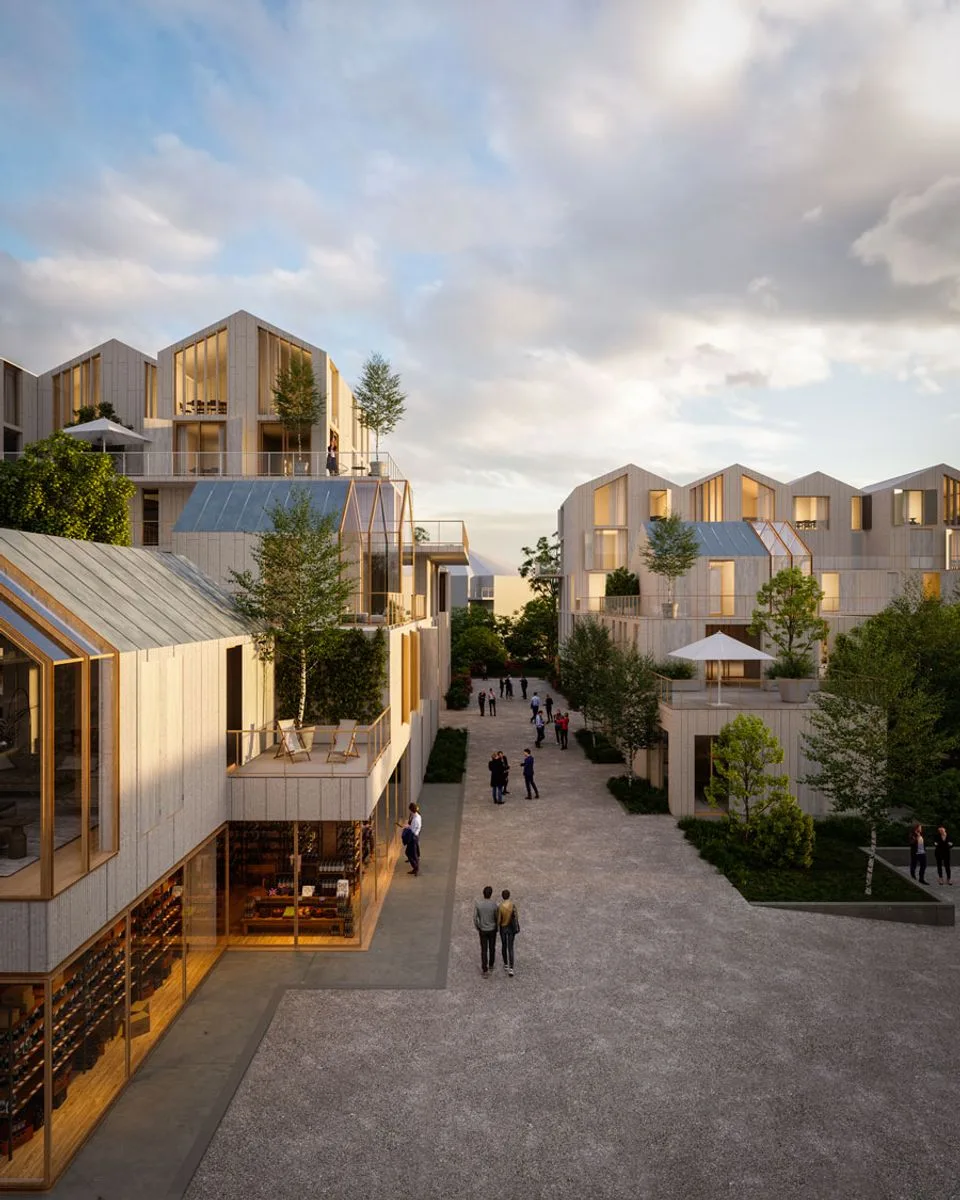
On the architectural level, we favored a contemporary expression that seeks neither imitation nor brutal rupture. The volumes are simple, confident, built with local or biosourced materials wherever possible. The facades play with variations of texture, depth, openings. We worked on **materiality** so that it resonates with Le Havre's built heritage (brick, light concrete, wood), while asserting a sober modernity. The housing is designed to offer generous spaces, through-spaces when possible, with exterior extensions (balconies, loggias, terraces) that invite outdoor living, feeling the sea wind, observing the seasons. This attention to domestic uses, to the way one lives at home and enters into relationship with the outside, seems essential to us in a context where the question of well-being and quality of living has become central.
The **park** we propose is not a simple decorative green space. It is conceived as an active ecological tool, a place where local fauna and flora can develop, circulate, regenerate. We worked with an endemic plant palette, resistant to wind and sea spray, favoring melliferous species and tree layers that allow hosting birds and insects. This park becomes an ecological corridor, connecting the natural spaces of the cape to the gardens and public spaces of the surrounding urban fabric. In this, it embodies our **overall environmental approach**: not simply reducing impact, but actively contributing to the preservation and enrichment of local biodiversity. Rainwater management, the choice of low-carbon materials, limiting soil impermeability, all this participates in a legible, tangible ecological ambition.
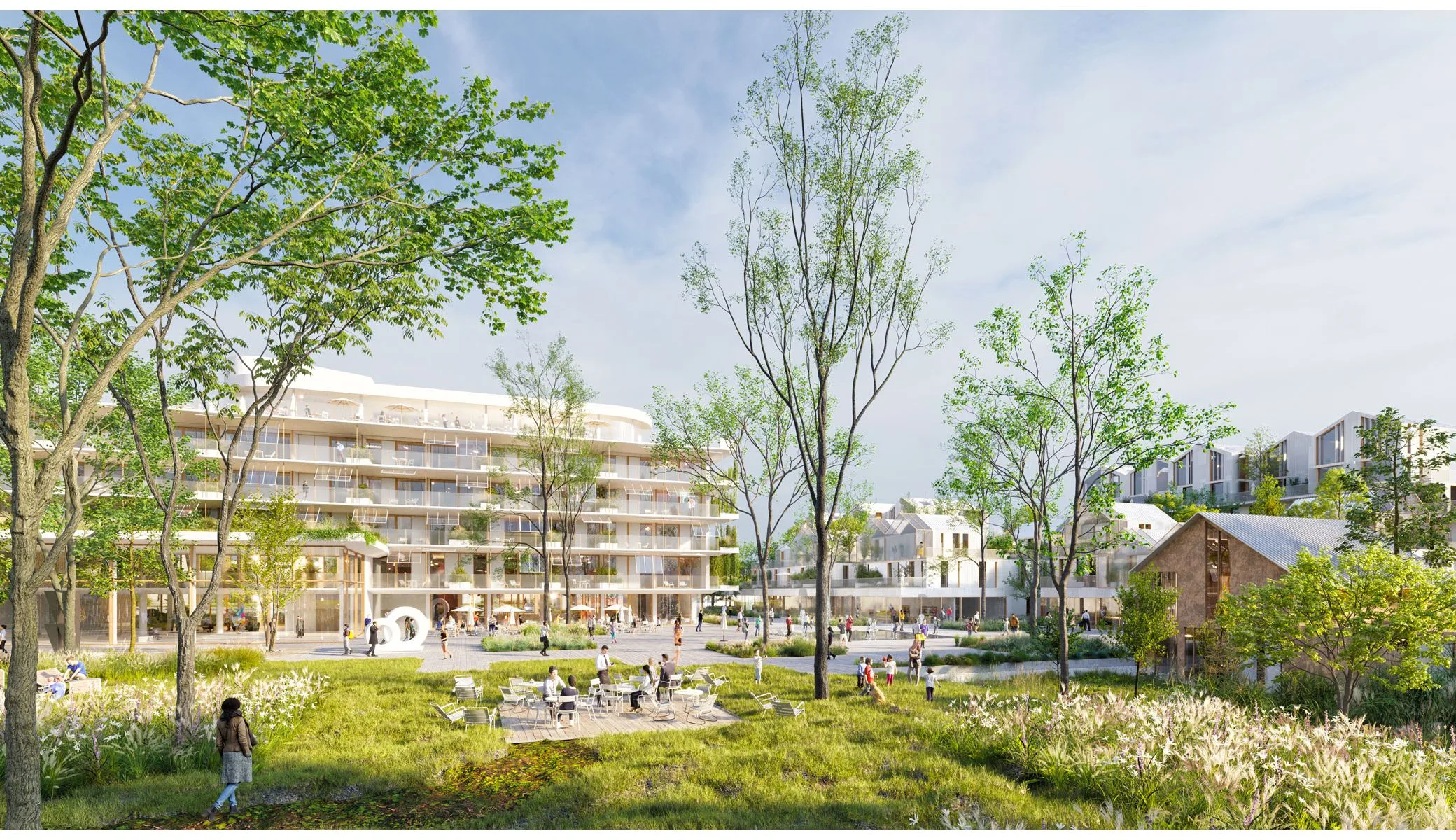
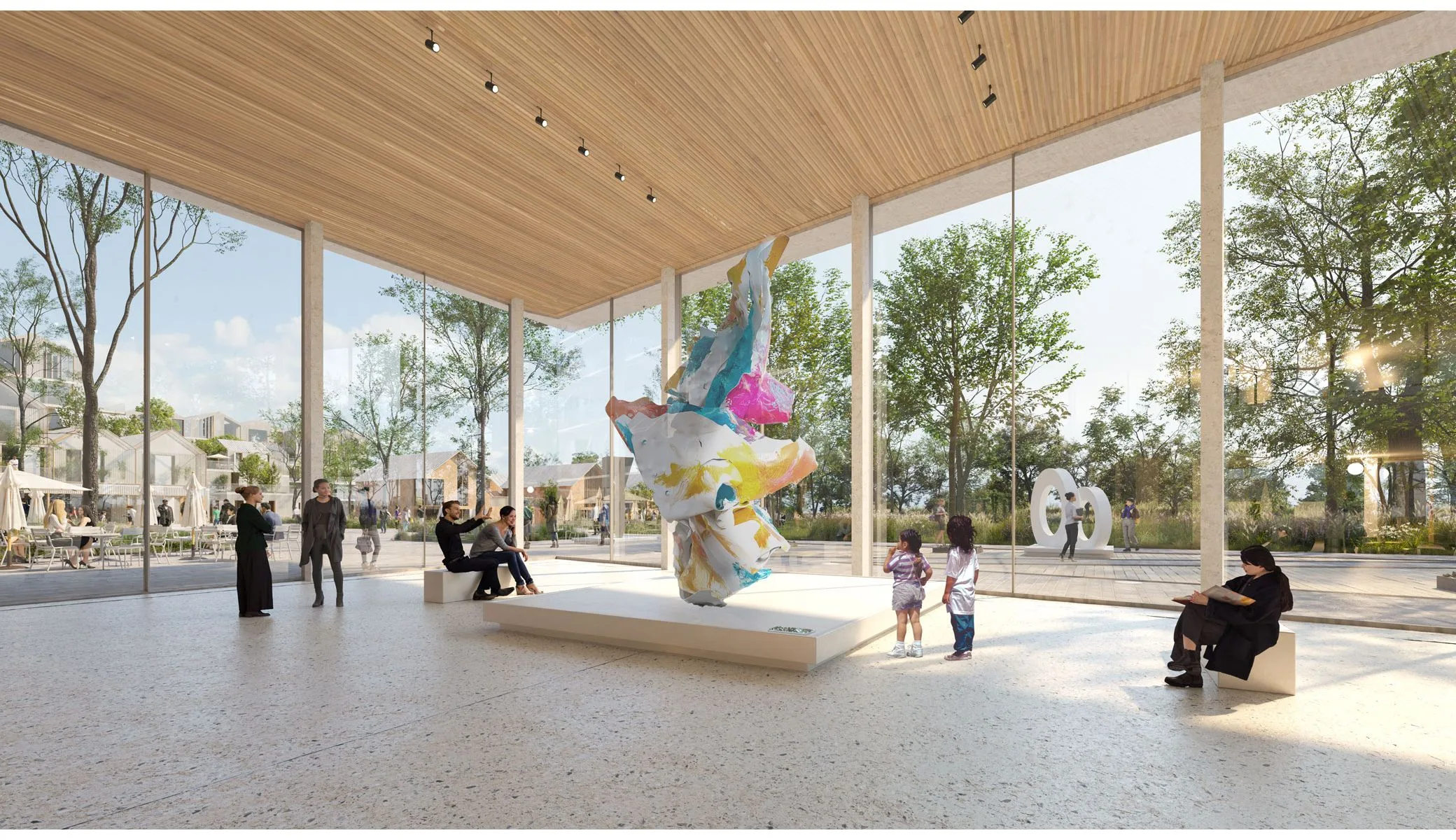
The village square, for its part, is designed to accommodate a diversity of uses throughout the seasons and hours. Market, cultural events, informal gatherings, children's play: its **flexibility** is its strength. It is not fixed in an overly determined design, but offers an open structure, capable of evolving with the residents' needs. Ground-floor shops animate this square, create daily life, a scale of proximity that is sometimes lacking in new housing developments. We deeply believe in this **functional diversity**, in this coexistence between housing, services, public spaces, and nature, which makes for the richness and resilience of living neighborhoods.
By choosing to rehabilitate the dormitory rather than demolish it, we also affirm an ethical and ecological position. Reusing the existing, transforming rather than razing, means saving resources, reducing waste, preserving the embodied energy accumulated in the structure. It also means recognizing that architecture has a memory, that it carries within it the traces of a collective life, of an era, of a past function that can nourish the future. This continuity seems precious to us in a world where everything always seems to start from zero.
This project for Sainte-Adresse did not come to fruition, but it continues to nourish our reflection on how to design generous neighborhoods, rooted in their geography, attentive to the fragile balances between man and nature. It testifies to our desire to make each project an opportunity to **reconnect with the territory**, to propose an architecture that does not merely occupy space, but seeks to inhabit it with care, intelligence, and respect.
Our approach rests on a fundamental principle: **finding the right balance between memory and invention**. We do not seek to erase the history of the place, nor to freeze it in sterile nostalgia. On the contrary, we want to make this history resonate through new forms, current uses, a renewed relationship with the site. The existing dormitory possesses undeniable contextual and constructive qualities. Rather than starting from scratch, we envision its rehabilitation as an anchoring point for the project, a narrative foundation from which a broader urban composition articulates itself. Around it, we propose creating a **flexible and dynamic village square**, a shared living space, as well as a **park conducive to calm and contemplation**, a true refuge for local biodiversity. This duality between urban animation and contemplative retreat structures the entire project.
The site stands at the junction between two worlds: the dense urbanity of Le Havre on one side, the protected nature of the cap de la Hève on the other. This very particular context, between **nature and urbanity**, demands careful attention to transitions. We imagined the project as a **stopover**, a breathing space where one can pause, look up, grasp the power of the landscape. The new housing, ground-floor shops, and public spaces are organized to offer views at different levels, accessible to all, permanent residents and occasional strollers alike. Each building is positioned so as not to obstruct perspectives, to create visual openings toward the sea, the cliffs, the open water. This desire to **share the landscape** guides the entire composition.
On the architectural level, we favored a contemporary expression that seeks neither imitation nor brutal rupture. The volumes are simple, confident, built with local or biosourced materials wherever possible. The facades play with variations of texture, depth, openings. We worked on **materiality** so that it resonates with Le Havre's built heritage (brick, light concrete, wood), while asserting a sober modernity. The housing is designed to offer generous spaces, through-spaces when possible, with exterior extensions (balconies, loggias, terraces) that invite outdoor living, feeling the sea wind, observing the seasons. This attention to domestic uses, to the way one lives at home and enters into relationship with the outside, seems essential to us in a context where the question of well-being and quality of living has become central.
The **park** we propose is not a simple decorative green space. It is conceived as an active ecological tool, a place where local fauna and flora can develop, circulate, regenerate. We worked with an endemic plant palette, resistant to wind and sea spray, favoring melliferous species and tree layers that allow hosting birds and insects. This park becomes an ecological corridor, connecting the natural spaces of the cape to the gardens and public spaces of the surrounding urban fabric. In this, it embodies our **overall environmental approach**: not simply reducing impact, but actively contributing to the preservation and enrichment of local biodiversity. Rainwater management, the choice of low-carbon materials, limiting soil impermeability, all this participates in a legible, tangible ecological ambition.
The village square, for its part, is designed to accommodate a diversity of uses throughout the seasons and hours. Market, cultural events, informal gatherings, children's play: its **flexibility** is its strength. It is not fixed in an overly determined design, but offers an open structure, capable of evolving with the residents' needs. Ground-floor shops animate this square, create daily life, a scale of proximity that is sometimes lacking in new housing developments. We deeply believe in this **functional diversity**, in this coexistence between housing, services, public spaces, and nature, which makes for the richness and resilience of living neighborhoods.
By choosing to rehabilitate the dormitory rather than demolish it, we also affirm an ethical and ecological position. Reusing the existing, transforming rather than razing, means saving resources, reducing waste, preserving the embodied energy accumulated in the structure. It also means recognizing that architecture has a memory, that it carries within it the traces of a collective life, of an era, of a past function that can nourish the future. This continuity seems precious to us in a world where everything always seems to start from zero.
This project for Sainte-Adresse did not come to fruition, but it continues to nourish our reflection on how to design generous neighborhoods, rooted in their geography, attentive to the fragile balances between man and nature. It testifies to our desire to make each project an opportunity to **reconnect with the territory**, to propose an architecture that does not merely occupy space, but seeks to inhabit it with care, intelligence, and respect.
- Lieu
- Sainte-Adresse, France
- Nature
- Logements
- Surface
- 20 046 m²
- Budget
- Confidentiel
- Concours
- 2020
- MOA
- ICADE, SCHEMA