Rue Neuve, Rue Haute
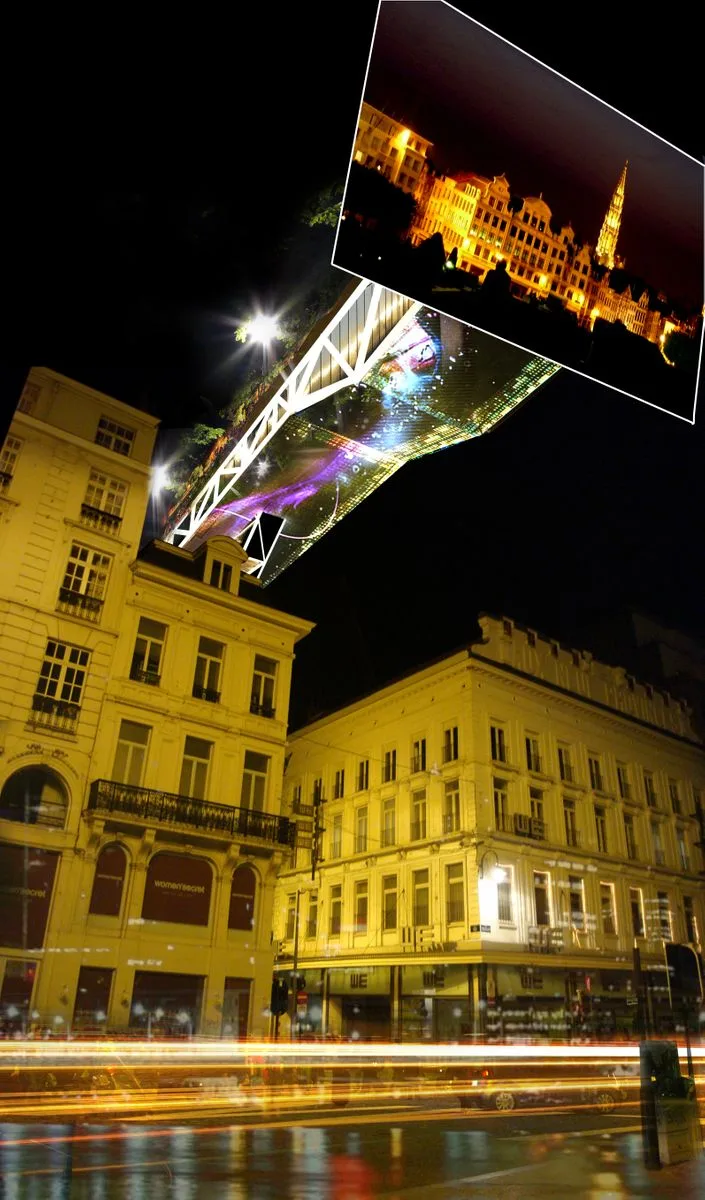
The idea is to establish a continuum with the city's vibrancy by projecting above rue Neuve, "la rue Haute." A projection in space but also in time: a vertical urbanistic gesture aimed at recomposing the space and time of people's lives around the unifying principle of well-being and the pleasure of living. The goal is to challenge the simple commercial passage, very dense by day and deserted by evening, not through dislocation of the existing, but through a stratification that completes what is missing. Indeed, "la rue Haute" is traced in section, gains thickness, and multiplies passages (cinema passage, restaurant passage, digital passage…). It continues the direction of rue Neuve, revisits its history, and reinforces its identity.
We designed the Rue Haute as a direct response to the programmed exhaustion of rue Neuve. Brussels, at the heart of its primary commercial district, lives to the rhythm of a dense crowd by day, absent by evening. This street, a major commercial artery, dies out as soon as the shops close. Rather than denying this reality or seeking to correct it through ground-level interventions, we proposed a vertical stratification, an urbanistic gesture that embraces the coexistence of temporalities and uses. The Rue Haute is the hypothesis of a city that unfolds in section, that gains thickness to accommodate what is missing: extended time, night, leisure, contemplation.
The project, developed with Tanguy Vermet, R. Haddad Architecte, and Pascal Haudressy for the City of Brussels, belongs to a speculative tradition of major idea competitions, one that authorizes thinking about the city differently, stepping outside the framework of conventional real estate operations. We took seriously the invitation to imagine a desirable future for this street, without limiting ourselves to the immediate constraints of the market or immediate technical feasibility. The goal was to propose a vision, an urbanistic horizon capable of provoking reaction, sparking debate, questioning established patterns.
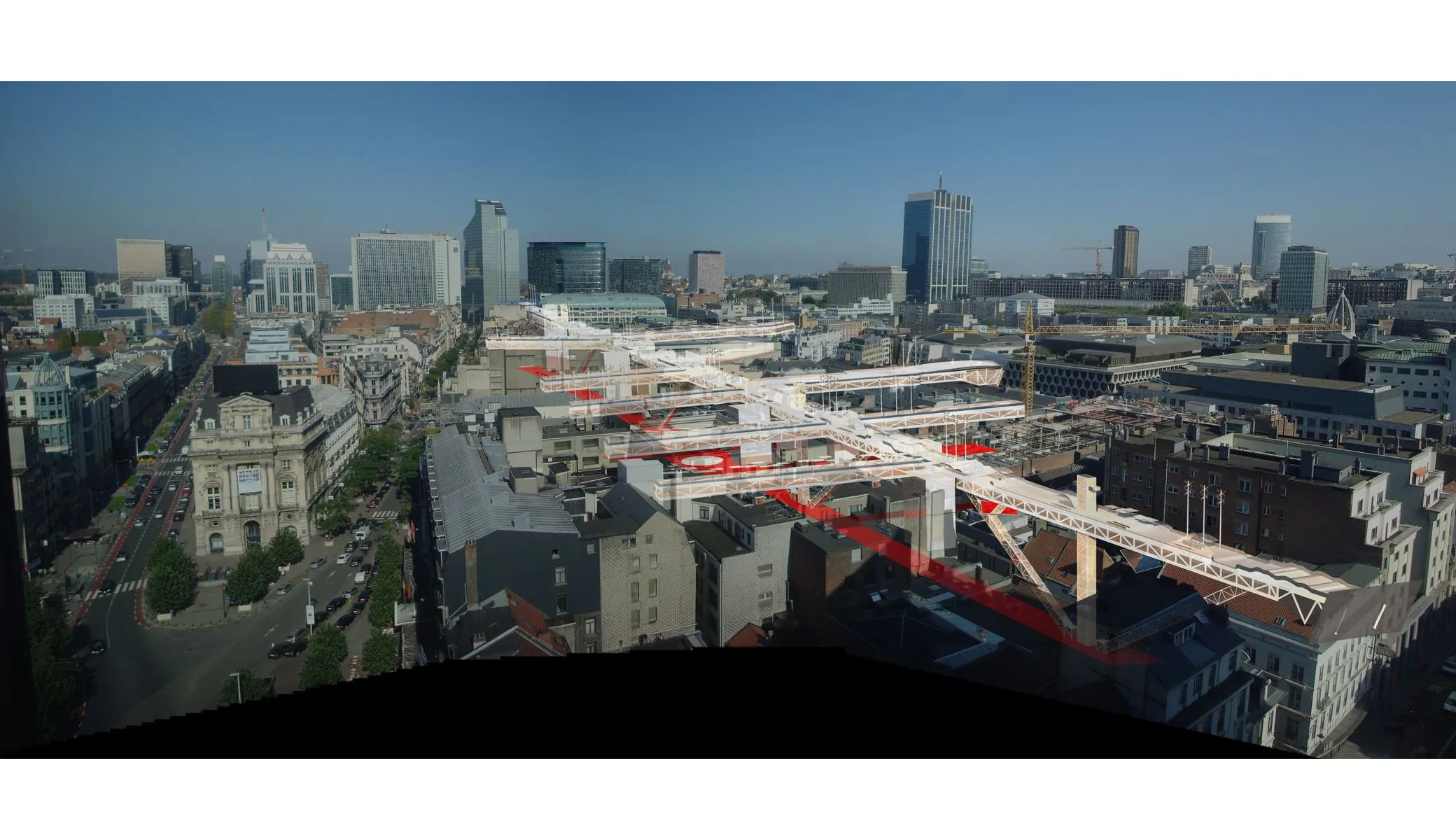
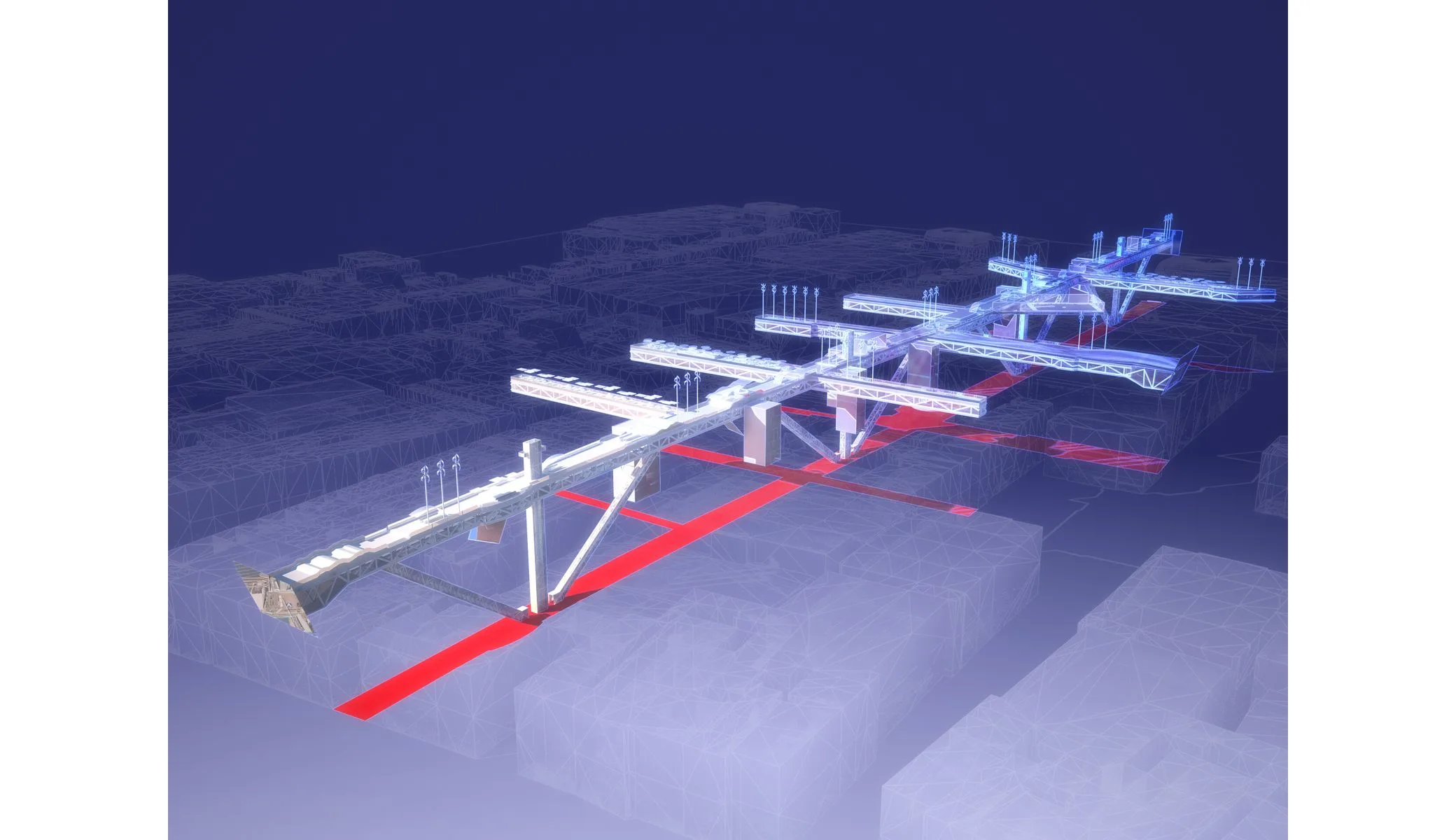
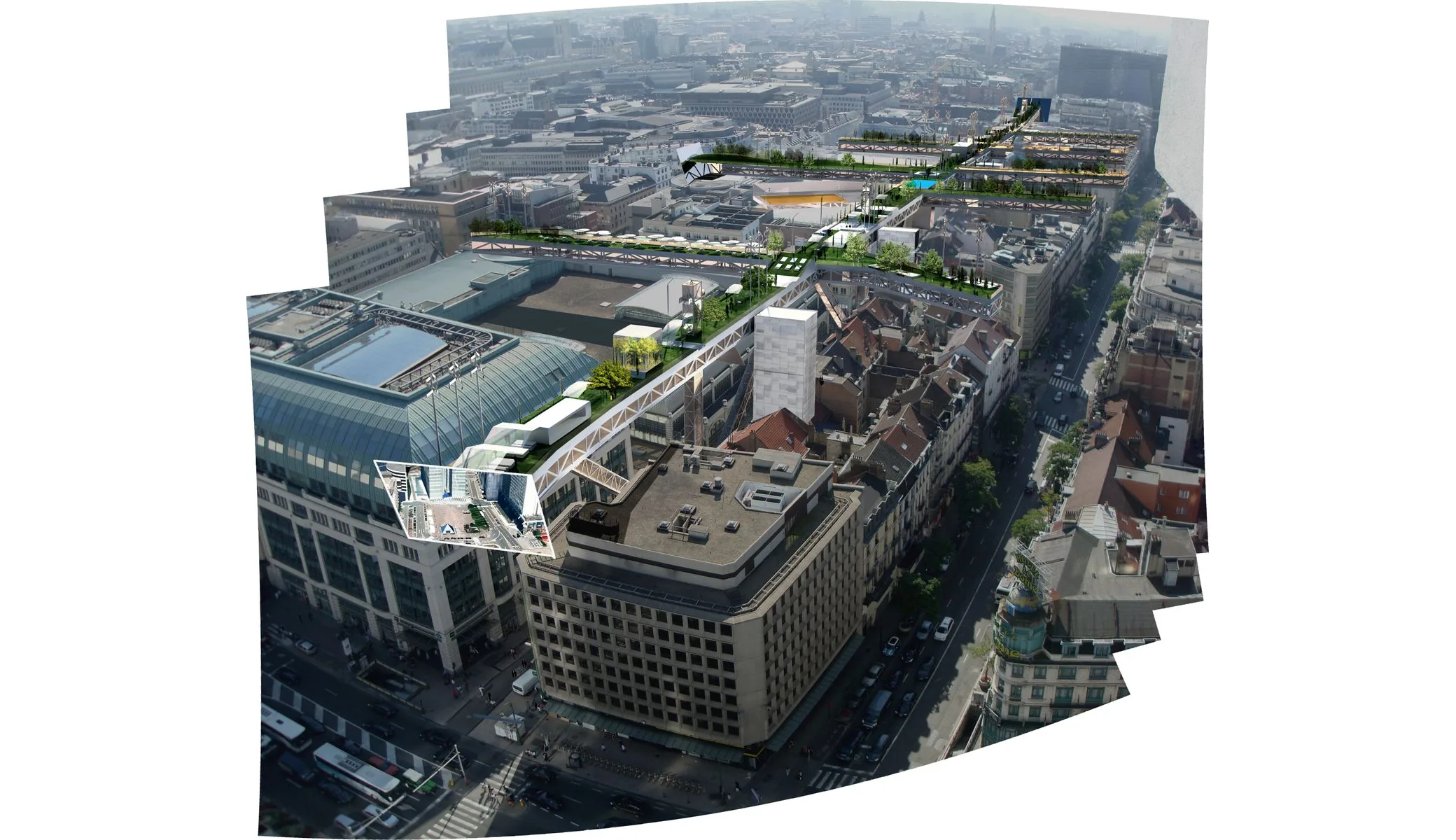
**The aerial street** is traced 35 meters above ground, a constructed band that crosses rue Neuve's space continuously, echoing its linear layout. It is not a placed building, but an urban infrastructure, an elevated ground plane that supports varied programs and unprecedented spatial sequences. This altitude is not arbitrary: it allows composition with rooftops, dialogue with bell towers, installation in an intermediate stratum between the dense ground and open sky. Here we assume kinship with the spatial utopias of the 1960s and 1970s, with projects by Yona Friedman and his *Spatial City*, not through formal nostalgia, but through conviction that the contemporary city must conquer new planes, new thicknesses to accommodate the diversity of uses and temporalities.
The ascending programming organizes the journey from rue Neuve level. One ascends by stages, traversing **thematic passages** (cinema passage, restaurant passage, digital passage) that reprise the historical vocabulary of Brussels galleries while projecting it into a vertical dimension. Each passage is a spatial sequence, an urbanity fragment that unfolds vertically. The urban cinema, for example, is not a closed room, but a projection device oriented toward Brussels' historic core, allowing spectators to watch historical monuments scroll by in a play of controlled images and framings. The elevated swimming pool, the rooftop basketball court, the high parks are all unusual programs in this commercial context, counterbalancing commerce's hegemony with recreational, athletic, contemplative uses.
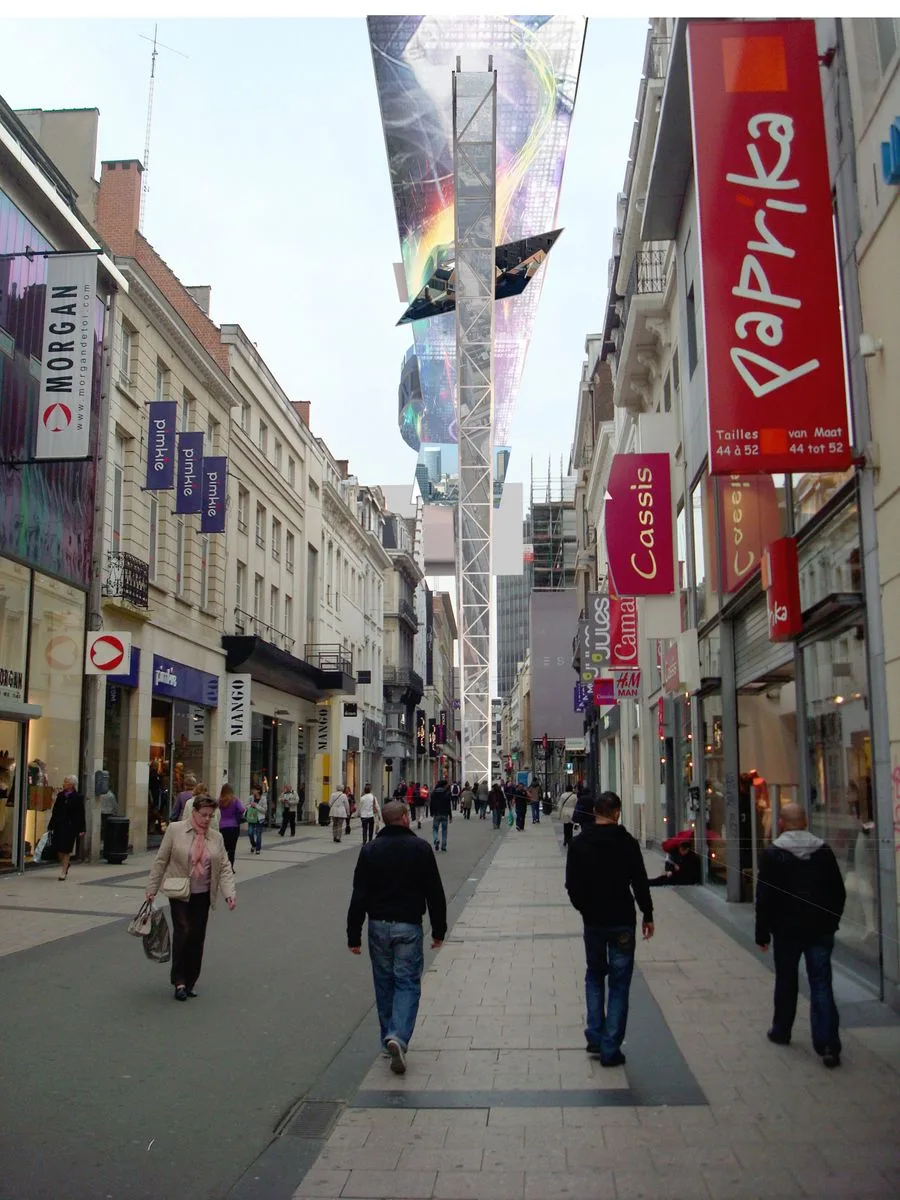
**The green crane**, the project's structuring element, is not merely a metaphor. It is a technical and poetic device that articulates the Rue Haute to rue Neuve's ground. Under the constructed band, giant reflective mirrors capture, displace, fragment urban sequences. They play with the street's intense mobility, with pedestrian flows, with facades. They transform the underside of the aerial street into an active, living, changing surface. This reflection strategy is not decorative, it is constitutive of the spatial experience: it amplifies, it troubles, it stimulates. It invites looking up, becoming aware of verticality, accepting that the city can unfold otherwise than on a horizontal plane.
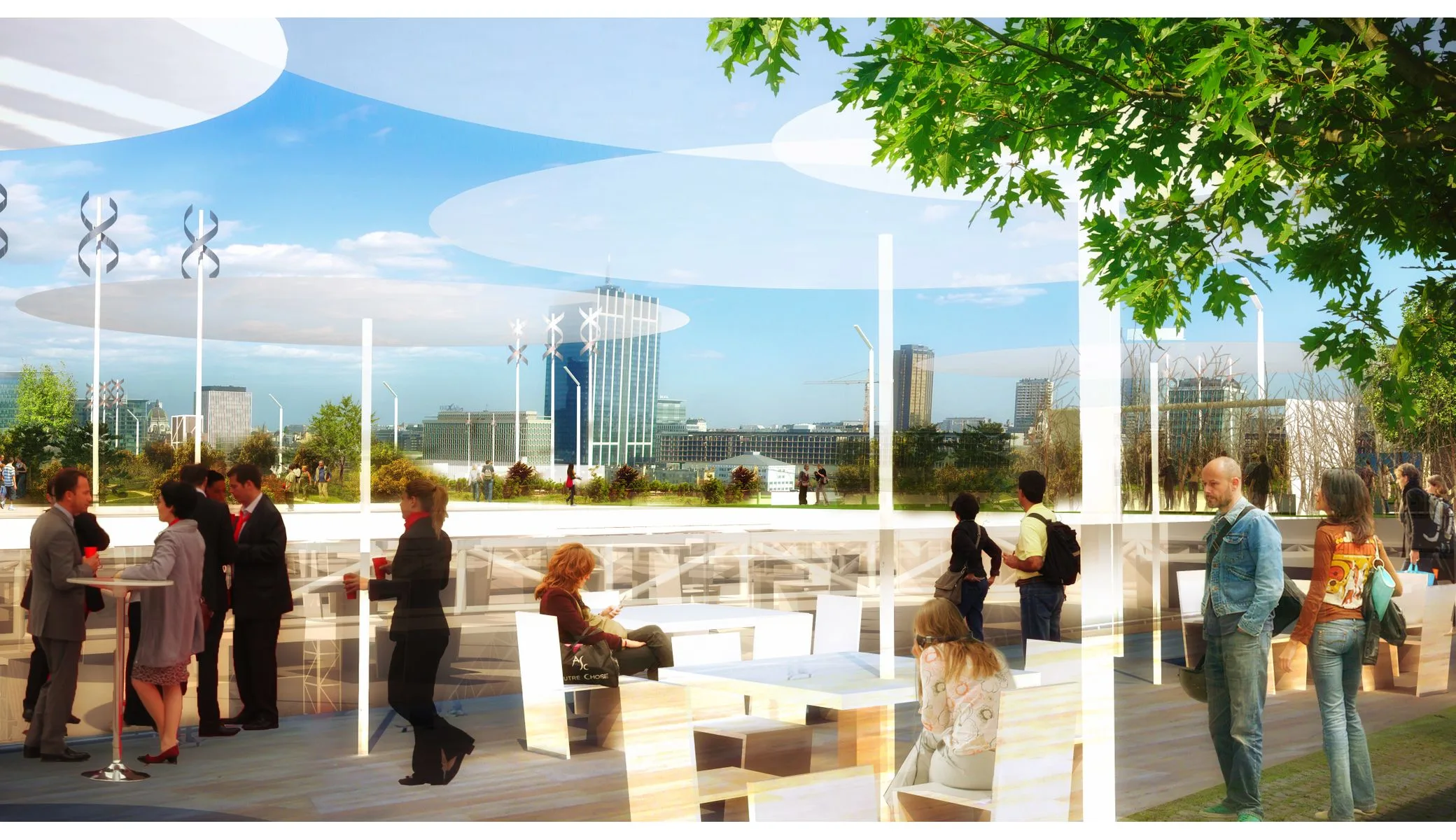
The rooftop belvedere, **the high park**, concludes this ascent. It is an elevated public space, a terrace garden accessible to all, a viewpoint over the city, a breathing space. This green band 35 meters above ground constitutes an ecological infrastructure, a vegetated surface that participates in thermal regulation, stormwater management, urban biodiversity. It is also an energy surface: we had imagined integrating photovoltaic devices, kinetic energy recovery systems linked to visitor flows, an integrated environmental approach that makes the Rue Haute not only a living space, but an active element in the urban metabolism.
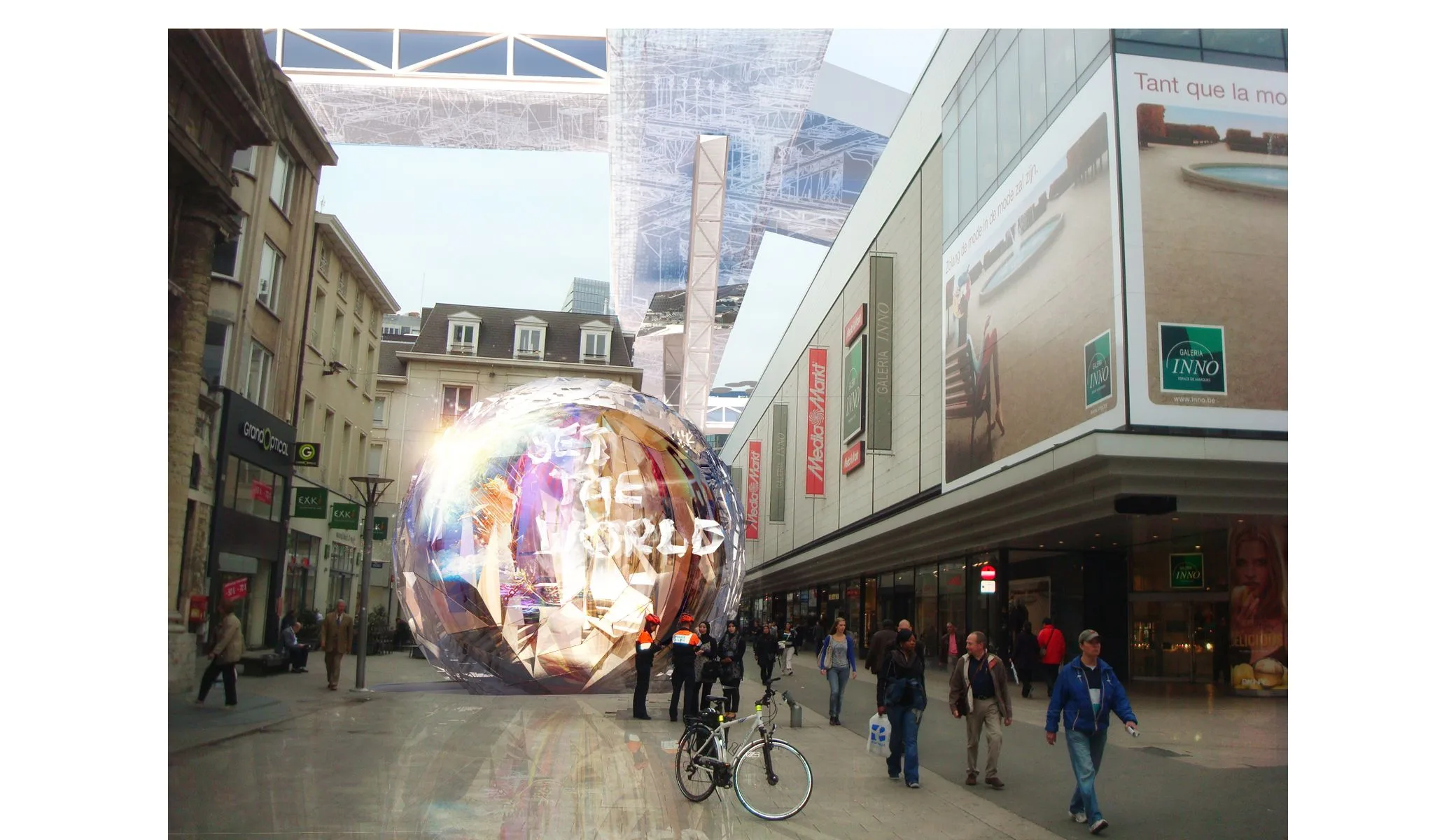
On the square of the former Notre-Dame church, we proposed a citizen artwork, **a pure spherical form** placed serenely facing the amorphous urban fabric. This sphere is not a fixed sculptural object, but an interactive device, a collective projection surface. Passersby, residents, visitors send spatial digital images to it, contributing in real time to an evolving visual work. Art is produced collectively, it belongs to no single author, it is the reflection of the city in movement, of its desires, its imaginaries. We valued this participatory dimension: it was about restoring to citizens a control, a capacity to act on their environment, to make public space a place of expression and co-creation.
The Rue Haute was not built, and it is the nature of idea competitions to often remain in proposal form. Yet it continues to question our way of thinking about the dense city, the commercial street, the coexistence of uses. It poses the question of urban verticality differently than through the isolated tower, it explores the notion of **multiple ground**, of superimposed habitable strata. It affirms that well-being and the pleasure of urban living are not decreed by ground-level improvements, but are built through the multiplication of spatial situations, through the diversity of routes, through the invention of new relationships between high and low, between day and night, between commerce and leisure. This project remains for us a horizon, a way of thinking about the city as a three-dimensional field where everything remains possible.
The project, developed with Tanguy Vermet, R. Haddad Architecte, and Pascal Haudressy for the City of Brussels, belongs to a speculative tradition of major idea competitions, one that authorizes thinking about the city differently, stepping outside the framework of conventional real estate operations. We took seriously the invitation to imagine a desirable future for this street, without limiting ourselves to the immediate constraints of the market or immediate technical feasibility. The goal was to propose a vision, an urbanistic horizon capable of provoking reaction, sparking debate, questioning established patterns.
**The aerial street** is traced 35 meters above ground, a constructed band that crosses rue Neuve's space continuously, echoing its linear layout. It is not a placed building, but an urban infrastructure, an elevated ground plane that supports varied programs and unprecedented spatial sequences. This altitude is not arbitrary: it allows composition with rooftops, dialogue with bell towers, installation in an intermediate stratum between the dense ground and open sky. Here we assume kinship with the spatial utopias of the 1960s and 1970s, with projects by Yona Friedman and his *Spatial City*, not through formal nostalgia, but through conviction that the contemporary city must conquer new planes, new thicknesses to accommodate the diversity of uses and temporalities.
The ascending programming organizes the journey from rue Neuve level. One ascends by stages, traversing **thematic passages** (cinema passage, restaurant passage, digital passage) that reprise the historical vocabulary of Brussels galleries while projecting it into a vertical dimension. Each passage is a spatial sequence, an urbanity fragment that unfolds vertically. The urban cinema, for example, is not a closed room, but a projection device oriented toward Brussels' historic core, allowing spectators to watch historical monuments scroll by in a play of controlled images and framings. The elevated swimming pool, the rooftop basketball court, the high parks are all unusual programs in this commercial context, counterbalancing commerce's hegemony with recreational, athletic, contemplative uses.
**The green crane**, the project's structuring element, is not merely a metaphor. It is a technical and poetic device that articulates the Rue Haute to rue Neuve's ground. Under the constructed band, giant reflective mirrors capture, displace, fragment urban sequences. They play with the street's intense mobility, with pedestrian flows, with facades. They transform the underside of the aerial street into an active, living, changing surface. This reflection strategy is not decorative, it is constitutive of the spatial experience: it amplifies, it troubles, it stimulates. It invites looking up, becoming aware of verticality, accepting that the city can unfold otherwise than on a horizontal plane.
The rooftop belvedere, **the high park**, concludes this ascent. It is an elevated public space, a terrace garden accessible to all, a viewpoint over the city, a breathing space. This green band 35 meters above ground constitutes an ecological infrastructure, a vegetated surface that participates in thermal regulation, stormwater management, urban biodiversity. It is also an energy surface: we had imagined integrating photovoltaic devices, kinetic energy recovery systems linked to visitor flows, an integrated environmental approach that makes the Rue Haute not only a living space, but an active element in the urban metabolism.
On the square of the former Notre-Dame church, we proposed a citizen artwork, **a pure spherical form** placed serenely facing the amorphous urban fabric. This sphere is not a fixed sculptural object, but an interactive device, a collective projection surface. Passersby, residents, visitors send spatial digital images to it, contributing in real time to an evolving visual work. Art is produced collectively, it belongs to no single author, it is the reflection of the city in movement, of its desires, its imaginaries. We valued this participatory dimension: it was about restoring to citizens a control, a capacity to act on their environment, to make public space a place of expression and co-creation.
The Rue Haute was not built, and it is the nature of idea competitions to often remain in proposal form. Yet it continues to question our way of thinking about the dense city, the commercial street, the coexistence of uses. It poses the question of urban verticality differently than through the isolated tower, it explores the notion of **multiple ground**, of superimposed habitable strata. It affirms that well-being and the pleasure of urban living are not decreed by ground-level improvements, but are built through the multiplication of spatial situations, through the diversity of routes, through the invention of new relationships between high and low, between day and night, between commerce and leisure. This project remains for us a horizon, a way of thinking about the city as a three-dimensional field where everything remains possible.
- Lieu
- Bruxelles, Belgique
- Nature
- Mixte
- Surface
- 34 000 m²
- Budget
- Confidentiel
- Concours
- 2011
- MOA
- Ville de Bruxelles
- Co-architectes
- Tanguy Vermet, R. Haddad Architecte, Pascal Haudressy