Pixel Tours
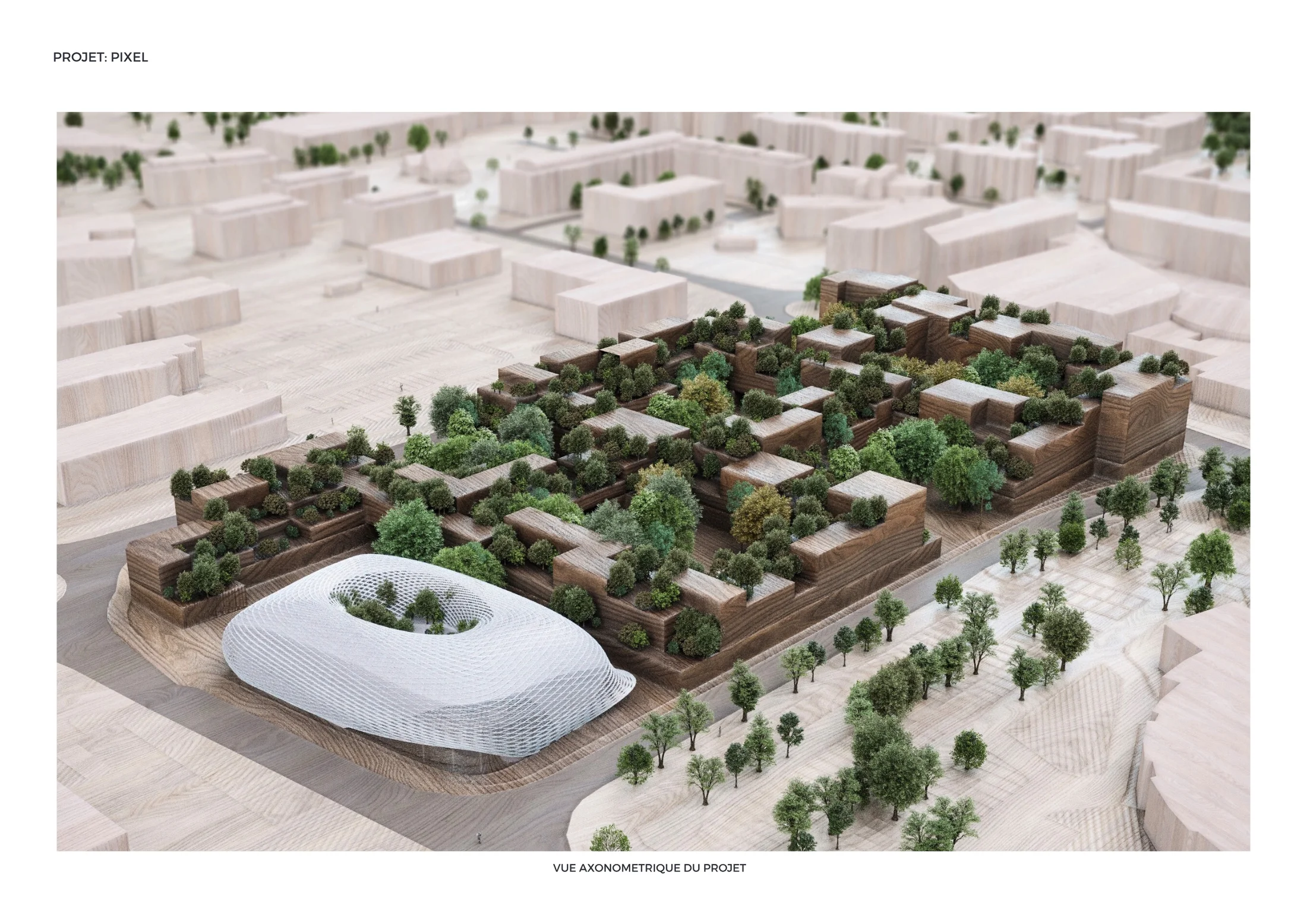
Pixel takes root in the heart of the Deux-Lions district in Tours. Rather than adding yet another object to the city, the project creates a place capable of generating life, an urban magnet mixing housing, retail, daycare, sports and recreational facilities.
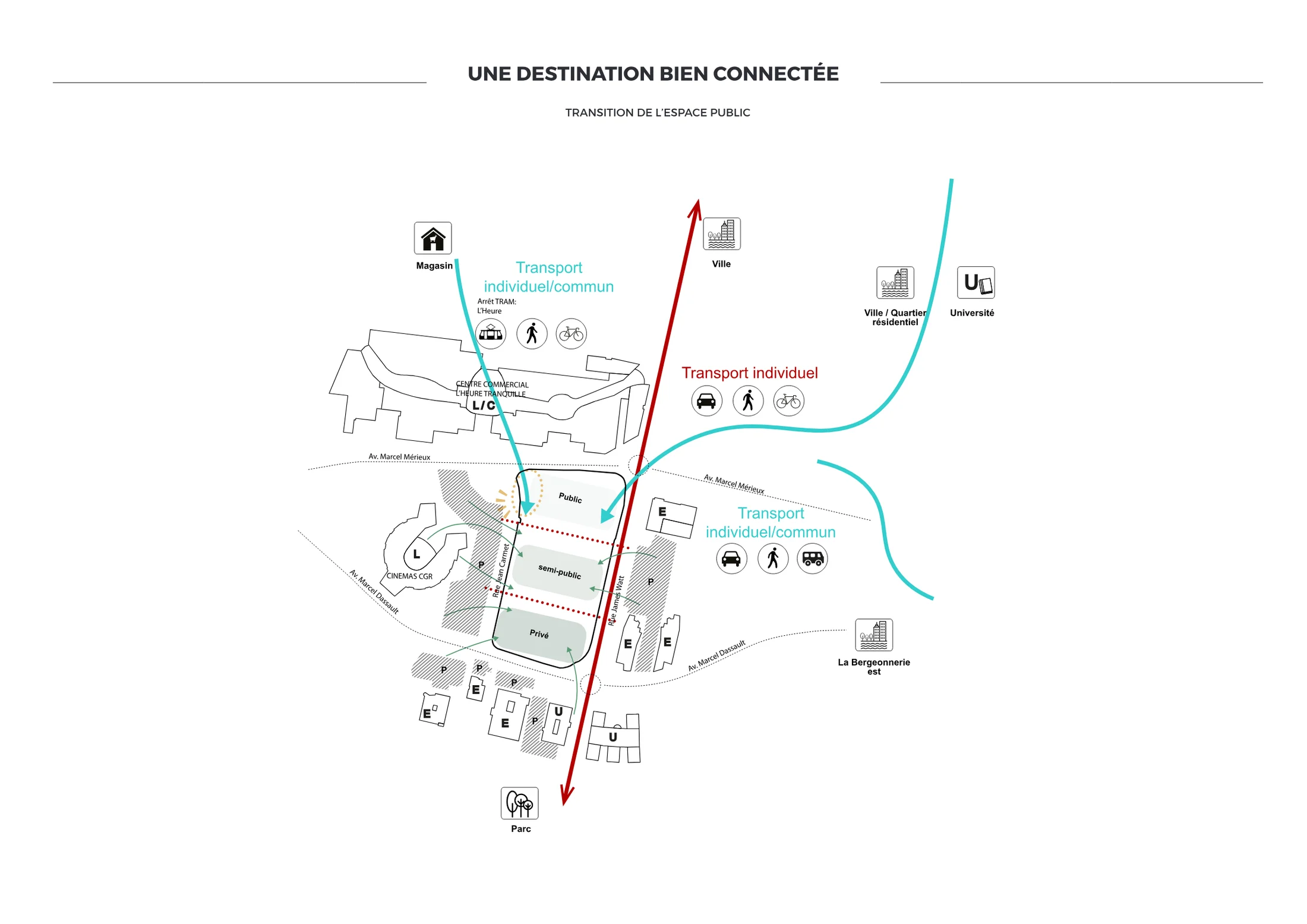
In Tours, the Deux-Lions district constitutes a territory in full transformation, carrying a metropolitan ambition still in the process of asserting itself. We approached this context not as a space to fill, but as an opportunity to produce a **missing centrality**, a place capable of generating urban intensity where programmatic voids still remained. Pixel does not follow the logic of an autonomous architectural object, but rather that of an **active device**, an urban magnet that fully assumes its function as a social and spatial catalyst.
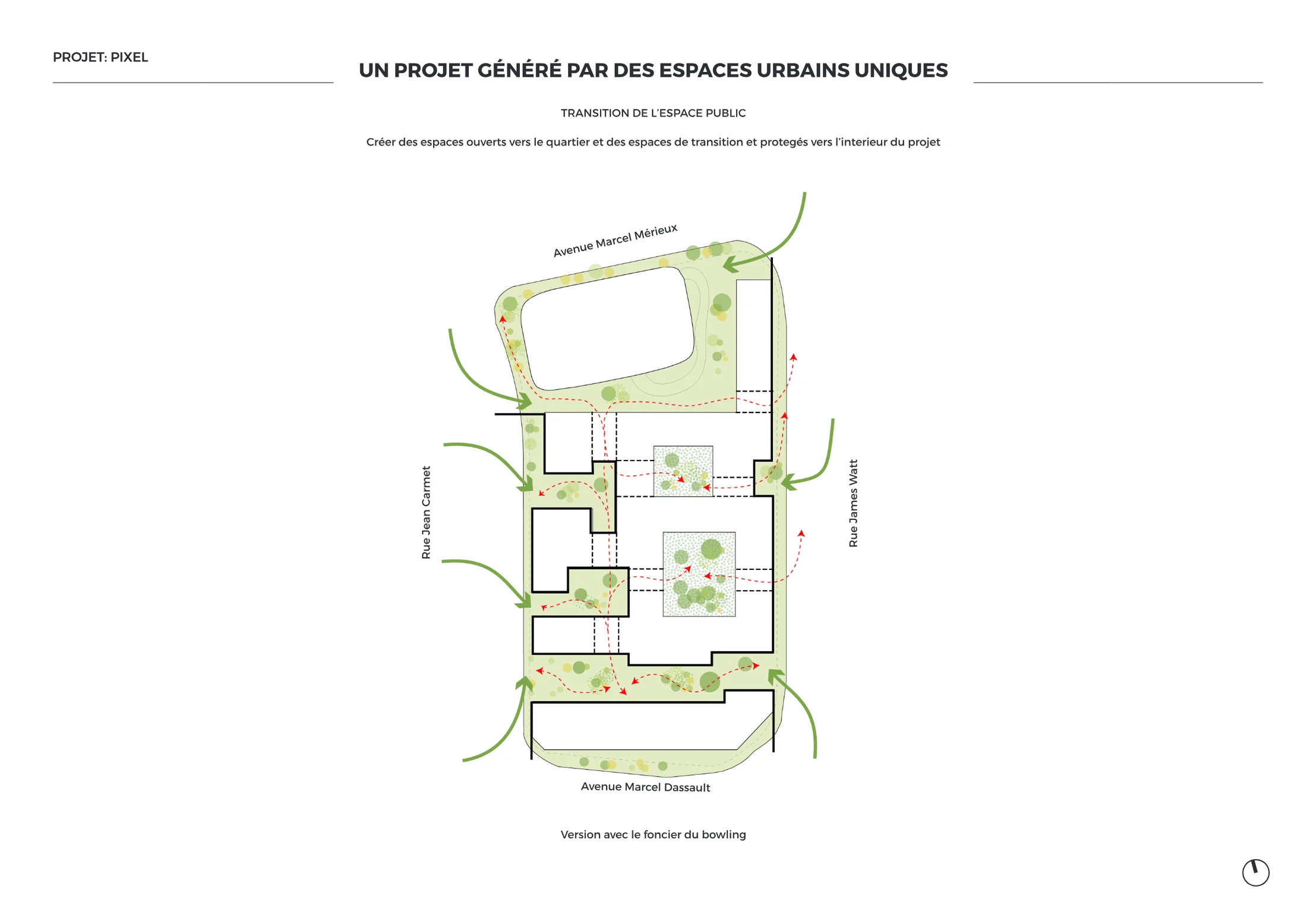
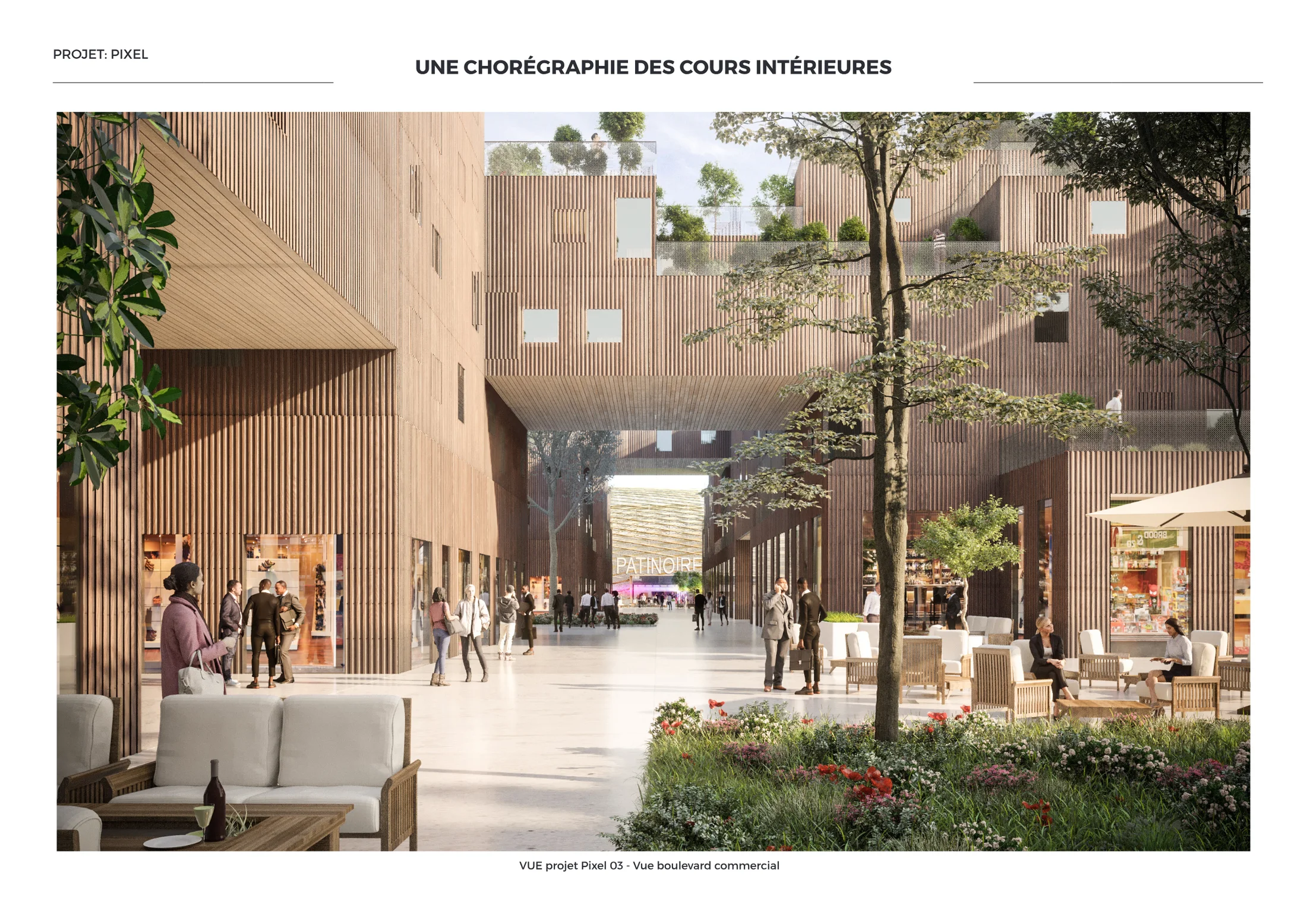
The project's footprint is vast, but this scale did not lead us to produce a compact mass. On the contrary, we sought to fragment the volume, hollow it out, introduce breakthroughs, patios, passages at different altitudes. This strategy of **urban porosity** allows us to maintain continuity between public space and the project's interior, to multiply thresholds, to break down the scale while preserving coherent density. The pathways do not simply cross the site, they structure it, creating a diversity of superimposed atmospheres and uses. This is a way of refusing the isolated tower or the hermetic bar, to propose instead a **lived fabric**, porous and relational.
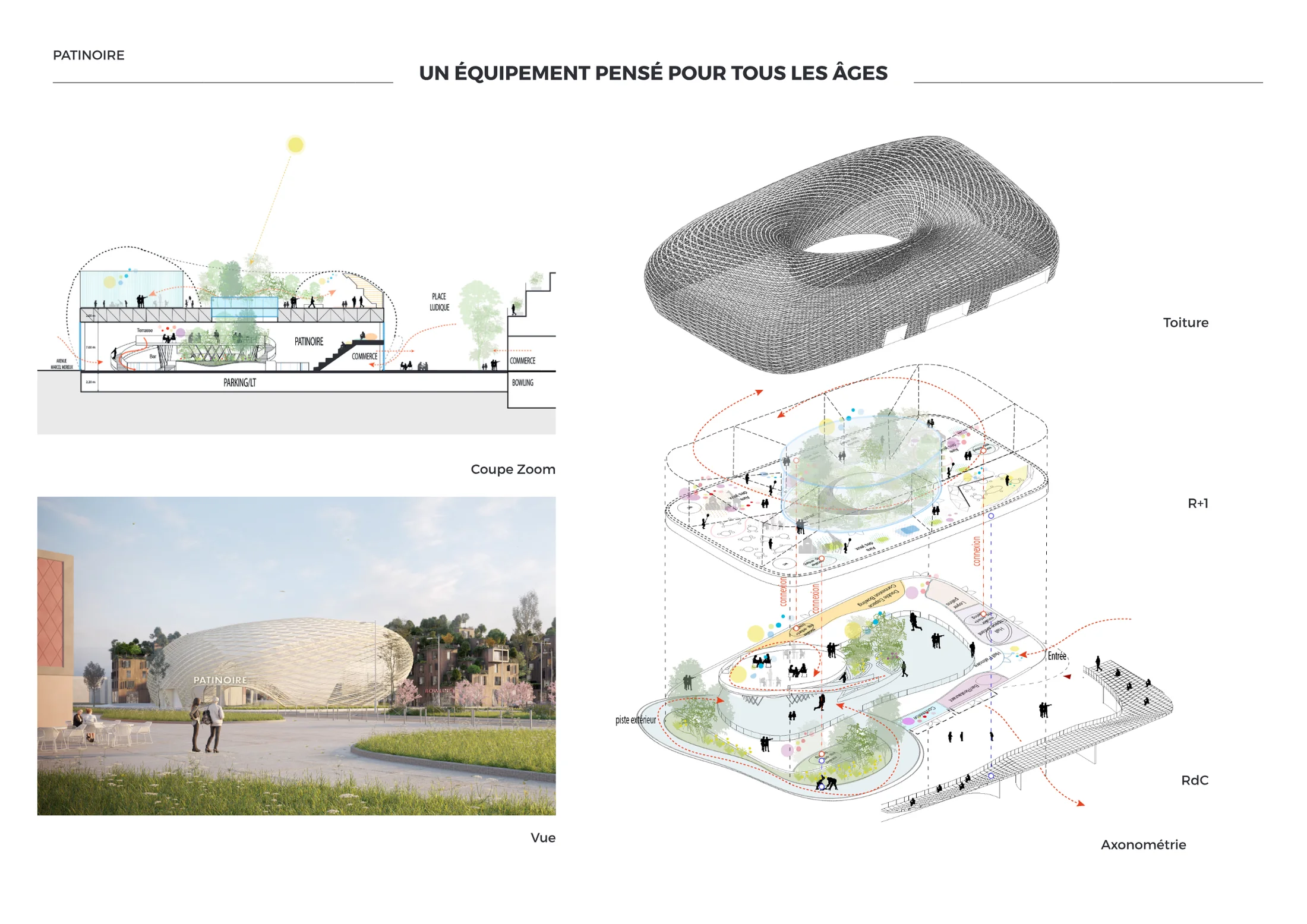
The program mixes housing, offices, retail, a daycare, as well as a hub of sports and recreational facilities including skating, bowling and play areas. This mix is not simply functional, it is spatial and temporal. The base accommodates retail and facilities, forming an **active foundation** anchored in the district's daily life. This is where the encounter with the street takes place, where flows are activated, where local life settles in. Above, the housing and residence for elderly people compose a residential layer that benefits from this activity without suffering its nuisances. This generational cohabitation is assumed, it is part of the social project carried by Pixel.
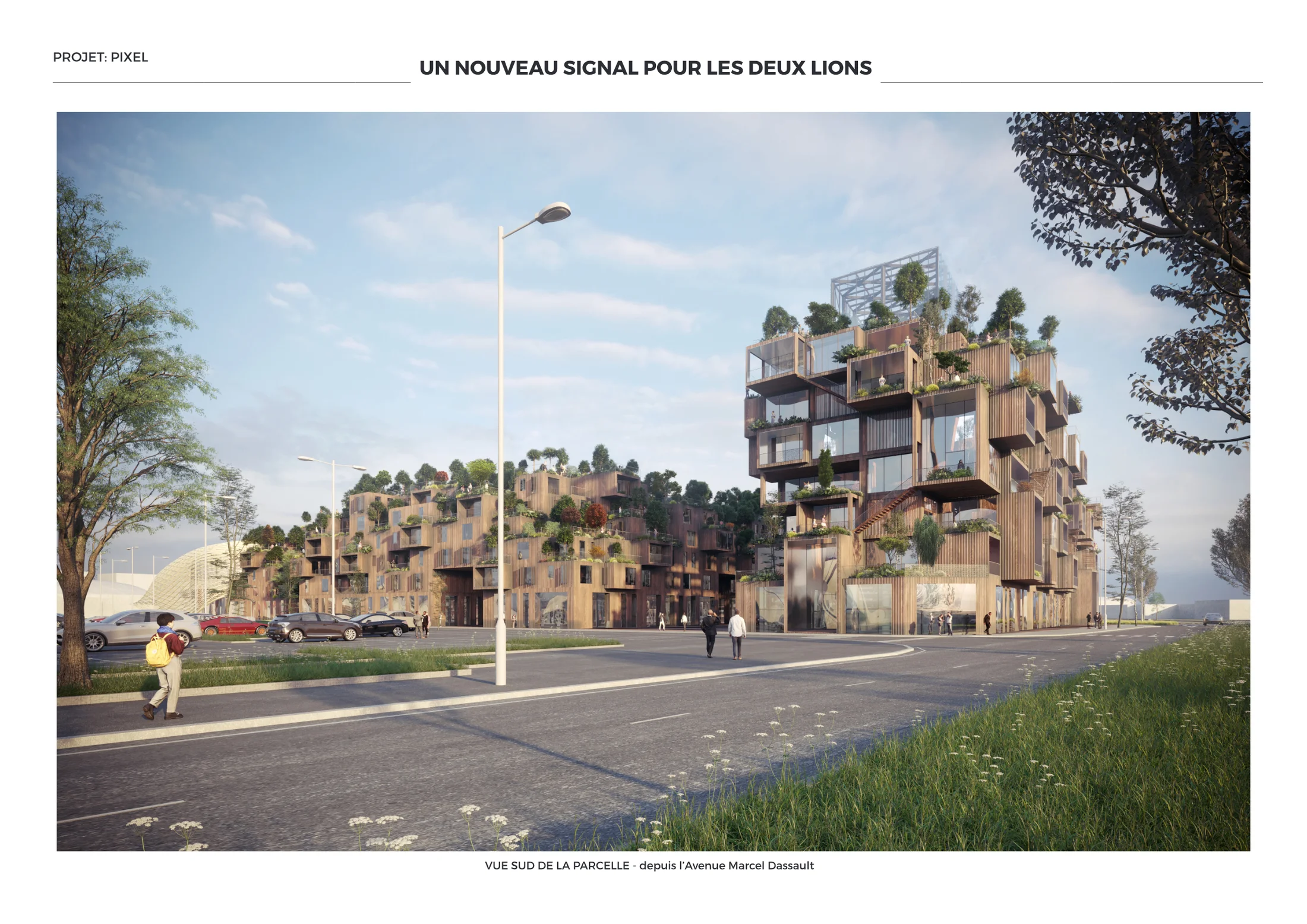
The second building, dedicated to leisure, acts as a **metropolitan attractor**. It transforms the project into a destination, beyond simply a place to live. By integrating programs rare at this scale (ice rink, bowling), we seek to create an attractiveness that overflows the immediate perimeter, that participates in building a polarity for the entire Tours metropolitan area. This building dialogues with the first through contrast, assuming a more forthright, more playful identity, while remaining coherent in the treatment of public spaces and materialities.
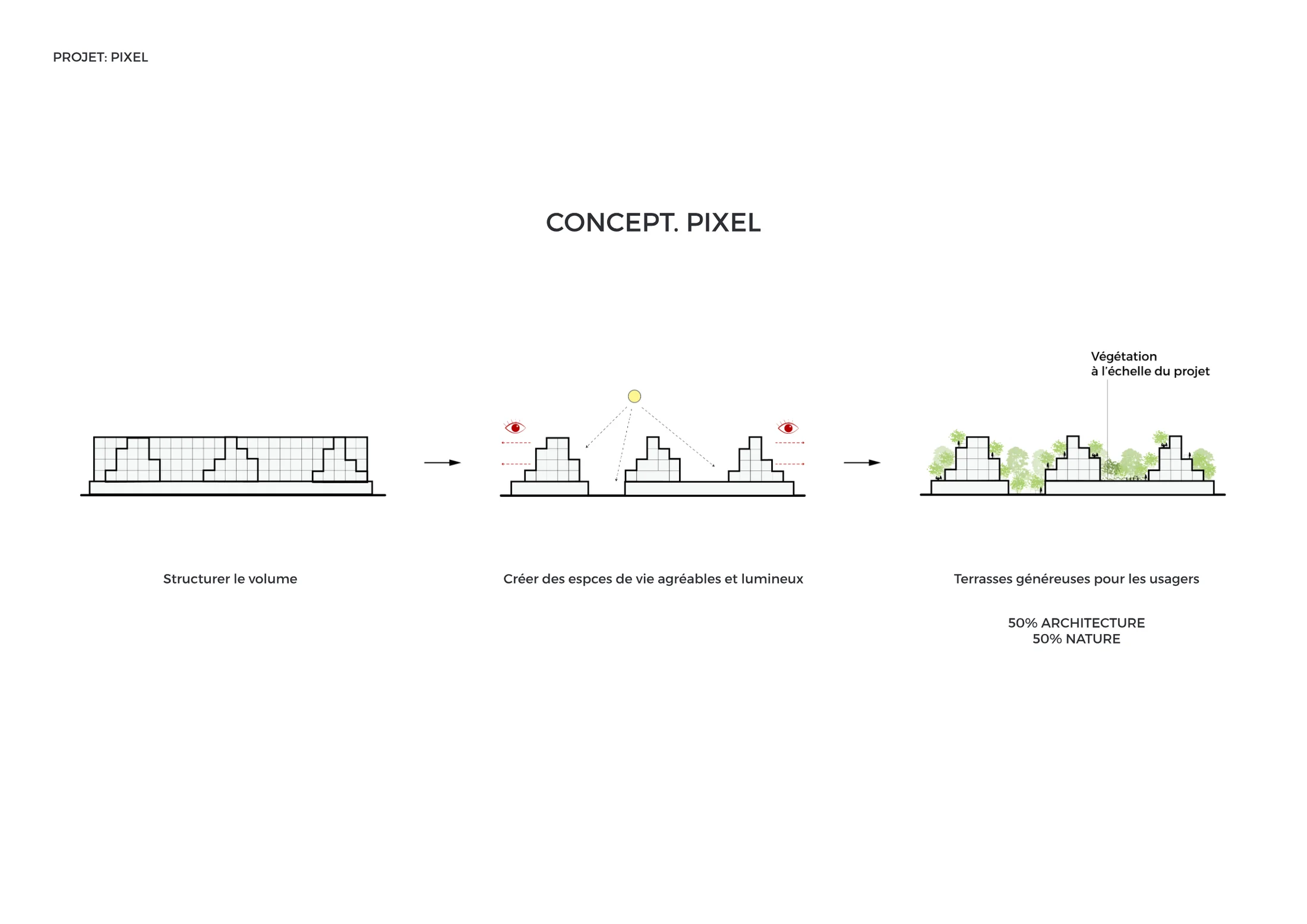
The housing units themselves are not conceived as closed cells. We multiplied terraces, outdoor extensions, intermediate spaces. Each apartment benefits from a direct relationship with light, views, sky. These thresholds between inside and outside are essential: they create a qualitative living environment, where intimacy coexists with openness, where the inhabitant can choose their degree of exposure or withdrawal. The **multiplication of thresholds** is a response to density: it allows living in proximity without suffering promiscuity, benefiting from closeness without sacrificing privacy.
Materiality plays a structuring role in this ambition. We chose wood for the housing, a material that brings warmth, visual lightness and environmental performance. This choice is not cosmetic, it responds to a desire to produce a **livable density**, in opposition to the massive and mineral models that still too often dominate operations at this scale. Wood also allows faster, cleaner implementation, more compatible with a sober and controlled construction site logic. It inscribes the project in a sustainable temporality, affirming that density and ecology are not contradictory. The wooden facades compose a rhythm, a vibration, that contrasts with the minerality of the base. This material stratification translates the programmatic hierarchy while unifying the whole in an overall coherence.
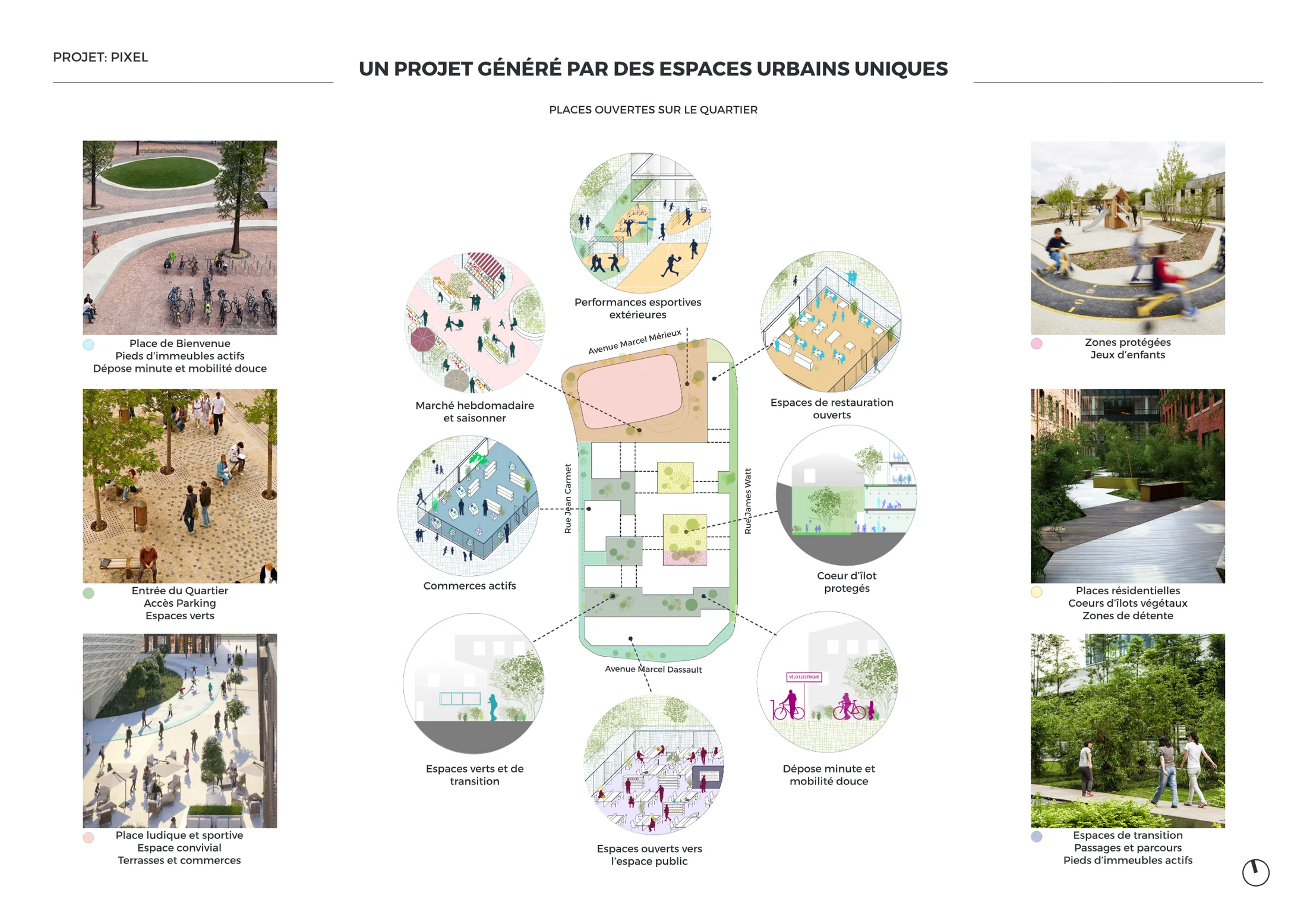
Public spaces are not residual. They are conceived as an **open social infrastructure**, supporting interactions, encounters, circulations. Plazas, patios, pathways form a network that connects the project to its immediate environment, that allows crossing as much as stopping. We sought to avoid the pitfall of the closed block, the residence folded in on itself. Pixel opens up, connects, dialogues with the Deux-Lions district and with the city beyond. This permeability is a condition for collective appropriation of the project.
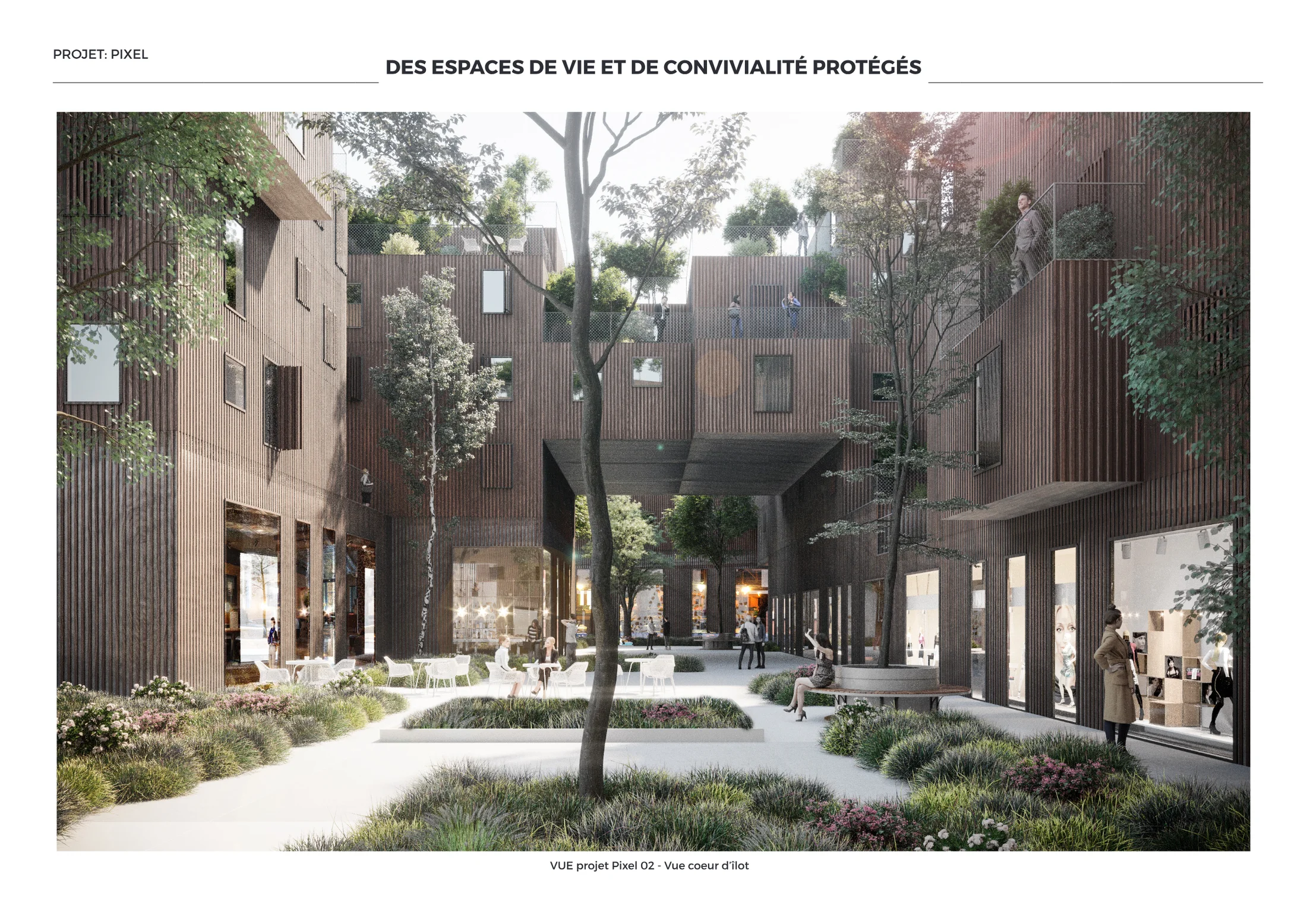
Vegetation accompanies this logic of porosity. It is not simply decor, but a structuring component of the spatial device. The patios accommodate plantings and vegetated layers that bring freshness, biodiversity, visual filtering. The terraces are conceived as suspended gardens, habitable extensions of the housing units. This vegetal presence participates in the **construction of an urban oasis**, a space protected from traffic flows while remaining fully connected to the city.
Pixel thus goes beyond the framework of a classic real estate operation. It carries an urban, social and environmental ambition. It asserts itself as a **place to live and a destination**, capable of attracting residents, users, visitors. Ultimately, we hope it will become a new centrality for the Deux-Lions district, a magnet capable of generating activity, employment, encounters, exchange. It is this capacity to produce the commons that justifies its density, its mix, its programmatic complexity. Pixel does not simply occupy a site, it creates an inhabited territory.
The project's footprint is vast, but this scale did not lead us to produce a compact mass. On the contrary, we sought to fragment the volume, hollow it out, introduce breakthroughs, patios, passages at different altitudes. This strategy of **urban porosity** allows us to maintain continuity between public space and the project's interior, to multiply thresholds, to break down the scale while preserving coherent density. The pathways do not simply cross the site, they structure it, creating a diversity of superimposed atmospheres and uses. This is a way of refusing the isolated tower or the hermetic bar, to propose instead a **lived fabric**, porous and relational.
The program mixes housing, offices, retail, a daycare, as well as a hub of sports and recreational facilities including skating, bowling and play areas. This mix is not simply functional, it is spatial and temporal. The base accommodates retail and facilities, forming an **active foundation** anchored in the district's daily life. This is where the encounter with the street takes place, where flows are activated, where local life settles in. Above, the housing and residence for elderly people compose a residential layer that benefits from this activity without suffering its nuisances. This generational cohabitation is assumed, it is part of the social project carried by Pixel.
The second building, dedicated to leisure, acts as a **metropolitan attractor**. It transforms the project into a destination, beyond simply a place to live. By integrating programs rare at this scale (ice rink, bowling), we seek to create an attractiveness that overflows the immediate perimeter, that participates in building a polarity for the entire Tours metropolitan area. This building dialogues with the first through contrast, assuming a more forthright, more playful identity, while remaining coherent in the treatment of public spaces and materialities.
The housing units themselves are not conceived as closed cells. We multiplied terraces, outdoor extensions, intermediate spaces. Each apartment benefits from a direct relationship with light, views, sky. These thresholds between inside and outside are essential: they create a qualitative living environment, where intimacy coexists with openness, where the inhabitant can choose their degree of exposure or withdrawal. The **multiplication of thresholds** is a response to density: it allows living in proximity without suffering promiscuity, benefiting from closeness without sacrificing privacy.
Materiality plays a structuring role in this ambition. We chose wood for the housing, a material that brings warmth, visual lightness and environmental performance. This choice is not cosmetic, it responds to a desire to produce a **livable density**, in opposition to the massive and mineral models that still too often dominate operations at this scale. Wood also allows faster, cleaner implementation, more compatible with a sober and controlled construction site logic. It inscribes the project in a sustainable temporality, affirming that density and ecology are not contradictory. The wooden facades compose a rhythm, a vibration, that contrasts with the minerality of the base. This material stratification translates the programmatic hierarchy while unifying the whole in an overall coherence.
Public spaces are not residual. They are conceived as an **open social infrastructure**, supporting interactions, encounters, circulations. Plazas, patios, pathways form a network that connects the project to its immediate environment, that allows crossing as much as stopping. We sought to avoid the pitfall of the closed block, the residence folded in on itself. Pixel opens up, connects, dialogues with the Deux-Lions district and with the city beyond. This permeability is a condition for collective appropriation of the project.
Vegetation accompanies this logic of porosity. It is not simply decor, but a structuring component of the spatial device. The patios accommodate plantings and vegetated layers that bring freshness, biodiversity, visual filtering. The terraces are conceived as suspended gardens, habitable extensions of the housing units. This vegetal presence participates in the **construction of an urban oasis**, a space protected from traffic flows while remaining fully connected to the city.
Pixel thus goes beyond the framework of a classic real estate operation. It carries an urban, social and environmental ambition. It asserts itself as a **place to live and a destination**, capable of attracting residents, users, visitors. Ultimately, we hope it will become a new centrality for the Deux-Lions district, a magnet capable of generating activity, employment, encounters, exchange. It is this capacity to produce the commons that justifies its density, its mix, its programmatic complexity. Pixel does not simply occupy a site, it creates an inhabited territory.
- Lieu
- Tours, France
- Nature
- Mixte
- Budget
- NC
- Concours
- 2019
- MOA
- Ville de Tours · Réalités