La Halle Créative
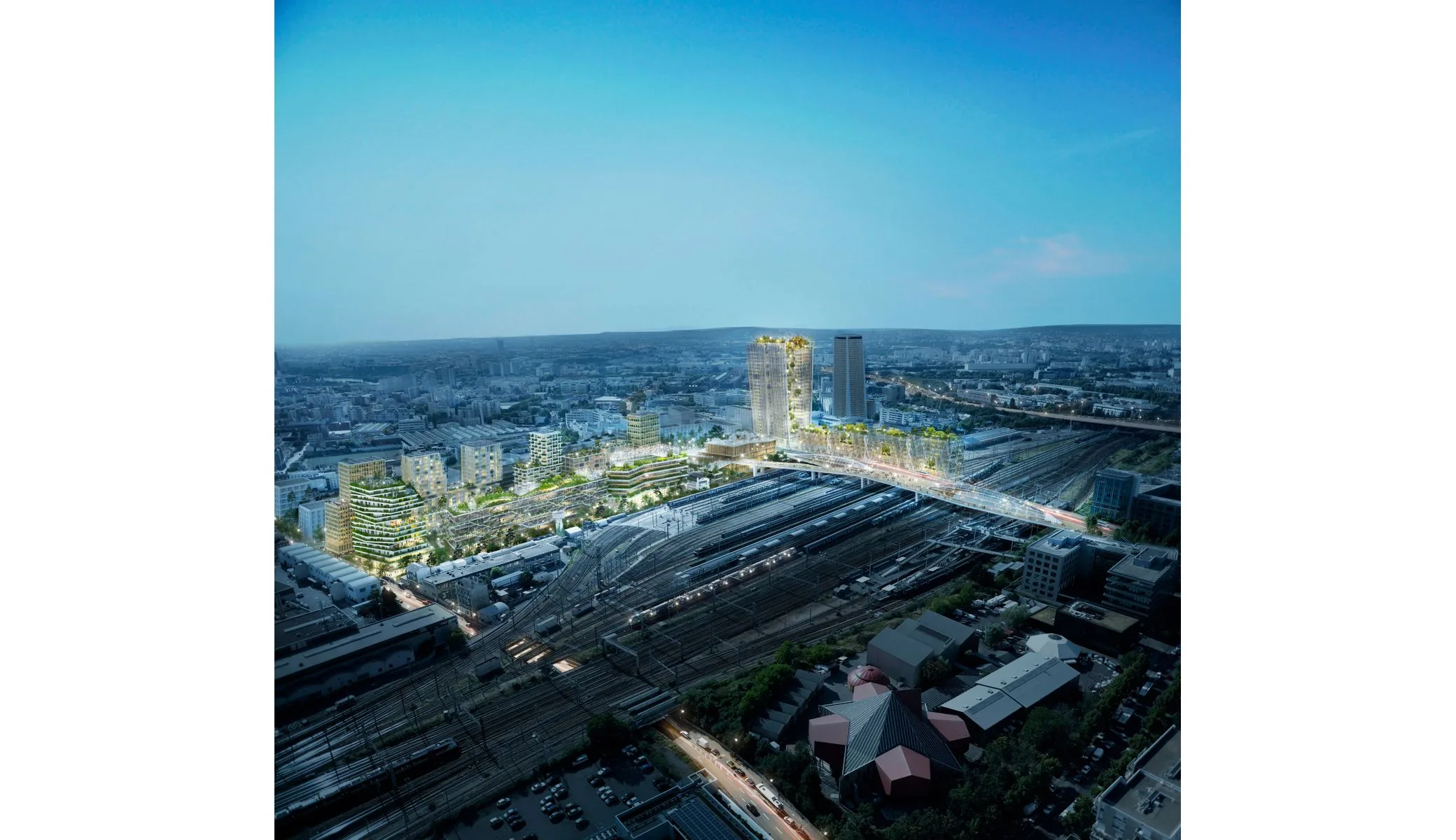
At the heart of the Jardin de la création stands the generator of artistic development: the Halle Créative. This building, with its emblematic architecture, will become the true landmark of the park. La Halle Créative is a hybrid project with mixed programming developed over seven levels, enabling artists to develop their imagination, research new concepts, realize their own projects, exchange ideas with professionals, and exhibit their creations in situ through an innovative artistic pathway. The building will also house offices and, on its roof, a sports circuit.
# La Halle Créative
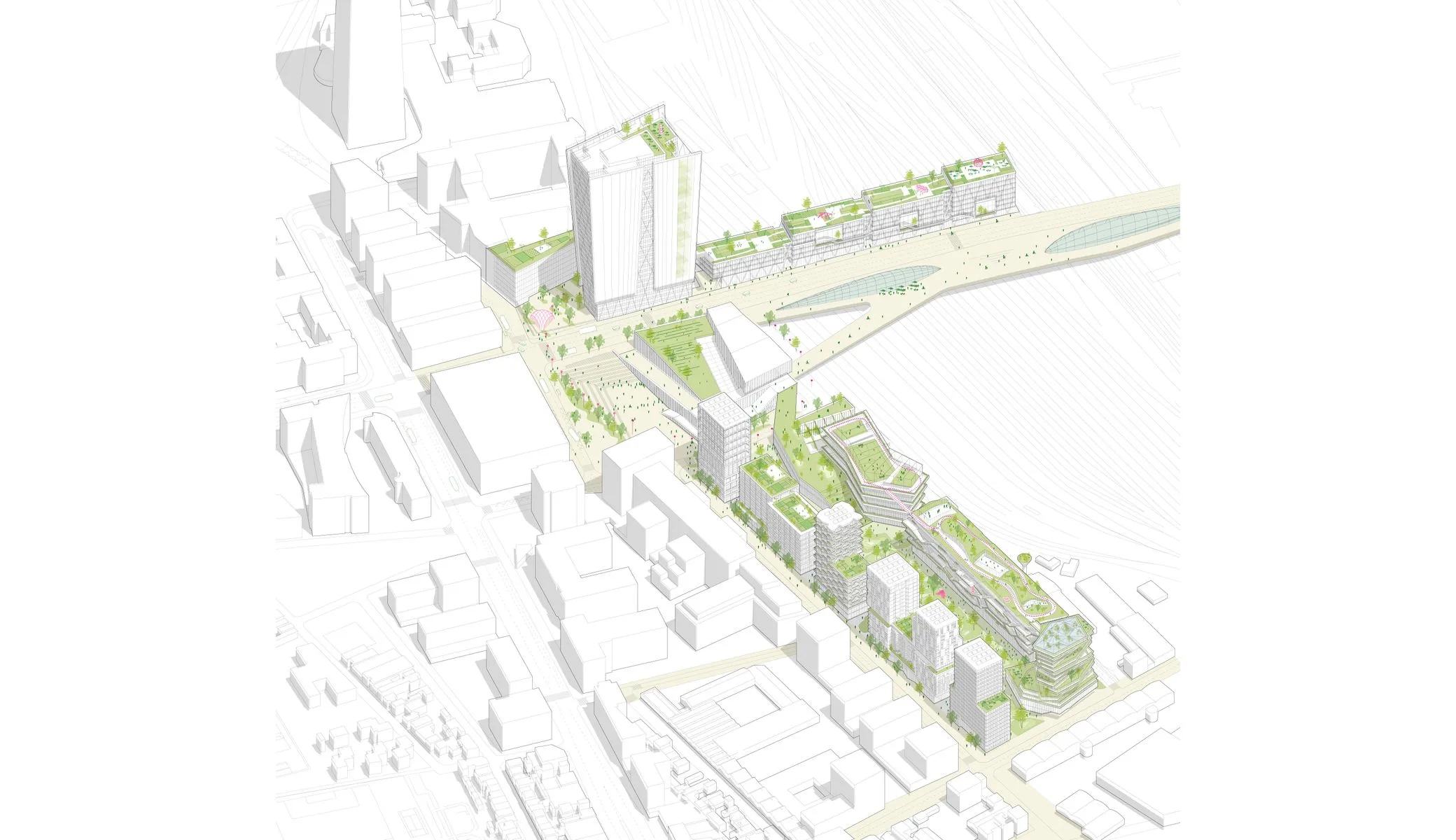
**Le Jardin de la création**, such is the name given to this new district of Saint-Denis, conceived as a territory dedicated to artistic experimentation and innovation. At the heart of this park rises the Halle Créative, a hybrid building of 15,000 m² designed as the generator of a cultural and economic ecosystem. We imagined this project for Kaufman & Broad and UBS in 2017, with the conviction that a facility intended for artists could not settle for a simple functional envelope. The architecture itself had to embody the creative gesture, to become a support for exchanges, encounters, and the circulation of ideas.
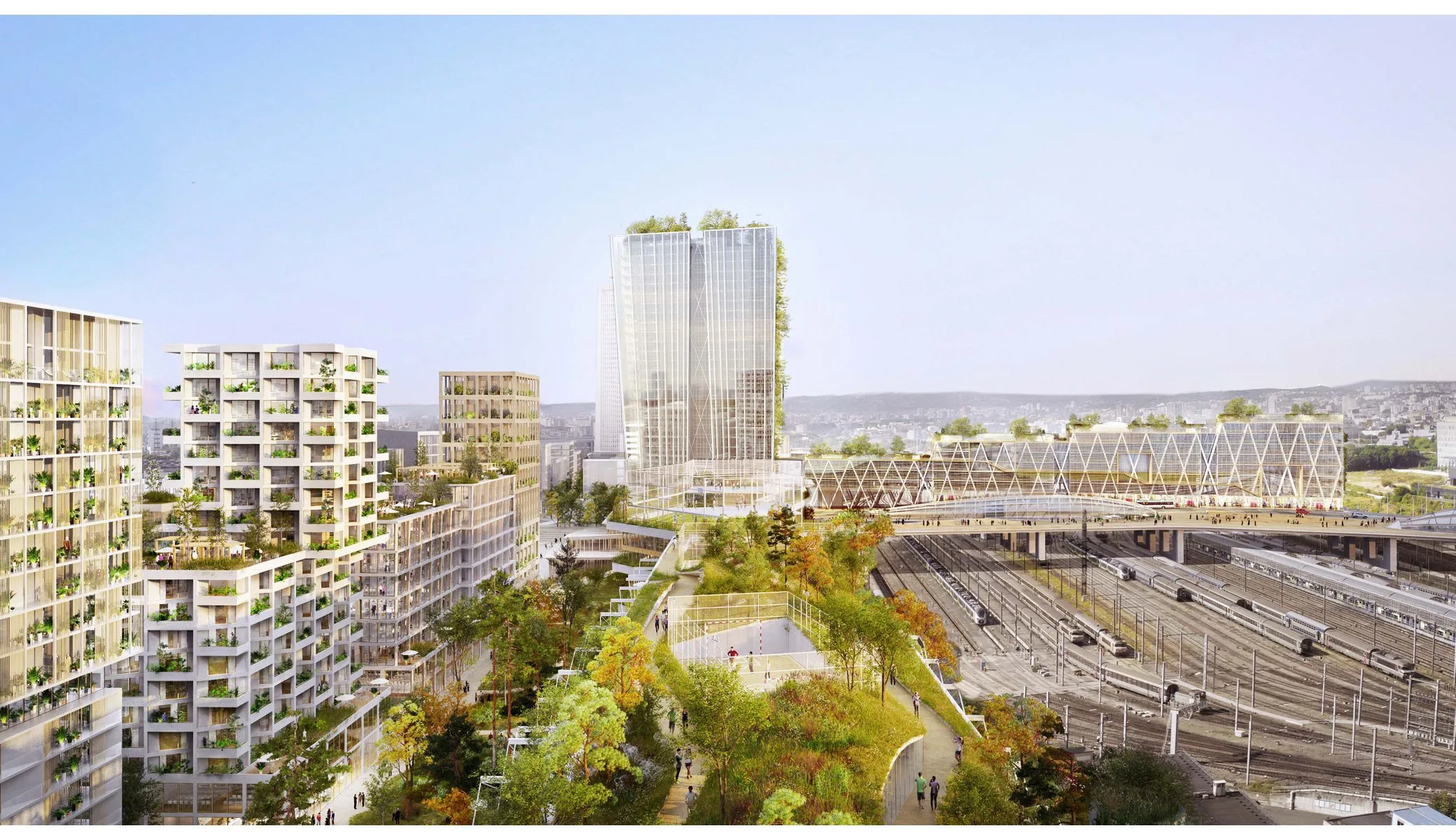
The site extends between the landscaped park of the Jardin de la création and the railway tracks that mark the northern boundary of the plot. This intermediate position, between cultivated nature and technical infrastructure, led us to conceive the building as a spatial linking device, an inhabited threshold. The Halle does not seek to mask the rails; it assumes this urban duality and makes it a quality: the transparency of the ground floor allows a through view, from the park toward the tracks, and reciprocally. The project rests on a base of two entirely glazed levels, benefiting from generous heights that give the common spaces necessary breathing room. This base houses an open, flexible cafeteria, co-working spaces, and above all the artist studios and fab-labs, places of creation, exchange, study, and teaching. These programs unfold on the ground floor and first level, forming an accessible, permeable continuum, where visual and physical porosity fosters spontaneous interactions.
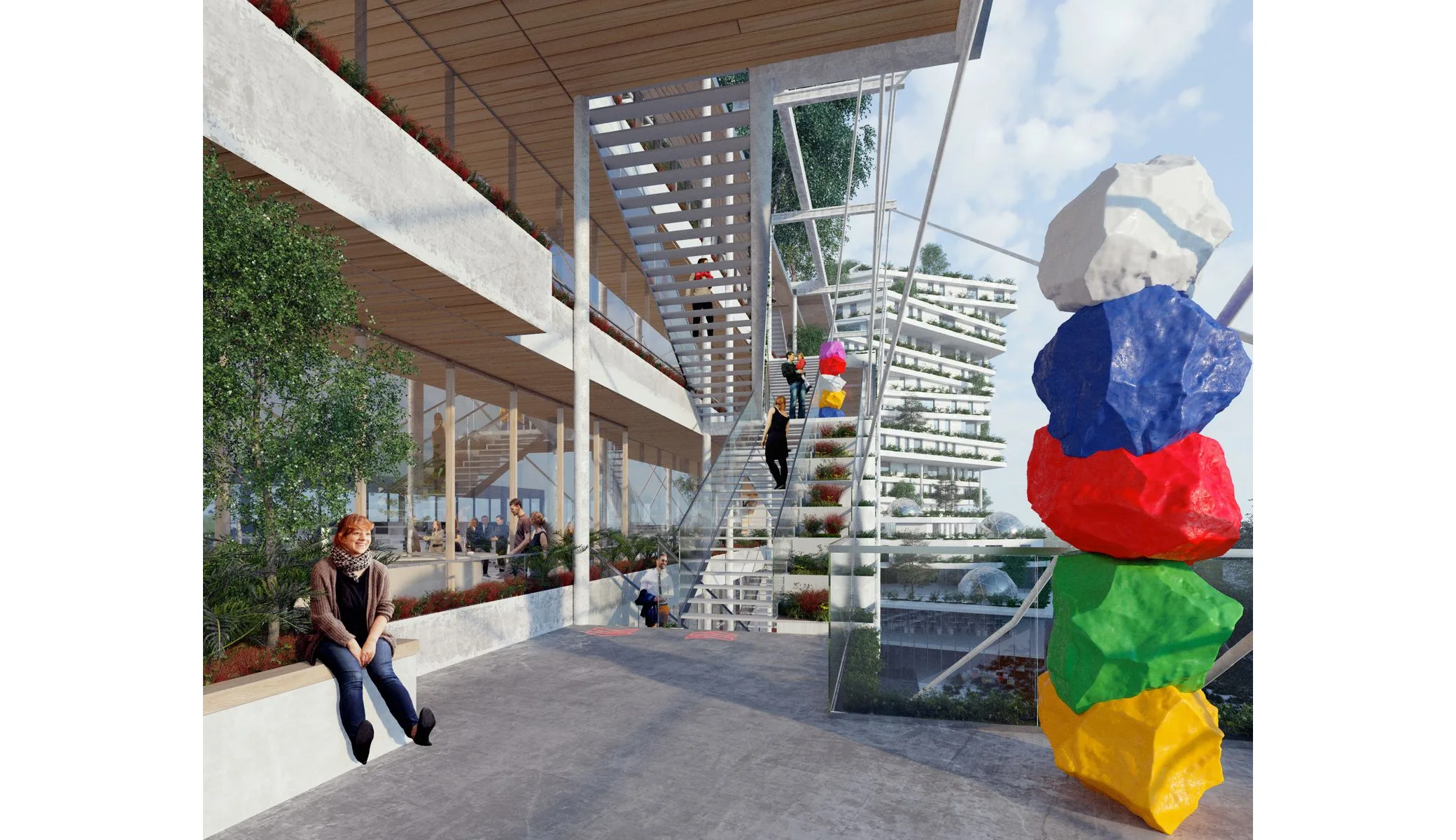
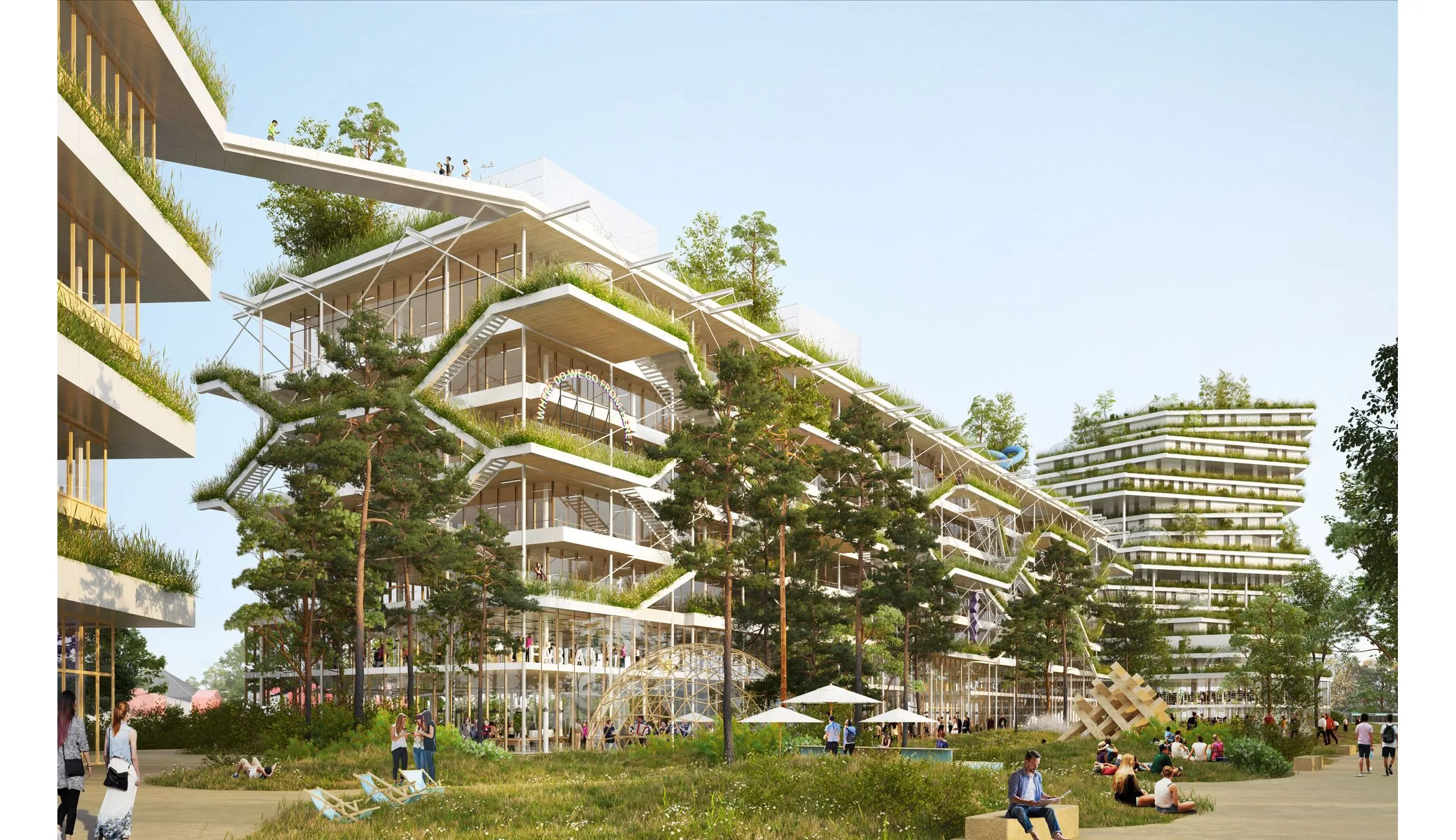
Above this transparent base, five levels of offices rise, from R+2 to R+6. We made these floor plates as **free and flexible** as possible to accommodate different types of occupation, from individual offices to collaborative spaces. The average width of the building is 19.20 m, a standard dimension allowing optimization of natural lighting and ventilation. The facade follows a 1.35 m grid, a regularity that offers freedom of interior subdivision. To free up even more usable surface area, we placed the vertical circulation on the facade, outside the floor plates. This structuring decision is not merely a technical feat: it transforms the staircase into a **programmatic element in its own right**, into a scenographic device that connects, on the four faces of the building, grandstands, balconies, planted spaces, and walkways.
It is precisely in this active envelope that the architectural identity of the Halle Créative resides. We designed a **unitary facade**, a continuous ribbon that wraps the volume without distinction of main or secondary face. This exterior pathway, which we named *la Promenade Artistique*, develops in a spiral around the building, connecting staircases, planted terraces, grandstands, and viewpoints. The visitor who takes it traverses a complex, almost labyrinthine spatial sequence, evoking Piranesi's engravings or Escher's impossible staircases. This is not a simple formal cladding but a true vertical public space, accessible to all, offering changing views of the park, the railway tracks, the distant city. This promenade also serves as a support for outdoor exhibitions, temporary art installations, and performances. It is the physical embodiment of the ambition of the Jardin de la création: to make art visible, accessible, and shared.
The materiality of the project responds to this dual requirement of **spatial generosity** and **constructive lightness**. The glazed base rests on a column-slab structure that allows large spans and maximum transparency. The upper levels, by contrast, rely on a mixed steel-concrete framework that permits transferring loads to the periphery, thus freeing the floor plates of any intermediate load-bearing point. The exterior circulations are realized in light metal structure, with metal mesh railings and grating steps, materials that accentuate the effect of suspension, of levitation of the pathway. The greening of terraces and balconies adds an additional layer, a natural filter that evolves with the seasons and softens the visual impact of the built volume.
On the environmental level, the project integrates several passive strategies. Natural ventilation of the office floor plates is favored by their moderate width and by the possibility of opening the facade bays. The planted spaces on the periphery play a role in thermal regulation, mitigating summer overheating and creating favorable microclimates. The glazed base, oriented due south toward the park, benefits from horizontal solar protections integrated into the metal structure of the upper walkways. Finally, the roof accommodates not only photovoltaic panels but also a **sports circuit** open to the public, connected to neighboring buildings by two lateral footbridges. This mutualization of uses on the roof participates in a logic of programmatic intensification, of densification of functions on the same ground footprint.
La Halle Créative is therefore not reducible to a simple office building with ground-floor commercial spaces. It is an **architectural manifesto** for another way of thinking about mixed-use programs, where public space is not limited to the ground floor but climbs, winds, traverses the edifice from bottom to top. It affirms that work, creation, sport, and contemplation can coexist in the same place, irrigated by a vertical circulation that itself becomes a meeting space. It is this programmatic and spatial porosity, this **hybridization of uses**, that makes the Halle the true landmark of the Jardin de la création, a building whose identity is constructed as much in the solids as in the voids, as much in the offices as in the suspended staircases that connect them to the park and to the city.
**Le Jardin de la création**, such is the name given to this new district of Saint-Denis, conceived as a territory dedicated to artistic experimentation and innovation. At the heart of this park rises the Halle Créative, a hybrid building of 15,000 m² designed as the generator of a cultural and economic ecosystem. We imagined this project for Kaufman & Broad and UBS in 2017, with the conviction that a facility intended for artists could not settle for a simple functional envelope. The architecture itself had to embody the creative gesture, to become a support for exchanges, encounters, and the circulation of ideas.
The site extends between the landscaped park of the Jardin de la création and the railway tracks that mark the northern boundary of the plot. This intermediate position, between cultivated nature and technical infrastructure, led us to conceive the building as a spatial linking device, an inhabited threshold. The Halle does not seek to mask the rails; it assumes this urban duality and makes it a quality: the transparency of the ground floor allows a through view, from the park toward the tracks, and reciprocally. The project rests on a base of two entirely glazed levels, benefiting from generous heights that give the common spaces necessary breathing room. This base houses an open, flexible cafeteria, co-working spaces, and above all the artist studios and fab-labs, places of creation, exchange, study, and teaching. These programs unfold on the ground floor and first level, forming an accessible, permeable continuum, where visual and physical porosity fosters spontaneous interactions.
Above this transparent base, five levels of offices rise, from R+2 to R+6. We made these floor plates as **free and flexible** as possible to accommodate different types of occupation, from individual offices to collaborative spaces. The average width of the building is 19.20 m, a standard dimension allowing optimization of natural lighting and ventilation. The facade follows a 1.35 m grid, a regularity that offers freedom of interior subdivision. To free up even more usable surface area, we placed the vertical circulation on the facade, outside the floor plates. This structuring decision is not merely a technical feat: it transforms the staircase into a **programmatic element in its own right**, into a scenographic device that connects, on the four faces of the building, grandstands, balconies, planted spaces, and walkways.
It is precisely in this active envelope that the architectural identity of the Halle Créative resides. We designed a **unitary facade**, a continuous ribbon that wraps the volume without distinction of main or secondary face. This exterior pathway, which we named *la Promenade Artistique*, develops in a spiral around the building, connecting staircases, planted terraces, grandstands, and viewpoints. The visitor who takes it traverses a complex, almost labyrinthine spatial sequence, evoking Piranesi's engravings or Escher's impossible staircases. This is not a simple formal cladding but a true vertical public space, accessible to all, offering changing views of the park, the railway tracks, the distant city. This promenade also serves as a support for outdoor exhibitions, temporary art installations, and performances. It is the physical embodiment of the ambition of the Jardin de la création: to make art visible, accessible, and shared.
The materiality of the project responds to this dual requirement of **spatial generosity** and **constructive lightness**. The glazed base rests on a column-slab structure that allows large spans and maximum transparency. The upper levels, by contrast, rely on a mixed steel-concrete framework that permits transferring loads to the periphery, thus freeing the floor plates of any intermediate load-bearing point. The exterior circulations are realized in light metal structure, with metal mesh railings and grating steps, materials that accentuate the effect of suspension, of levitation of the pathway. The greening of terraces and balconies adds an additional layer, a natural filter that evolves with the seasons and softens the visual impact of the built volume.
On the environmental level, the project integrates several passive strategies. Natural ventilation of the office floor plates is favored by their moderate width and by the possibility of opening the facade bays. The planted spaces on the periphery play a role in thermal regulation, mitigating summer overheating and creating favorable microclimates. The glazed base, oriented due south toward the park, benefits from horizontal solar protections integrated into the metal structure of the upper walkways. Finally, the roof accommodates not only photovoltaic panels but also a **sports circuit** open to the public, connected to neighboring buildings by two lateral footbridges. This mutualization of uses on the roof participates in a logic of programmatic intensification, of densification of functions on the same ground footprint.
La Halle Créative is therefore not reducible to a simple office building with ground-floor commercial spaces. It is an **architectural manifesto** for another way of thinking about mixed-use programs, where public space is not limited to the ground floor but climbs, winds, traverses the edifice from bottom to top. It affirms that work, creation, sport, and contemplation can coexist in the same place, irrigated by a vertical circulation that itself becomes a meeting space. It is this programmatic and spatial porosity, this **hybridization of uses**, that makes the Halle the true landmark of the Jardin de la création, a building whose identity is constructed as much in the solids as in the voids, as much in the offices as in the suspended staircases that connect them to the park and to the city.
- Lieu
- Saint-Denis, France
- Nature
- Mixte
- Surface
- 15 000 m²
- Budget
- 35 M€ HT
- Concours
- 2017
- MOA
- Kaufman & Broad + UBS