Intelligence Campus
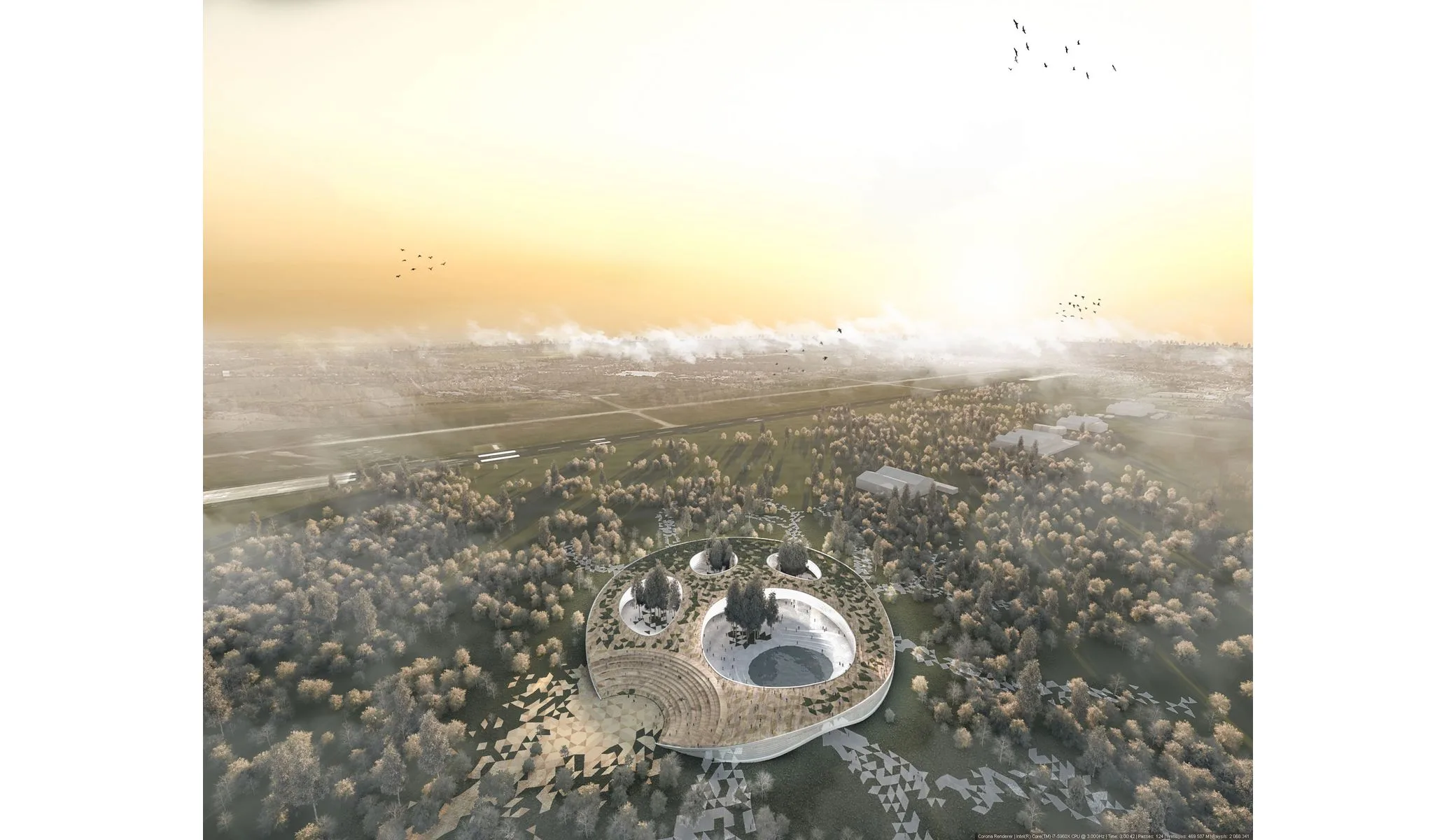
We envision the new Intelligence Campus as a biomimetic city, as a complex ecosystem that will develop innovative solutions for the city of tomorrow. Biomimicry allows us to draw inspiration from natural principles to develop sustainable innovations. Urbanity and Nature will come together in this campus, coexisting in symbiosis as a single unified whole.
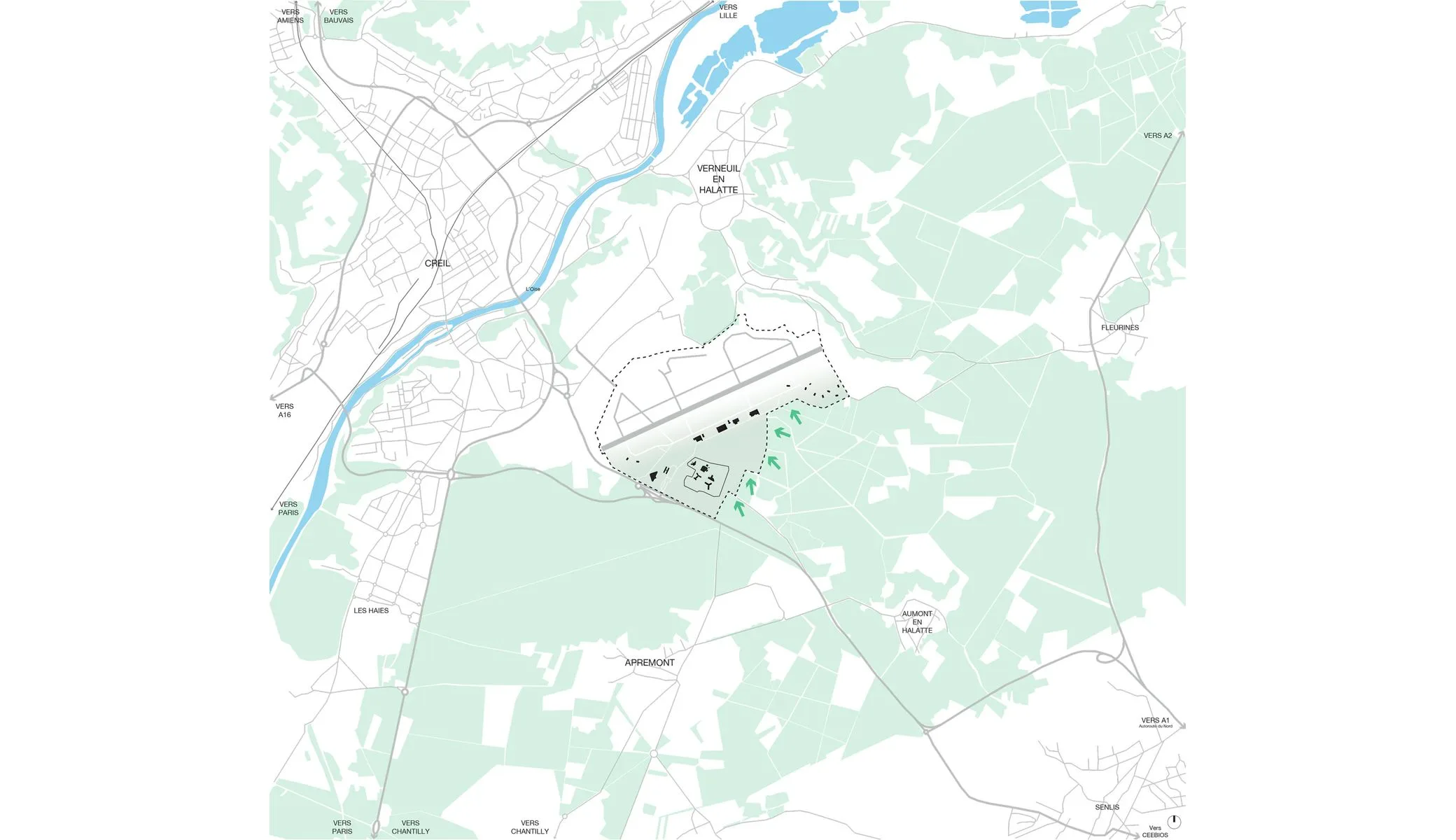
We envision the new Intelligence Campus in Creil as a **biomimetic city**, a complex ecosystem that develops innovative solutions for the city of tomorrow. Biomimicry allows us to draw inspiration from natural principles to develop sustainable innovations. Urbanity and nature come together in this campus, coexisting in symbiosis as a single unified whole. This project for the Ministry of Defense, located in the Oise valley, offers us the rare opportunity to design a place that is both emblematic and imbued with discretion, an attractive hub in the Paris region that respects programmatic requirements while enhancing the qualities of the site.
The Oise valley offers us a remarkable natural context that we place at the center of our approach. Rather than imposing a monumental architectural gesture, we seek to compose with what nature has offered the site. The Intelligence Campus welcomes different profiles: military personnel, researchers, students, civilians, clients, entrepreneurs. This diversity of users becomes the driving force of our design. We envision a place as a **point of convergence**, where informal encounters and temporary synergies become possible without being imposed.
The project's design is structured around the concept of **Plugin City**: a multitude of cell agglomerations with different functions grouped within a single campus. This assembly logic allows for programmatic flexibility essential for a military and research facility. In the organization of the whole, there is a hierarchy of elements that responds to security constraints, circulation, and institutional representation. We create an emblematic building that becomes the icon of the new Creil Air Base, while avoiding the pitfall of gratuitous monumentality.
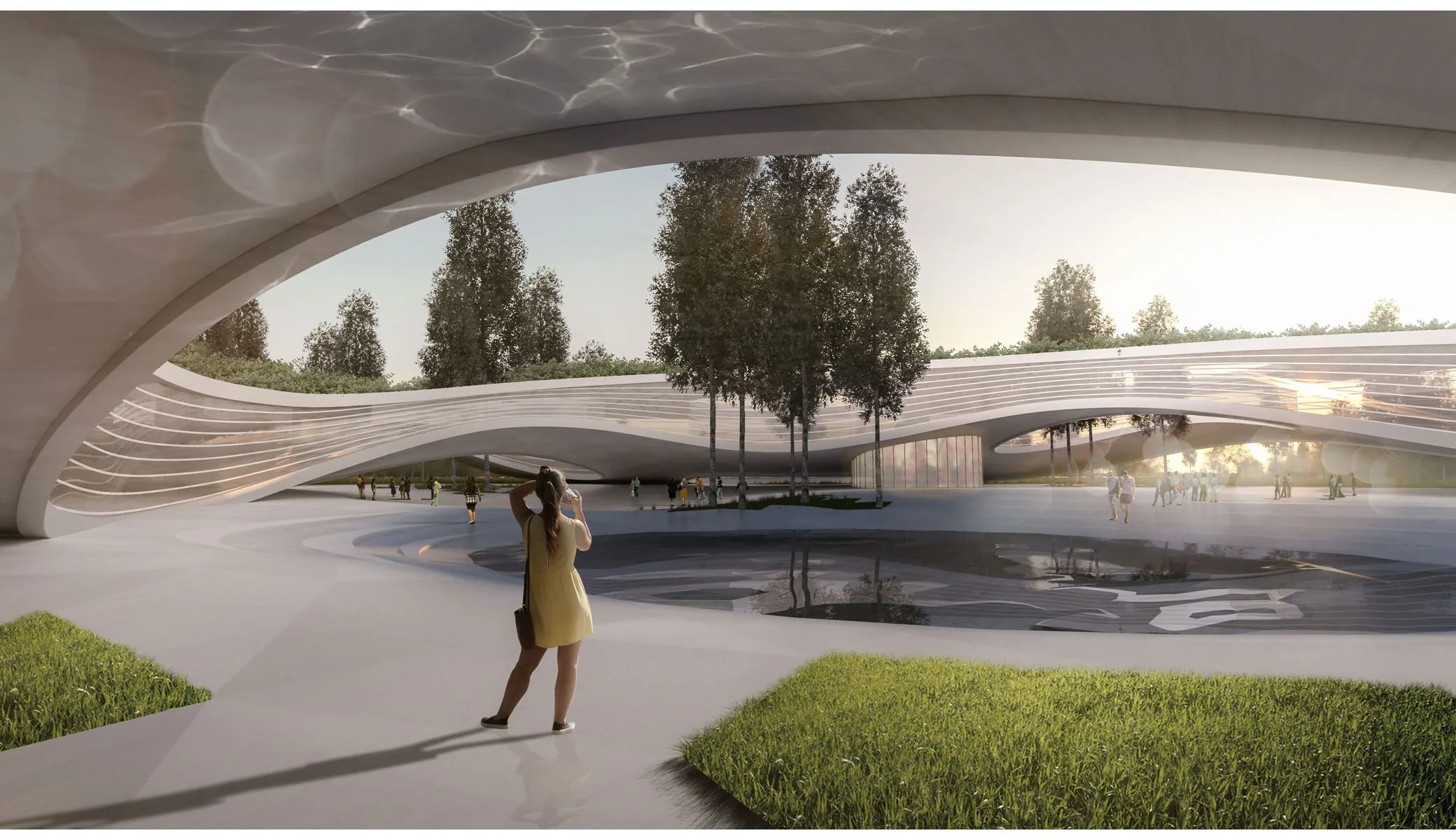
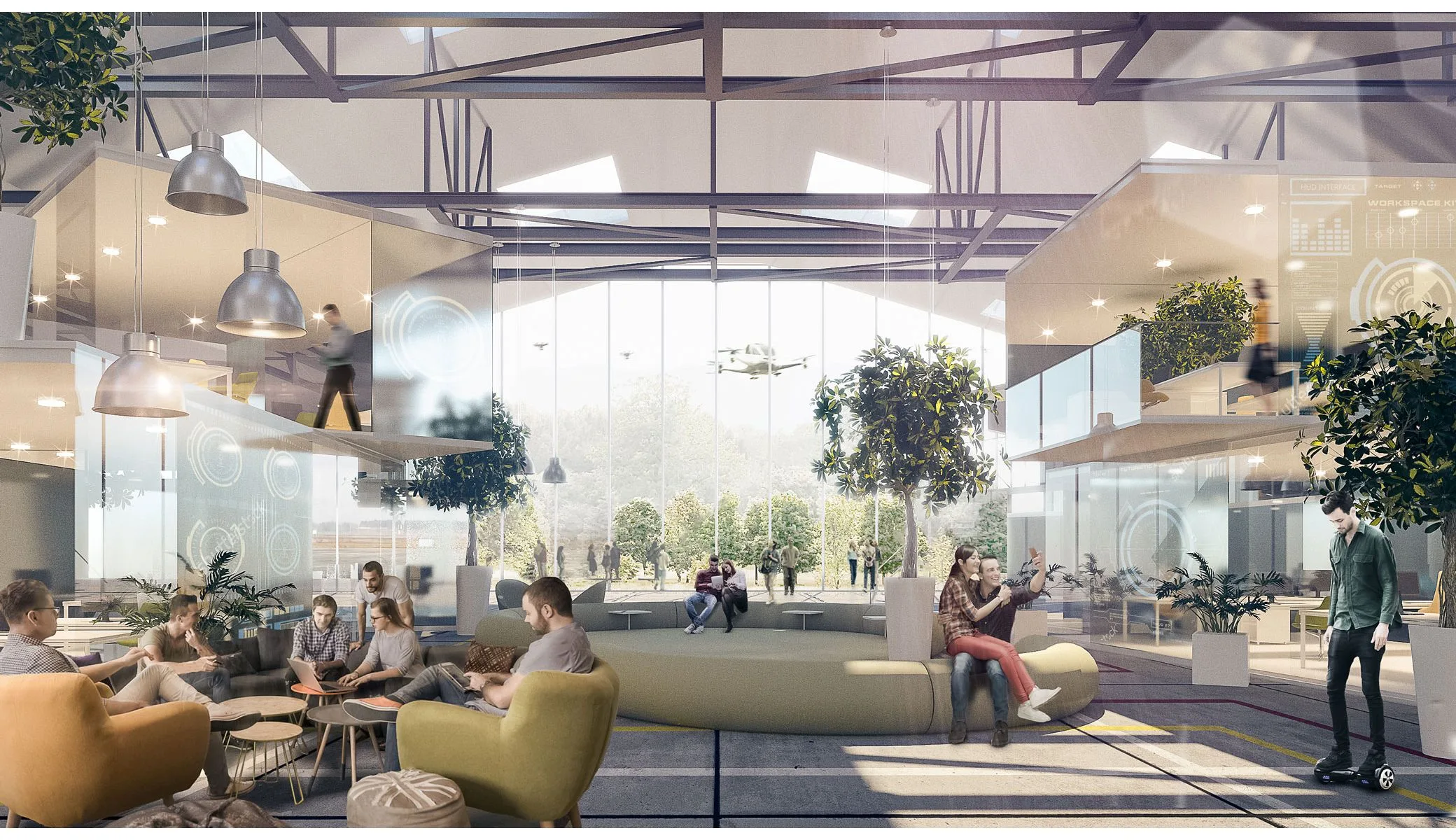
We envision a **fluid architecture**, a creative hub that highlights informal sharing spaces allowing people to meet or work. Spontaneous amphitheaters and multipurpose rooms belong to this territory. This fluidity draws directly from natural systems: communication networks, energy and information flows circulate as in a living organism. The architecture becomes a support for the emergence of unpredictable collaborations, where innovation and advanced research often find their origin.
We envision the creation of **modular spaces** that can function independently from one another, but at the same time become a whole if the needs arise. This modularity is not simply a technical feat, it responds to a clear programmatic vision: the Intelligence Campus must be able to evolve, adapt to changing uses, accommodate new functions without compromising the integrity of the whole. Through this urbanization, we create potentially temporary synergies while favoring contact with nature: being able to escape when desired or gather according to momentary needs.
The project's materiality follows this biomimetic logic. The facades breathe, the circulation spaces become *climatic galleries* that naturally regulate interior atmospheres. We work with local materials, light structures that reduce the project's carbon footprint. The vegetated roofs extend the landscape of the Oise valley, create favorable micro-climates, participate in stormwater management. Each constructive element responds to a logic of environmental efficiency, without renouncing architectural expression.
The **environmental approach** irrigates the entire project. Biomimicry is not just a conceptual reference, it becomes a design method. We study natural systems to extract principles applicable to architecture: natural ventilation inspired by termite mounds, light management inspired by foliage, spatial organization inspired by root networks. This approach allows us to design an energy-efficient campus that does not depend solely on complex technical solutions. The project's intelligence resides as much in its passive design as in its active equipment.
The exterior spaces become as important as the built volumes. We design *research gardens*, pedestrian paths that invite contemplative wandering, terraces that extend work spaces toward the landscape. Contact with nature is not decorative, it contributes to users' well-being, promotes concentration and creativity. In a program as demanding as that of a military and research campus, this relationship to the landscape becomes an essential issue.
The spatial organization favors **impromptu encounters**, those informal moments where the best ideas are often born. The circulation spaces are not simple functional corridors, they become inhabitable spaces, widened in places to accommodate rest areas, open libraries, nomadic workstations. This programmatic porosity reflects our vision of an architecture of possibilities, where users appropriate the space according to their momentary needs.
The Intelligence Campus in Creil embodies our conviction that architecture can draw inspiration from the living world to create adapted, evolving, economical environments. This project explores an alternative path to the traditional monumentality of institutional facilities: that of a discreet but intense architecture, which stages uses rather than imposing itself as a formal gesture. A place where researchers, military personnel and students find the spatial conditions to invent together the city of tomorrow.
The Oise valley offers us a remarkable natural context that we place at the center of our approach. Rather than imposing a monumental architectural gesture, we seek to compose with what nature has offered the site. The Intelligence Campus welcomes different profiles: military personnel, researchers, students, civilians, clients, entrepreneurs. This diversity of users becomes the driving force of our design. We envision a place as a **point of convergence**, where informal encounters and temporary synergies become possible without being imposed.
The project's design is structured around the concept of **Plugin City**: a multitude of cell agglomerations with different functions grouped within a single campus. This assembly logic allows for programmatic flexibility essential for a military and research facility. In the organization of the whole, there is a hierarchy of elements that responds to security constraints, circulation, and institutional representation. We create an emblematic building that becomes the icon of the new Creil Air Base, while avoiding the pitfall of gratuitous monumentality.
We envision a **fluid architecture**, a creative hub that highlights informal sharing spaces allowing people to meet or work. Spontaneous amphitheaters and multipurpose rooms belong to this territory. This fluidity draws directly from natural systems: communication networks, energy and information flows circulate as in a living organism. The architecture becomes a support for the emergence of unpredictable collaborations, where innovation and advanced research often find their origin.
We envision the creation of **modular spaces** that can function independently from one another, but at the same time become a whole if the needs arise. This modularity is not simply a technical feat, it responds to a clear programmatic vision: the Intelligence Campus must be able to evolve, adapt to changing uses, accommodate new functions without compromising the integrity of the whole. Through this urbanization, we create potentially temporary synergies while favoring contact with nature: being able to escape when desired or gather according to momentary needs.
The project's materiality follows this biomimetic logic. The facades breathe, the circulation spaces become *climatic galleries* that naturally regulate interior atmospheres. We work with local materials, light structures that reduce the project's carbon footprint. The vegetated roofs extend the landscape of the Oise valley, create favorable micro-climates, participate in stormwater management. Each constructive element responds to a logic of environmental efficiency, without renouncing architectural expression.
The **environmental approach** irrigates the entire project. Biomimicry is not just a conceptual reference, it becomes a design method. We study natural systems to extract principles applicable to architecture: natural ventilation inspired by termite mounds, light management inspired by foliage, spatial organization inspired by root networks. This approach allows us to design an energy-efficient campus that does not depend solely on complex technical solutions. The project's intelligence resides as much in its passive design as in its active equipment.
The exterior spaces become as important as the built volumes. We design *research gardens*, pedestrian paths that invite contemplative wandering, terraces that extend work spaces toward the landscape. Contact with nature is not decorative, it contributes to users' well-being, promotes concentration and creativity. In a program as demanding as that of a military and research campus, this relationship to the landscape becomes an essential issue.
The spatial organization favors **impromptu encounters**, those informal moments where the best ideas are often born. The circulation spaces are not simple functional corridors, they become inhabitable spaces, widened in places to accommodate rest areas, open libraries, nomadic workstations. This programmatic porosity reflects our vision of an architecture of possibilities, where users appropriate the space according to their momentary needs.
The Intelligence Campus in Creil embodies our conviction that architecture can draw inspiration from the living world to create adapted, evolving, economical environments. This project explores an alternative path to the traditional monumentality of institutional facilities: that of a discreet but intense architecture, which stages uses rather than imposing itself as a formal gesture. A place where researchers, military personnel and students find the spatial conditions to invent together the city of tomorrow.
- Lieu
- Creil, France
- Nature
- Programme mixte
- Surface
- Confidentiel
- Budget
- Confidentiel
- Concours
- 2017
- MOA
- Ministère de la Défense