Gallery N
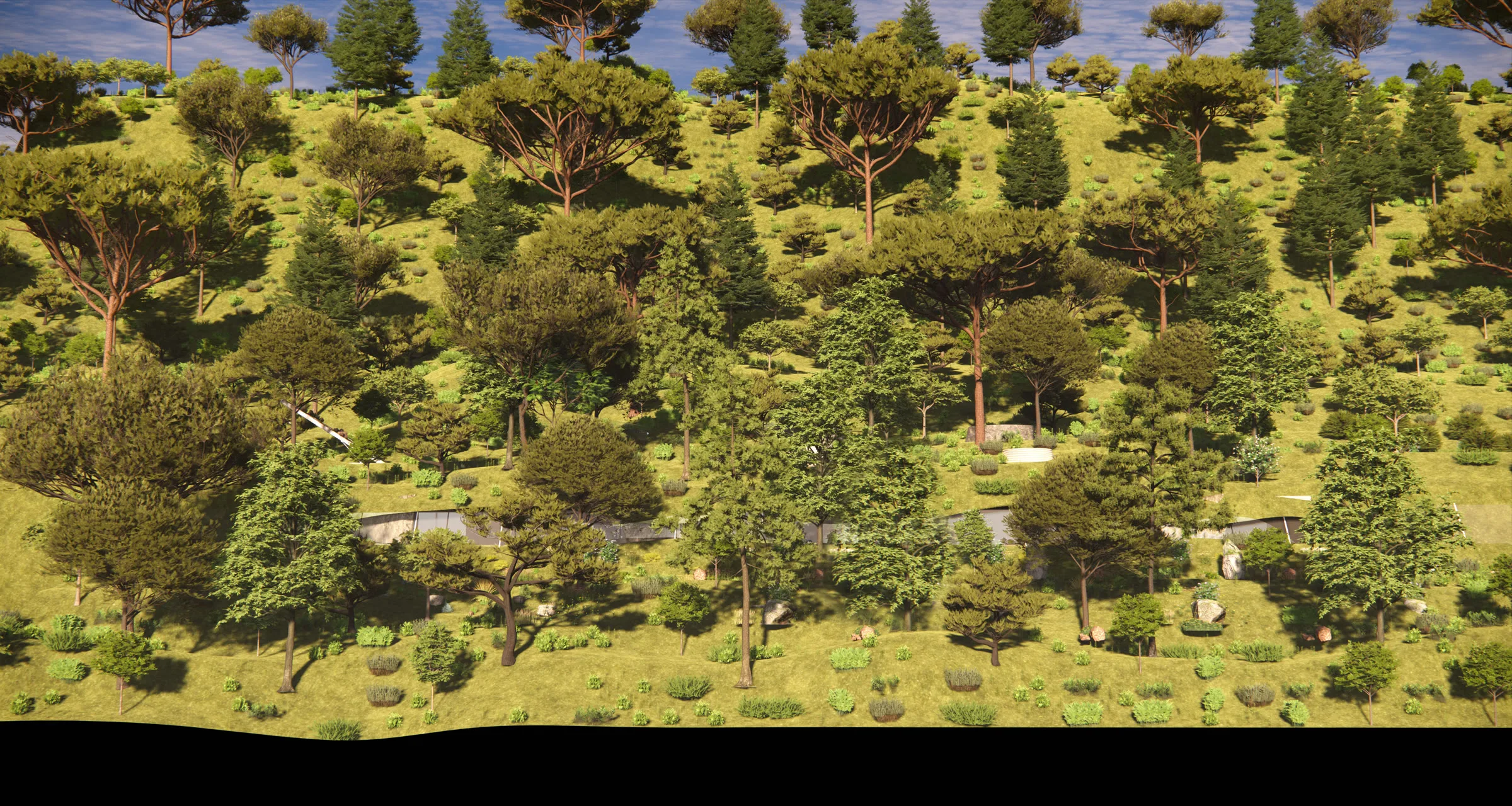
Contemporary art gallery and artist residency in the Jura forest, a semi-buried architectural signal emerging from the landscape like a vegetalized submarine.
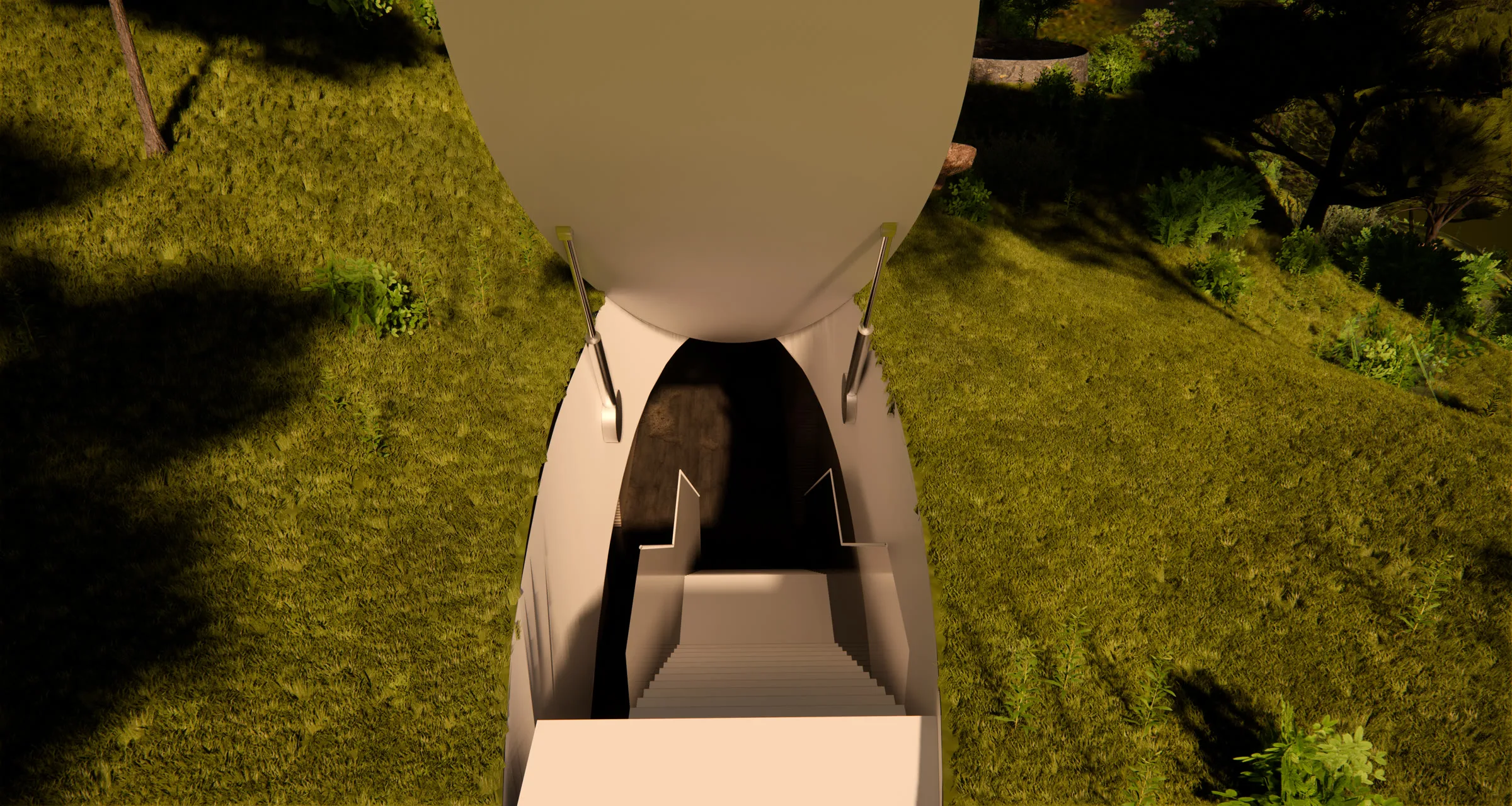
In the Jura forest, at Lemuy, we designed for Galerie Navarra a project that questions the presence of architecture in a natural environment. The forest site imposes its law: that of the canopy, the undergrowth, the gentle slope, and the silence. Rather than asserting an object placed on the ground, we chose to work with **partial burial**, an insertion strategy that makes the building a thickness of the landscape rather than a vertical signal. Architecture becomes topography, it excavates as much as it emerges.
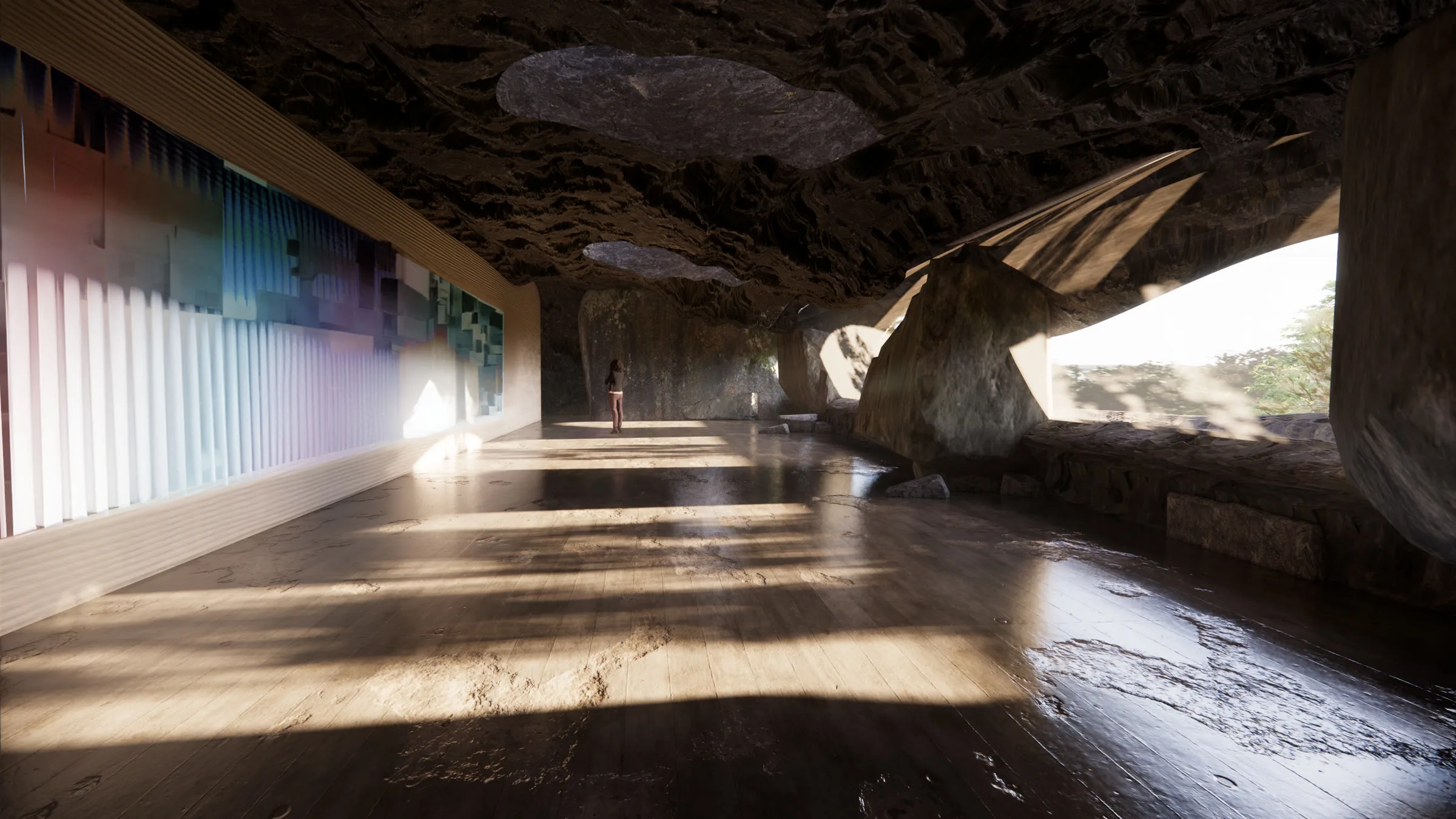
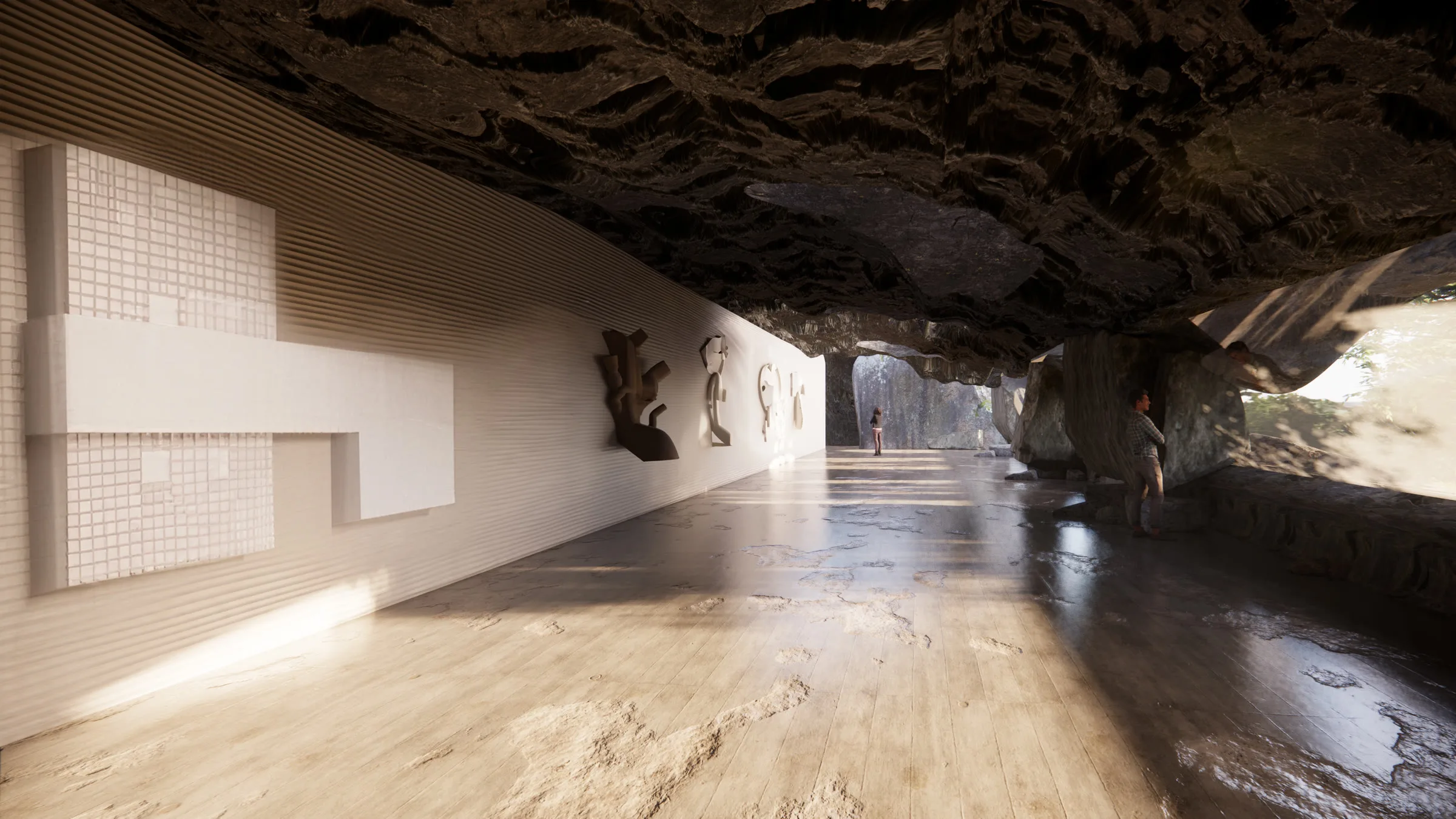
The program combines two complementary functions: a contemporary art gallery designed to host temporary exhibitions and an artist residency allowing for in situ creative periods. This duality between **exhibition space** and **production space** structures the entire project. The gallery unfolds in the lower part, anchored in the ground, benefiting from the thermal coolness and hygrometric stability of the earth. The residency, meanwhile, is positioned in the upper part, flush with the natural ground level, offering artists direct contact with the surrounding forest.
The image of the **vegetalized submarine** quickly established itself in our thinking. Not as a gratuitous metaphor, but as a way of conceiving the coexistence between a technical body (the gallery, its requirements for controlled light, climate control, conservation) and a living envelope (the planted roofs, the continuity of the plant cover). The building emerges partially, its metal facade captures the light filtering through the trees, its soft reflections dialogue with bark and ferns. This metal skin, far from being cold, will develop a patina over time, evolving with the seasons and ambient humidity.
**Burial** is not merely a formal strategy, it is an environmental response. By sinking into the ground, the building benefits from the **thermal inertia of the earth**, drastically reducing heating needs in winter and cooling in summer. The planted roofs extend the forest mantle, maintain local biodiversity, manage rainwater through progressive infiltration. We carefully worked out the plant composition of these roofs: mosses, low grasses, plants adapted to the Jura undergrowth, capable of thriving with little direct light. The goal was to make the roof **disappear** when viewed from surrounding paths, to maintain the illusion of a continuous forest.
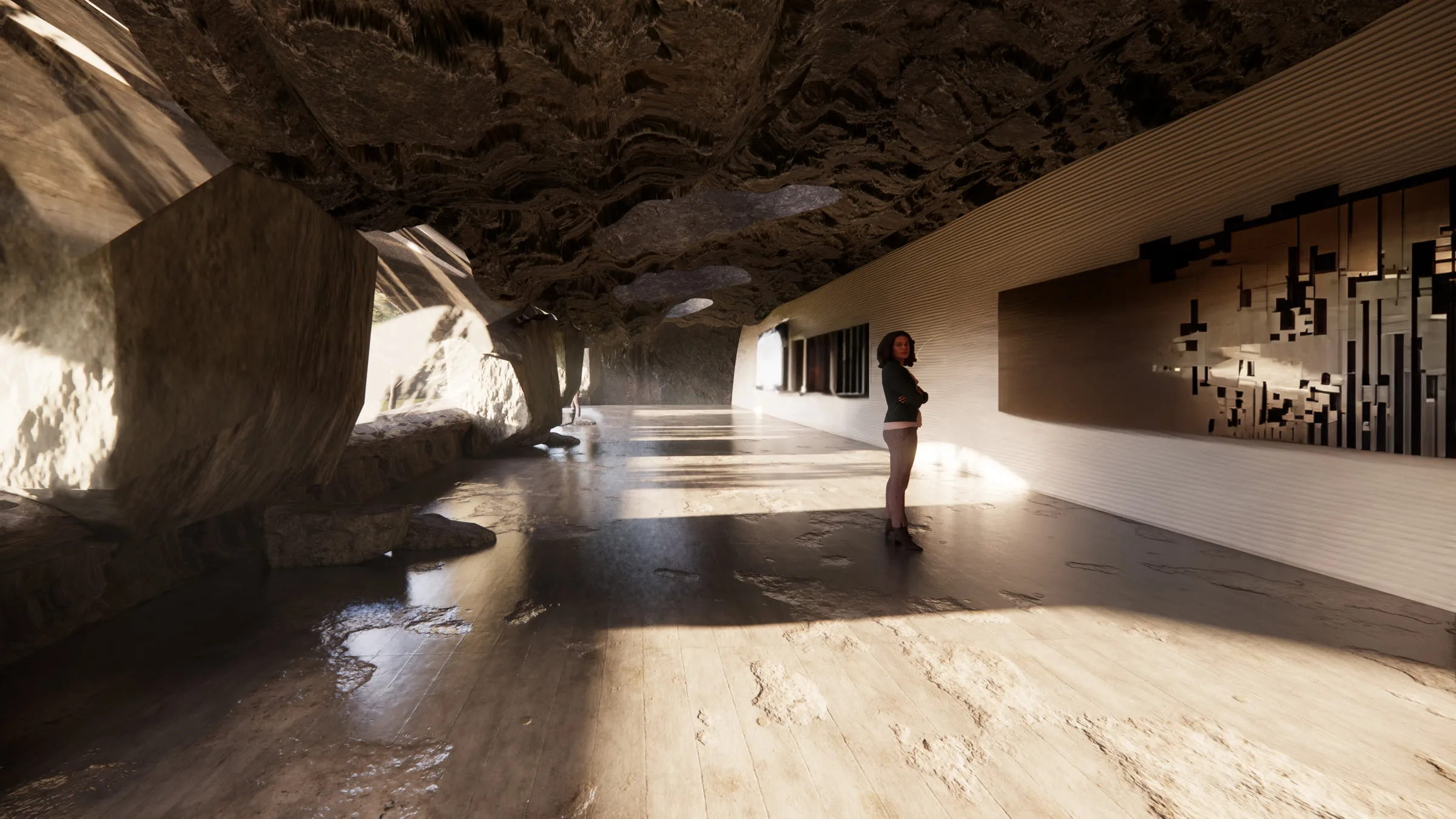
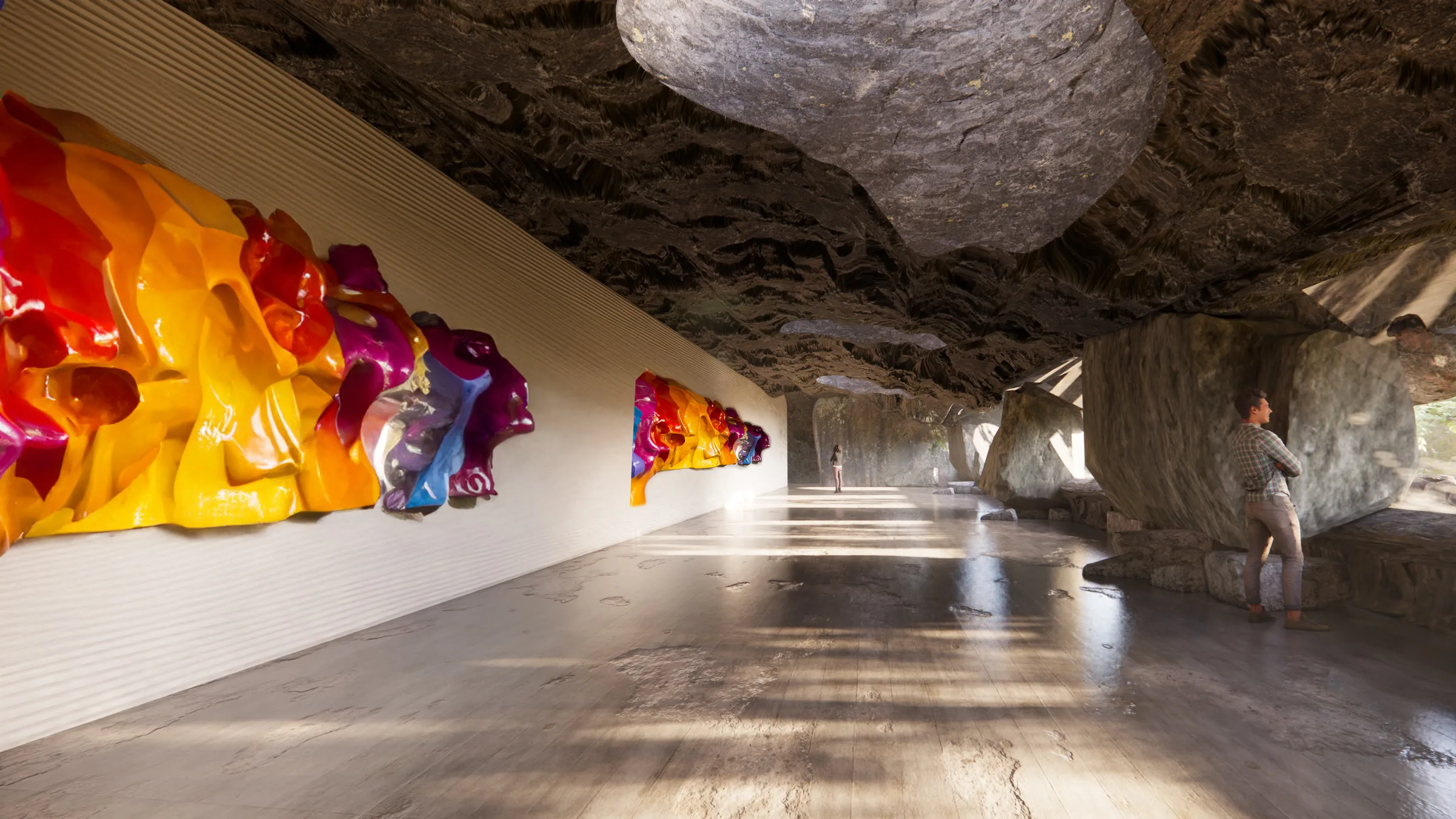
Inside the gallery, we orchestrated a precise relationship between **natural light and artificial light**. The exhibition rooms benefit from calibrated openings, horizontal or vertical slits that frame fragments of landscape: a trunk, a clearing, a play of moving shadows. These openings are never gratuitous. They punctuate the circulation, create visual pauses, establish a dialogue between the exhibited work and the outside world. Contemporary art is not isolated in an aseptic white cube, it enters into **resonance** with the forest, its rhythms, its light variations, its atmospheres.
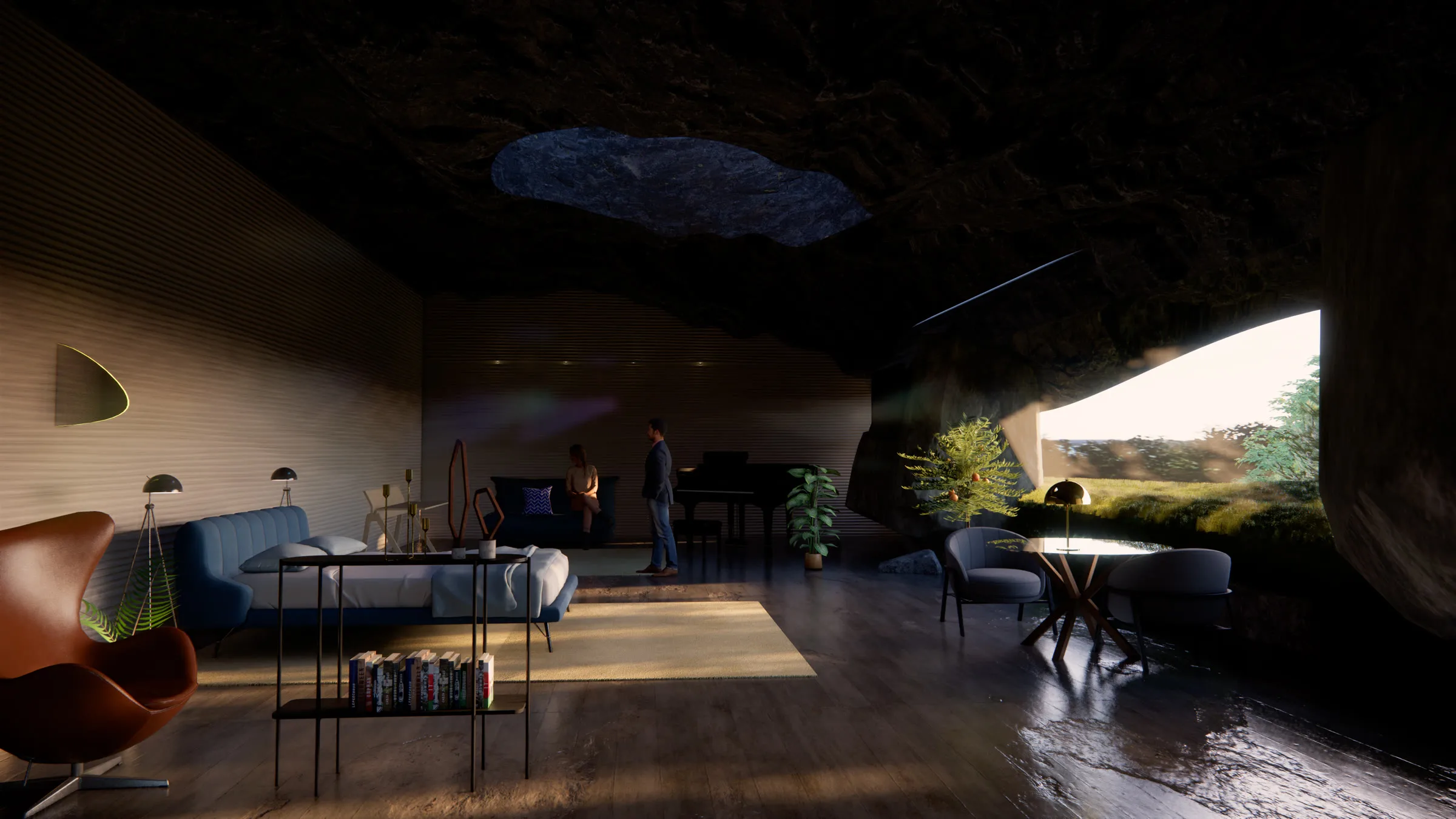
The artist residency, positioned above the gallery, functions as a **landscape observatory**. Large bay window oriented toward the trees, generous workspace, intimate bedrooms that allow for withdrawal and concentration. We conceived this space not as a simple temporary lodging, but as a **creation tool**, a spatial device that encourages immersion in the site. The resident artist literally lives above their potential exhibition space, this physical proximity creates a virtuous loop between production and exhibition.
The project's **materiality** rests on three components: metal for the emerged envelope (weathering steel or anodized aluminum, depending on final budget constraints), raw concrete for the buried walls (ensuring waterproofing and resistance to earth pressure), and wood for interior fittings (floors, screens, built-in furniture). This material triptych responds to clear constructive logics: durability against forest humidity, maintenance sobriety, coherence with local resources (the Jura is a land of forests and wood craftsmanship).
The project for Galerie Navarra remains at this stage a **concept**, an architectural exploration that poses the question of art's place in natural contexts. But this conceptual status in no way diminishes the rigor of the thinking. On the contrary, it allowed us to fully develop an idea: that of an architecture that **effaces itself to better reveal**. Effacement here is not a weakness, it is a radical stance. The building does not seek to dominate the forest, it lodges within it, finds its rightful place there, offers works and artists a discreet yet intensely present setting.
This approach is part of our ongoing research on **buried, semi-buried, topographic architectures**. For several years, we have been exploring these typologies that question the visibility of architecture as a supreme value. In a context of ecological crisis and visual saturation, it seems urgent to us to think of buildings that **inhabit the ground** rather than dominate it, that inscribe themselves in natural cycles rather than interrupt them. Gallery N (N for Navarra, for Nature, for Necessary discretion) embodies this ambition: to make architecture a **humble and precise** gesture, in service of art and landscape.
The program combines two complementary functions: a contemporary art gallery designed to host temporary exhibitions and an artist residency allowing for in situ creative periods. This duality between **exhibition space** and **production space** structures the entire project. The gallery unfolds in the lower part, anchored in the ground, benefiting from the thermal coolness and hygrometric stability of the earth. The residency, meanwhile, is positioned in the upper part, flush with the natural ground level, offering artists direct contact with the surrounding forest.
The image of the **vegetalized submarine** quickly established itself in our thinking. Not as a gratuitous metaphor, but as a way of conceiving the coexistence between a technical body (the gallery, its requirements for controlled light, climate control, conservation) and a living envelope (the planted roofs, the continuity of the plant cover). The building emerges partially, its metal facade captures the light filtering through the trees, its soft reflections dialogue with bark and ferns. This metal skin, far from being cold, will develop a patina over time, evolving with the seasons and ambient humidity.
**Burial** is not merely a formal strategy, it is an environmental response. By sinking into the ground, the building benefits from the **thermal inertia of the earth**, drastically reducing heating needs in winter and cooling in summer. The planted roofs extend the forest mantle, maintain local biodiversity, manage rainwater through progressive infiltration. We carefully worked out the plant composition of these roofs: mosses, low grasses, plants adapted to the Jura undergrowth, capable of thriving with little direct light. The goal was to make the roof **disappear** when viewed from surrounding paths, to maintain the illusion of a continuous forest.
Inside the gallery, we orchestrated a precise relationship between **natural light and artificial light**. The exhibition rooms benefit from calibrated openings, horizontal or vertical slits that frame fragments of landscape: a trunk, a clearing, a play of moving shadows. These openings are never gratuitous. They punctuate the circulation, create visual pauses, establish a dialogue between the exhibited work and the outside world. Contemporary art is not isolated in an aseptic white cube, it enters into **resonance** with the forest, its rhythms, its light variations, its atmospheres.
The artist residency, positioned above the gallery, functions as a **landscape observatory**. Large bay window oriented toward the trees, generous workspace, intimate bedrooms that allow for withdrawal and concentration. We conceived this space not as a simple temporary lodging, but as a **creation tool**, a spatial device that encourages immersion in the site. The resident artist literally lives above their potential exhibition space, this physical proximity creates a virtuous loop between production and exhibition.
The project's **materiality** rests on three components: metal for the emerged envelope (weathering steel or anodized aluminum, depending on final budget constraints), raw concrete for the buried walls (ensuring waterproofing and resistance to earth pressure), and wood for interior fittings (floors, screens, built-in furniture). This material triptych responds to clear constructive logics: durability against forest humidity, maintenance sobriety, coherence with local resources (the Jura is a land of forests and wood craftsmanship).
The project for Galerie Navarra remains at this stage a **concept**, an architectural exploration that poses the question of art's place in natural contexts. But this conceptual status in no way diminishes the rigor of the thinking. On the contrary, it allowed us to fully develop an idea: that of an architecture that **effaces itself to better reveal**. Effacement here is not a weakness, it is a radical stance. The building does not seek to dominate the forest, it lodges within it, finds its rightful place there, offers works and artists a discreet yet intensely present setting.
This approach is part of our ongoing research on **buried, semi-buried, topographic architectures**. For several years, we have been exploring these typologies that question the visibility of architecture as a supreme value. In a context of ecological crisis and visual saturation, it seems urgent to us to think of buildings that **inhabit the ground** rather than dominate it, that inscribe themselves in natural cycles rather than interrupt them. Gallery N (N for Navarra, for Nature, for Necessary discretion) embodies this ambition: to make architecture a **humble and precise** gesture, in service of art and landscape.
- Lieu
- Lemuy, France
- Nature
- Culturel
- Surface
- Confidentiel
- Budget
- Confidentiel
- Concours
- 2023
- MOA
- Galerie Navarra