Shared Teaching Building
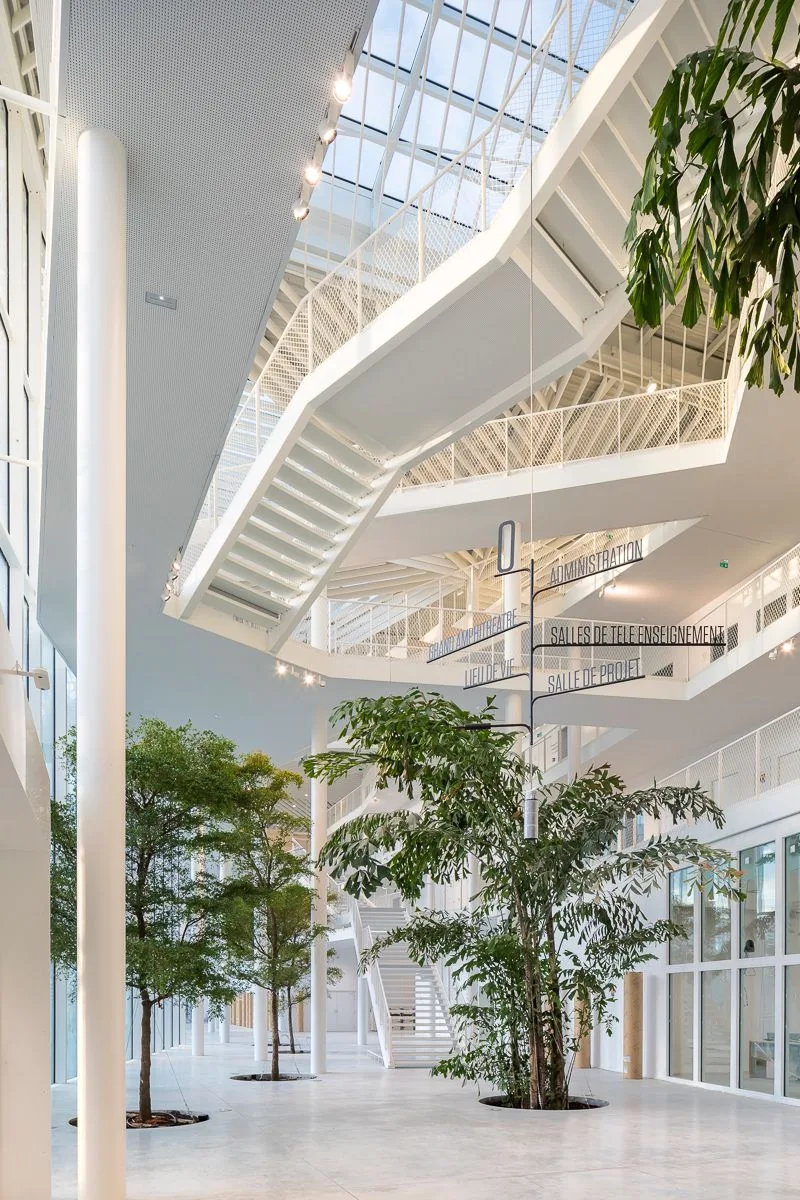
We learn more and evolve better when cultures and knowledge from diverse horizons intersect. This is the founding principle of the Shared Teaching Building on the Saclay plateau, designed to bring together seven major schools: École Polytechnique, AgroParisTech, Institut Mines Télécom, ENSTA ParisTech, ENSAE ParisTech, IOGS. Under one roof, the BEM gathers amphitheaters, classrooms, informal spaces, and landscaped walkways. People no longer circulate through corridors but through living spaces bathed in soft light, where students from different disciplines meet and collaborate. Delivered in 2013, this facility has become a reference in the design of university campuses in France. Official project website
We conceived the Shared Teaching Building in Saclay as a spatial manifesto of multidisciplinarity. When École Polytechnique entrusted us with this project in 2013, together with Sou Fujimoto Architects, Nicolas Laisné and DREAM, the challenge was twofold: to build a 10,000 m² facility capable of accommodating seven major schools under one roof (Polytechnique, AgroParisTech, Institut Mines Télécom, ENSTA ParisTech, ENSAE ParisTech, IOGS), and above all to invent an *architecture of encounter*, a place where disciplinary compartmentalization dissolves into physical space. The Saclay campus, served by the future line 18 of the Grand Paris Express and totaling 1.74 million m², did not need a simple functional building. It required a strong urban and pedagogical signal, an edifice that embodies the ongoing transformation of the French university model.
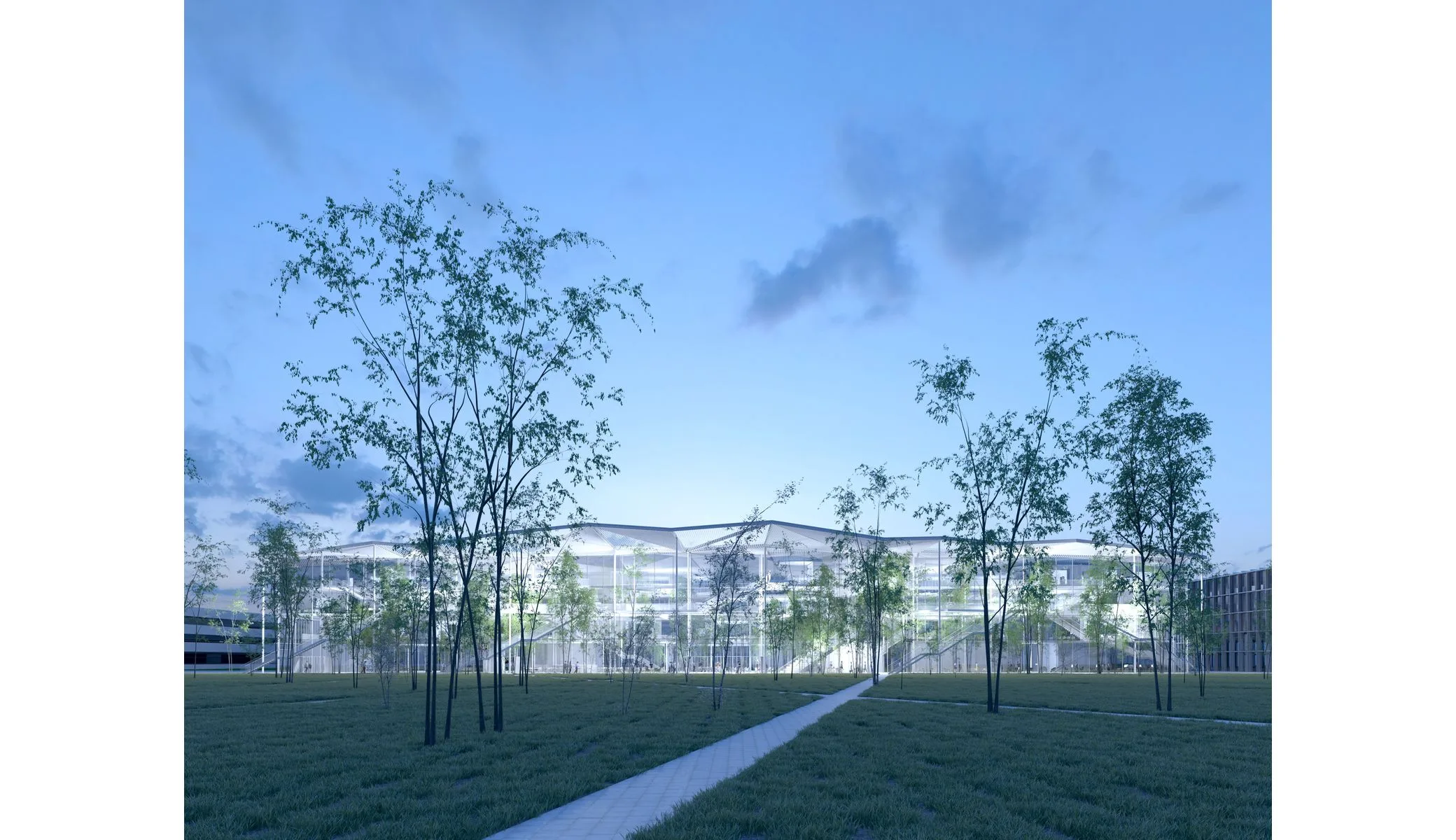
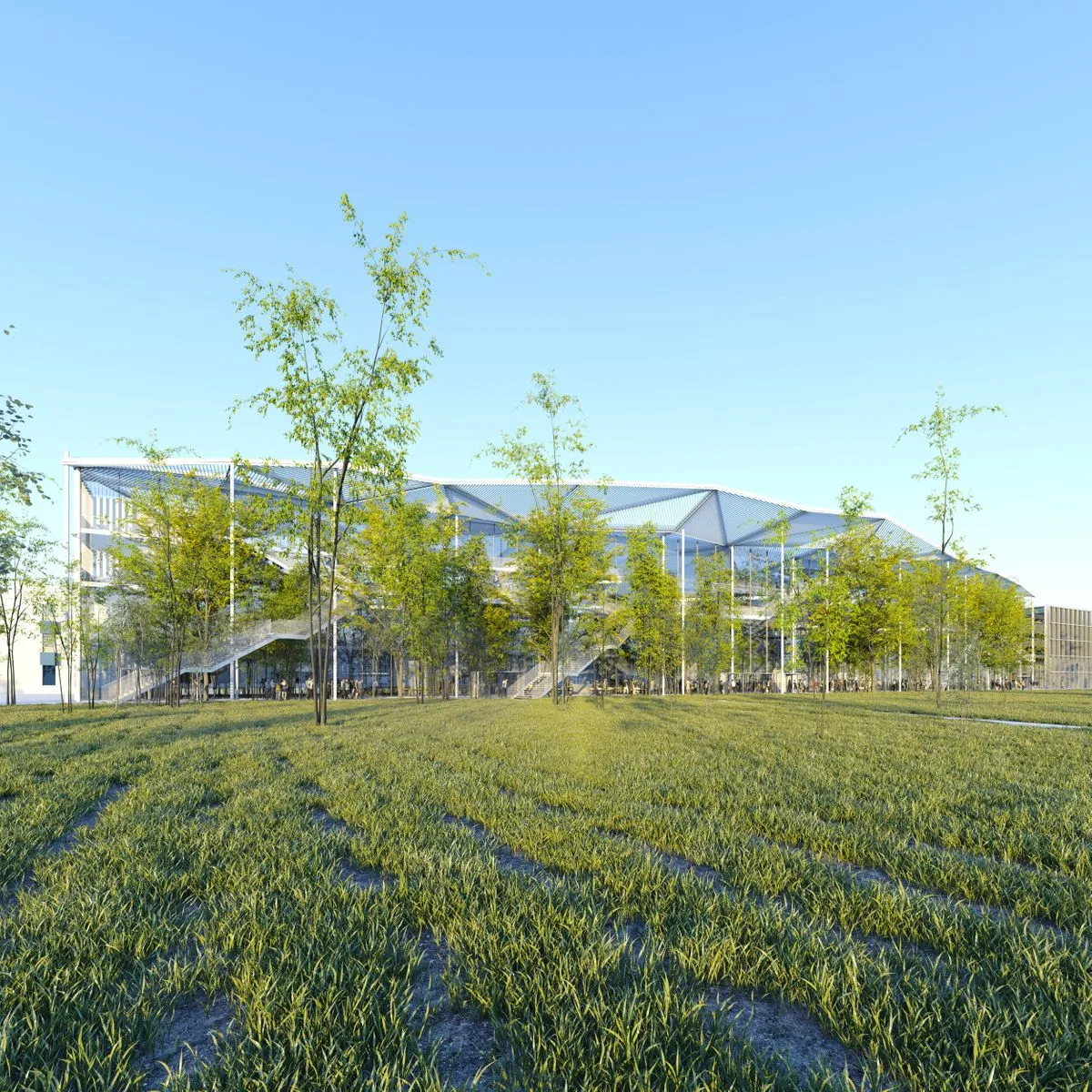
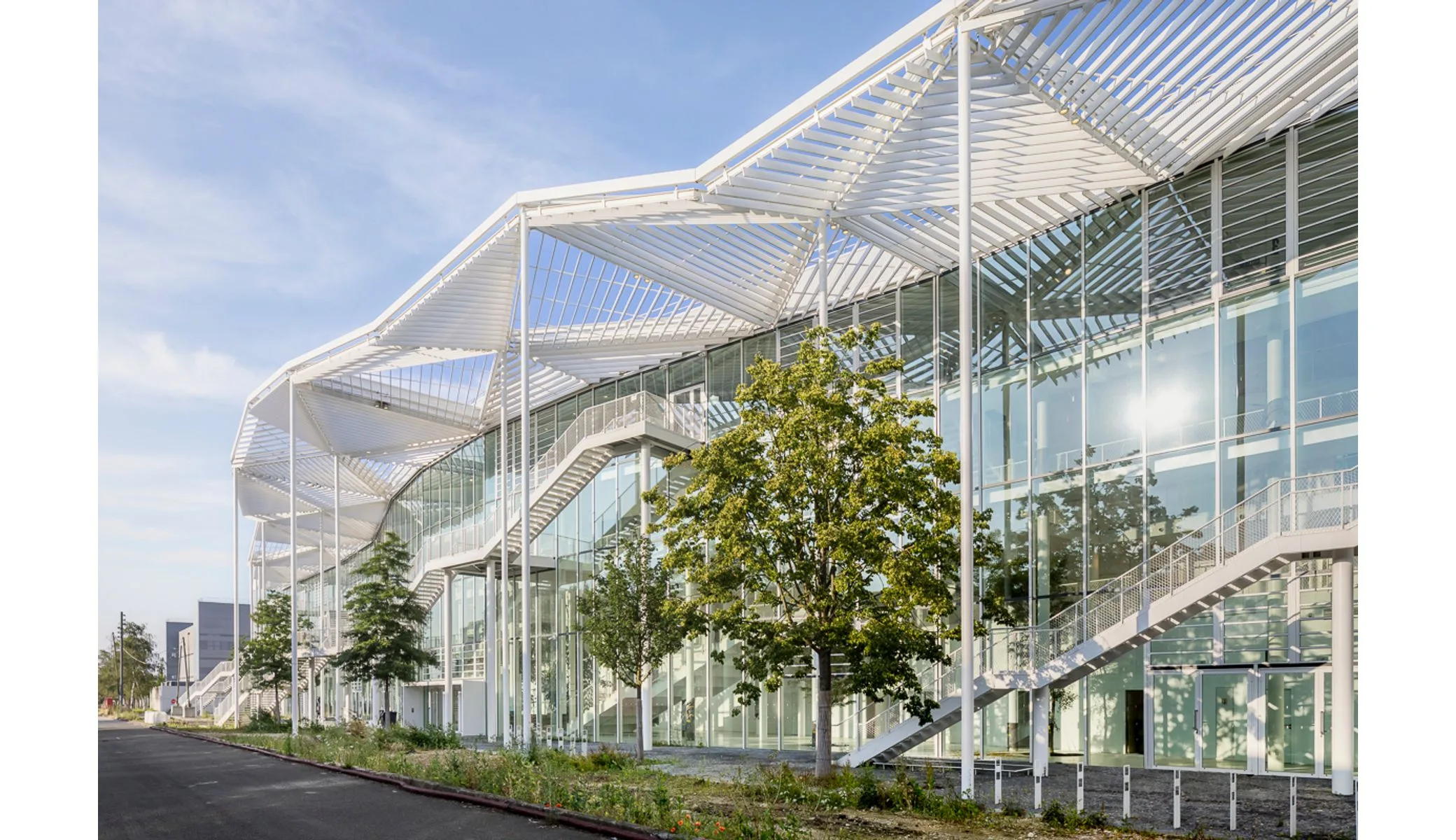
The site, at the heart of the École polytechnique's planned development zone, was characterized by its openness to the "green," a vast semi-wooded public space that structures the new district. We chose to **link the building to this landscape through a broad transparent facade oriented to the east**, creating permanent visual permeability between interior and exterior. The BEM does not close in on its uses, it exposes them, makes them readable from public space. This transparency is not gratuitous: it expresses a profound architectural conviction, that higher education must show itself, share itself, break down its barriers. The building thus becomes a showcase for academic activities, a place where knowledge in the making can be perceived.
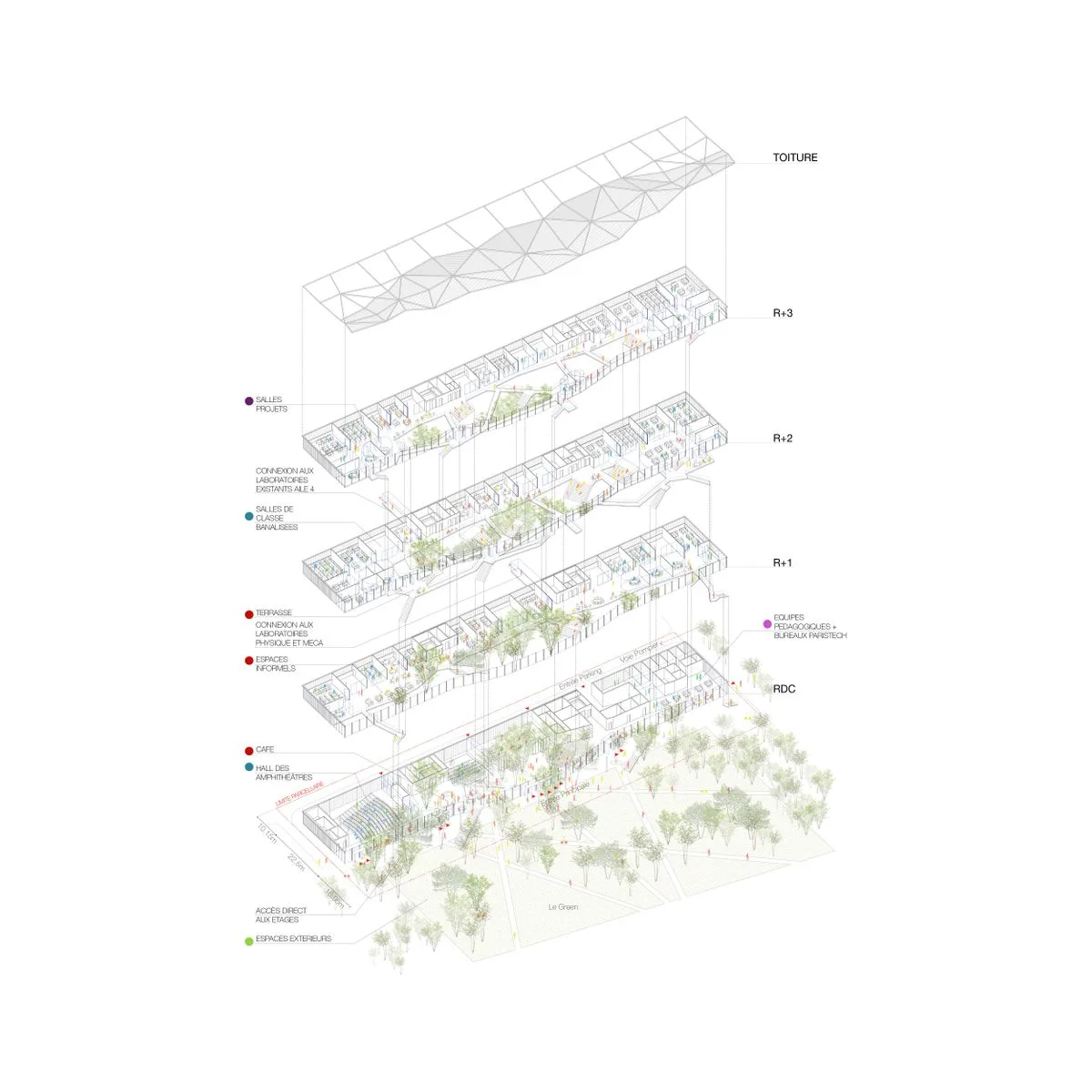
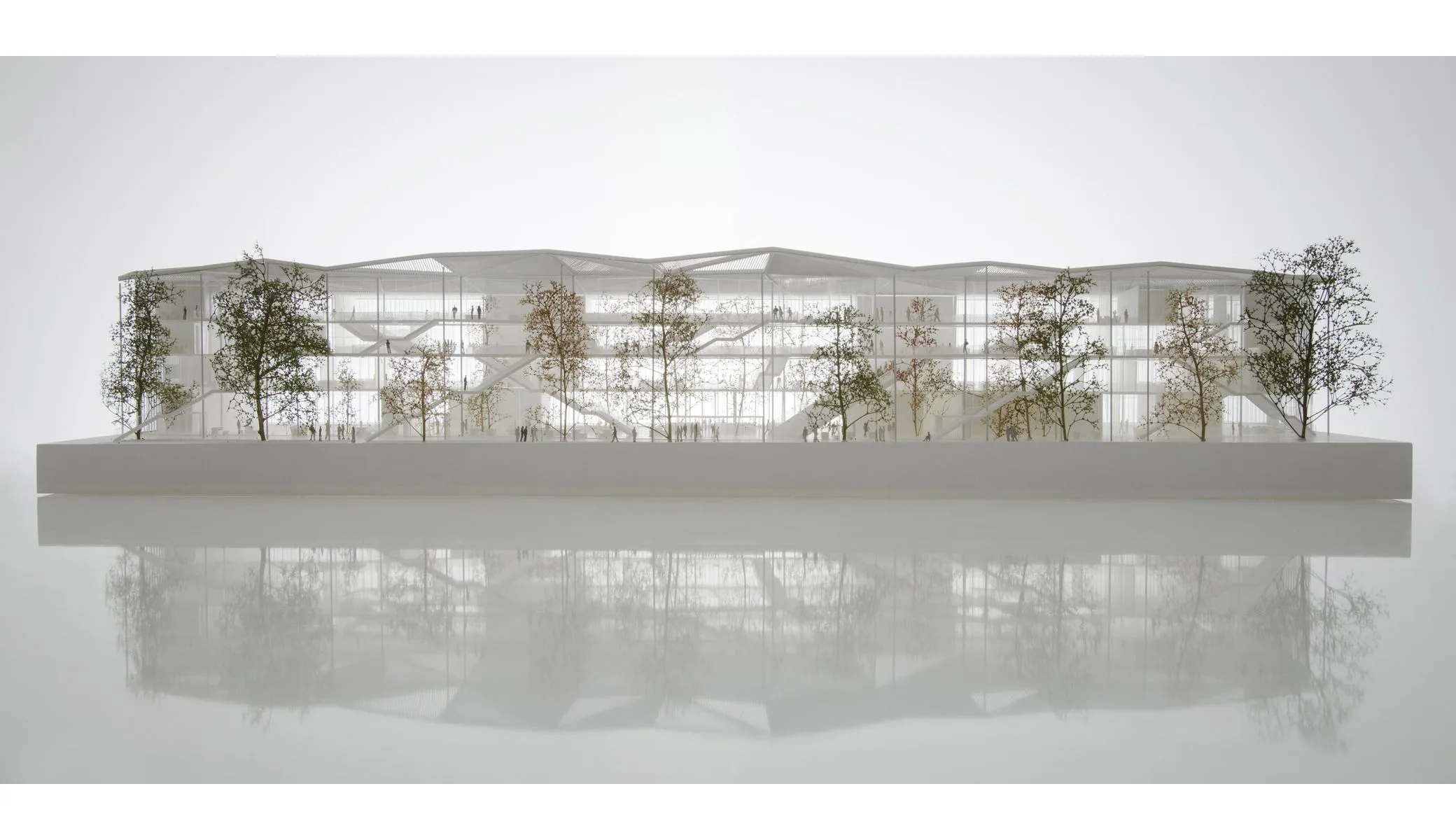
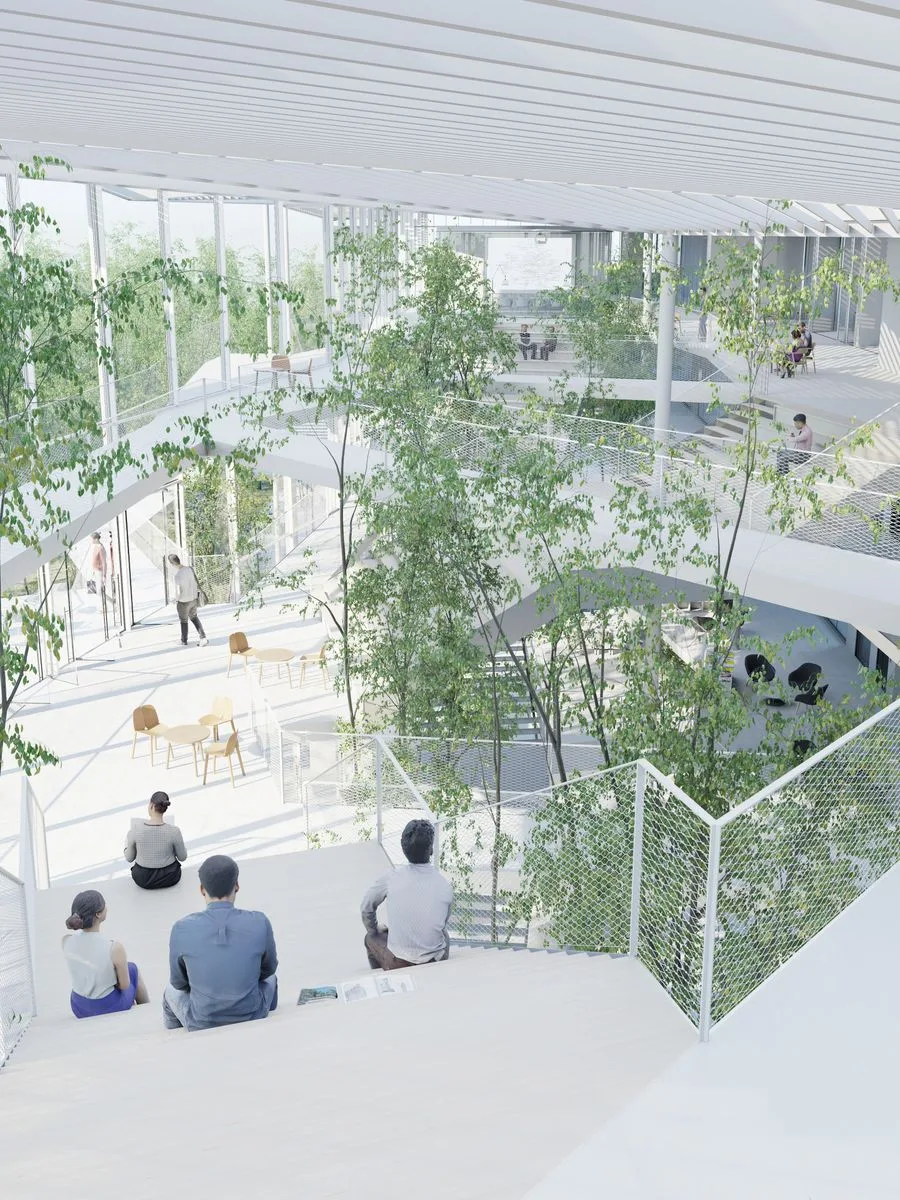
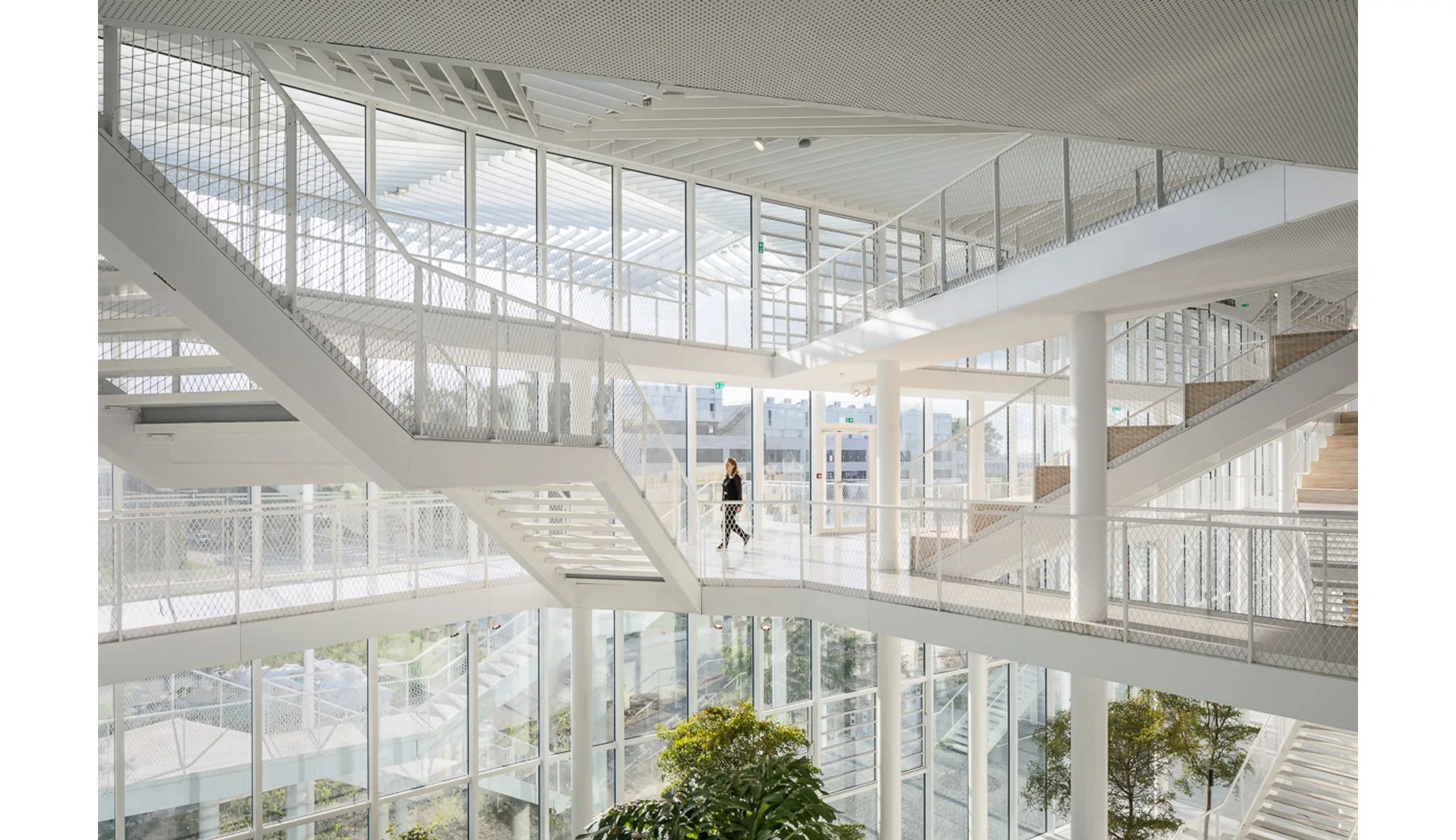
In plan, we organized the program around **inhabited platforms**, true "spontaneous amphitheaters" that exceed the simple function of circulation. These superimposed levels house amphitheaters, classrooms, informal work spaces, and communal areas. The central idea is to refuse the corridor, that neutral non-place that separates functions without ever truly connecting them. Here, people meet in **intermediate living spaces**, bathed in natural light, where students from different disciplines (engineers, agronomists, economists, physicists) share the same pause, reading, or discussion spaces. These platforms unfold in generous tiers, offering changing views of the surrounding landscape and other levels of the building. The interior spatiality thus fosters **informal exchanges**, those moments of academic serendipity where the most fruitful collaborations are born.
The collaboration with Sou Fujimoto, an architect whose work explores thresholds and in-betweens, profoundly nourished our reflection on programmatic ambiguity. Fujimoto often speaks of *the architecture of gradations*, of those spaces that are neither totally public nor totally private. This is exactly what we sought to produce here: places where **proximity and intimacy coexist**, where one can withdraw to work alone while remaining connected to the collective dynamic of the campus. The classrooms themselves are no longer closed boxes but partially glazed volumes, allowing visual continuity without compromising the acoustics necessary for teaching.
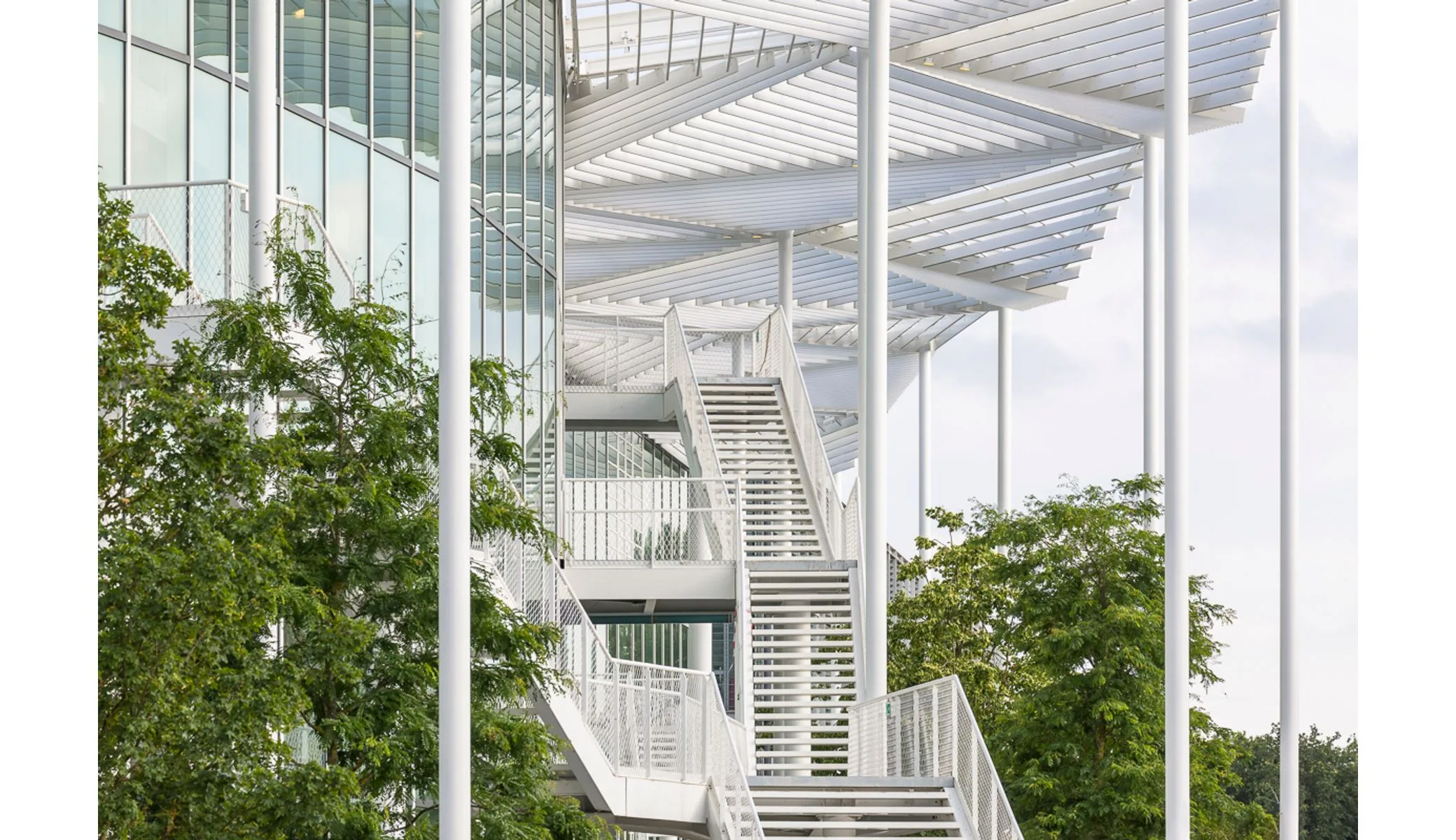
Materially, the project rests on a **mixed concrete and metal structural system**, which frees large spans and allows flexibility of floors. The facades combine clear glass and fine screen printing to modulate light input: we wanted a soft, diffuse light, never harsh, conducive to concentration. The exposed concrete floors inside assume their structural and thermal role, contributing to the building's inertia. The vertical circulation spaces, treated as sculpted volumes, become architectural objects in their own right, spatial punctuations that rhythm movement. Outside, landscaped walkways interweave with built volumes, creating **porosity between interior and exterior**, between built and landscape.
Environmentally, the BEM prefigures the BBC (Low Consumption Building) standards that would become the norm for public facilities in France. We favored natural cross-ventilation whenever possible, supplemented by double-flow in the denser zones. The thermal inertia of concrete floors smooths temperature peaks. Solar protections, integrated into the facade, limit summer overheating without resorting to intensive air conditioning. The roof, partially vegetated, manages part of the rainwater and contributes to campus biodiversity. This project, designed in 2013 and delivered ten years later in 2023, had to adapt to regulatory and technical developments that occurred during this decade. This long timeframe, unusual, allowed successive adjustments, a maturation of the project in contact with future users.
Today, the Shared Teaching Building functions as a **living academic platform**, a place where architecture actively supports the pedagogical mission. Students no longer simply attend classes in their home school: they traverse the building, discover other approaches, other disciplinary cultures. The BEM embodies this conviction we have always defended at OXO Architectes: **architecture is a tool for social transformation**. By organizing space in a certain way, by creating porosities, thresholds, intermediate places, we influence behaviors, we foster encounters, we make possible what was not before. Saclay is no longer a compartmentalized campus but an interconnected ecosystem, and the BEM is its beating heart.
The site, at the heart of the École polytechnique's planned development zone, was characterized by its openness to the "green," a vast semi-wooded public space that structures the new district. We chose to **link the building to this landscape through a broad transparent facade oriented to the east**, creating permanent visual permeability between interior and exterior. The BEM does not close in on its uses, it exposes them, makes them readable from public space. This transparency is not gratuitous: it expresses a profound architectural conviction, that higher education must show itself, share itself, break down its barriers. The building thus becomes a showcase for academic activities, a place where knowledge in the making can be perceived.
In plan, we organized the program around **inhabited platforms**, true "spontaneous amphitheaters" that exceed the simple function of circulation. These superimposed levels house amphitheaters, classrooms, informal work spaces, and communal areas. The central idea is to refuse the corridor, that neutral non-place that separates functions without ever truly connecting them. Here, people meet in **intermediate living spaces**, bathed in natural light, where students from different disciplines (engineers, agronomists, economists, physicists) share the same pause, reading, or discussion spaces. These platforms unfold in generous tiers, offering changing views of the surrounding landscape and other levels of the building. The interior spatiality thus fosters **informal exchanges**, those moments of academic serendipity where the most fruitful collaborations are born.
The collaboration with Sou Fujimoto, an architect whose work explores thresholds and in-betweens, profoundly nourished our reflection on programmatic ambiguity. Fujimoto often speaks of *the architecture of gradations*, of those spaces that are neither totally public nor totally private. This is exactly what we sought to produce here: places where **proximity and intimacy coexist**, where one can withdraw to work alone while remaining connected to the collective dynamic of the campus. The classrooms themselves are no longer closed boxes but partially glazed volumes, allowing visual continuity without compromising the acoustics necessary for teaching.
Materially, the project rests on a **mixed concrete and metal structural system**, which frees large spans and allows flexibility of floors. The facades combine clear glass and fine screen printing to modulate light input: we wanted a soft, diffuse light, never harsh, conducive to concentration. The exposed concrete floors inside assume their structural and thermal role, contributing to the building's inertia. The vertical circulation spaces, treated as sculpted volumes, become architectural objects in their own right, spatial punctuations that rhythm movement. Outside, landscaped walkways interweave with built volumes, creating **porosity between interior and exterior**, between built and landscape.
Environmentally, the BEM prefigures the BBC (Low Consumption Building) standards that would become the norm for public facilities in France. We favored natural cross-ventilation whenever possible, supplemented by double-flow in the denser zones. The thermal inertia of concrete floors smooths temperature peaks. Solar protections, integrated into the facade, limit summer overheating without resorting to intensive air conditioning. The roof, partially vegetated, manages part of the rainwater and contributes to campus biodiversity. This project, designed in 2013 and delivered ten years later in 2023, had to adapt to regulatory and technical developments that occurred during this decade. This long timeframe, unusual, allowed successive adjustments, a maturation of the project in contact with future users.
Today, the Shared Teaching Building functions as a **living academic platform**, a place where architecture actively supports the pedagogical mission. Students no longer simply attend classes in their home school: they traverse the building, discover other approaches, other disciplinary cultures. The BEM embodies this conviction we have always defended at OXO Architectes: **architecture is a tool for social transformation**. By organizing space in a certain way, by creating porosities, thresholds, intermediate places, we influence behaviors, we foster encounters, we make possible what was not before. Saclay is no longer a compartmentalized campus but an interconnected ecosystem, and the BEM is its beating heart.
- Lieu
- Saclay, France
- Nature
- ERP / ENSEIGNEMENT
- Surface
- 10 000 m²
- Budget
- 23 M€
- Concours
- 2013
- Livraison
- 2023
- MOA
- École Polytechnique
- Co-architectes
- Sou Fujimoto Architects, Nicolas Laisné, DREAM