Arbalète
Choosing to settle in a city like Paris, regulated and homogeneous from an architectural point of view, while proposing an object that is unique from this perspective, inevitably raises questions of integration and impact on the urban landscape. In Paris, our relationship to urban space changes and differs from other cities. The relentless constancy displayed by Parisian facades pushes us toward inattention. As strollers, we enter a state of architectural unconsciousness, enveloped in a uniform and continuous fabric. We only emerge from this vegetative state when, by chance, our gaze falls upon a roughness, an exceptional object, or a change of rhythm in the score of Parisian facades.
# Arbalète
Choosing to settle in a city like Paris, regulated and homogeneous from an architectural point of view, while proposing an object that is unique from this perspective, inevitably raises questions of integration and impact on the urban landscape. In Paris, our relationship to urban space changes and differs from other cities. The relentless constancy displayed by Parisian facades pushes us toward inattention. As strollers, we enter a state of architectural unconsciousness, enveloped in a uniform and continuous fabric. We only emerge from this vegetative state when, by chance, our gaze falls upon a roughness, an exceptional object, or a change of rhythm in the score of Parisian facades.
Unconsciousness then gives way to surprise, to contemplation. It is precisely this moment of shift that interests us. How do we provoke this attention without brutally breaking with the context? How do we create the singular in the ordinary, the memorable in the everyday? The rue de l'Arbalète, with its gap tooth, offers us this rare opportunity to reinscribe a fragment of urbanity in a dense and stratified neighborhood, where each architectural gesture engages a responsibility toward human scale and the history of the place.
With this project, we wish to propose a similar urban and inhabited experience, in harmony with this particular environment. Our ambition is to install on this parcel a singular project that intrigues and amazes while preserving the intimacy of its dwellings. It is not about making a gratuitous gesture, but about weaving a dialogue between **the rule and the exception**, between the permanence of the Haussmannian fabric and the necessity of a contemporary architecture that assumes its presence. The project must assert itself without arrogance, distinguish itself without ostentation.
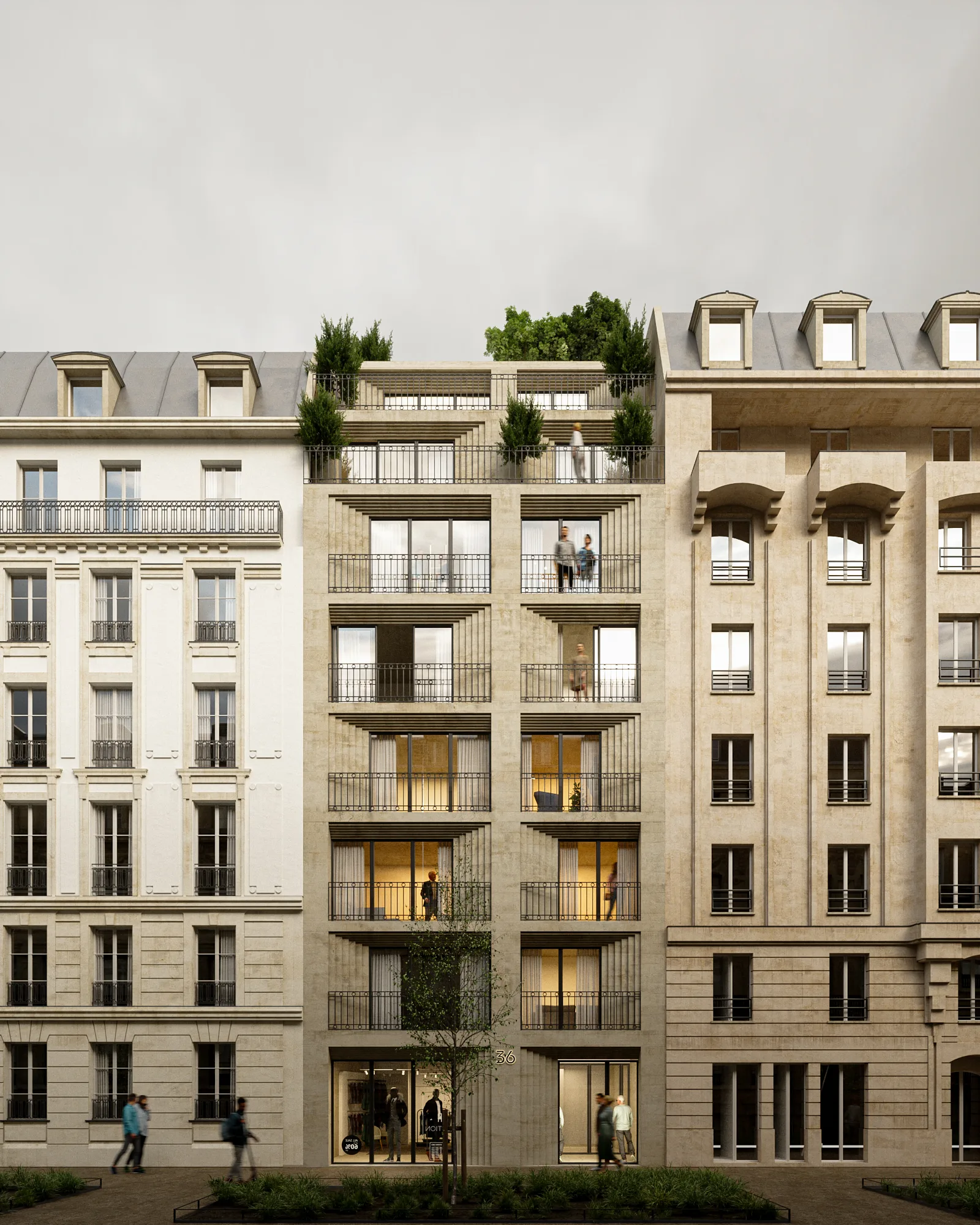
It is of course appropriate not to stray from the traditional writing of Parisian buildings, but rather to reinterpret it in order to offer a new perception of it. We do not seek to mimic the past or to produce a pastiche. What interests us is understanding the deep logics of the Parisian facade: its verticality, its relationships of solids and voids, its moldings, its horizontal rhythms, the hierarchy of its floors. From this inherited grammar, we propose a **contemporary reinterpretation** that preserves proportions while exploring new material and spatial expressions.
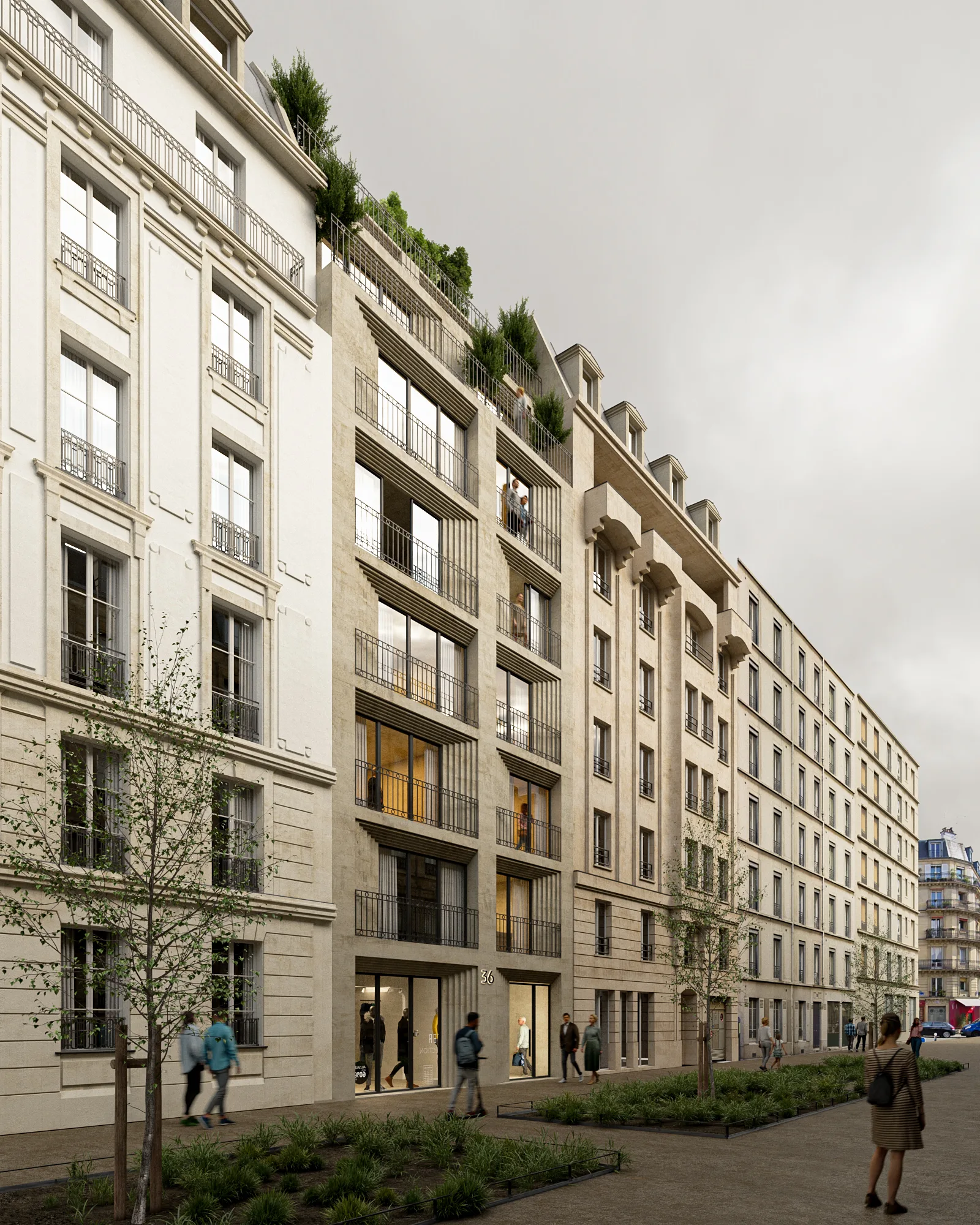
Fine and coherent work on the facade is then necessary, whether in the choice of materials, its design, or its proportional relationships. Every element counts. The modest dimension of the parcel accentuates this requirement: nothing can be left to chance. The facade becomes a multi-scale system, readable from afar as a sober and unitary volume, and revealing up close a tactile and spatial complexity. This articulation between urban scale and domestic scale structures our entire approach.
In a logic of integration into the urban universe of the capital, we have chosen quality materials, in the lineage of Haussmannian buildings. Stone has been at the center of our reflection. But this is not ordinary stone: we have worked on the idea of a **sculpted monolith**, a homogeneous volume whose material would be simultaneously structure, envelope, and ornament. Imagining the project as a block of stone worked with intelligence and finesse has become a strong guiding line of our proposal. Stone is not here an applied cladding, but a material that carries thickness, depth, memory.
This materiality calls for a specific implementation. We have imagined **perforated stone panels** that generate a second skin, filtering light, ensuring the intimacy of interior spaces while offering inhabitants framed views of the street. These panels, through their thickness and geometric design, create plays of shadows and lights that evolve throughout the day. They give the building its own life, a sensitive presence that escapes the fixity of the image. This controlled porosity also allows us to respond to thermal issues, regulating solar gain without resorting to added technical devices.
We also wish to bring more nature into the city. It seems right to us that today everyone should have direct access to nature in an urban environment, even in a context as dense as the fifth arrondissement. The question is not limited to vegetal ornament: it engages a reflection on quality of life, the relationship to the outside, the necessary breathing space of habitat. This is why we have conceived the exterior elements of the main facade as vegetation supports. The perforated stone panels, through their relief and interstices, are conducive to the attachment and development of certain climbing plants. The balconies of the upper floors will accommodate planted flower boxes, creating microclimates and breathing spaces for the inhabitants.
The roof, entirely vegetated and accessible, extends this ambition. It does not merely serve as an invisible fifth floor: it becomes a **shared garden**, a common space that enriches the use of the building and participates in rainwater management, thermal regulation, and urban biodiversity. In an arrondissement where free space is counted by the square meter, this roof offers a rare luxury: that of a direct relationship to the sky, a collective breathing space, a possible appropriation of common space.
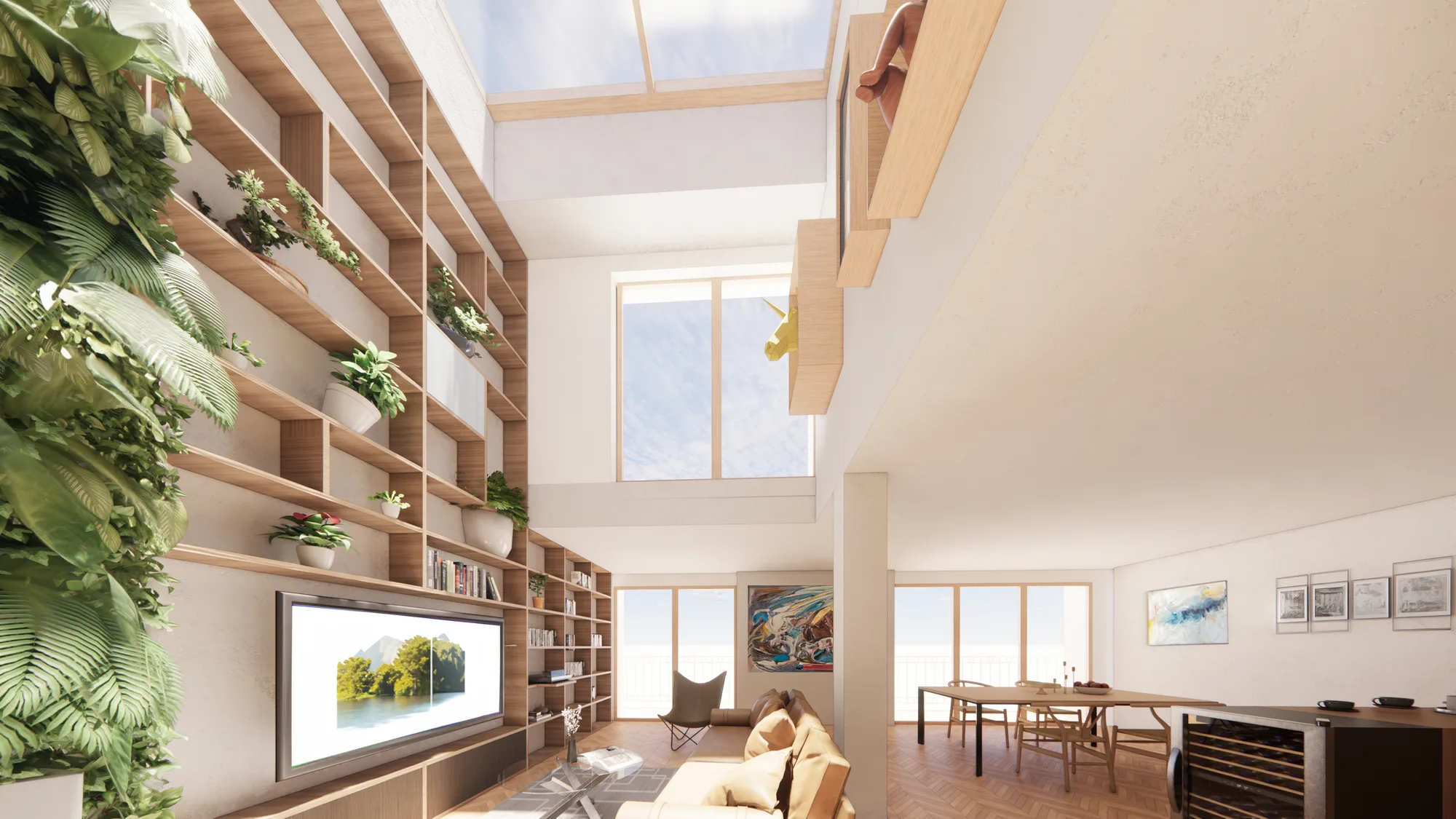
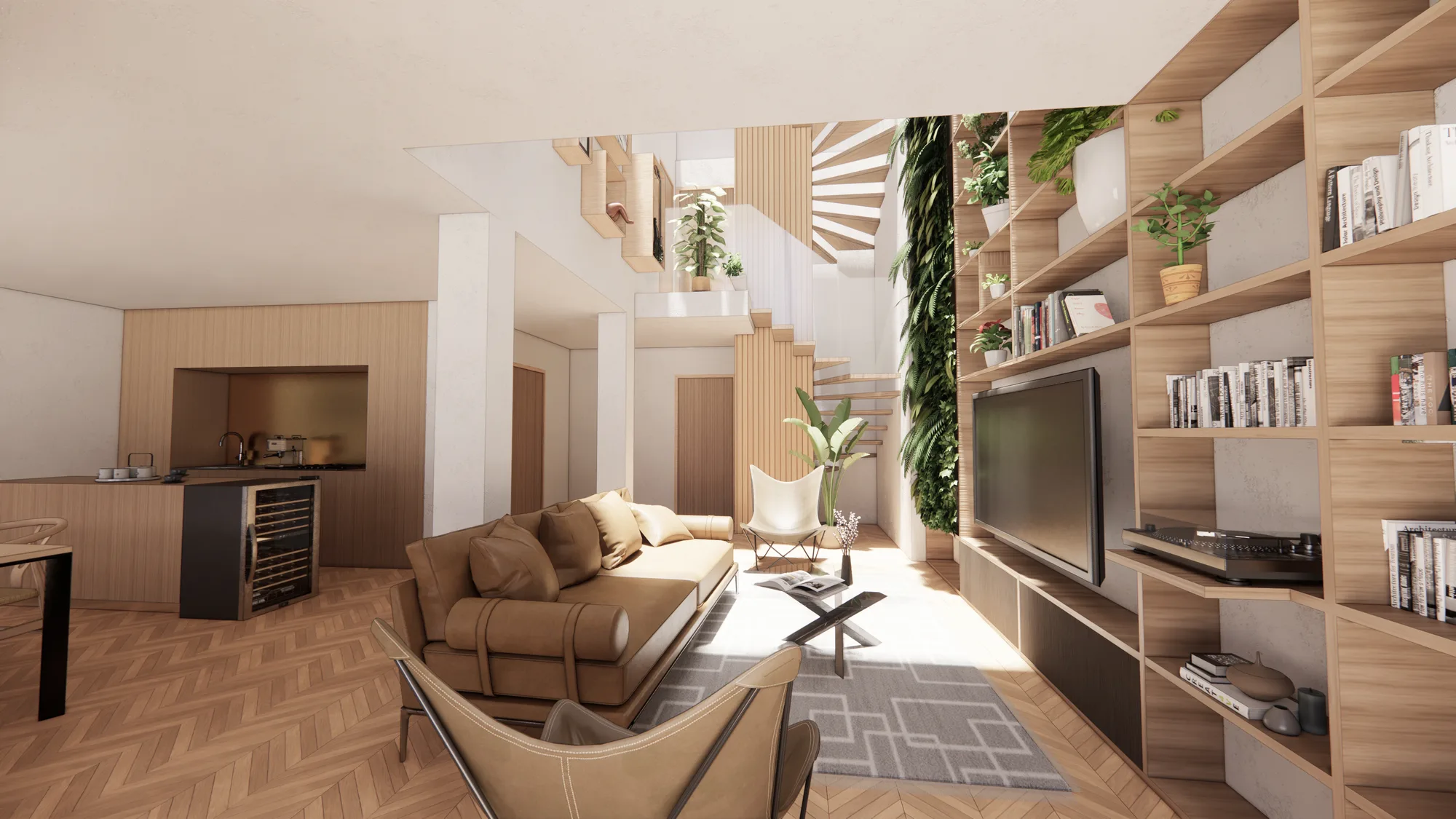
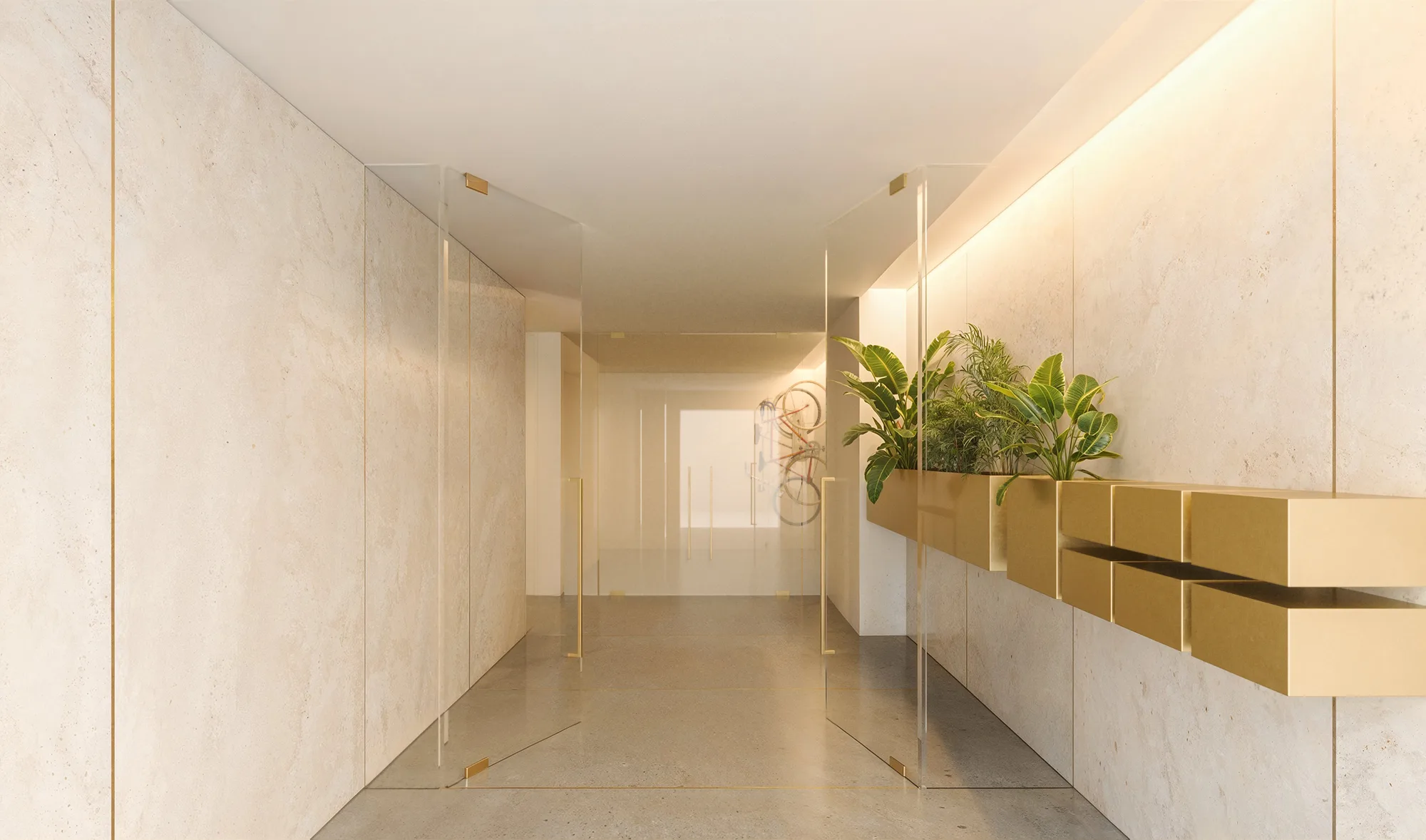
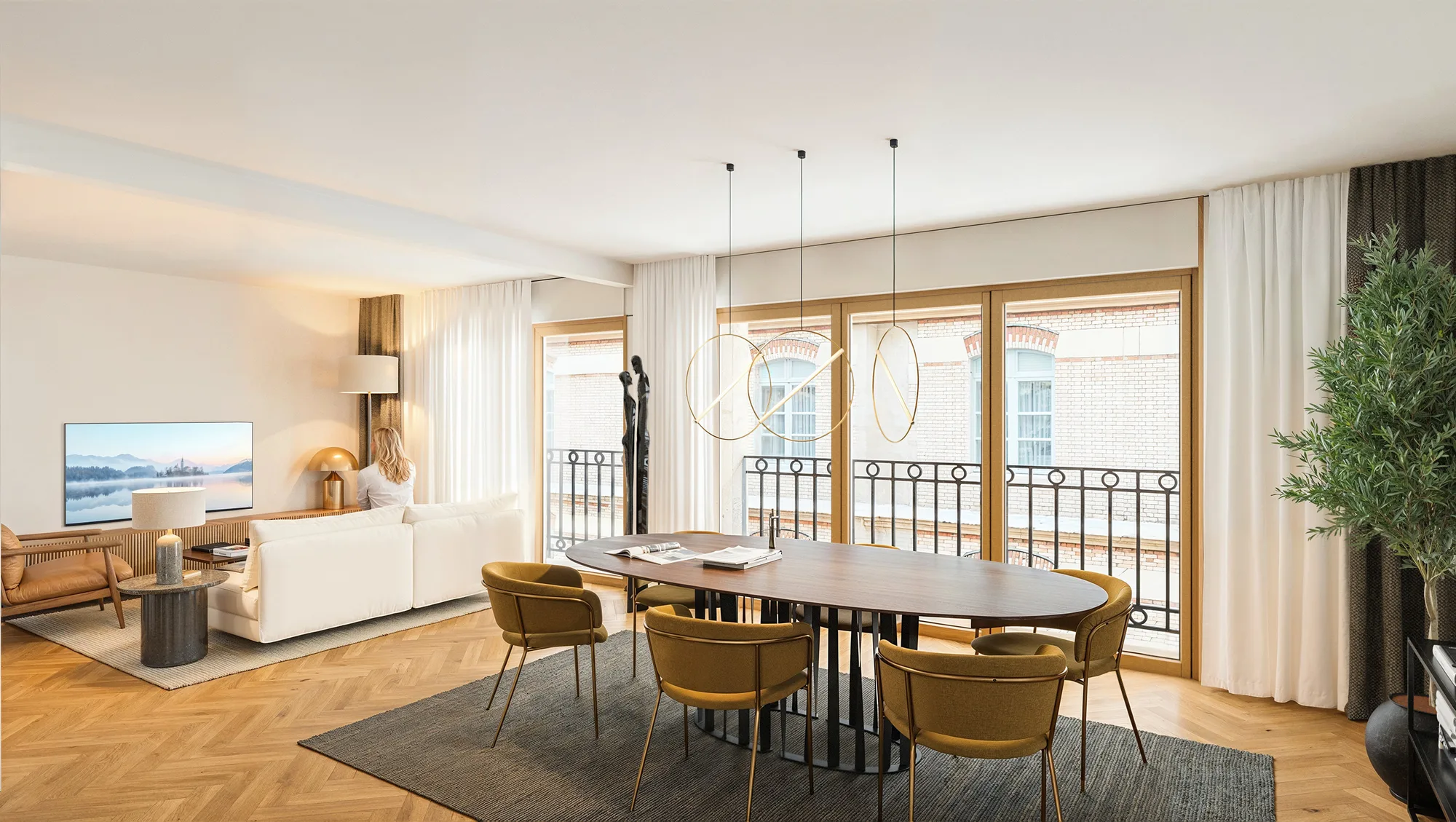
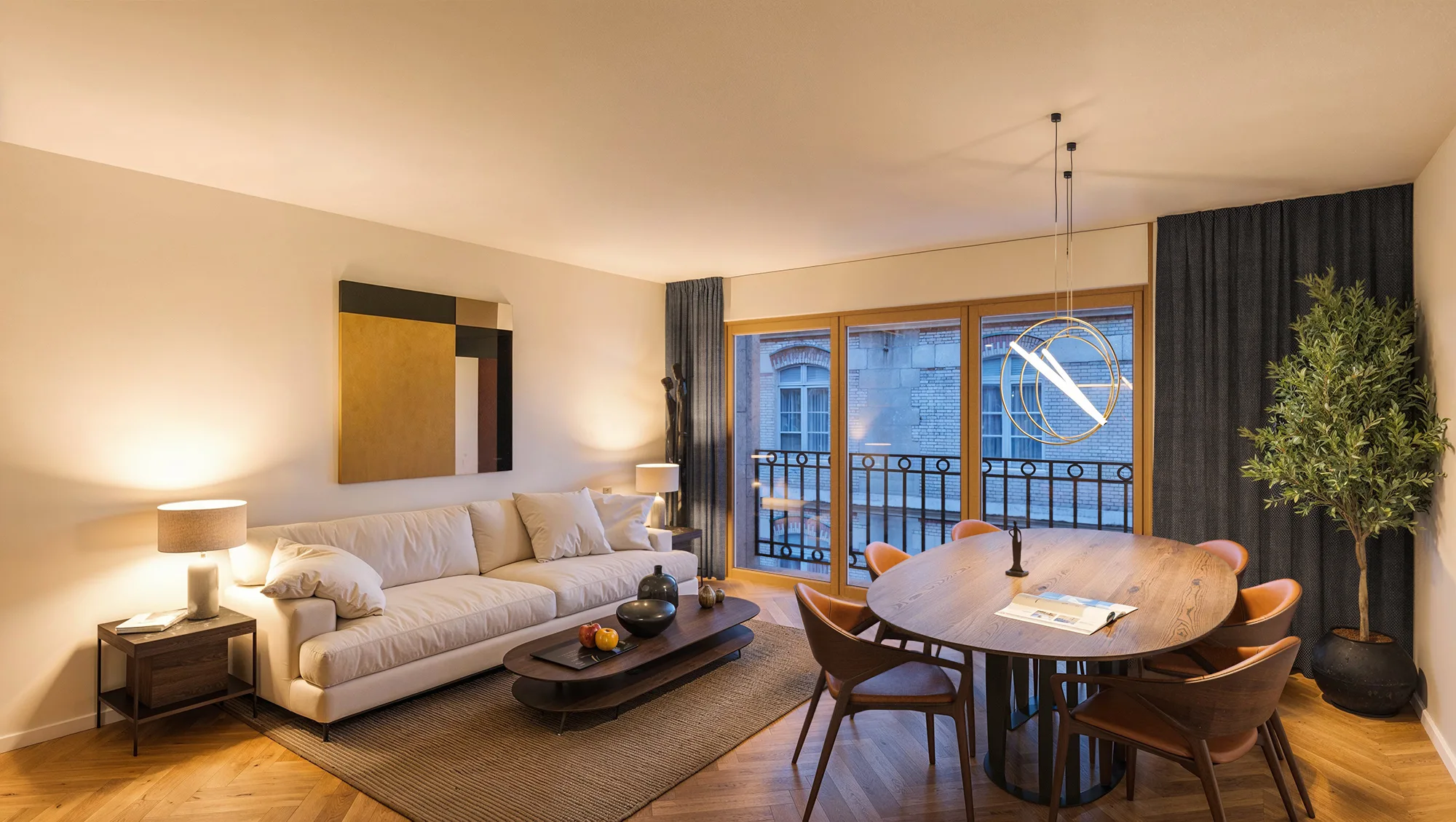
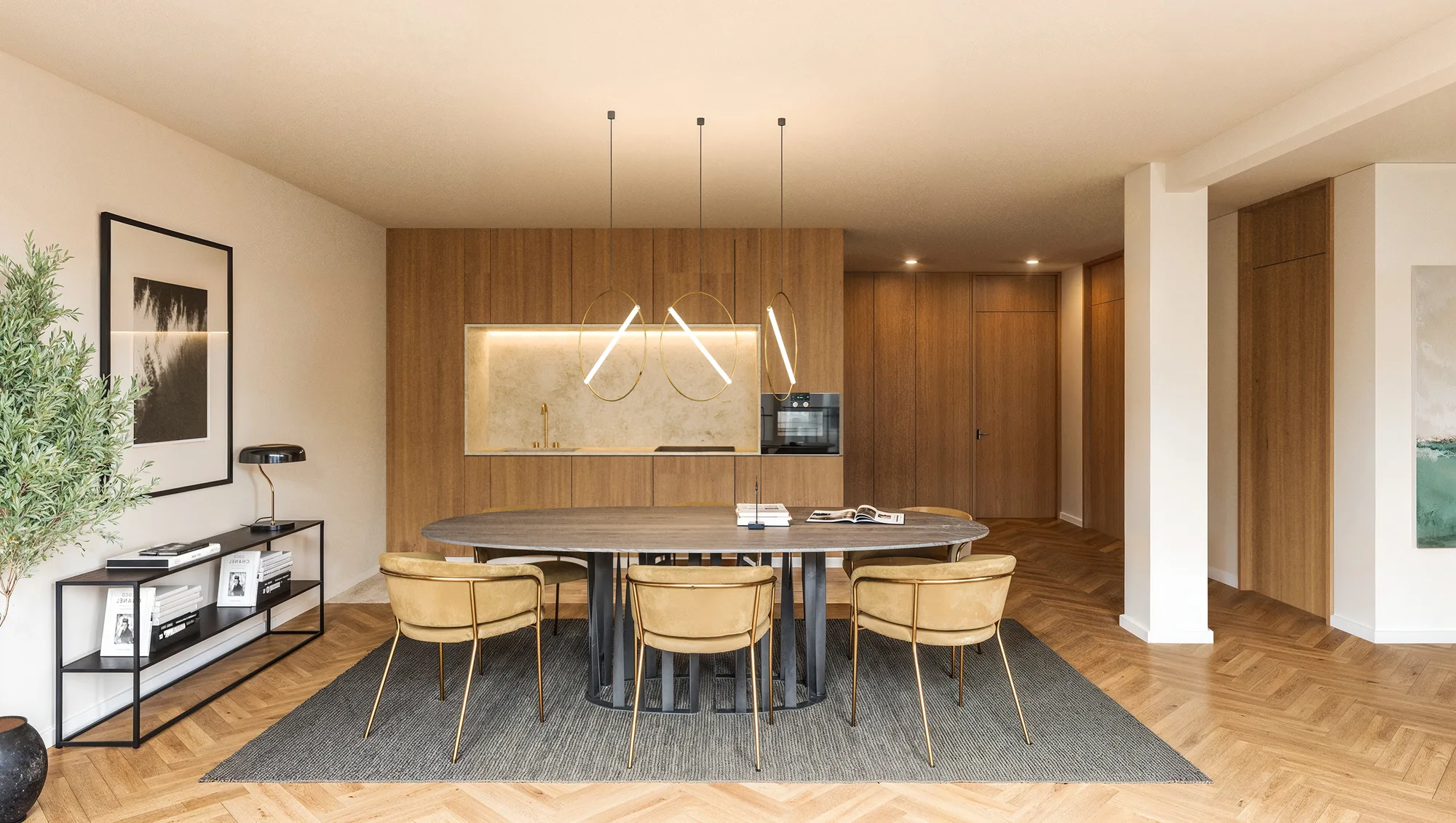
The interior organization of the dwellings responds to this same requirement of spatial quality. Despite the modesty of the parcel, we have sought to offer generous spaces, bathed in light, cross-ventilated when possible, always in relation to the exterior. The exterior extensions, balconies or loggias protected by the perforated panels, become natural extensions of the living room, intermediate spaces neither quite inside nor quite outside. These thick thresholds enrich the experience of dwelling, offering filters, refuges, observation posts on the city.
The Arbalète project, although inserted into a constrained urban fabric, allows us to explore questions that exceed its modest dimension. How does material sculpt space? How can contemporary ornament reconnect with a tradition without mechanically reproducing it? How can vegetation be structurally inscribed in the design of a Parisian building, and not as a cosmetic addition? It is these questions, embodied in a precise architectural object, that make the project a living, habitable, and memorable fragment of the city.
Choosing to settle in a city like Paris, regulated and homogeneous from an architectural point of view, while proposing an object that is unique from this perspective, inevitably raises questions of integration and impact on the urban landscape. In Paris, our relationship to urban space changes and differs from other cities. The relentless constancy displayed by Parisian facades pushes us toward inattention. As strollers, we enter a state of architectural unconsciousness, enveloped in a uniform and continuous fabric. We only emerge from this vegetative state when, by chance, our gaze falls upon a roughness, an exceptional object, or a change of rhythm in the score of Parisian facades.
Unconsciousness then gives way to surprise, to contemplation. It is precisely this moment of shift that interests us. How do we provoke this attention without brutally breaking with the context? How do we create the singular in the ordinary, the memorable in the everyday? The rue de l'Arbalète, with its gap tooth, offers us this rare opportunity to reinscribe a fragment of urbanity in a dense and stratified neighborhood, where each architectural gesture engages a responsibility toward human scale and the history of the place.
With this project, we wish to propose a similar urban and inhabited experience, in harmony with this particular environment. Our ambition is to install on this parcel a singular project that intrigues and amazes while preserving the intimacy of its dwellings. It is not about making a gratuitous gesture, but about weaving a dialogue between **the rule and the exception**, between the permanence of the Haussmannian fabric and the necessity of a contemporary architecture that assumes its presence. The project must assert itself without arrogance, distinguish itself without ostentation.
It is of course appropriate not to stray from the traditional writing of Parisian buildings, but rather to reinterpret it in order to offer a new perception of it. We do not seek to mimic the past or to produce a pastiche. What interests us is understanding the deep logics of the Parisian facade: its verticality, its relationships of solids and voids, its moldings, its horizontal rhythms, the hierarchy of its floors. From this inherited grammar, we propose a **contemporary reinterpretation** that preserves proportions while exploring new material and spatial expressions.
Fine and coherent work on the facade is then necessary, whether in the choice of materials, its design, or its proportional relationships. Every element counts. The modest dimension of the parcel accentuates this requirement: nothing can be left to chance. The facade becomes a multi-scale system, readable from afar as a sober and unitary volume, and revealing up close a tactile and spatial complexity. This articulation between urban scale and domestic scale structures our entire approach.
In a logic of integration into the urban universe of the capital, we have chosen quality materials, in the lineage of Haussmannian buildings. Stone has been at the center of our reflection. But this is not ordinary stone: we have worked on the idea of a **sculpted monolith**, a homogeneous volume whose material would be simultaneously structure, envelope, and ornament. Imagining the project as a block of stone worked with intelligence and finesse has become a strong guiding line of our proposal. Stone is not here an applied cladding, but a material that carries thickness, depth, memory.
This materiality calls for a specific implementation. We have imagined **perforated stone panels** that generate a second skin, filtering light, ensuring the intimacy of interior spaces while offering inhabitants framed views of the street. These panels, through their thickness and geometric design, create plays of shadows and lights that evolve throughout the day. They give the building its own life, a sensitive presence that escapes the fixity of the image. This controlled porosity also allows us to respond to thermal issues, regulating solar gain without resorting to added technical devices.
We also wish to bring more nature into the city. It seems right to us that today everyone should have direct access to nature in an urban environment, even in a context as dense as the fifth arrondissement. The question is not limited to vegetal ornament: it engages a reflection on quality of life, the relationship to the outside, the necessary breathing space of habitat. This is why we have conceived the exterior elements of the main facade as vegetation supports. The perforated stone panels, through their relief and interstices, are conducive to the attachment and development of certain climbing plants. The balconies of the upper floors will accommodate planted flower boxes, creating microclimates and breathing spaces for the inhabitants.
The roof, entirely vegetated and accessible, extends this ambition. It does not merely serve as an invisible fifth floor: it becomes a **shared garden**, a common space that enriches the use of the building and participates in rainwater management, thermal regulation, and urban biodiversity. In an arrondissement where free space is counted by the square meter, this roof offers a rare luxury: that of a direct relationship to the sky, a collective breathing space, a possible appropriation of common space.
The interior organization of the dwellings responds to this same requirement of spatial quality. Despite the modesty of the parcel, we have sought to offer generous spaces, bathed in light, cross-ventilated when possible, always in relation to the exterior. The exterior extensions, balconies or loggias protected by the perforated panels, become natural extensions of the living room, intermediate spaces neither quite inside nor quite outside. These thick thresholds enrich the experience of dwelling, offering filters, refuges, observation posts on the city.
The Arbalète project, although inserted into a constrained urban fabric, allows us to explore questions that exceed its modest dimension. How does material sculpt space? How can contemporary ornament reconnect with a tradition without mechanically reproducing it? How can vegetation be structurally inscribed in the design of a Parisian building, and not as a cosmetic addition? It is these questions, embodied in a precise architectural object, that make the project a living, habitable, and memorable fragment of the city.
- Lieu
- Paris, France
- Nature
- Logements
- Surface
- 681 m²
- MOA
- Globalstone