
Le Rocher
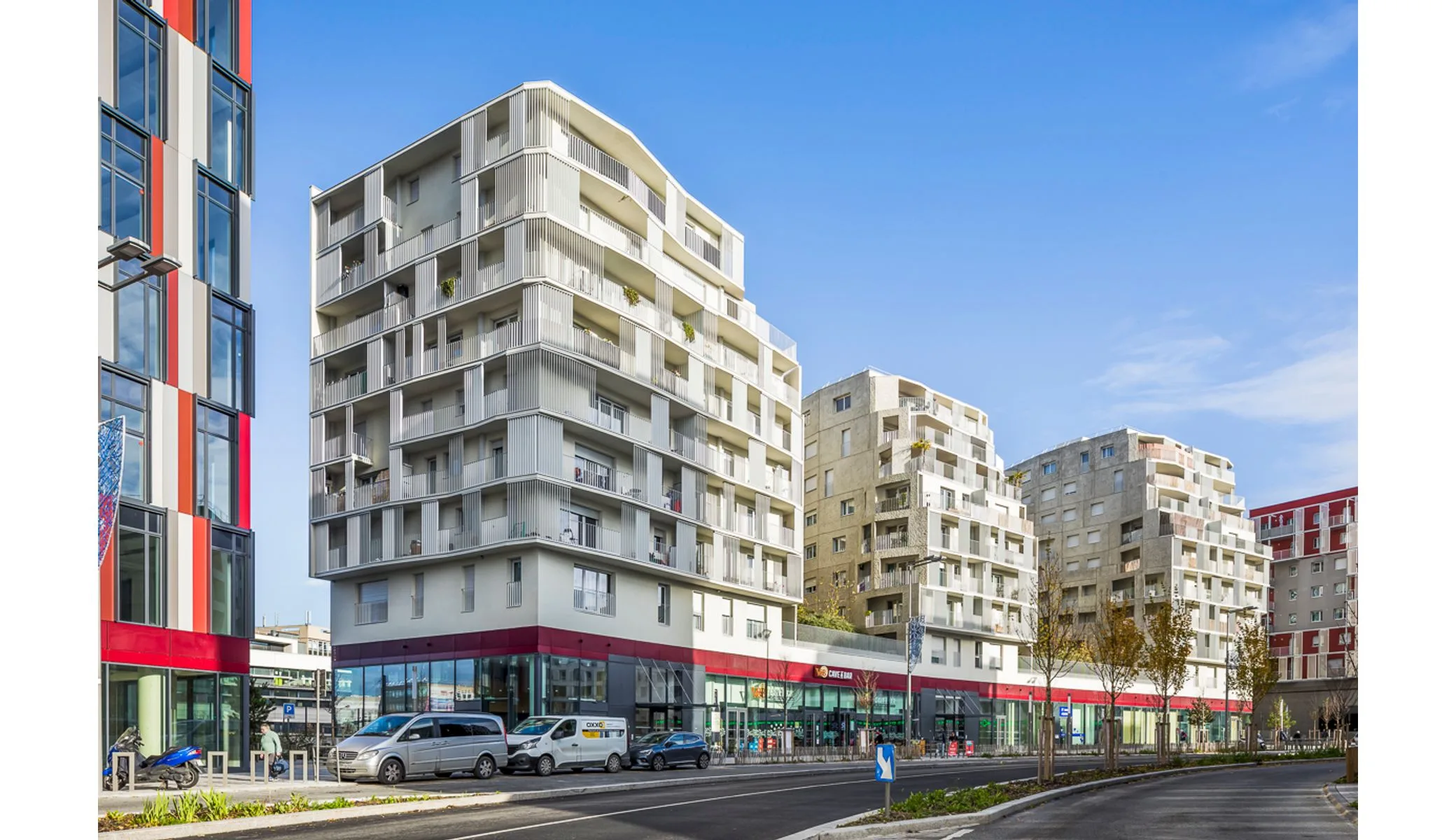
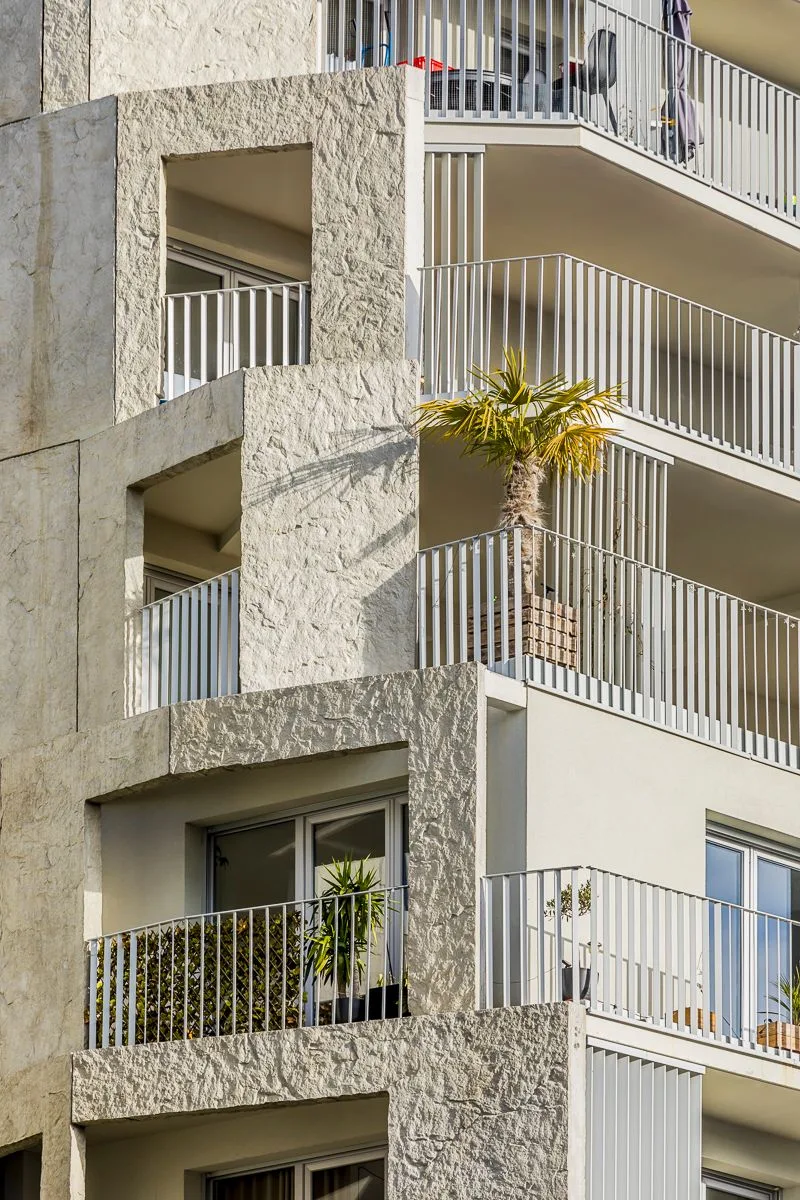
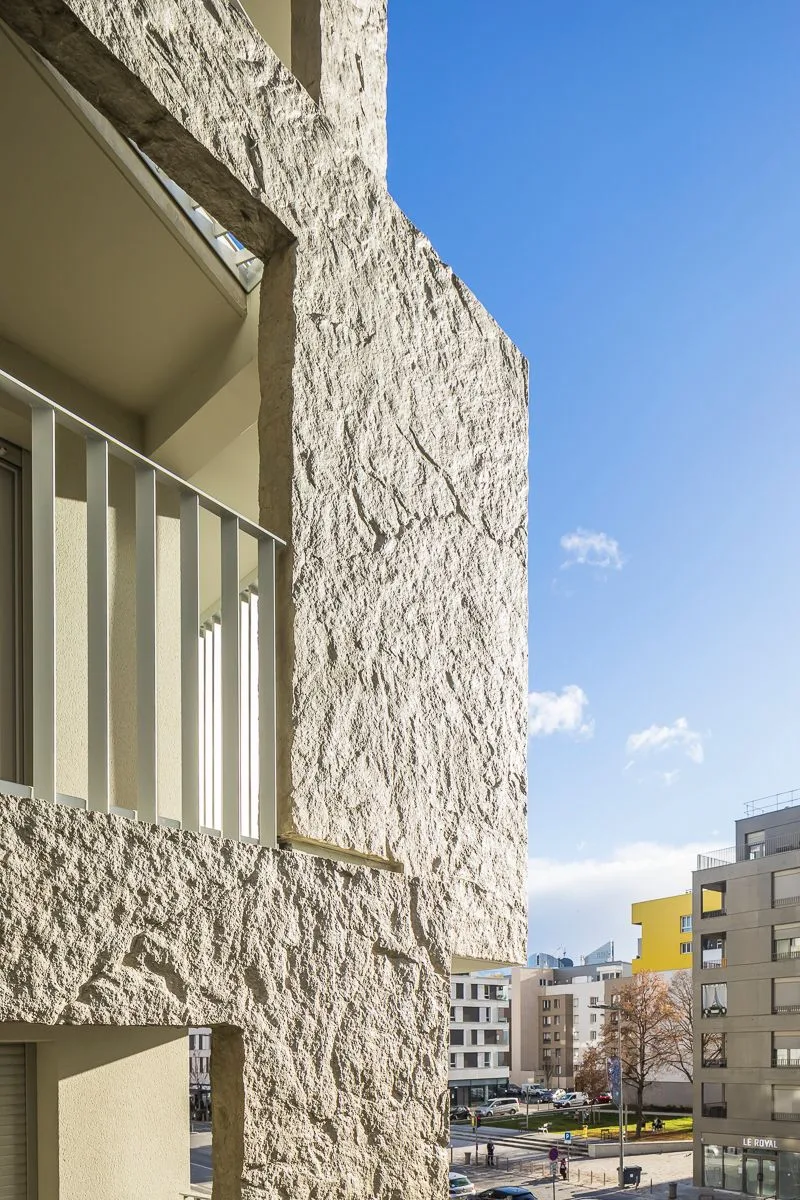
A morning glow illuminates this large white rock with its yellow hue, emphasizing its fractures, caressing its material. Nature has taken over its summit and lichen has slipped into the interstices of its faults, creating a vegetal universe at the heart of this mineral mass whose presence gives residents the sensation of living in a veritable rock. This housing program is organized around two planted courtyard hearts, interiorized nature spaces, detaching three separate volumes backed against the railway line.
# Le Rocher
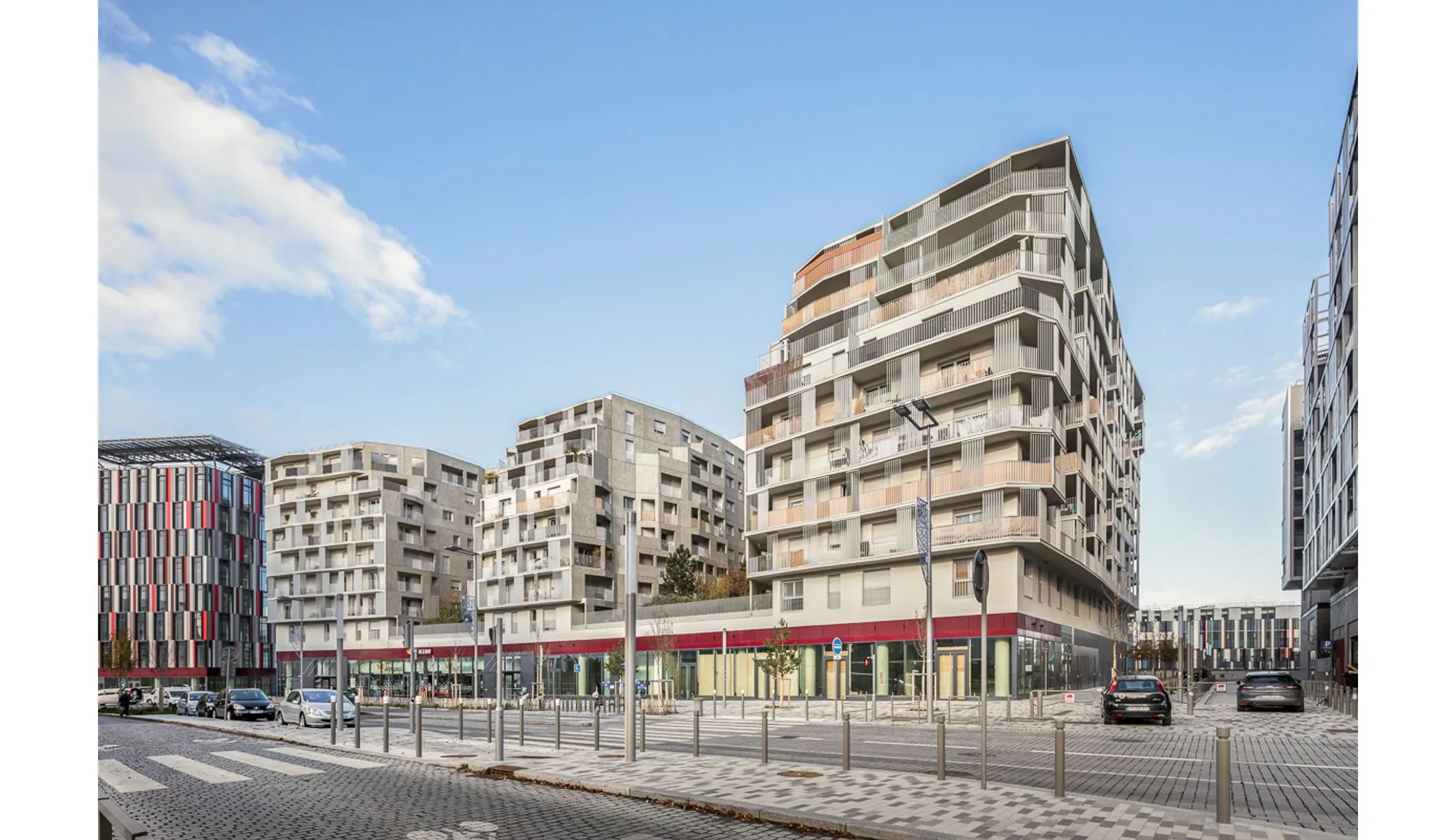
In Nanterre, in immediate contact with the railway line and Boulevard des Provinces Françaises, we conceived Le Rocher as an architectural project that questions **mineral material** and **volume sculpture**, while responding to the acoustic and urban constraints of a complex site. This 10,870 m² program, comprising 157 housing units and ground-floor commercial spaces, is part of a reflection on the transformation of a neighborhood in transition, where Paris Nanterre University and railway infrastructures sketch a hybrid landscape, at once urban and technical.
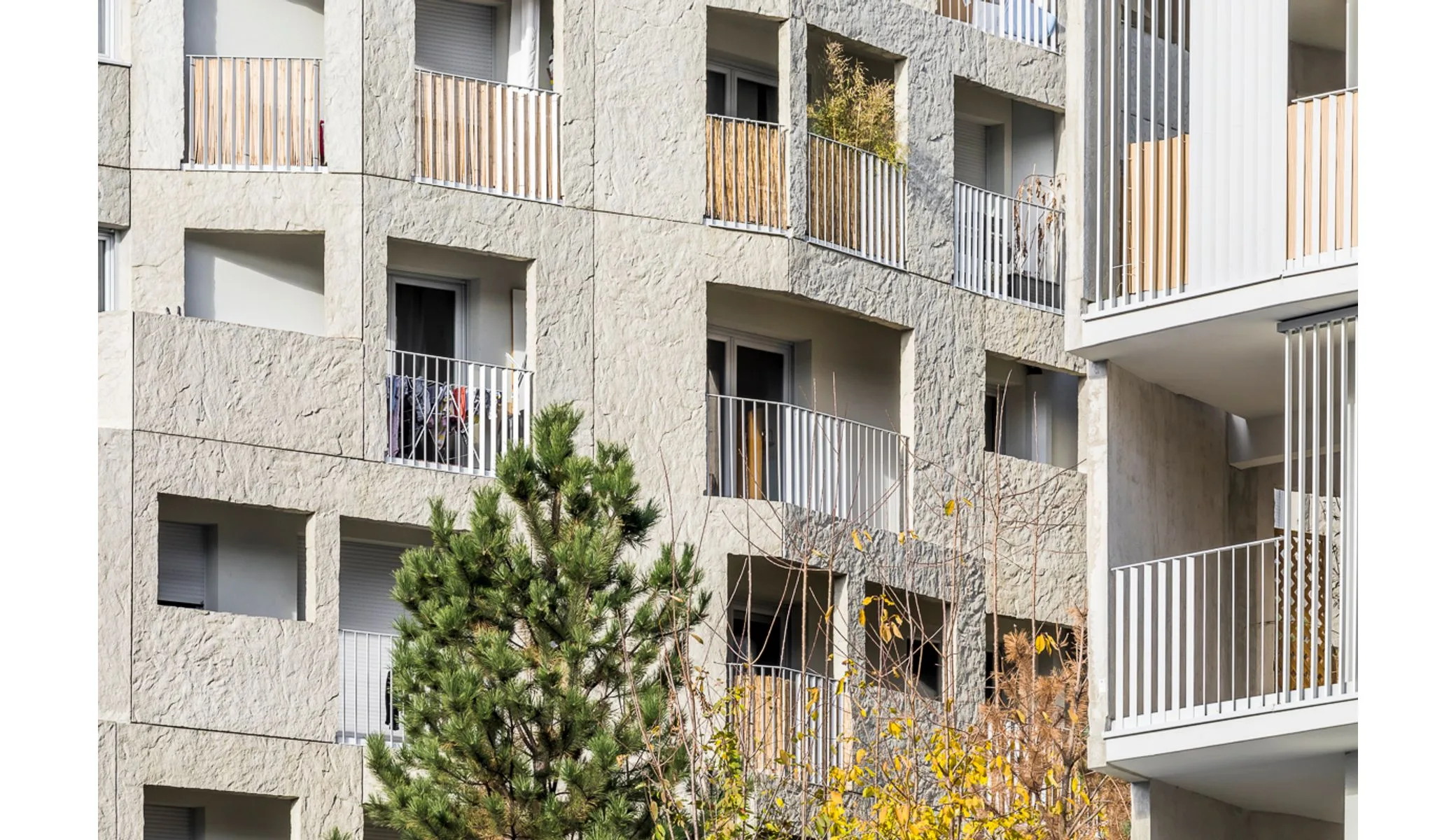
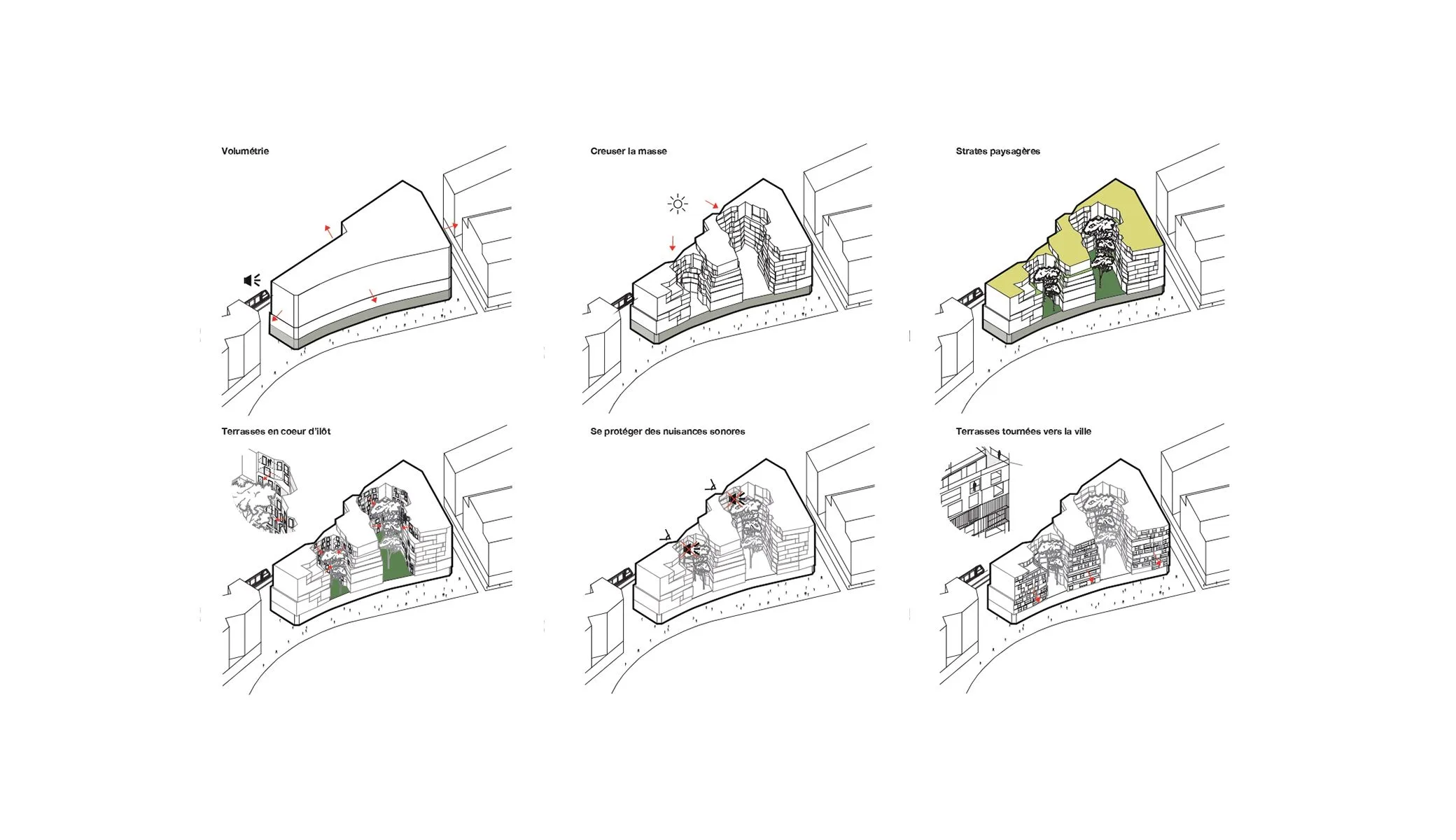
The project takes its name from its **monolithic form**, which evokes the gypsum blocks extracted from the quarries of Cormeilles-en-Parisis, located just a few kilometers away. This geological reference is not anecdotal: it anchors the building in the industrial and natural history of the territory, while proposing a contemporary reading of the built mass. We wanted to create a large white, compact volume, whose faults and fractures reveal a **sculpted architecture**, as if the building had been hollowed out, torn away, carved from a unitary block.
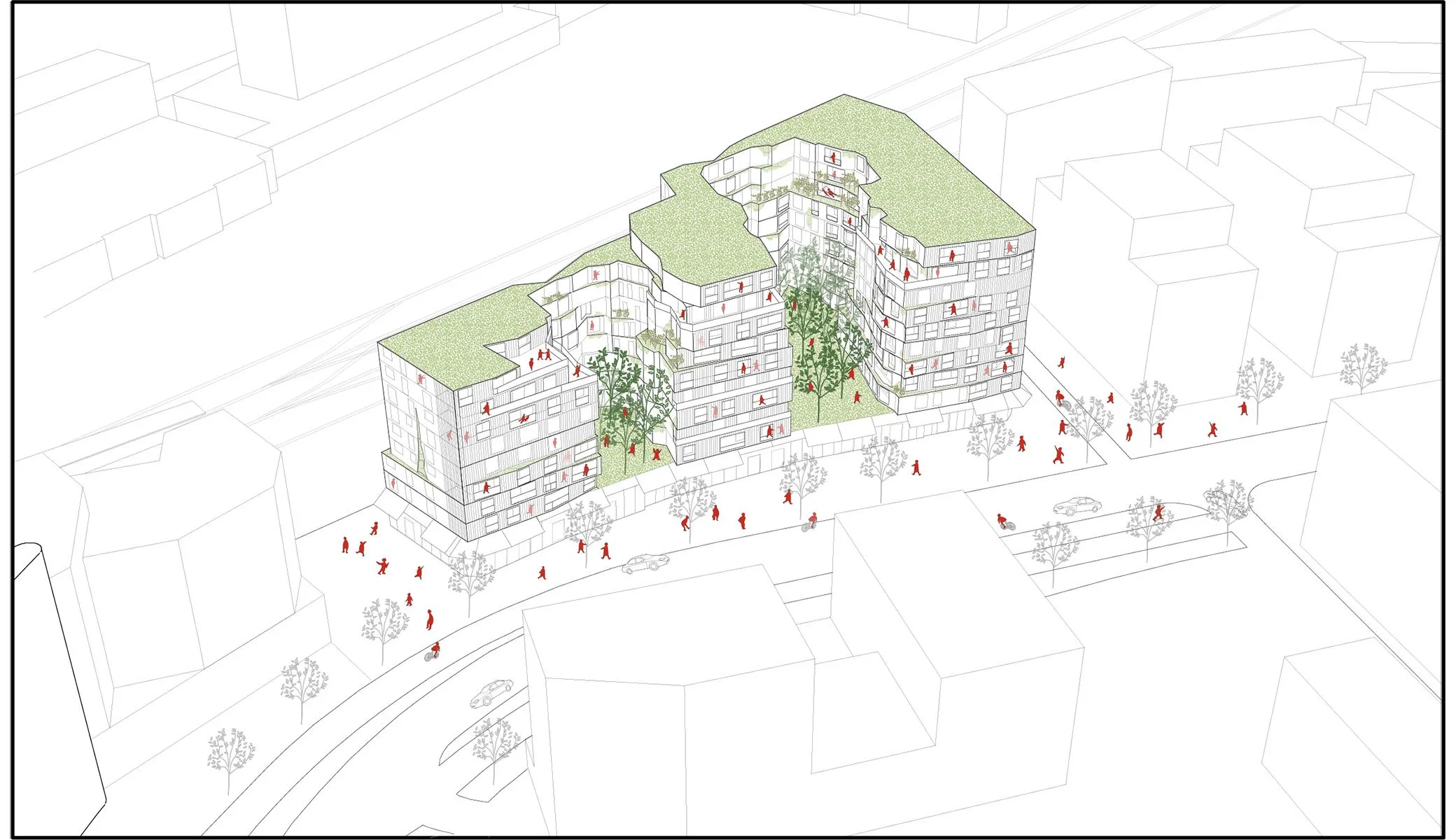
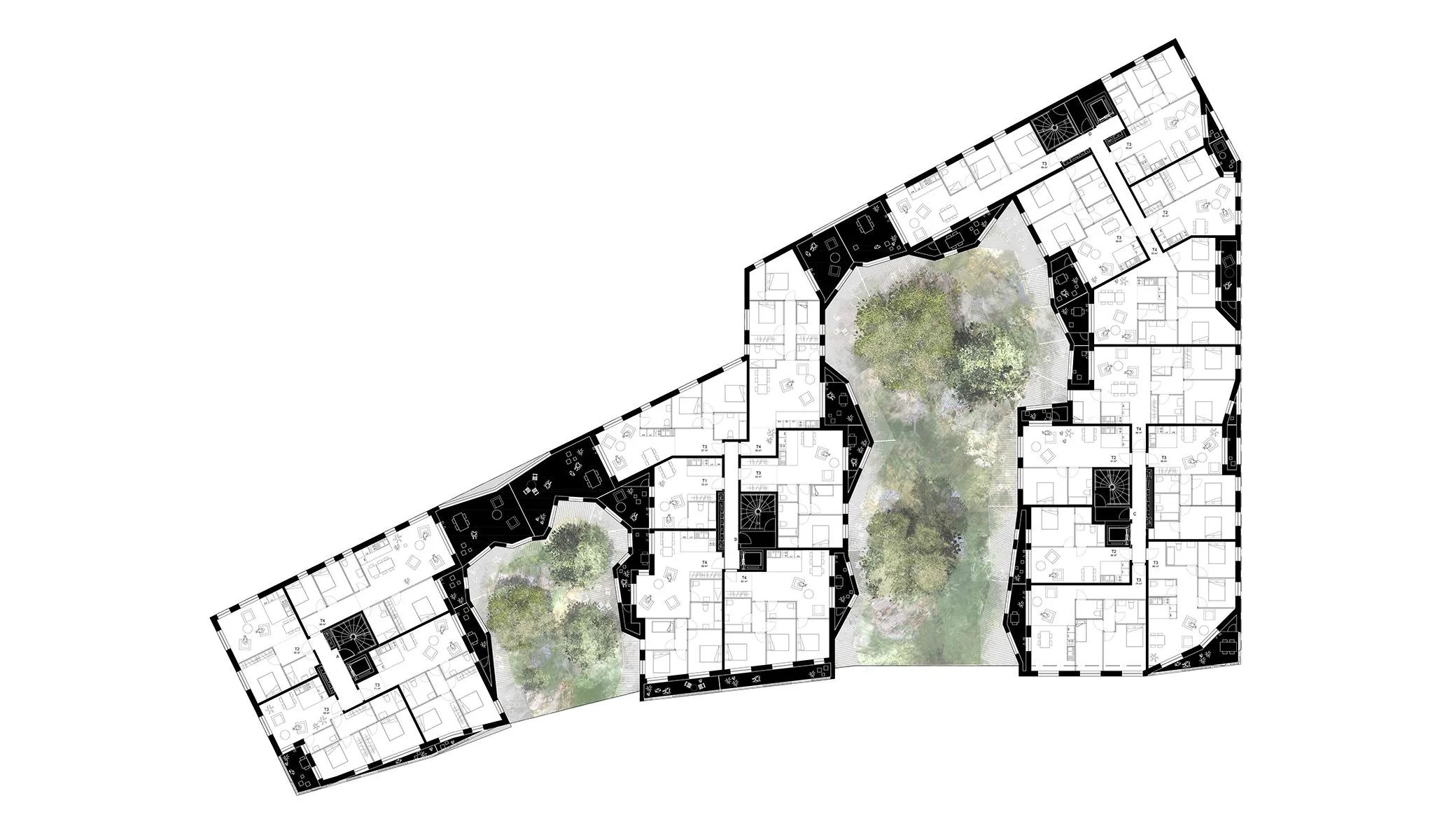
The situation at the railway line boundary imposed a clear response to noise nuisances. Rather than conceiving a simple protective screen, we chose to **make this constraint an architectural stance**. The three volumes that compose the project back northward against the rails, forming a physical barrier that protects two **planted courtyard hearts**, veritable green lungs interiorized within the built mass. This arrangement liberates generous nature spaces, accessible to residents, and creates a depth that breaks with the monotony of bars parallel to infrastructures.
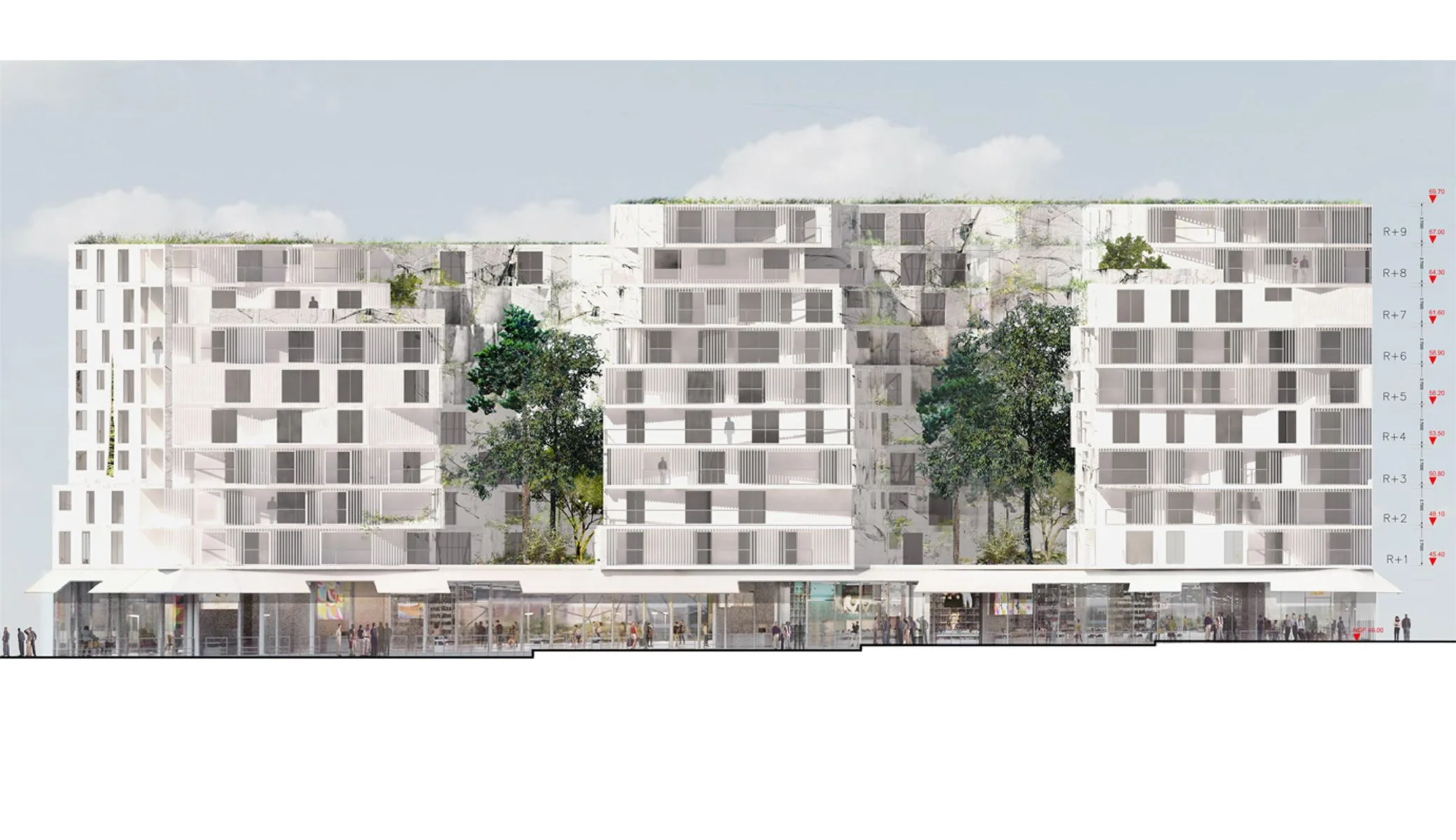
To maintain a visual relationship with the surrounding landscape, particularly toward the University of Nanterre, we pierced the monolith with **two large glazed faults**. These breaches traverse the volume from side to side, allowing filtered views, luminous openings, and revealing the thickness of the building. They also play a structuring role in the composition: they fragment the monolith, create thresholds, and introduce a temporality in the perception of the project. Depending on the time of day, light slides into these faults, reveals the reliefs of the facade, makes the white surfaces vibrate.
The commercial base anchors the ensemble to the ground and constitutes the **pedestal of the block**. It unifies the three residential volumes that seem to float above, in unstable equilibrium, like suspended blocks. This play of cantilevers and setbacks gives the project its plastic force. The housing units are organized in free plans, served from the courtyard hearts, which allows for diversifying typologies and offering generous exterior spaces, balconies and terraces that extend the habitat toward the vegetal.
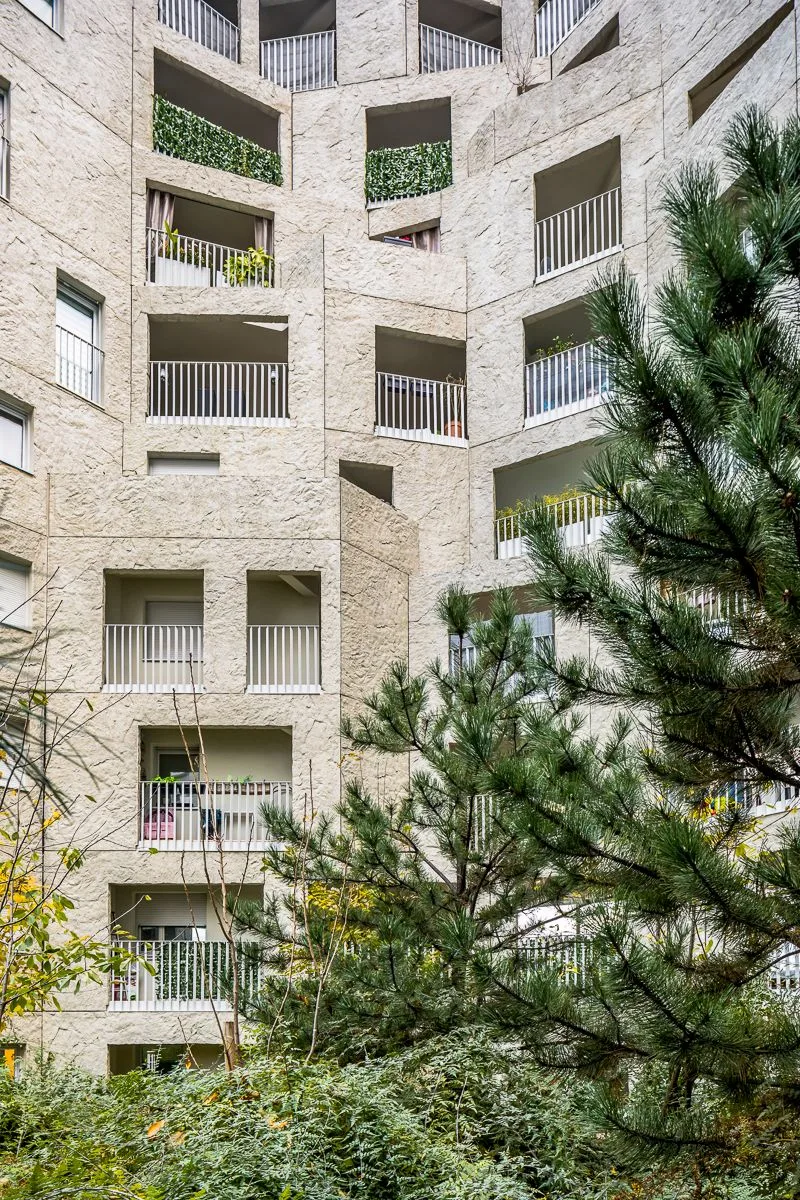
The project's **materiality** rests on the use of white concrete, treated in large prefabricated panels that emphasize the monolithic dimension of the volume. This technical choice allows for obtaining a smooth, homogeneous surface, whose white nuances vary according to the light. The faults are marked by continuous glazing, without visible frames, which accentuate the contrast between opacity and transparency. The vegetal, for its part, comes to soften this minerality: climbing plants, shrubs, grasses progressively colonize the terraces, the courtyard hearts, creating a **hybrid universe** where nature and architecture conjugate as in an abandoned quarry.
We sought to articulate two scales of nature. On one side, a **public and sumptuous** nature, that of the large planted subjects in the courtyard hearts, which recalls the generosity of the Fontainebleau forest. On the other, an **intimate and domestic** nature, that of private gardens, planted terraces, balconies where each resident can cultivate their own relationship to the vegetal. The courtyard hearts thus function as **green filters**, breathing spaces that structure collective life without imposing total publicness.
On the environmental level, the project integrates a reflection on **bioclimatic management** and reduction of energy consumption. The housing orientation privileges solar gains to the south and west, while the glazed faults ensure natural cross ventilation in the courtyard hearts. The intensive vegetation of common spaces contributes to regulating temperatures and improving air quality. The choice of prefabrication for the facades allowed for limiting construction waste and reducing construction timelines, delivered in 2020 after a competition won in 2015.
Le Rocher is not only a housing building: it is an **inhabited mass**, a sculpted volume where domestic life finds its place in the interstices, the hollows, the setbacks. We wanted to offer residents the sensation of living in a veritable rock, a mineral shelter open to the sky and to the city, where nature progressively reclaims its rights, as it would in a forsaken quarry. It is this tension between geological duration and the short time of dwelling that gives the project its singularity and its strong urban presence.
In Nanterre, in immediate contact with the railway line and Boulevard des Provinces Françaises, we conceived Le Rocher as an architectural project that questions **mineral material** and **volume sculpture**, while responding to the acoustic and urban constraints of a complex site. This 10,870 m² program, comprising 157 housing units and ground-floor commercial spaces, is part of a reflection on the transformation of a neighborhood in transition, where Paris Nanterre University and railway infrastructures sketch a hybrid landscape, at once urban and technical.
The project takes its name from its **monolithic form**, which evokes the gypsum blocks extracted from the quarries of Cormeilles-en-Parisis, located just a few kilometers away. This geological reference is not anecdotal: it anchors the building in the industrial and natural history of the territory, while proposing a contemporary reading of the built mass. We wanted to create a large white, compact volume, whose faults and fractures reveal a **sculpted architecture**, as if the building had been hollowed out, torn away, carved from a unitary block.
The situation at the railway line boundary imposed a clear response to noise nuisances. Rather than conceiving a simple protective screen, we chose to **make this constraint an architectural stance**. The three volumes that compose the project back northward against the rails, forming a physical barrier that protects two **planted courtyard hearts**, veritable green lungs interiorized within the built mass. This arrangement liberates generous nature spaces, accessible to residents, and creates a depth that breaks with the monotony of bars parallel to infrastructures.
To maintain a visual relationship with the surrounding landscape, particularly toward the University of Nanterre, we pierced the monolith with **two large glazed faults**. These breaches traverse the volume from side to side, allowing filtered views, luminous openings, and revealing the thickness of the building. They also play a structuring role in the composition: they fragment the monolith, create thresholds, and introduce a temporality in the perception of the project. Depending on the time of day, light slides into these faults, reveals the reliefs of the facade, makes the white surfaces vibrate.
The commercial base anchors the ensemble to the ground and constitutes the **pedestal of the block**. It unifies the three residential volumes that seem to float above, in unstable equilibrium, like suspended blocks. This play of cantilevers and setbacks gives the project its plastic force. The housing units are organized in free plans, served from the courtyard hearts, which allows for diversifying typologies and offering generous exterior spaces, balconies and terraces that extend the habitat toward the vegetal.
The project's **materiality** rests on the use of white concrete, treated in large prefabricated panels that emphasize the monolithic dimension of the volume. This technical choice allows for obtaining a smooth, homogeneous surface, whose white nuances vary according to the light. The faults are marked by continuous glazing, without visible frames, which accentuate the contrast between opacity and transparency. The vegetal, for its part, comes to soften this minerality: climbing plants, shrubs, grasses progressively colonize the terraces, the courtyard hearts, creating a **hybrid universe** where nature and architecture conjugate as in an abandoned quarry.
We sought to articulate two scales of nature. On one side, a **public and sumptuous** nature, that of the large planted subjects in the courtyard hearts, which recalls the generosity of the Fontainebleau forest. On the other, an **intimate and domestic** nature, that of private gardens, planted terraces, balconies where each resident can cultivate their own relationship to the vegetal. The courtyard hearts thus function as **green filters**, breathing spaces that structure collective life without imposing total publicness.
On the environmental level, the project integrates a reflection on **bioclimatic management** and reduction of energy consumption. The housing orientation privileges solar gains to the south and west, while the glazed faults ensure natural cross ventilation in the courtyard hearts. The intensive vegetation of common spaces contributes to regulating temperatures and improving air quality. The choice of prefabrication for the facades allowed for limiting construction waste and reducing construction timelines, delivered in 2020 after a competition won in 2015.
Le Rocher is not only a housing building: it is an **inhabited mass**, a sculpted volume where domestic life finds its place in the interstices, the hollows, the setbacks. We wanted to offer residents the sensation of living in a veritable rock, a mineral shelter open to the sky and to the city, where nature progressively reclaims its rights, as it would in a forsaken quarry. It is this tension between geological duration and the short time of dwelling that gives the project its singularity and its strong urban presence.
- Lieu
- Nanterre, France
- Nature
- Logements
- Surface
- 10 870 m²
- Budget
- 15,4 M
- Concours
- 2015
- Livraison
- 2020
- MOA
- Bouygues Immobilier