
Flying Garden
A 13,000 m² urban ecosystem connecting both banks of the Seine, offices, shops, shared gardens and urban agriculture under a plant cover self-producing 80% of its energy.
# Flying Garden
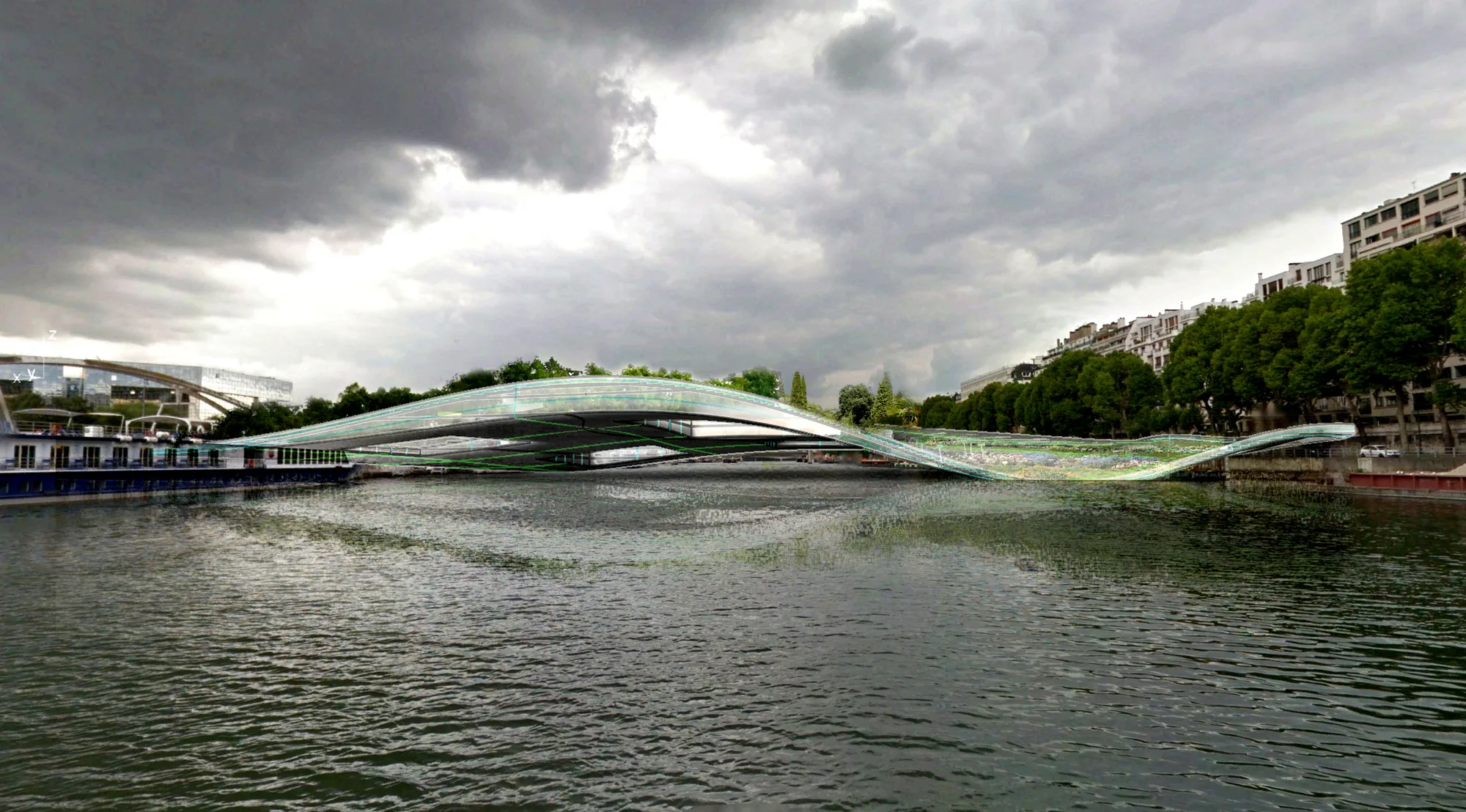
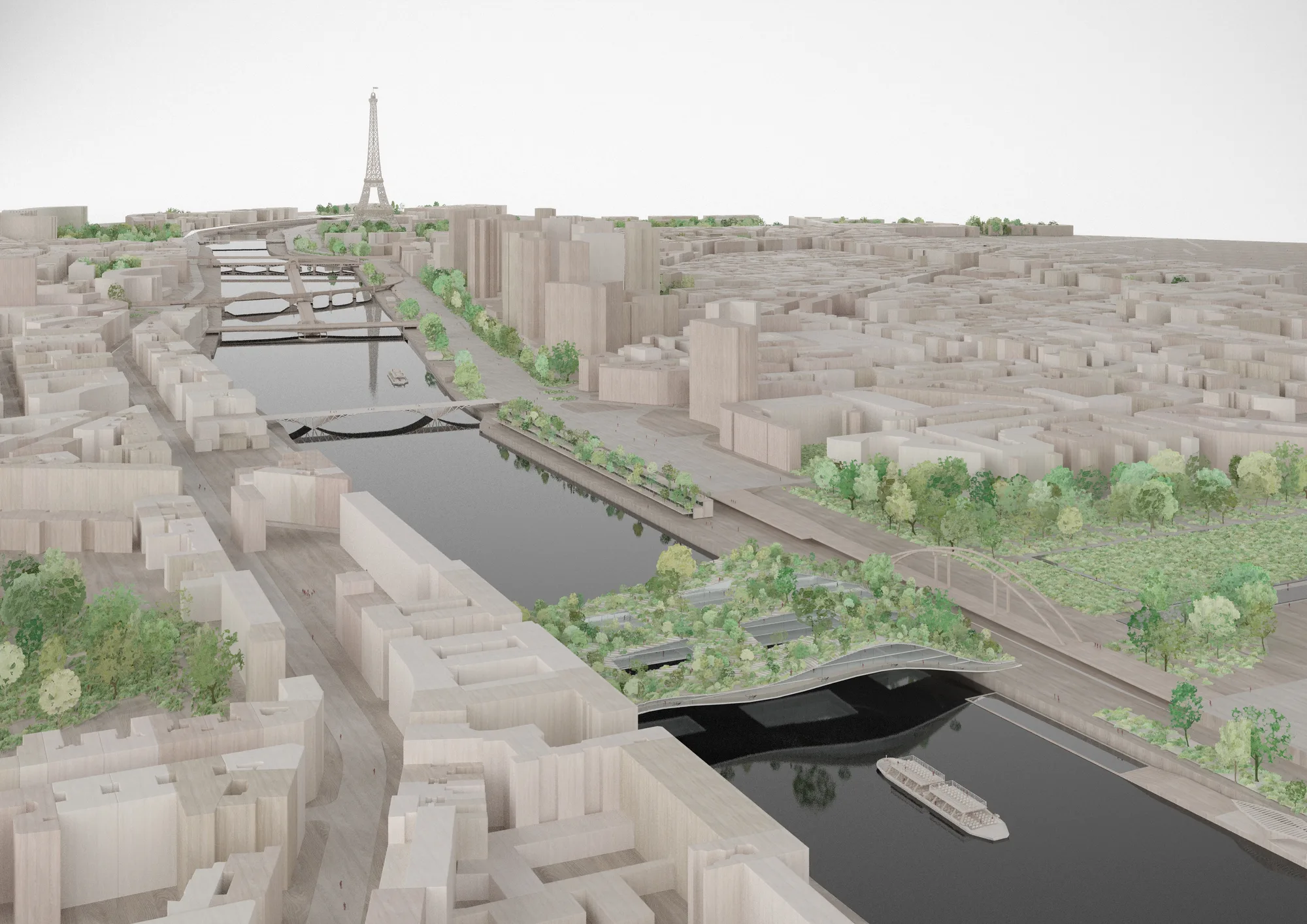
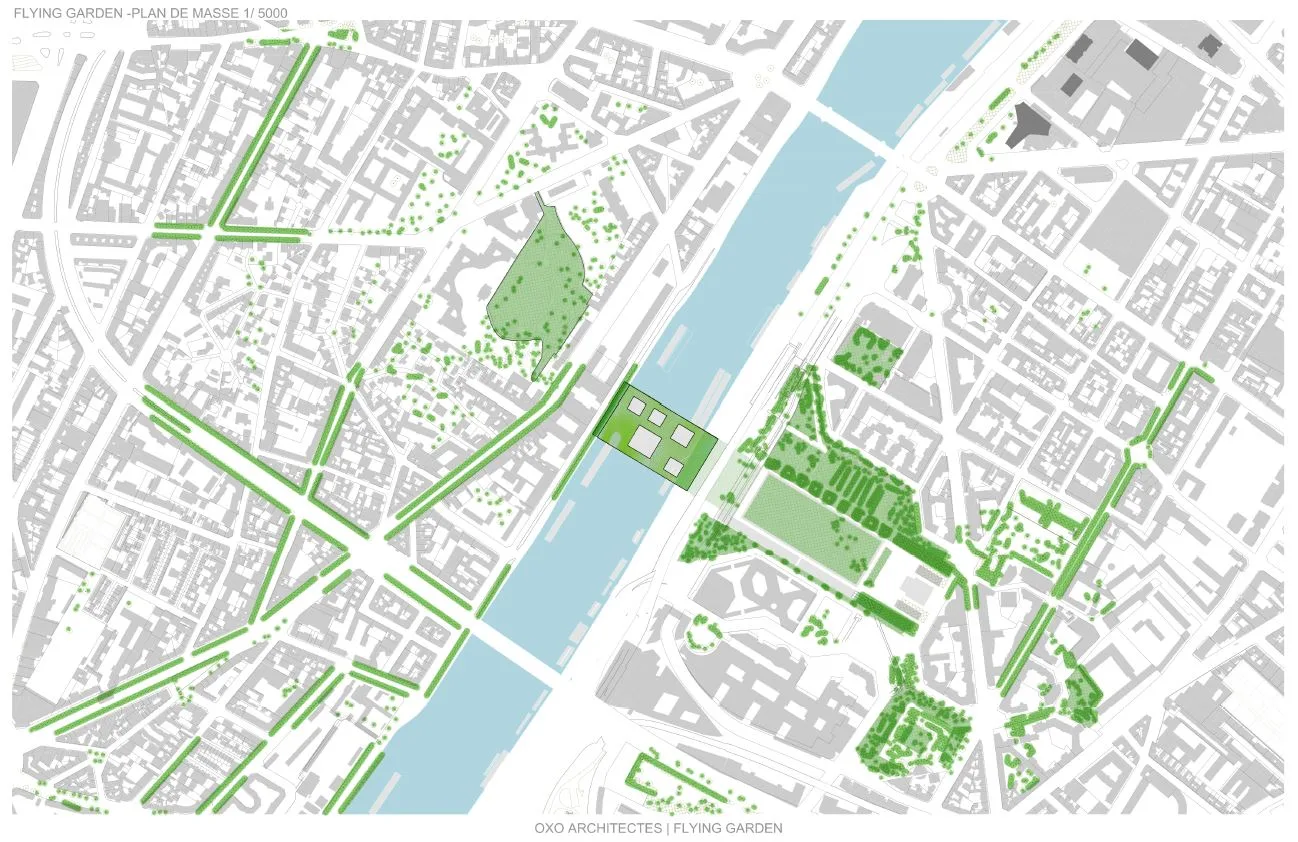
We imagined Flying Garden as a radical response to the physical and symbolic fracture that the Seine imposes on the Parisian urban fabric. Beyond linking the quays of Javel-Bas to the right bank, this project questions the very notion of urban infrastructure and proposes an **inhabited device** where crossing becomes a pretext for creating a true productive and social ecosystem. The 13,000 m² program unfolds in a continuous surface, at once bridge and park, building and garden, infrastructure and landscape.
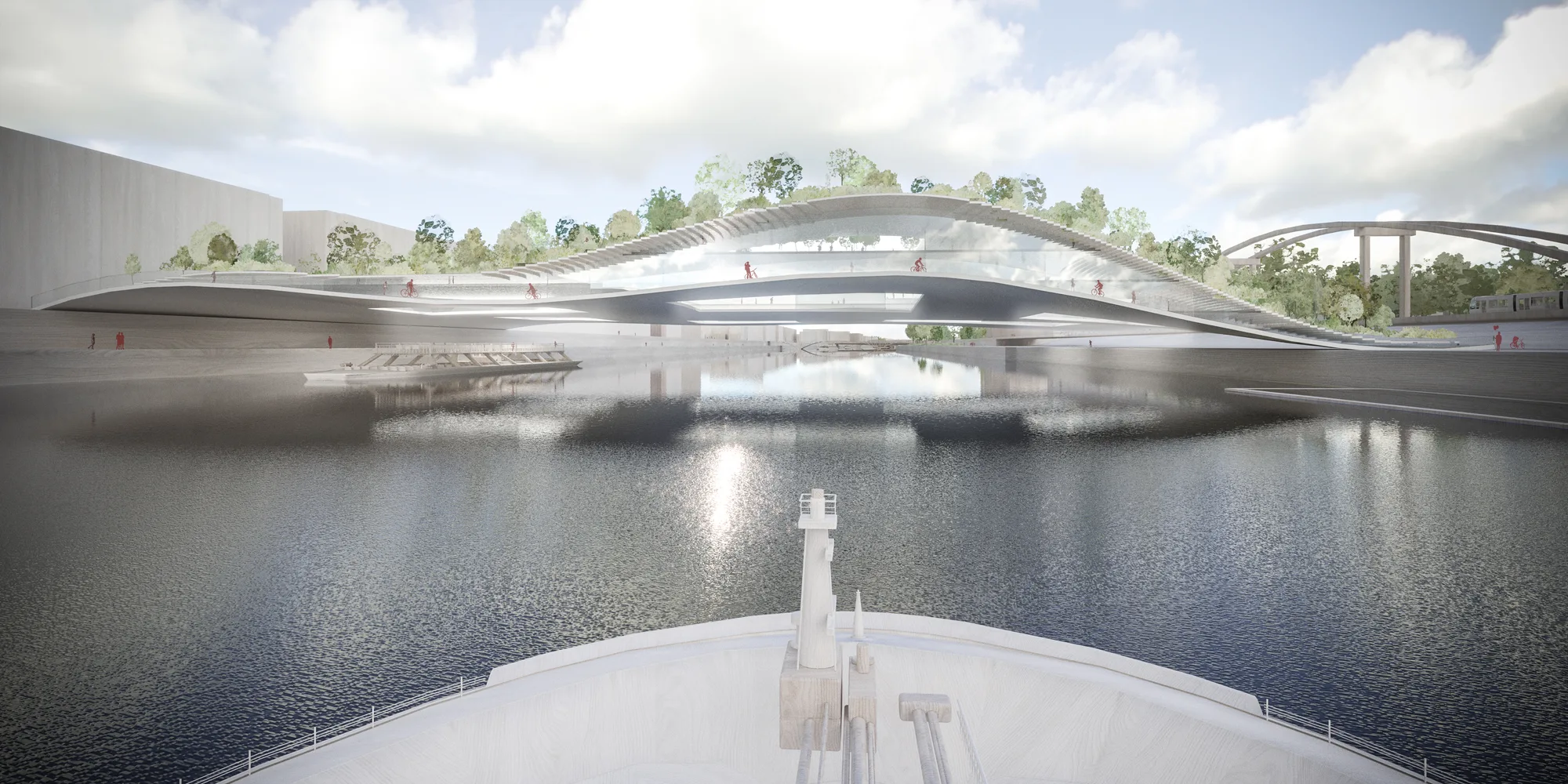
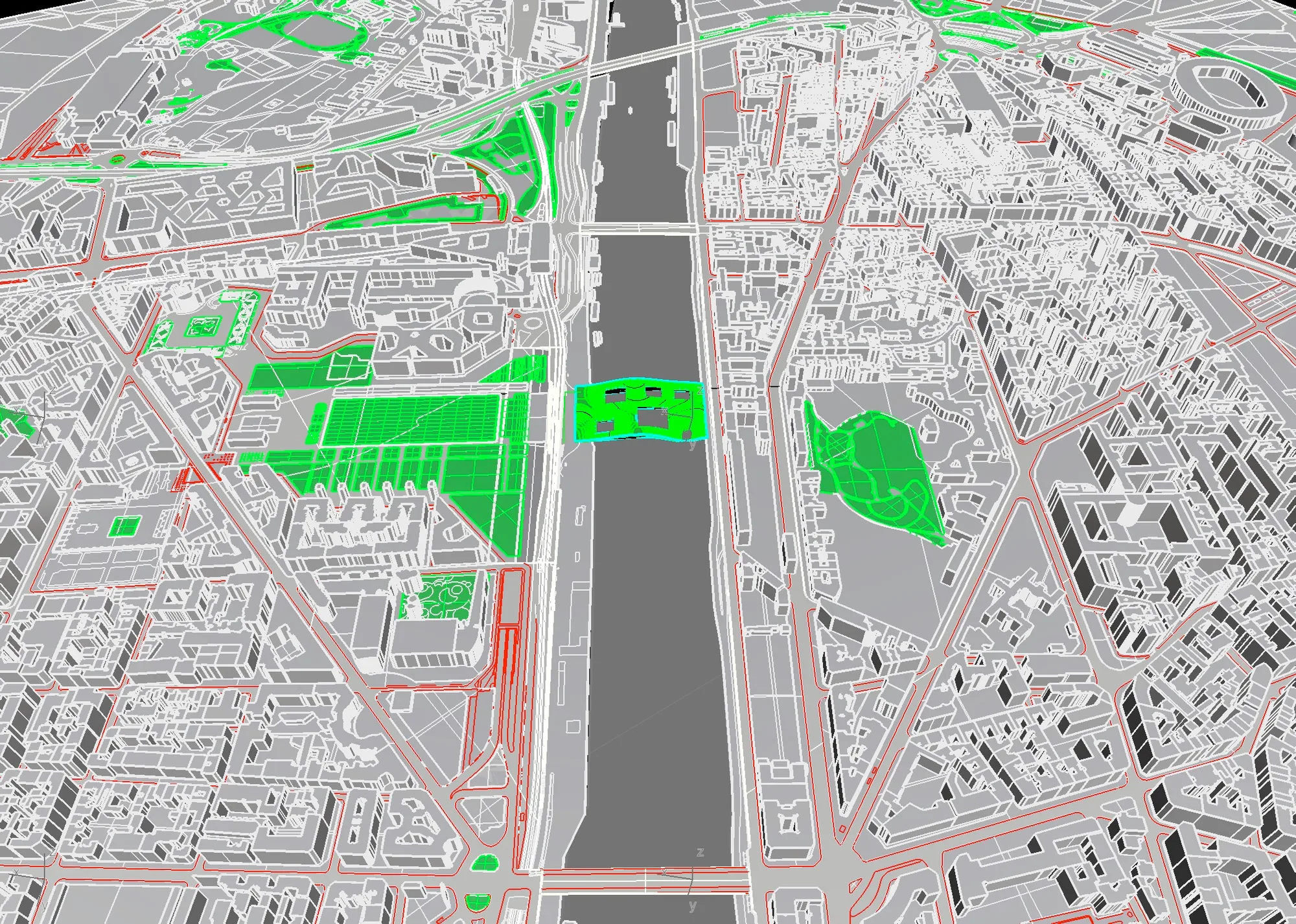
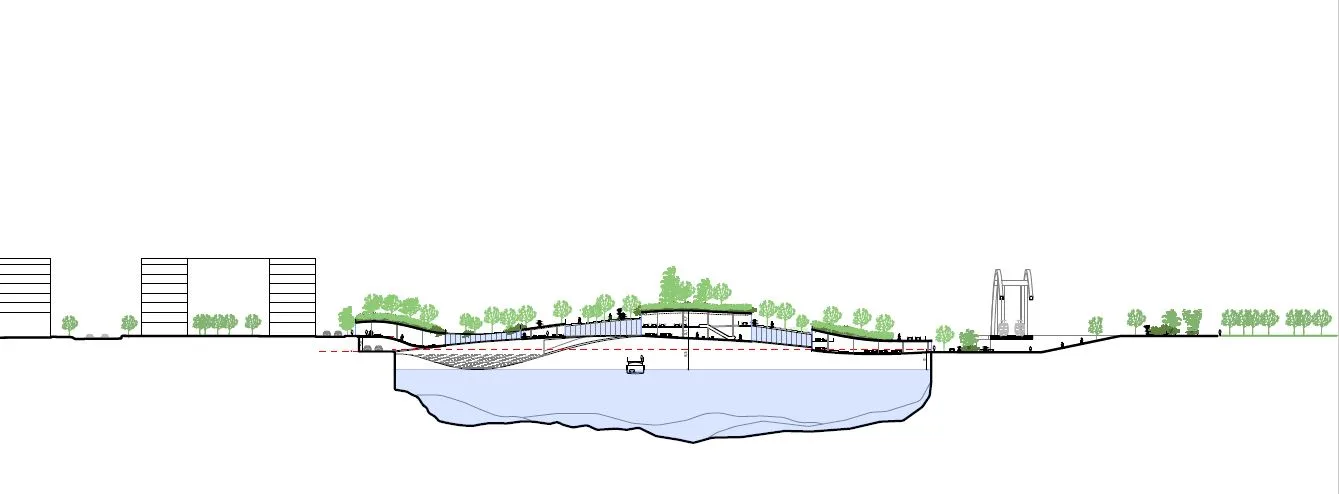
The site immediately confronted us with a dual responsibility: to dialogue with the André-Citroën park, a major figure of contemporary Parisian landscape, and to inscribe itself in a river charged with dense architectural history. We refused the posture of the traditional bridge, that straight line which crosses without engaging. With **SLA A/S** and **Lagneau Architectes**, we conceived a form that *embraces* the Seine, an undulating structure whose curves accompany the flow of water, creating an artificial topography in levitation. This formal gesture is not gratuitous: it generates differentiated micro-spaces, variations in altitude and orientation that allow for diversification of uses and atmospheres.
The **plant cover** that blankets the whole constitutes the project's true stance. This continuous fleece, composed of a plurality of plant species adapted to exposure conditions, humidity and substrate, transforms the infrastructure into a *natural extension* of the André-Citroën park. But where the park is a green enclave in the city, Flying Garden becomes a productive layer superimposed on the river. We integrated parcels of urban agriculture, shared gardens, composting spaces, creating a circular economy at the neighborhood scale. Children's gardens and leisure spaces slip beneath this canopy, protected from the sun in summer, open to the river in winter.
The project's **productive** dimension goes far beyond vegetation. Energy is conceived as a local resource, captured and transformed on site. Solar panels integrated into roofs and guardrails, **river hydro-power** drawn from the Seine's current, and thalassothermy (exploitation of the river water's temperature difference) cover nearly 80% of the site's energy needs. This radical choice of **energy self-production** is not a technological gimmick but a territorial strategy: Flying Garden becomes an active node in a decentralized, resilient energy network, less dependent on large centralized infrastructures.
We paid particular attention to the project's **materiality**. Wood constitutes the main structural framework, a choice dictated by its lightness, its capacity to span great distances, and its low carbon impact. Hemp wool insulation, plant-based paints, recycled or bio-sourced materials compose an essential part of the construction palette. This material requirement does not arise from superficial ecological discourse: it engages a **life cycle thinking**, from the origin of resources to their end of life, through their implementation. Each material was chosen for its capacity to degrade, recycle, or be reused.
The mixed program, offices, shops, facilities, public spaces, redistributes the usual hierarchies. Offices are no longer confined in hermetic towers but **open onto the garden**, benefit from natural light filtered by the canopy, and share outdoor spaces with neighborhood residents. Shops are not relegated to ground floors but are scattered along pedestrian and cycling paths that traverse the surface from one side to the other. This project refuses functional segregation in favor of a **shared metabolism**, where uses contaminate each other mutually.
Pedestrian and cycling paths are not simple technical routes. They structure the spatial experience, create belvederes over the river, changing viewpoints along the promenade. In levitation above the water, these paths reveal **multiple perspectives**, unprecedented framings of the urban landscape. Flying Garden's undulating silhouette reflects in the Seine, creates plays of shimmer and reflections that amplify the project's presence in its context. We sought to produce an architecture that never gives itself completely, that reveals itself progressively, according to seasons, times of day, variations of light.
This project remains a **study** commissioned by the **Compagnie de Phalsbourg** in 2018. It was not realized, but it continues to nourish our reflection on the place of nature in the city, on the capacity of infrastructures to generate new uses, on **architecture as ecosystem**. Flying Garden interrogates the possibility of a productive, resilient urbanism, capable of responding to climate challenges without renouncing density or mixed uses. It affirms that a bridge can be a park, that a park can be productive, that an infrastructure can be inhabited, shared, living. This project sketches another relationship to the Seine, no longer as a limit to cross but as a milieu to inhabit, cultivate, and steward.
We imagined Flying Garden as a radical response to the physical and symbolic fracture that the Seine imposes on the Parisian urban fabric. Beyond linking the quays of Javel-Bas to the right bank, this project questions the very notion of urban infrastructure and proposes an **inhabited device** where crossing becomes a pretext for creating a true productive and social ecosystem. The 13,000 m² program unfolds in a continuous surface, at once bridge and park, building and garden, infrastructure and landscape.
The site immediately confronted us with a dual responsibility: to dialogue with the André-Citroën park, a major figure of contemporary Parisian landscape, and to inscribe itself in a river charged with dense architectural history. We refused the posture of the traditional bridge, that straight line which crosses without engaging. With **SLA A/S** and **Lagneau Architectes**, we conceived a form that *embraces* the Seine, an undulating structure whose curves accompany the flow of water, creating an artificial topography in levitation. This formal gesture is not gratuitous: it generates differentiated micro-spaces, variations in altitude and orientation that allow for diversification of uses and atmospheres.
The **plant cover** that blankets the whole constitutes the project's true stance. This continuous fleece, composed of a plurality of plant species adapted to exposure conditions, humidity and substrate, transforms the infrastructure into a *natural extension* of the André-Citroën park. But where the park is a green enclave in the city, Flying Garden becomes a productive layer superimposed on the river. We integrated parcels of urban agriculture, shared gardens, composting spaces, creating a circular economy at the neighborhood scale. Children's gardens and leisure spaces slip beneath this canopy, protected from the sun in summer, open to the river in winter.
The project's **productive** dimension goes far beyond vegetation. Energy is conceived as a local resource, captured and transformed on site. Solar panels integrated into roofs and guardrails, **river hydro-power** drawn from the Seine's current, and thalassothermy (exploitation of the river water's temperature difference) cover nearly 80% of the site's energy needs. This radical choice of **energy self-production** is not a technological gimmick but a territorial strategy: Flying Garden becomes an active node in a decentralized, resilient energy network, less dependent on large centralized infrastructures.
We paid particular attention to the project's **materiality**. Wood constitutes the main structural framework, a choice dictated by its lightness, its capacity to span great distances, and its low carbon impact. Hemp wool insulation, plant-based paints, recycled or bio-sourced materials compose an essential part of the construction palette. This material requirement does not arise from superficial ecological discourse: it engages a **life cycle thinking**, from the origin of resources to their end of life, through their implementation. Each material was chosen for its capacity to degrade, recycle, or be reused.
The mixed program, offices, shops, facilities, public spaces, redistributes the usual hierarchies. Offices are no longer confined in hermetic towers but **open onto the garden**, benefit from natural light filtered by the canopy, and share outdoor spaces with neighborhood residents. Shops are not relegated to ground floors but are scattered along pedestrian and cycling paths that traverse the surface from one side to the other. This project refuses functional segregation in favor of a **shared metabolism**, where uses contaminate each other mutually.
Pedestrian and cycling paths are not simple technical routes. They structure the spatial experience, create belvederes over the river, changing viewpoints along the promenade. In levitation above the water, these paths reveal **multiple perspectives**, unprecedented framings of the urban landscape. Flying Garden's undulating silhouette reflects in the Seine, creates plays of shimmer and reflections that amplify the project's presence in its context. We sought to produce an architecture that never gives itself completely, that reveals itself progressively, according to seasons, times of day, variations of light.
This project remains a **study** commissioned by the **Compagnie de Phalsbourg** in 2018. It was not realized, but it continues to nourish our reflection on the place of nature in the city, on the capacity of infrastructures to generate new uses, on **architecture as ecosystem**. Flying Garden interrogates the possibility of a productive, resilient urbanism, capable of responding to climate challenges without renouncing density or mixed uses. It affirms that a bridge can be a park, that a park can be productive, that an infrastructure can be inhabited, shared, living. This project sketches another relationship to the Seine, no longer as a limit to cross but as a milieu to inhabit, cultivate, and steward.
- Lieu
- Paris, France
- Nature
- Mixte
- Surface
- 13 000 m²
- Concours
- 2018
- MOA
- Compagnie de Phalsbourg
- Co-architectes
- SLA A/S + Lagneau Architectes