
Les Menuires Convention Center
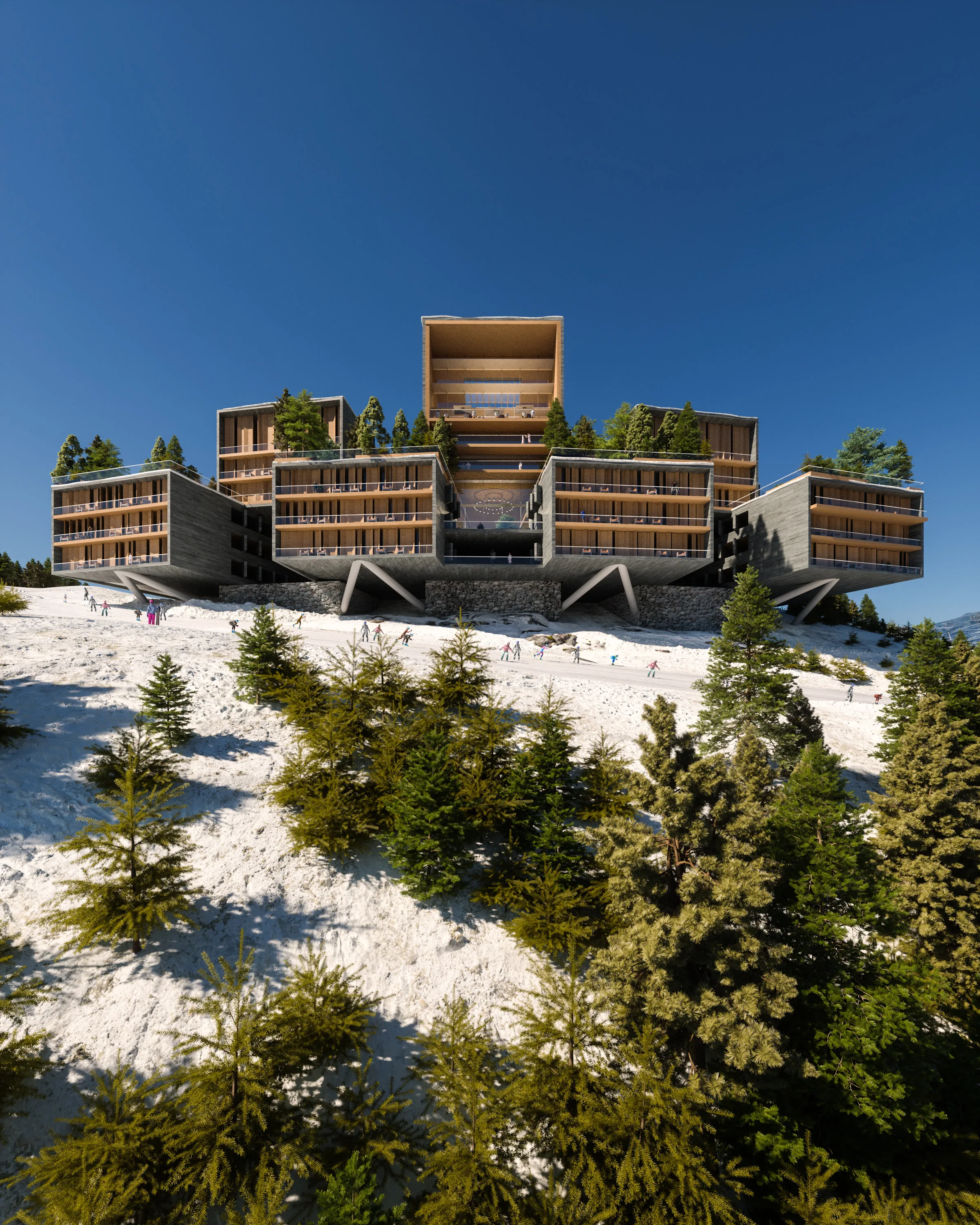
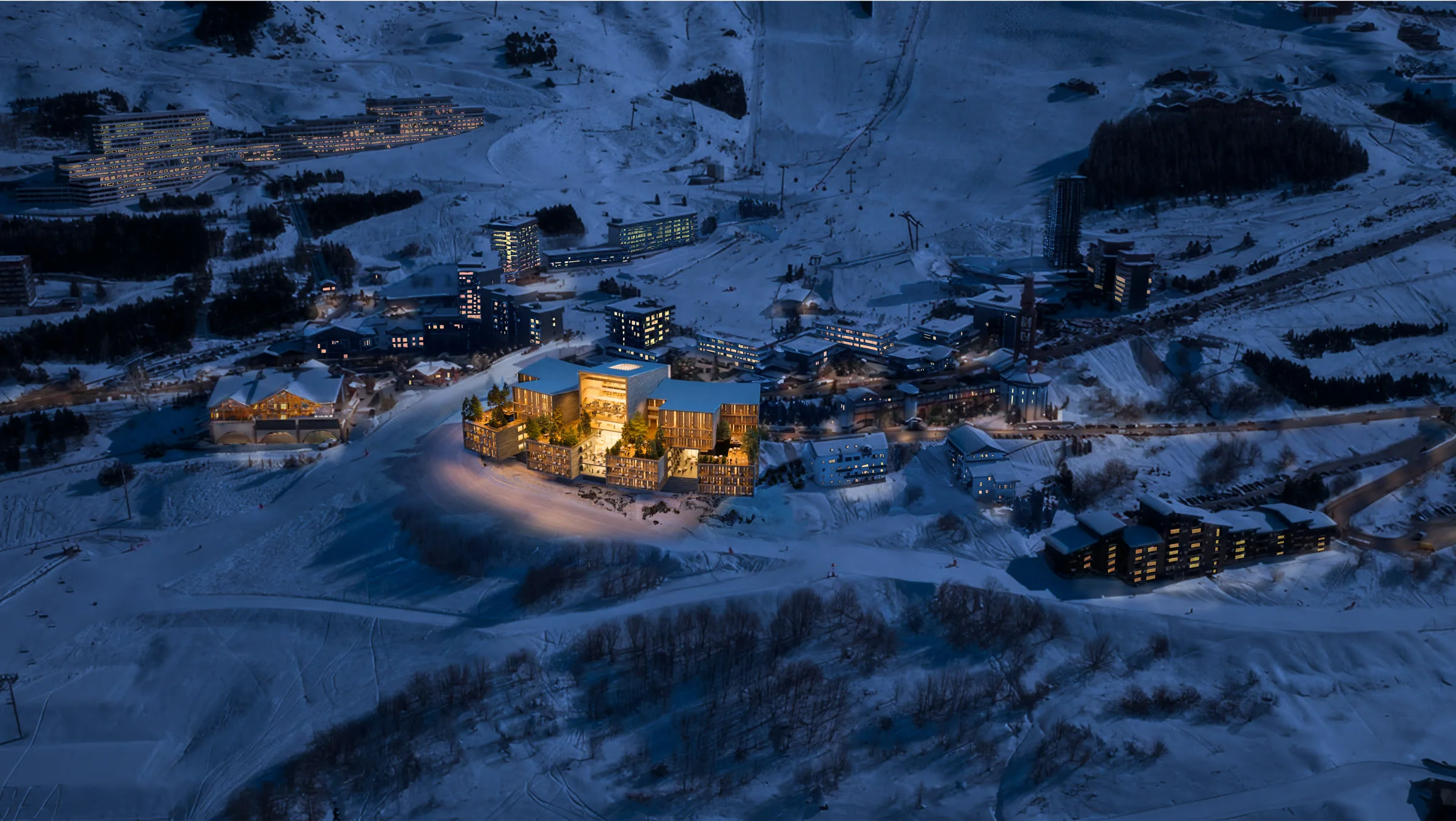
High-altitude convention and dining center in Les Menuires, a building inserted into the slope, with soft vegetated roofs that extend the mountain.
We designed this project for Les Menuires in 2023, in a singular context that called for deep reflection on what it means to build at altitude today. The resort, born in the 1960s, still bears the imprint of an era when mountain architecture primarily sought programmatic efficiency. Our ambition was different: **to reinscribe the architectural gesture within the logic of the site**, to ensure that the built form no longer opposes the landscape but becomes its natural, almost obvious extension.
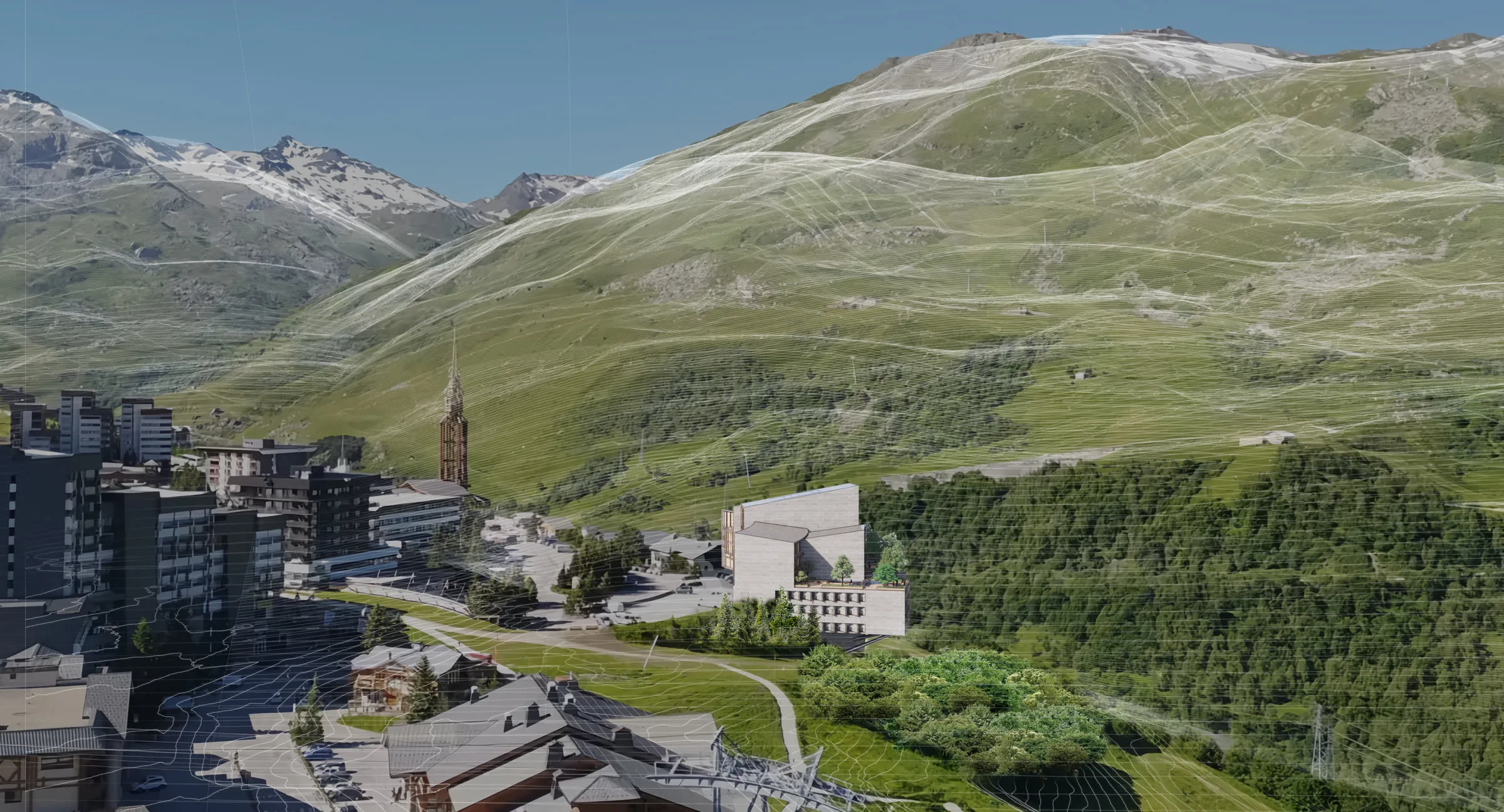
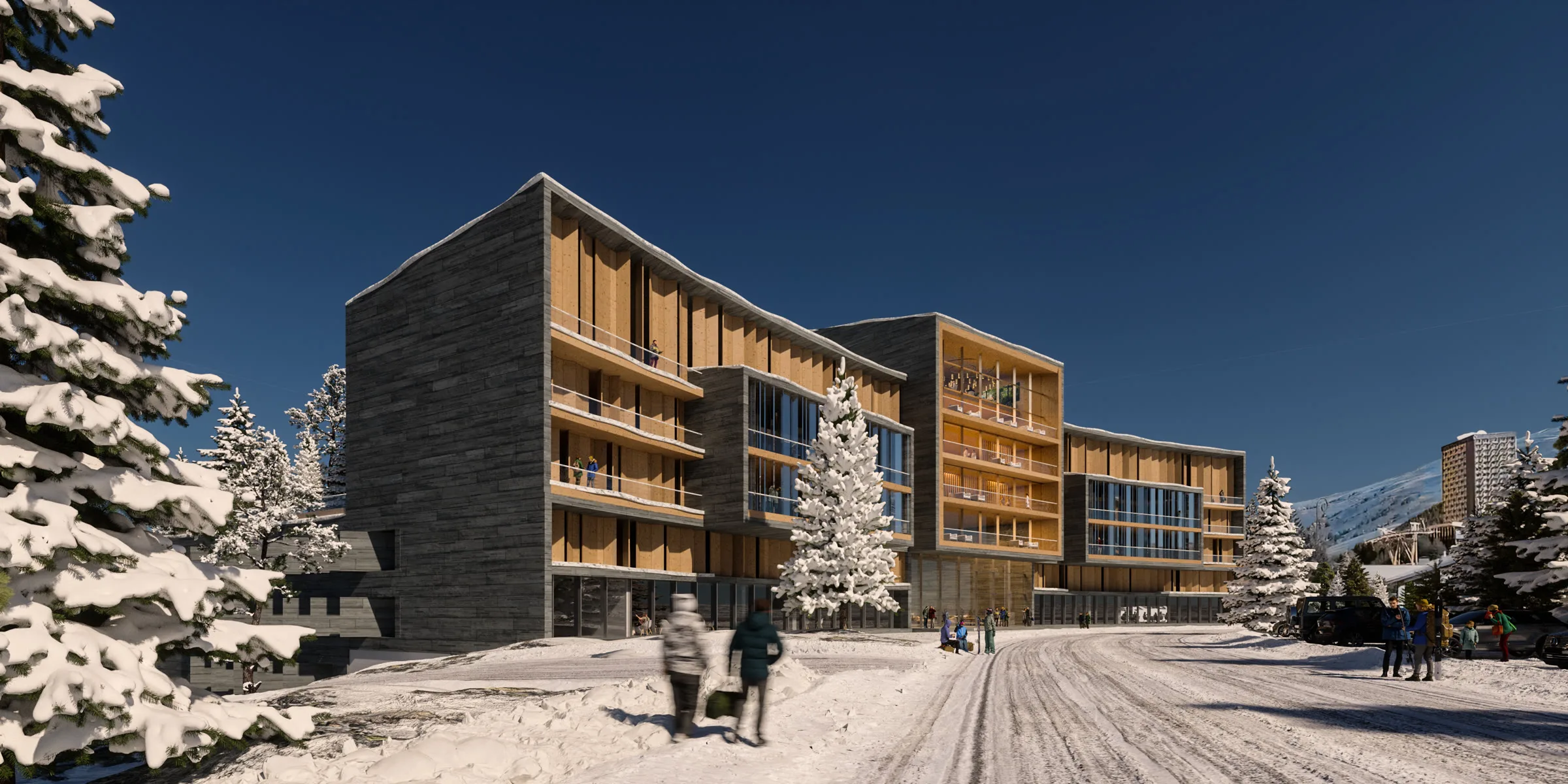
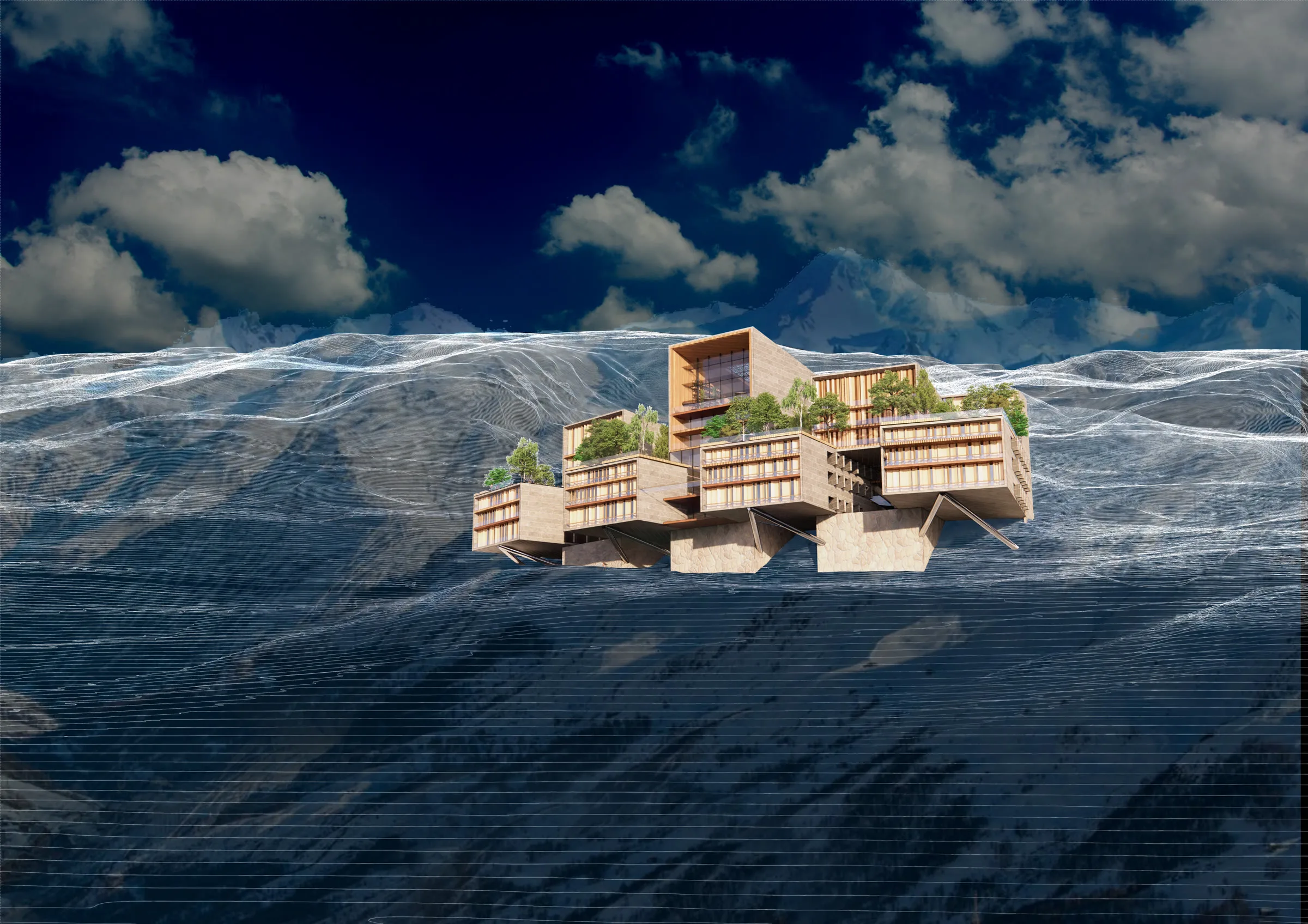
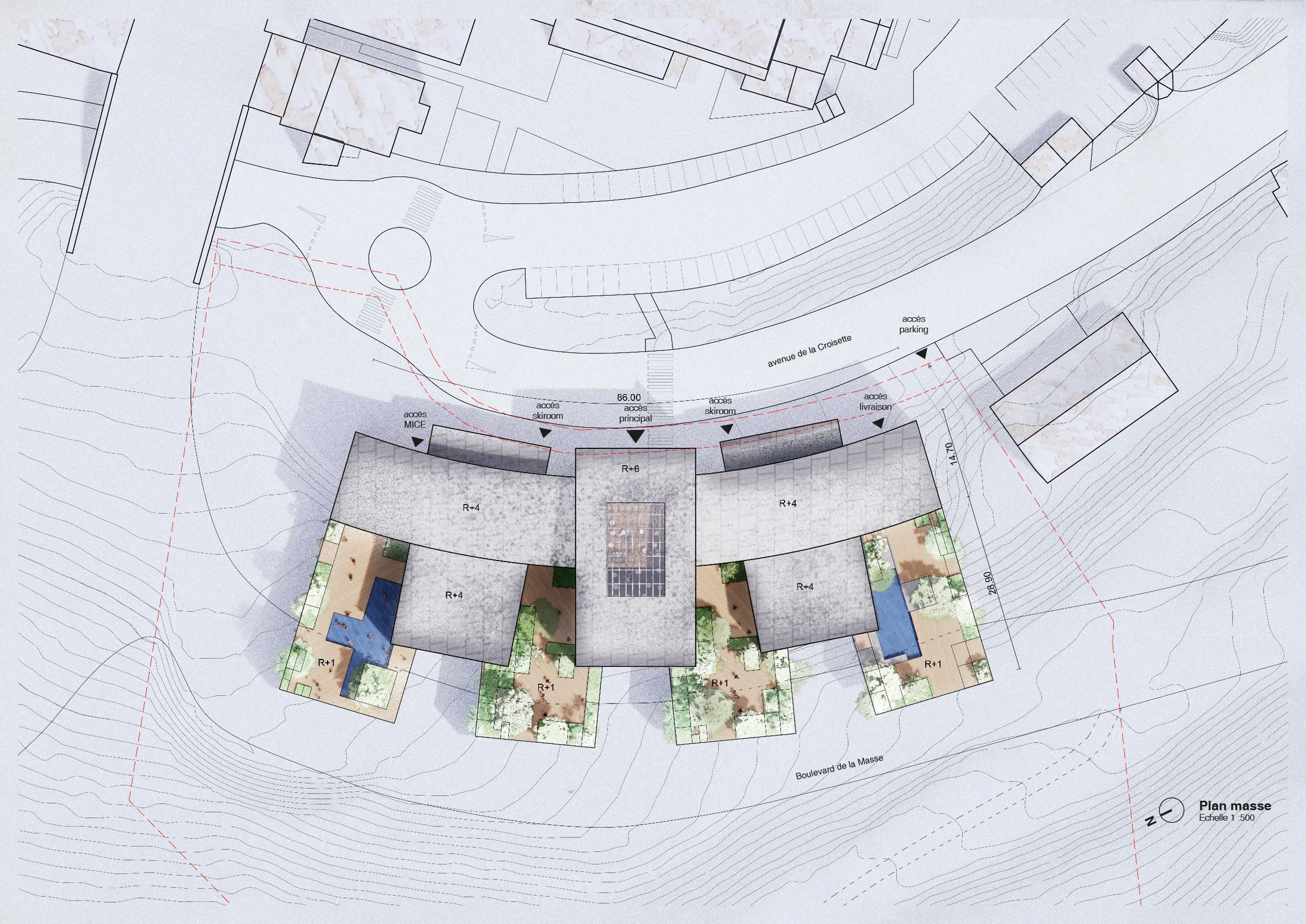
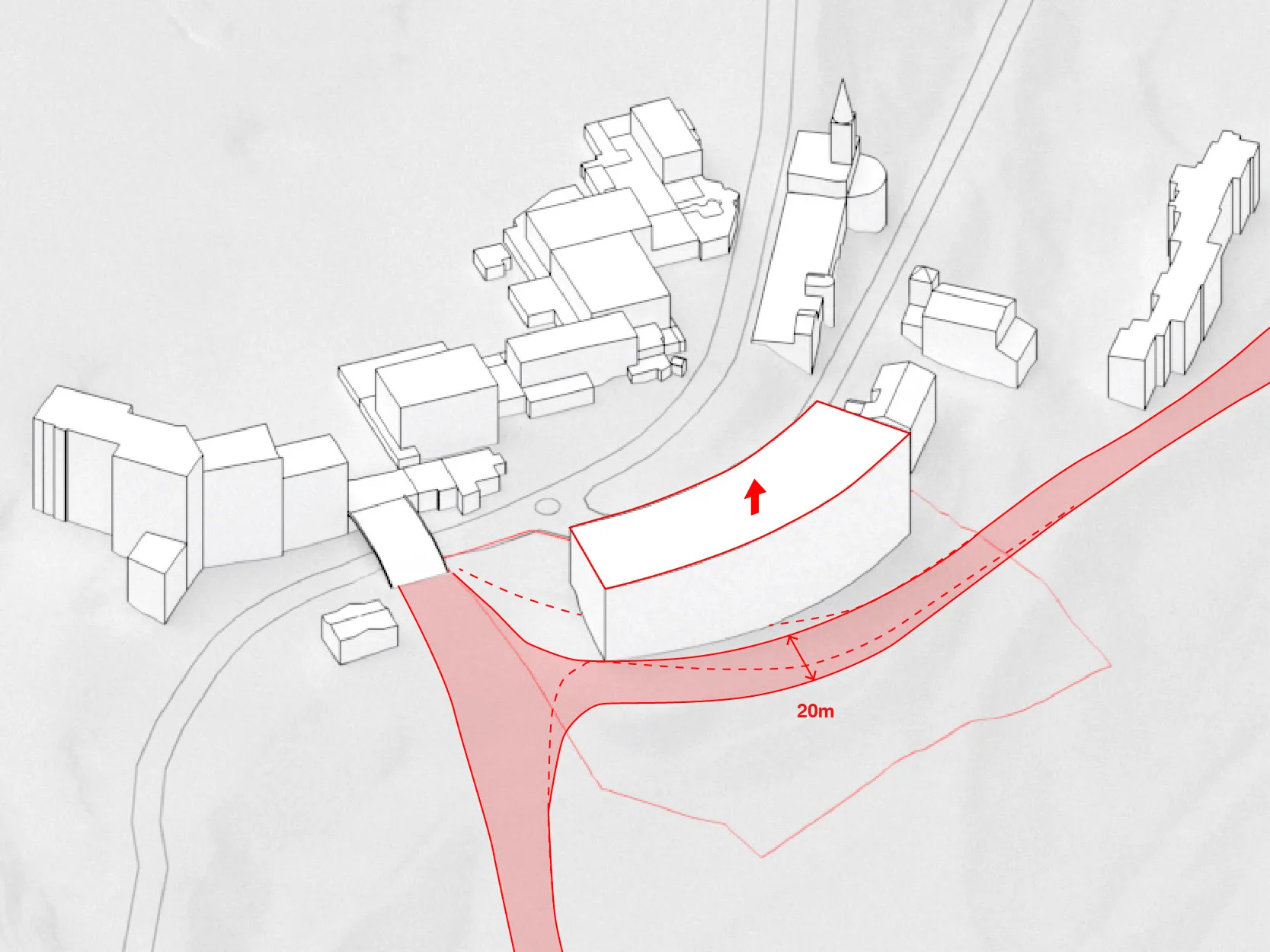
The site is located on a marked slope, facing due south, with a gradient that could have seemed constraining but which revealed itself to be the very matrix of the project. Rather than undertaking massive terracing or imposing an emergent volume, we chose to **embrace the topography**, to let ourselves be guided by it. The convention center does not sit upon the mountain, it inserts itself into it, nestles within it, partially disappears beneath vegetated roofs that become usable surfaces, new inhabited grounds.
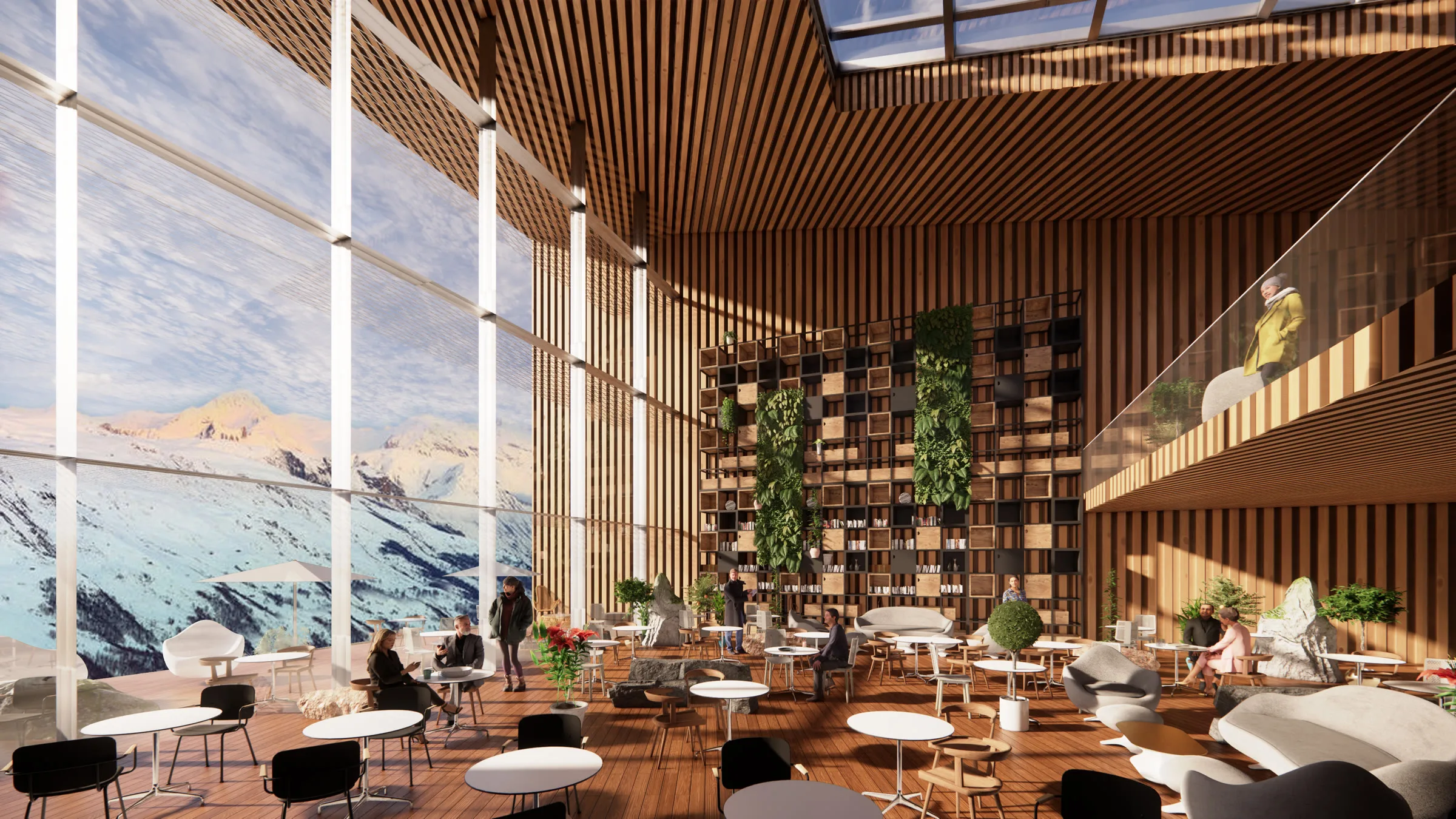
The program combined a convention center, dining spaces, and accommodation functions, totaling approximately 4,500 m² distributed across several levels. What interested us was the way these uses could coexist without neutralizing each other, how a facility of this type could remain convivial, almost domestic, without losing its capacity to host. We imagined **two restaurants, one in the upper section, the other in the lower section**, which punctuate the building's experience like contemporary refuges, places of pause and sharing inscribed within a logic of passage. Between them, the convention spaces unfold, modular, generous with natural light, open to the panoramas.
The architecture is built around the idea of **soft roofs**, undulating forms that do not seek effect but respond to climatic and landscape necessity. These vegetated roofs are not simple technical coverings, they constitute true fifth facades, surfaces habitable in summer, thermal protections in winter, living interfaces between the edifice and its environment. They draw waves that extend the mountain, create plays of shadow and light, modulate the building's scale. From a distance, one first perceives these green undulations before distinguishing the constructed volume itself.
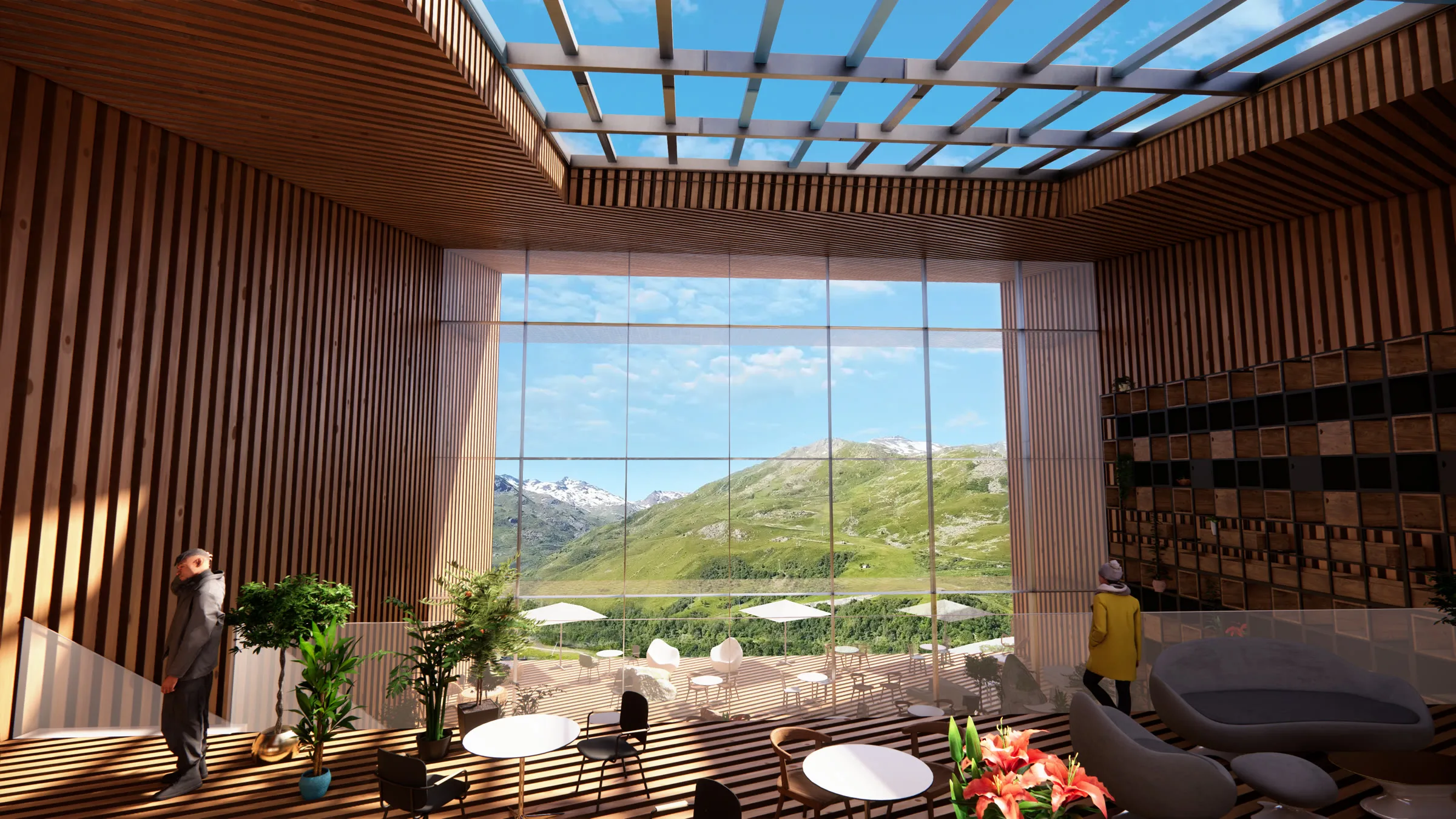
Materiality fully participates in this logic of anchoring. We favored **wood and local stone**, materials that carry within them alpine constructive memory without lapsing into pastiche. Wood structures, clothes, warms the interior spaces. It is present in the exposed frameworks, cladding, joinery, creating tactile and visual continuity. Stone ensures the foundation, marks the bases, dialogues with the surrounding rock outcrops. This is not an architecture of citation but an architecture that **draws from vernacular vocabulary to reinterpret it** in light of contemporary issues, notably climatic ones.
Because the environmental question runs through the entire project. The vegetated roofs play a role of **natural insulation**, limiting thermal losses in winter and offering welcome inertia in summer. The insertion into the slope reduces surfaces exposed to prevailing winds, diminishes visual impact, facilitates passive management of thermal flows. The large glazed bays, oriented due south, maximize solar gains in cold season, while mobile solar protections prevent summer overheating. The whole forms a coherent system, where each architectural decision responds to a bioclimatic logic conceived from the origin, integrated into the parti rather than applied afterwards.
Inside, the spatial experience rests on a subtle play between **intimacy and openness**. The convention spaces benefit from large bays that frame the peaks, establish constant dialogue with the exterior, recall that one is in the mountains, that the landscape is not a backdrop but an active presence. The restaurants offer more gathered atmospheres, almost refuges, where wood materiality creates a warm atmosphere, conducive to conviviality. This contrast between collective exchange places and individual contemplation spaces structures the building's life, confers upon it a richness of use that exceeds the simple congress function.
The project was not realized, but it carries within it a reflection that we continue to nourish in other contexts: that of an **architecture that does not seek to dominate but to accompany**, that accepts partial effacement, that makes topographic constraint a formal and ecological opportunity. In Les Menuires, we wanted to show that a public facility of this scale could blend into its site without renouncing its architectural presence, that it could be simultaneously contemporary and deeply anchored, technical and sensitive.
This project allowed us to explore further this idea of **inhabited roof**, which is neither entirely roof nor entirely ground, but an intermediate space, a fertile in-between. At altitude, where land pressure is strong and natural spaces precious, this approach offers an alternative to sprawl or brutal verticality. It proposes another way of inhabiting the mountain, respectful of its equilibriums, attentive to its rhythms, concerned with preserving what makes its singularity. Alpine architecture has long oscillated between mimicry and rupture; we seek, for our part, a third way, that of active dialogue, of modest but resolutely contemporary inscription, where each constructed gesture enriches the territory instead of impoverishing it.
The site is located on a marked slope, facing due south, with a gradient that could have seemed constraining but which revealed itself to be the very matrix of the project. Rather than undertaking massive terracing or imposing an emergent volume, we chose to **embrace the topography**, to let ourselves be guided by it. The convention center does not sit upon the mountain, it inserts itself into it, nestles within it, partially disappears beneath vegetated roofs that become usable surfaces, new inhabited grounds.
The program combined a convention center, dining spaces, and accommodation functions, totaling approximately 4,500 m² distributed across several levels. What interested us was the way these uses could coexist without neutralizing each other, how a facility of this type could remain convivial, almost domestic, without losing its capacity to host. We imagined **two restaurants, one in the upper section, the other in the lower section**, which punctuate the building's experience like contemporary refuges, places of pause and sharing inscribed within a logic of passage. Between them, the convention spaces unfold, modular, generous with natural light, open to the panoramas.
The architecture is built around the idea of **soft roofs**, undulating forms that do not seek effect but respond to climatic and landscape necessity. These vegetated roofs are not simple technical coverings, they constitute true fifth facades, surfaces habitable in summer, thermal protections in winter, living interfaces between the edifice and its environment. They draw waves that extend the mountain, create plays of shadow and light, modulate the building's scale. From a distance, one first perceives these green undulations before distinguishing the constructed volume itself.
Materiality fully participates in this logic of anchoring. We favored **wood and local stone**, materials that carry within them alpine constructive memory without lapsing into pastiche. Wood structures, clothes, warms the interior spaces. It is present in the exposed frameworks, cladding, joinery, creating tactile and visual continuity. Stone ensures the foundation, marks the bases, dialogues with the surrounding rock outcrops. This is not an architecture of citation but an architecture that **draws from vernacular vocabulary to reinterpret it** in light of contemporary issues, notably climatic ones.
Because the environmental question runs through the entire project. The vegetated roofs play a role of **natural insulation**, limiting thermal losses in winter and offering welcome inertia in summer. The insertion into the slope reduces surfaces exposed to prevailing winds, diminishes visual impact, facilitates passive management of thermal flows. The large glazed bays, oriented due south, maximize solar gains in cold season, while mobile solar protections prevent summer overheating. The whole forms a coherent system, where each architectural decision responds to a bioclimatic logic conceived from the origin, integrated into the parti rather than applied afterwards.
Inside, the spatial experience rests on a subtle play between **intimacy and openness**. The convention spaces benefit from large bays that frame the peaks, establish constant dialogue with the exterior, recall that one is in the mountains, that the landscape is not a backdrop but an active presence. The restaurants offer more gathered atmospheres, almost refuges, where wood materiality creates a warm atmosphere, conducive to conviviality. This contrast between collective exchange places and individual contemplation spaces structures the building's life, confers upon it a richness of use that exceeds the simple congress function.
The project was not realized, but it carries within it a reflection that we continue to nourish in other contexts: that of an **architecture that does not seek to dominate but to accompany**, that accepts partial effacement, that makes topographic constraint a formal and ecological opportunity. In Les Menuires, we wanted to show that a public facility of this scale could blend into its site without renouncing its architectural presence, that it could be simultaneously contemporary and deeply anchored, technical and sensitive.
This project allowed us to explore further this idea of **inhabited roof**, which is neither entirely roof nor entirely ground, but an intermediate space, a fertile in-between. At altitude, where land pressure is strong and natural spaces precious, this approach offers an alternative to sprawl or brutal verticality. It proposes another way of inhabiting the mountain, respectful of its equilibriums, attentive to its rhythms, concerned with preserving what makes its singularity. Alpine architecture has long oscillated between mimicry and rupture; we seek, for our part, a third way, that of active dialogue, of modest but resolutely contemporary inscription, where each constructed gesture enriches the territory instead of impoverishing it.
- Lieu
- Les Menuires, France
- Nature
- Équipement
- Surface
- 4 500 m²
- Budget
- Confidentiel
- Concours
- 2023
- MOA
- SEM Les Menuires