
FLOWING PARK
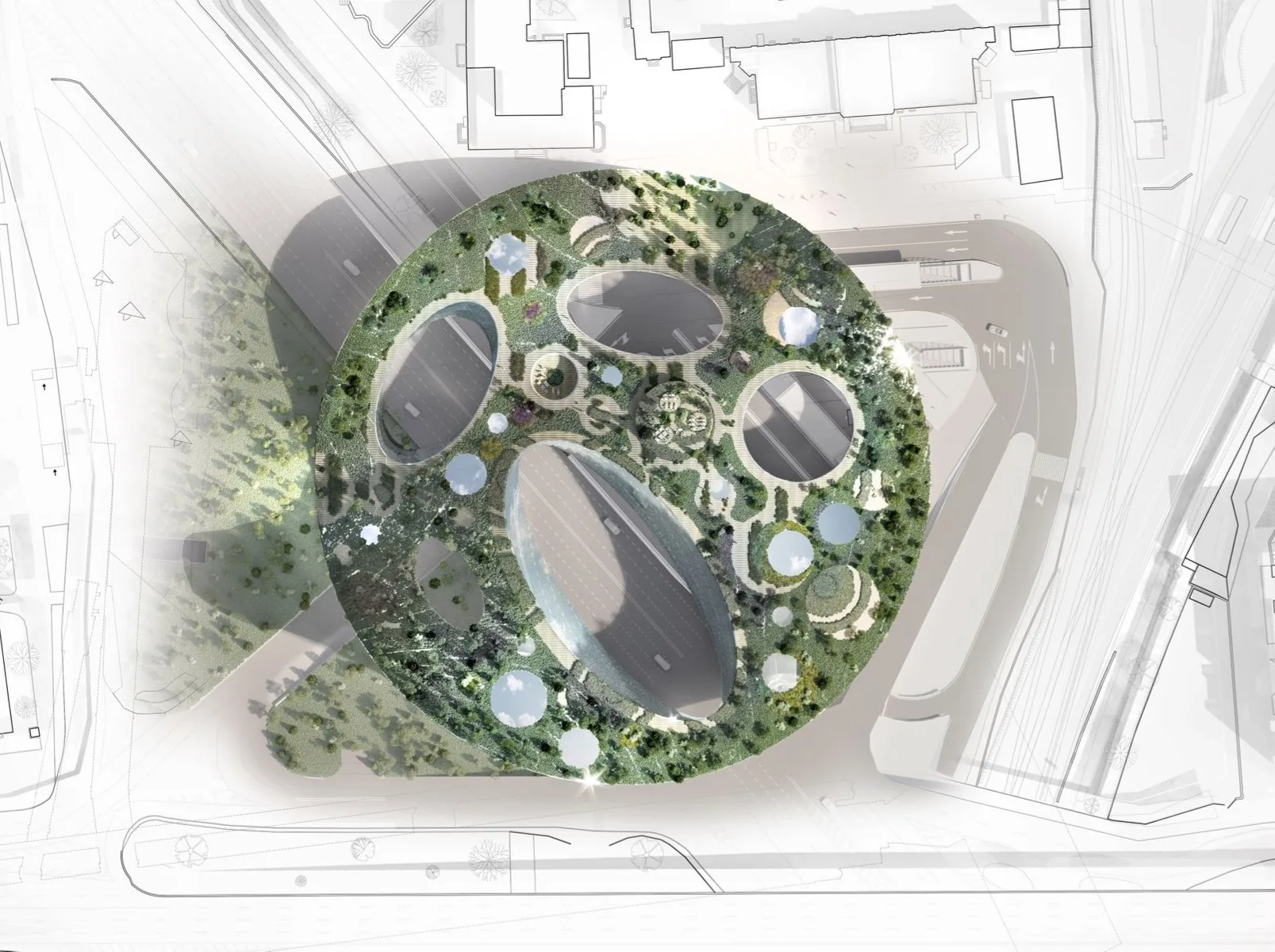
The Flowing Park project site is located next to Moscow's Third Ring Road, near Savyoloskaya Station. The site, covering approximately 50,000m², is an intermodal transportation hub fragmented across several parcels. The project program consists of offices, a hotel, retail spaces, and a bus station.
# FLOWING PARK
Moscow, 2018. We are approached by Compagnie de Phalsbourg and Imagim Real Estate to imagine a mixed-use project on a fragmented site, wedged between the Third Ring Road and Savyoloskaya Station. The site, approximately 50,000 m², presents itself as a node of infrastructures: railway station, metro station, bus terminal, incessant automobile traffic. It is an intermodal transportation hub, but also a **place of rupture**, where pedestrians struggle to circulate, where public space is lacking, where the city seems to have given up offering anything other than narrow sidewalks and underground passages.
The challenge is twofold. First, **weave together** these fragmented parcels, connect the different modes of transport, streamline pedestrian routes. Second, restore to this territory an urban dimension, a **breathing space** in a capital where density and automobile traffic often saturate daily experience. We collaborate with Sou Fujimoto Architects, whose sensitivity to **organic structures** and transitions between interior and exterior nourishes our shared reflection. Together, we seek an architectural response that is not merely functional, but that invents a **new urban topography**.
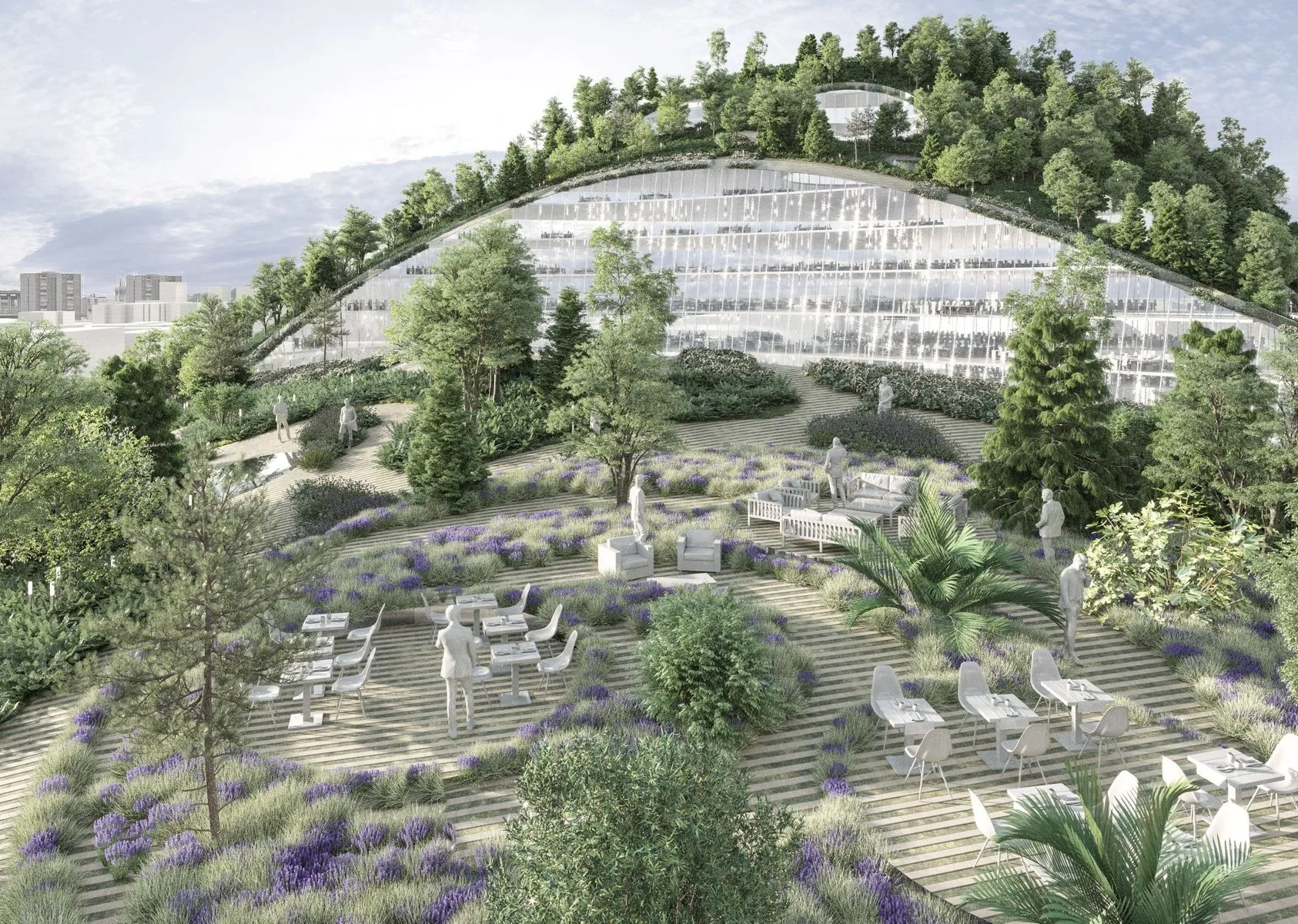
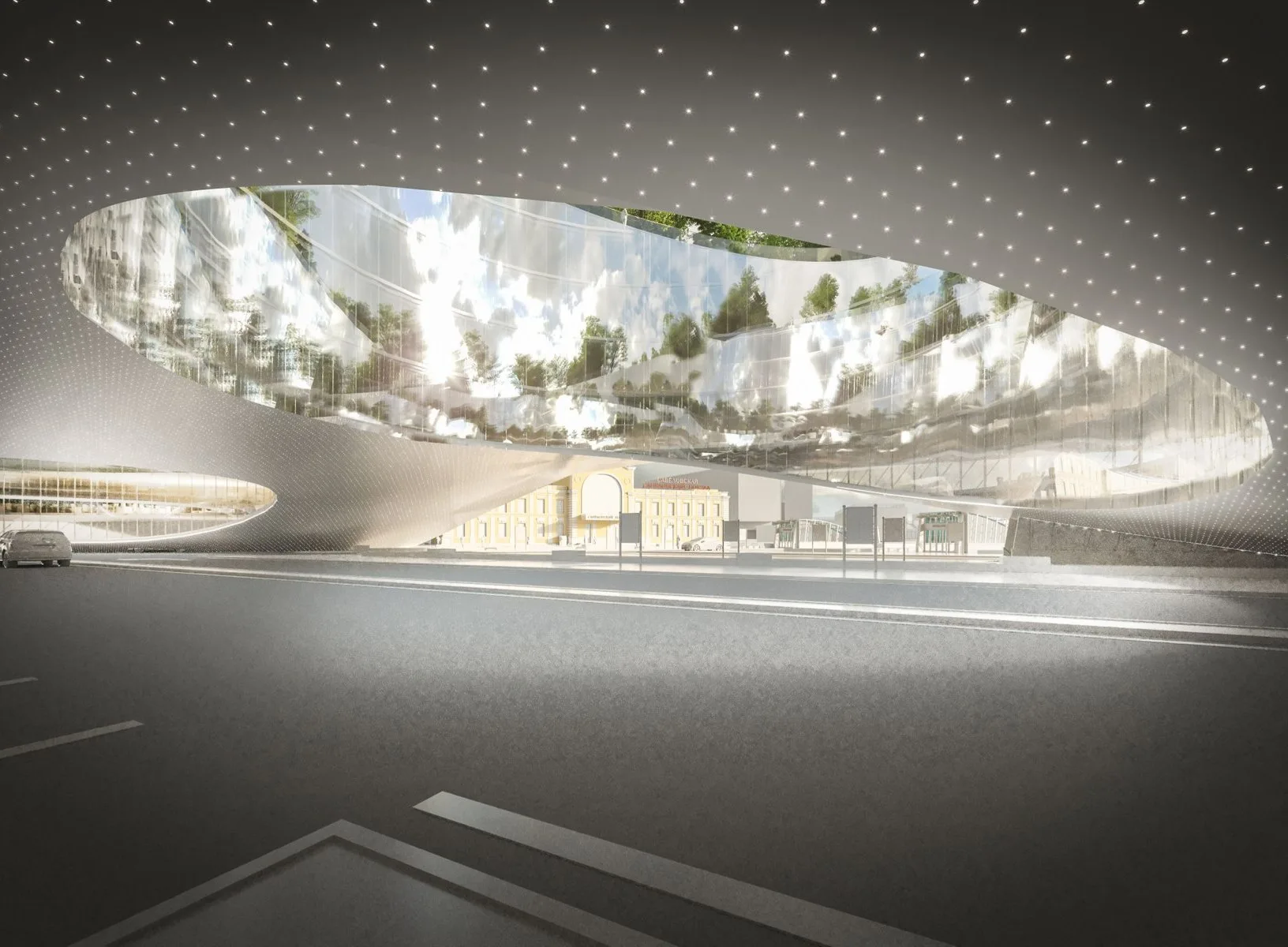
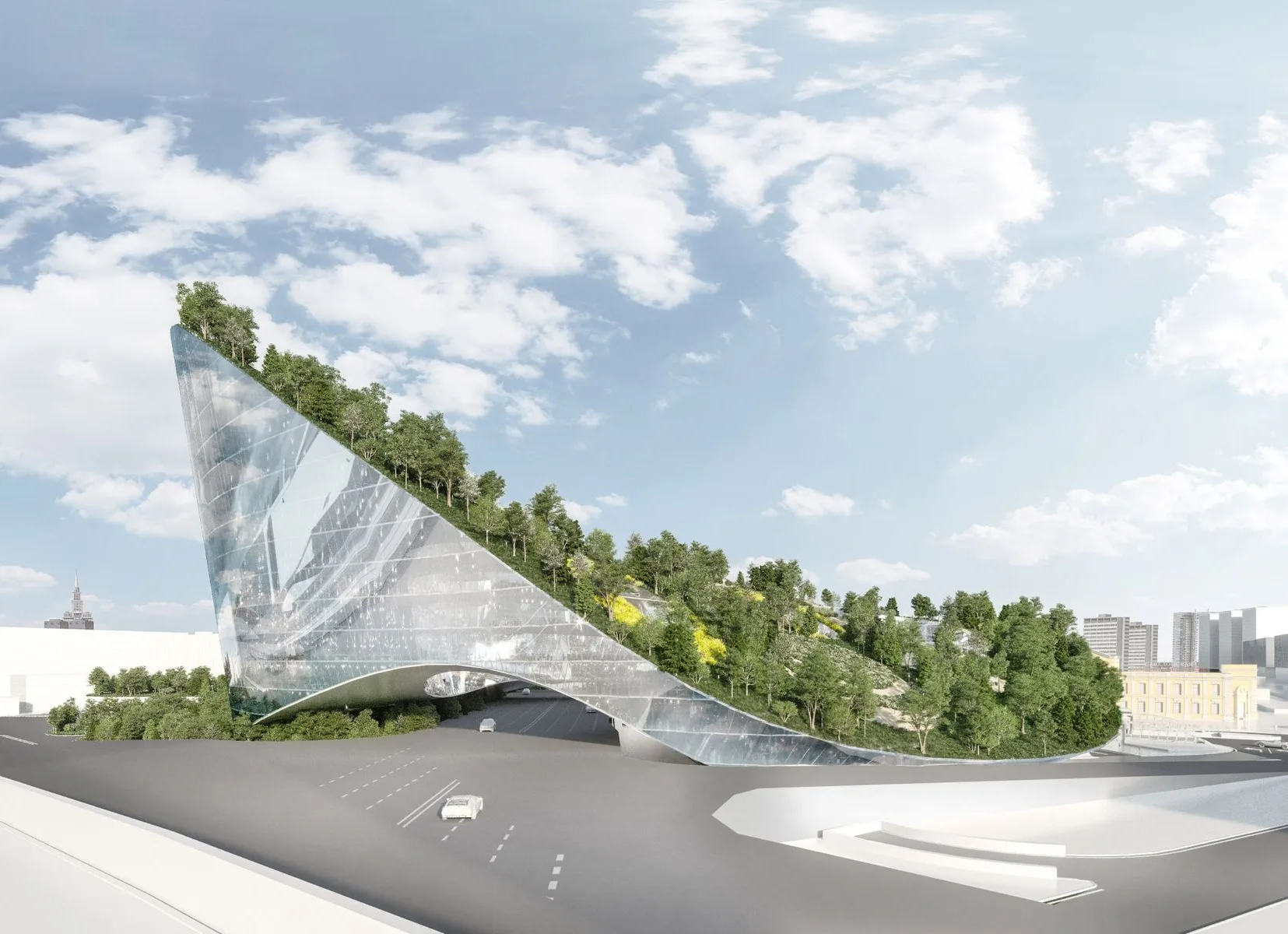
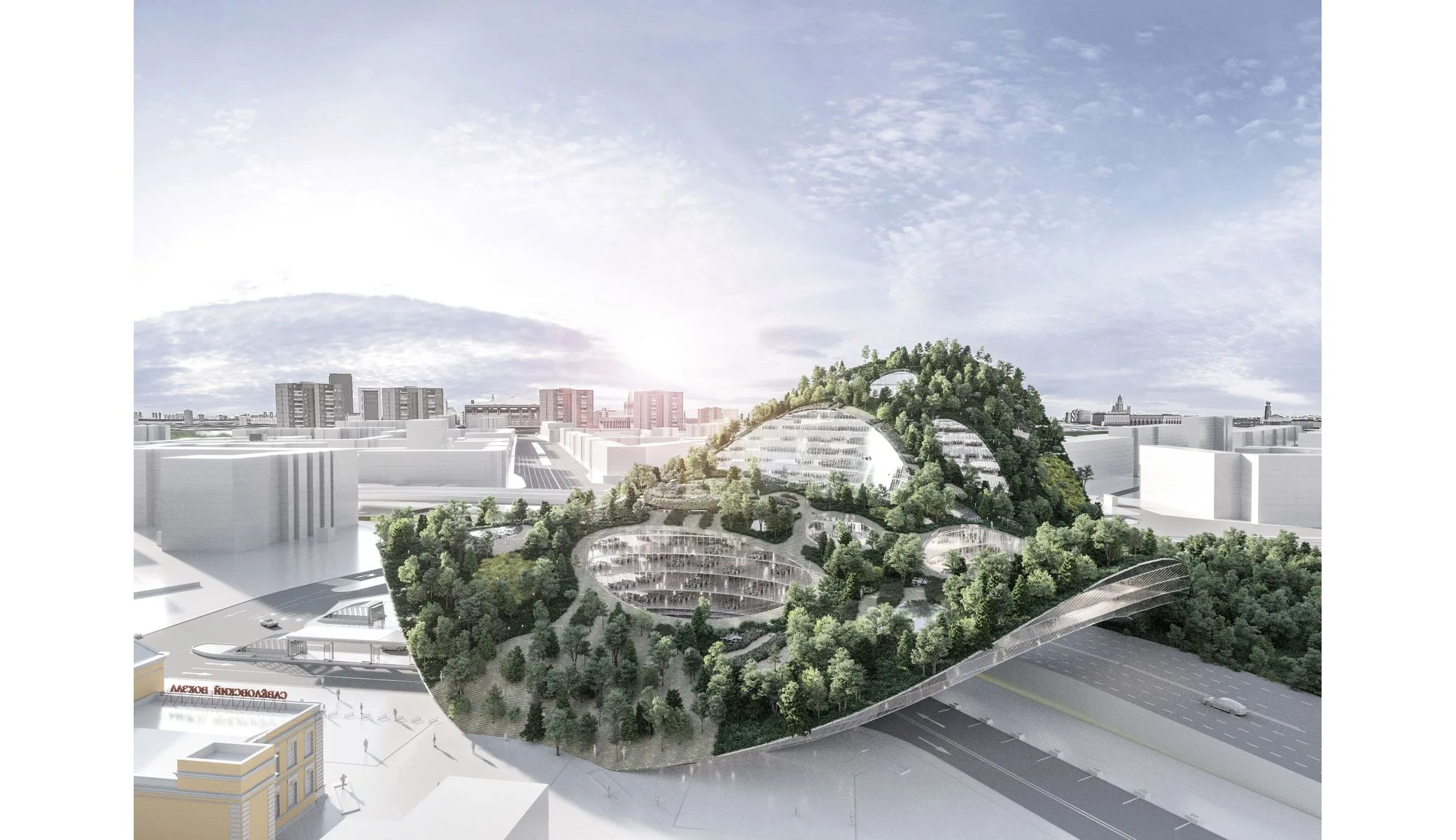
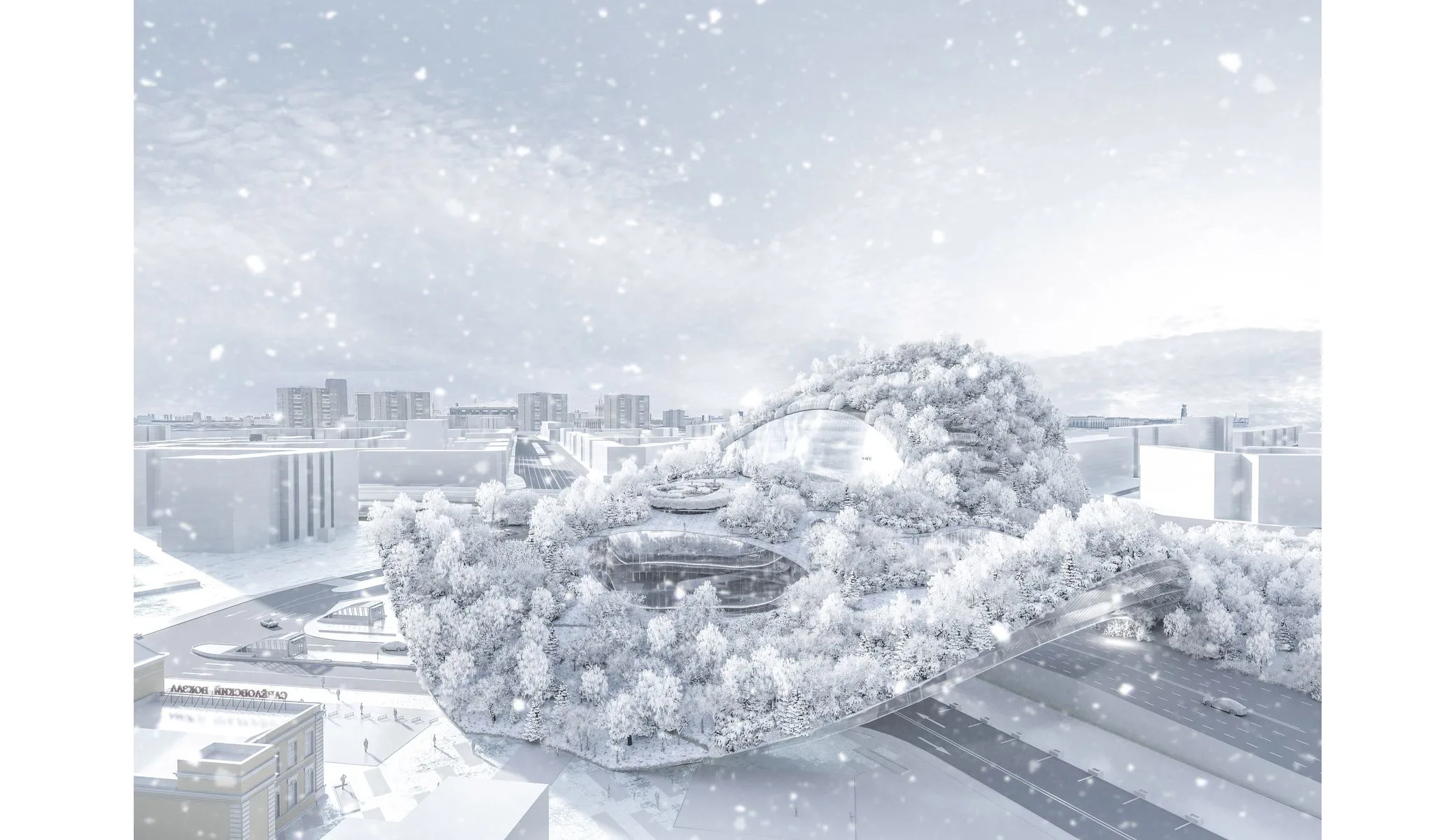
The program is ambitious: offices, hotel, retail, restaurant, bus station, totaling approximately 80,000 m². Rather than juxtaposing separate volumes, we propose a **continuous built surface**, a structure that folds, rises, hollows out to simultaneously accommodate flows and uses. The central idea is that of an **elevated park**, a vegetated promenade that spans Butyrskaya Street, a major traffic artery, and physically connects the railway station to the metro and bus terminal. This simple gesture, an inhabited bridge, radically transforms the perception of the site. It is no longer about crossing a hostile intersection, but about walking through an elevated garden, protected from noise, open to the sky.
The project's morphology flows directly from this ambition. The base accommodates retail and the bus station, constituting an **active ground floor**, constantly animated by travelers and neighborhood residents. Above, the park unfolds like a **natural canopy**, offering shade and vegetation to the bus station below. The offices and hotel emerge as distinct volumes, but connected by this shared green stratum. We worked the geometry so that the park is **accessible from all levels**, through gentle ramps, integrated stairs, visual breakthroughs. Access from the railway station occurs naturally, without interruption of continuity, as if the platform extended the park.
The patios play a structuring role. They are not simply interior courtyards, but **vertical respirations** that bring natural light and ventilation to work spaces, circulation areas, the bus station, and even the automobile lanes located underground. These through voids create porosity, a **permeability between above and below**, between the artificial and the vegetal. They also visually fragment the built mass, avoiding a monolithic effect. From the street, one glimpses the sky through the building, one senses the vegetation cascading down along the walls.
The materiality responds to this dual requirement of robustness and lightness. The base, subject to the constraints of an infrastructure program, expresses itself in **structural concrete**, treated with care to avoid brutality. The facades of the offices and hotel alternate between glass and **light-colored metal panels**, reflecting the changing light of the Moscow sky. We sought a **soft texture**, almost textile, evoking the folds of fabric stretched between support points. The park asserts its vegetal nature: mature trees, shrubs, grasses, permeable surfaces. Irrigation and maintenance are considered from the outset, with rainwater harvesting systems and a choice of species adapted to Moscow's rigorous continental climate.
The environmental approach is not limited to the park. The patios promote natural ventilation, reducing dependence on mechanical systems. Rooftop and walkway vegetation contributes to the **urban cooling island effect**, mitigating summer overheating. The **relative compactness of the built volume** limits thermal losses in winter, a critical period at these latitudes. We also studied the orientation of glazed facades to optimize passive solar gains, while integrating movable protections against glare. The objective is to reduce energy consumption while offering **maximum comfort of use**, both for office employees and passing travelers.
This project rests on a conviction: **infrastructure can become a place of life**. Too often, bus stations, interchanges, transportation nodes are treated as residual spaces, functional but inhospitable. We believe on the contrary that they offer a unique opportunity to **reinvent the city upon itself**, to create generous public spaces where they are not expected. Flowing Park is a manifesto for this architecture of movement, which no longer separates circulation and dwelling, infrastructure and landscape, but **interweaves them in a single spatial continuity**. In collaborating with Sou Fujimoto, we sought to surpass simple programmatic juxtaposition to propose an **unprecedented urban experience**, where crossing becomes strolling, where waiting becomes contemplating.
This project was not built, but it continues to fuel our reflection on **large mixed-use projects**, on the way architecture can reconcile density and quality of life, functional efficiency and spatial generosity. Flowing Park remains for us a model of what a 21st-century station could be: no longer a simple transit point, but a fragment of city in its own right, inhabited, traversed, loved.
Moscow, 2018. We are approached by Compagnie de Phalsbourg and Imagim Real Estate to imagine a mixed-use project on a fragmented site, wedged between the Third Ring Road and Savyoloskaya Station. The site, approximately 50,000 m², presents itself as a node of infrastructures: railway station, metro station, bus terminal, incessant automobile traffic. It is an intermodal transportation hub, but also a **place of rupture**, where pedestrians struggle to circulate, where public space is lacking, where the city seems to have given up offering anything other than narrow sidewalks and underground passages.
The challenge is twofold. First, **weave together** these fragmented parcels, connect the different modes of transport, streamline pedestrian routes. Second, restore to this territory an urban dimension, a **breathing space** in a capital where density and automobile traffic often saturate daily experience. We collaborate with Sou Fujimoto Architects, whose sensitivity to **organic structures** and transitions between interior and exterior nourishes our shared reflection. Together, we seek an architectural response that is not merely functional, but that invents a **new urban topography**.
The program is ambitious: offices, hotel, retail, restaurant, bus station, totaling approximately 80,000 m². Rather than juxtaposing separate volumes, we propose a **continuous built surface**, a structure that folds, rises, hollows out to simultaneously accommodate flows and uses. The central idea is that of an **elevated park**, a vegetated promenade that spans Butyrskaya Street, a major traffic artery, and physically connects the railway station to the metro and bus terminal. This simple gesture, an inhabited bridge, radically transforms the perception of the site. It is no longer about crossing a hostile intersection, but about walking through an elevated garden, protected from noise, open to the sky.
The project's morphology flows directly from this ambition. The base accommodates retail and the bus station, constituting an **active ground floor**, constantly animated by travelers and neighborhood residents. Above, the park unfolds like a **natural canopy**, offering shade and vegetation to the bus station below. The offices and hotel emerge as distinct volumes, but connected by this shared green stratum. We worked the geometry so that the park is **accessible from all levels**, through gentle ramps, integrated stairs, visual breakthroughs. Access from the railway station occurs naturally, without interruption of continuity, as if the platform extended the park.
The patios play a structuring role. They are not simply interior courtyards, but **vertical respirations** that bring natural light and ventilation to work spaces, circulation areas, the bus station, and even the automobile lanes located underground. These through voids create porosity, a **permeability between above and below**, between the artificial and the vegetal. They also visually fragment the built mass, avoiding a monolithic effect. From the street, one glimpses the sky through the building, one senses the vegetation cascading down along the walls.
The materiality responds to this dual requirement of robustness and lightness. The base, subject to the constraints of an infrastructure program, expresses itself in **structural concrete**, treated with care to avoid brutality. The facades of the offices and hotel alternate between glass and **light-colored metal panels**, reflecting the changing light of the Moscow sky. We sought a **soft texture**, almost textile, evoking the folds of fabric stretched between support points. The park asserts its vegetal nature: mature trees, shrubs, grasses, permeable surfaces. Irrigation and maintenance are considered from the outset, with rainwater harvesting systems and a choice of species adapted to Moscow's rigorous continental climate.
The environmental approach is not limited to the park. The patios promote natural ventilation, reducing dependence on mechanical systems. Rooftop and walkway vegetation contributes to the **urban cooling island effect**, mitigating summer overheating. The **relative compactness of the built volume** limits thermal losses in winter, a critical period at these latitudes. We also studied the orientation of glazed facades to optimize passive solar gains, while integrating movable protections against glare. The objective is to reduce energy consumption while offering **maximum comfort of use**, both for office employees and passing travelers.
This project rests on a conviction: **infrastructure can become a place of life**. Too often, bus stations, interchanges, transportation nodes are treated as residual spaces, functional but inhospitable. We believe on the contrary that they offer a unique opportunity to **reinvent the city upon itself**, to create generous public spaces where they are not expected. Flowing Park is a manifesto for this architecture of movement, which no longer separates circulation and dwelling, infrastructure and landscape, but **interweaves them in a single spatial continuity**. In collaborating with Sou Fujimoto, we sought to surpass simple programmatic juxtaposition to propose an **unprecedented urban experience**, where crossing becomes strolling, where waiting becomes contemplating.
This project was not built, but it continues to fuel our reflection on **large mixed-use projects**, on the way architecture can reconcile density and quality of life, functional efficiency and spatial generosity. Flowing Park remains for us a model of what a 21st-century station could be: no longer a simple transit point, but a fragment of city in its own right, inhabited, traversed, loved.
- Lieu
- Moscou
- Nature
- Programme mixte
- Surface
- 80 000 m2
- Concours
- 2018
- MOA
- Compagnie de Phalsbourg + Imagim Real Estate
- Co-architectes
- Sou Fujimoto Architects