
Mille Arbres
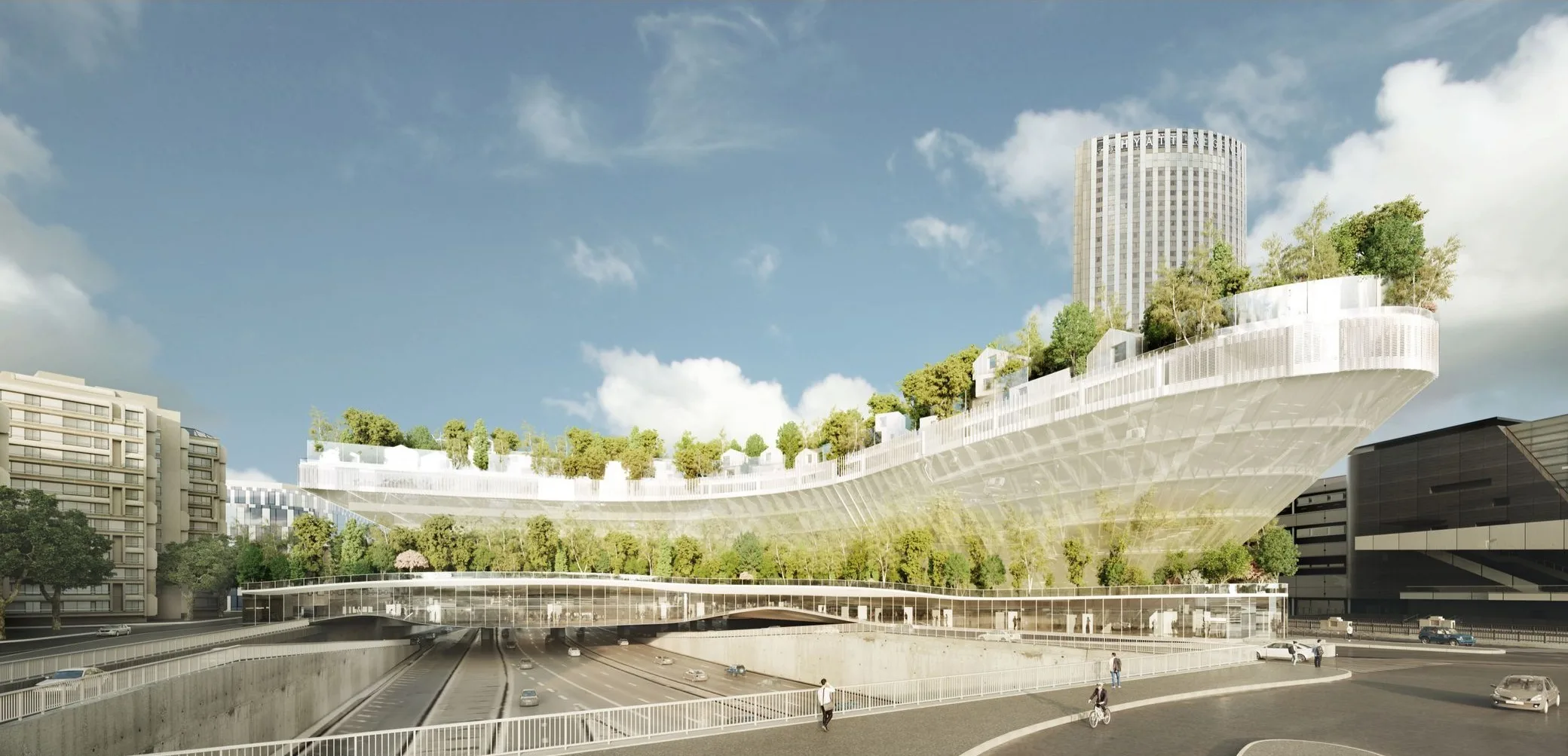
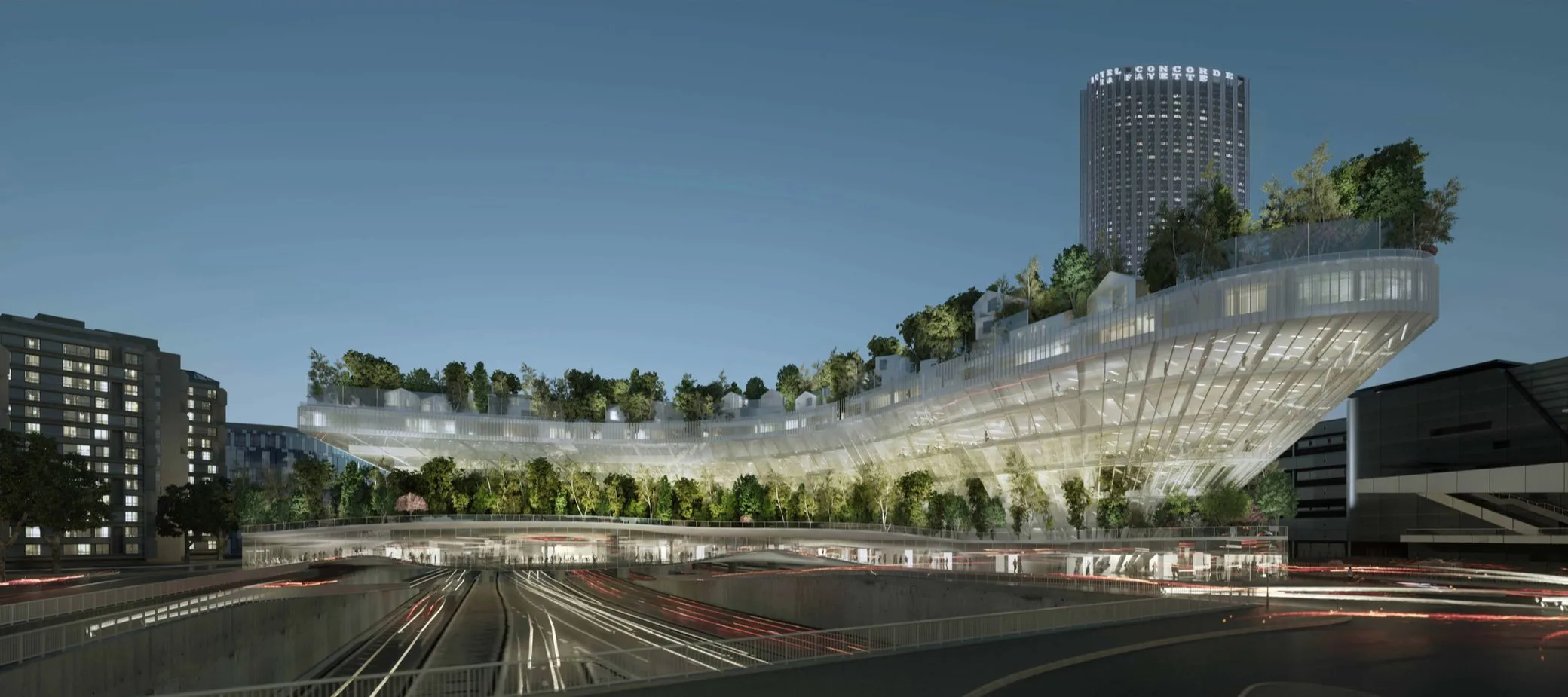
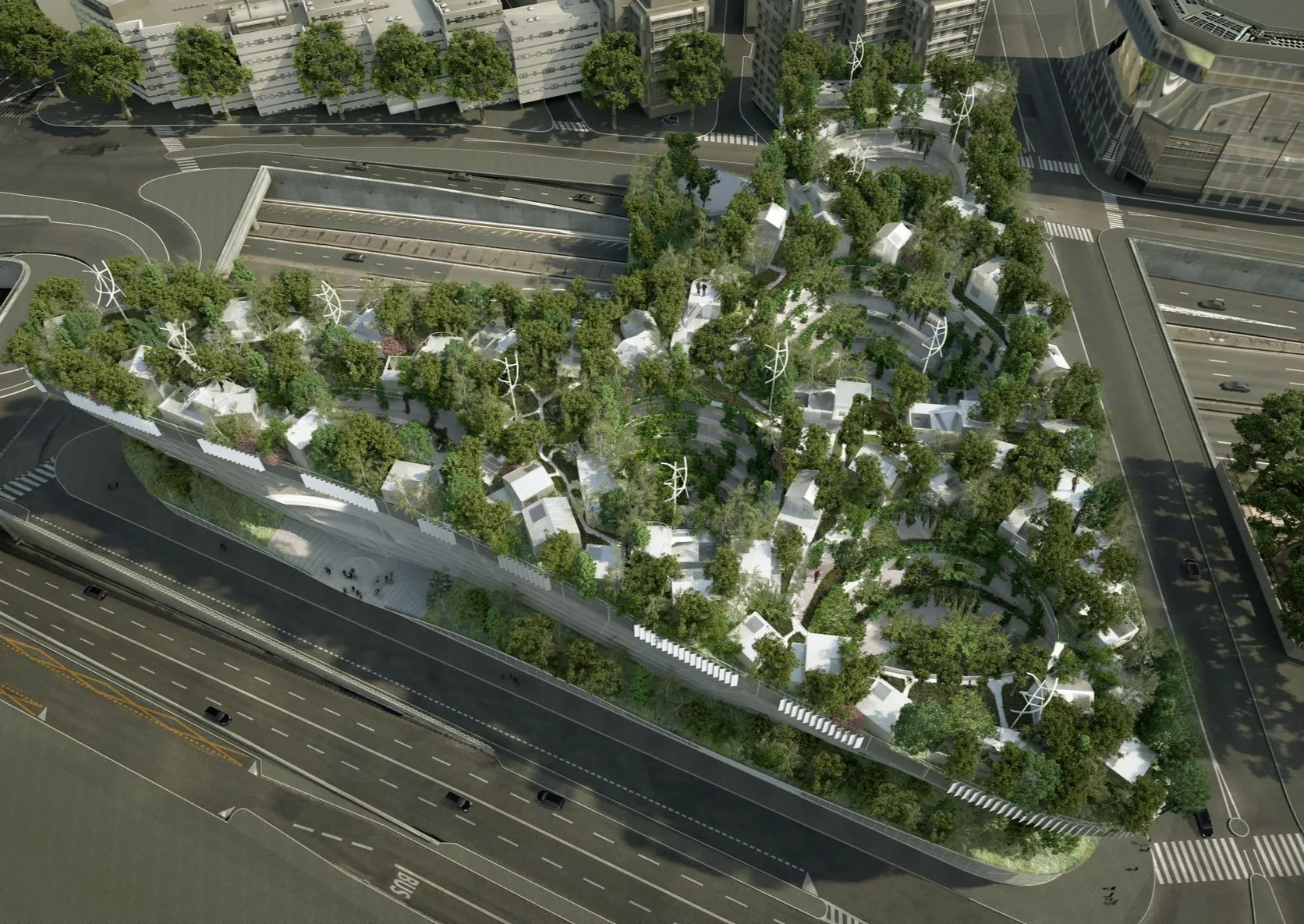
Mille Arbres is an urban gamble: building above the Paris périphérique, transforming a boundary into an inhabited bridge. The building spans the A1 highway between Paris and Levallois-Perret and accommodates housing, offices, shops, and a suspended one-hectare forest. Winner of an international competition, designed in collaboration with Sou Fujimoto, Mille Arbres redefines the relationship between the city and its margins. A project that proves an urban scar can become a space of life, nature, and continuity.
We conceived **Mille Arbres** as a direct response to one of Paris's most violent fractures: the périphérique. This sunken, noisy, and polluted highway has separated the capital from its neighboring communes for decades. Between Porte Maillot and Levallois-Perret, the competition site was an urban void, a technical scar where only cars circulate. We wanted to transform this severance into a connection, this non-place into a destination. With Sou Fujimoto Architects, we imagined a building that physically spans the road infrastructure to create pedestrian and vegetal continuity between two urban territories long disconnected. The gesture is not spectacular for its own sake: it is necessary.
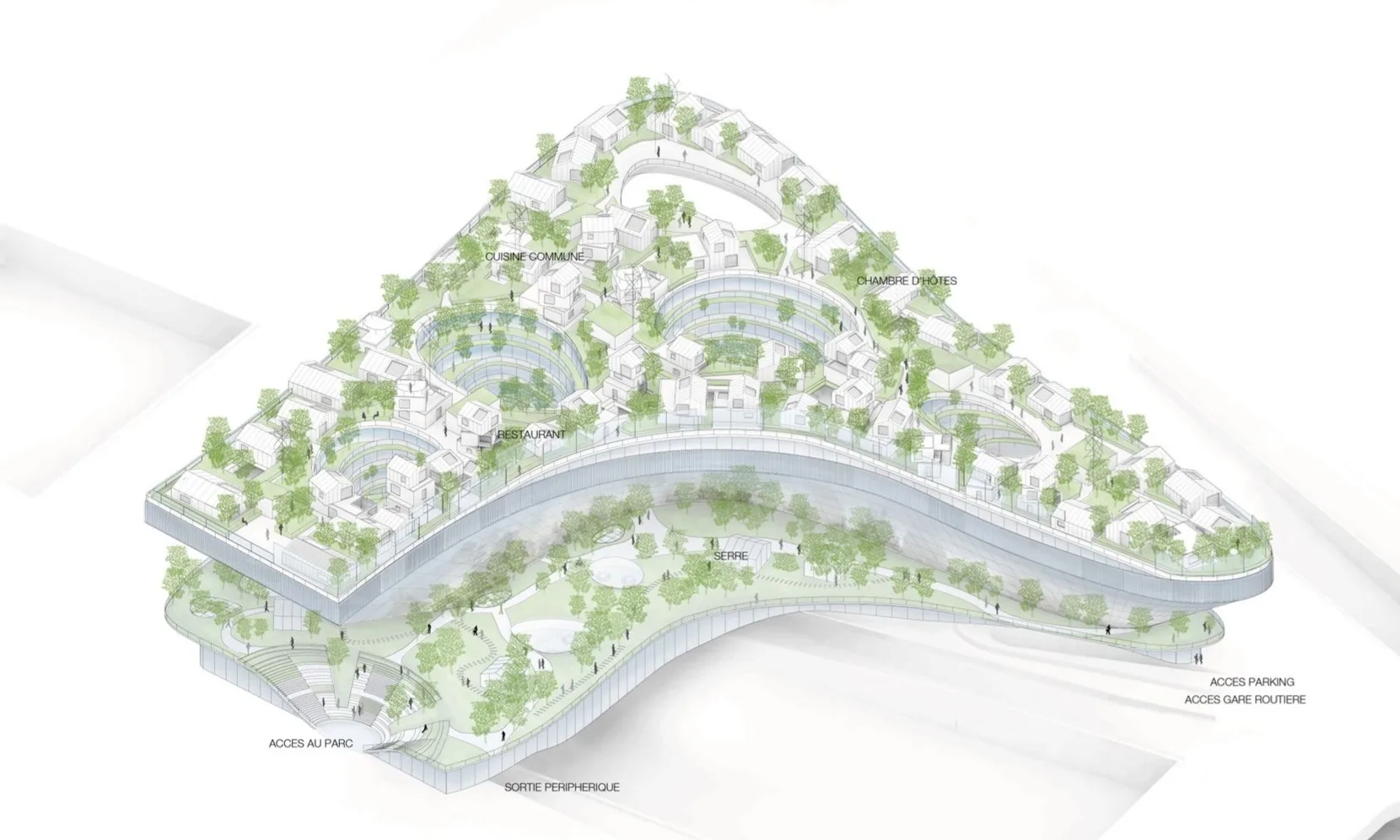
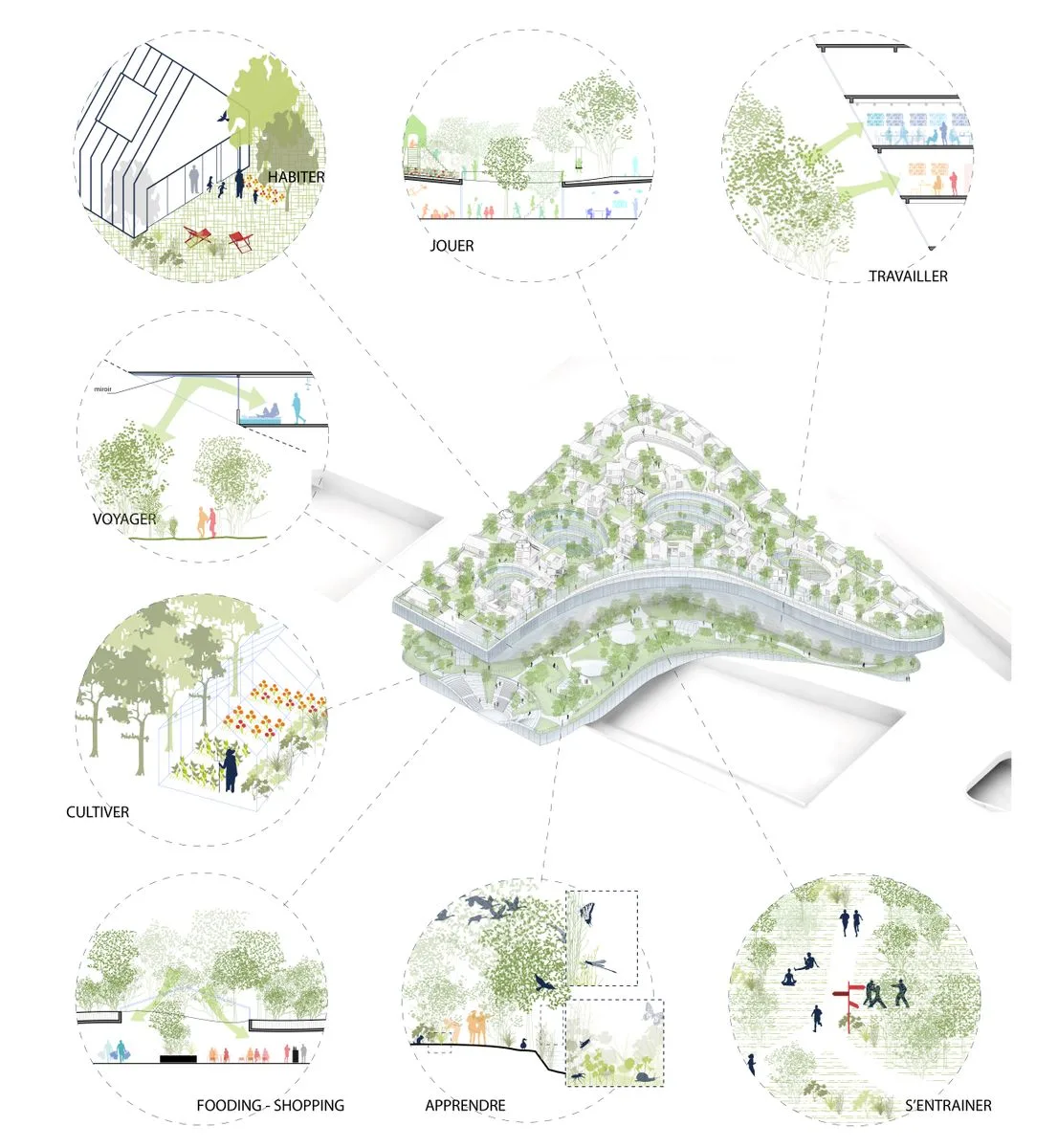
The program is deliberately **hybrid**, mixing 56,000 m² of housing, offices, shops, hotel, daycare, and bus station. This mix is not merely functional, it is structural. We refuse the idea of the mono-program, the monofunctional building that dies as soon as usage changes. Mille Arbres must live at all hours, welcoming residents, workers, visitors, families. The bus station, often relegated to the basement or distant periphery, becomes here the project's base, assumed as necessary urban infrastructure. Above, functions are superimposed and dialogue. We designed each floor plate to allow mutation: offices into housing, hotel into residences, shops into facilities. This **reversibility** is a response to the unpredictable economic transformations of the metropolis. A building that cannot evolve is a condemned building.
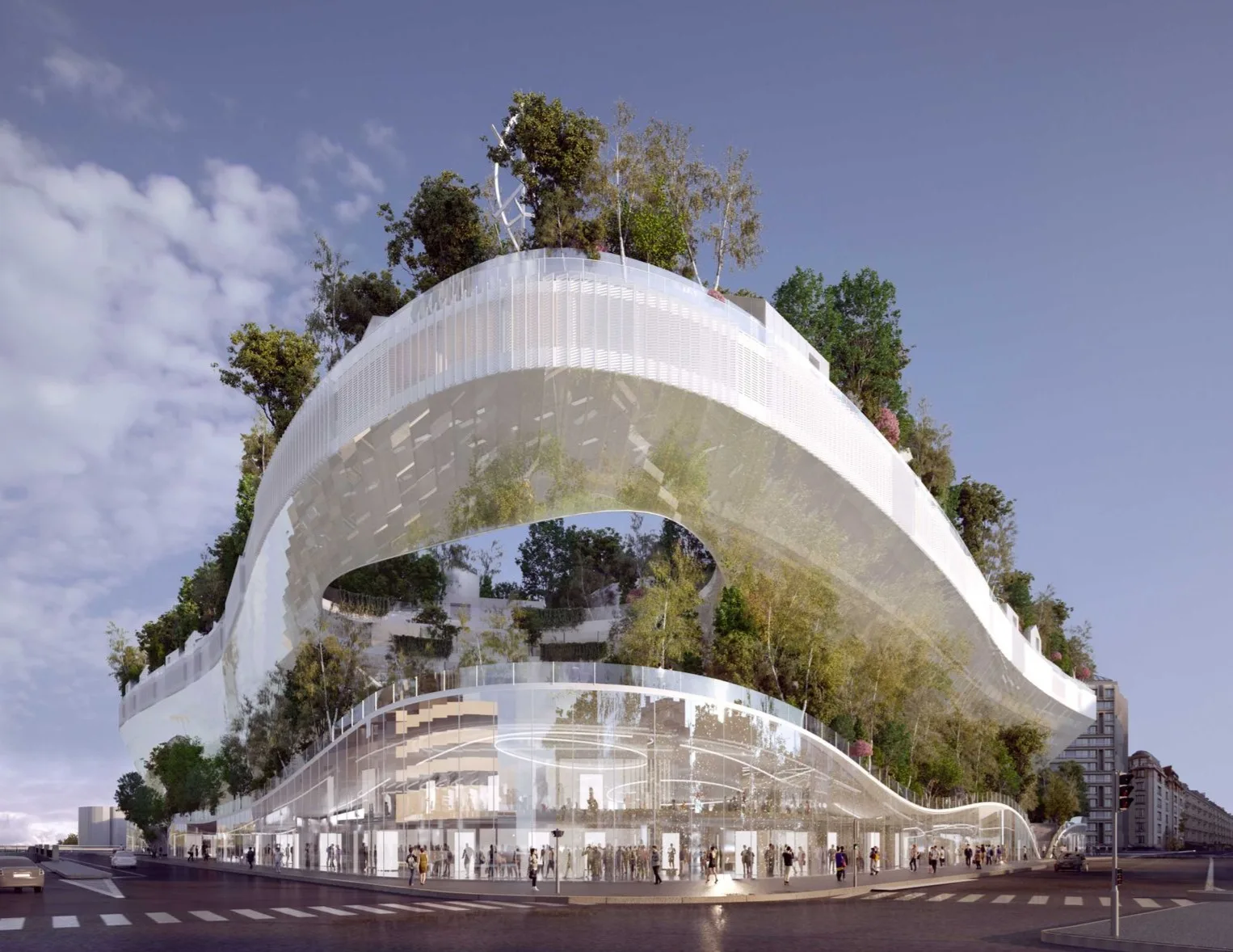
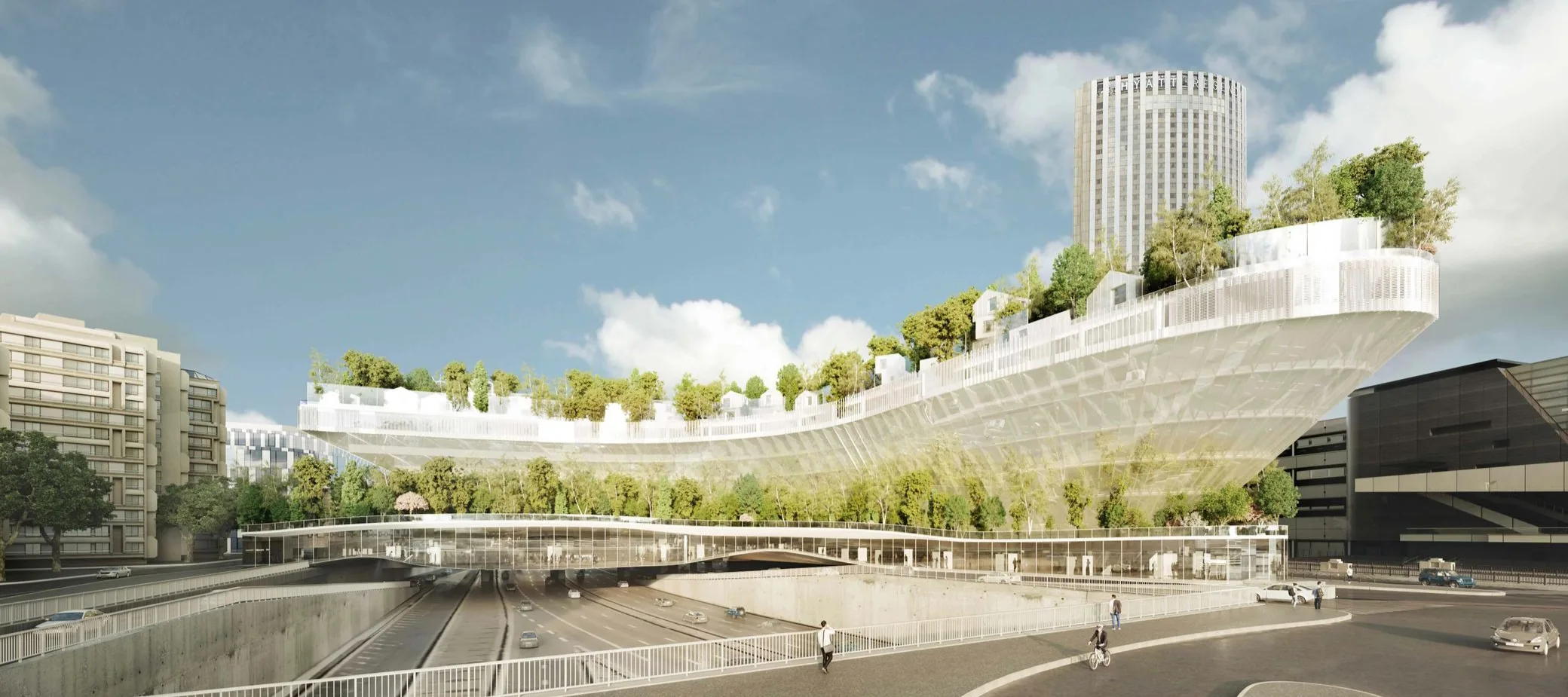
The building's form derives directly from this programmatic and urban ambition. Its **inverted pyramid** silhouette liberates the ground to the maximum extent. Rather than occupying the entire available footprint and crushing the site under an opaque slab, we chose to concentrate the mass in height, thus creating a vast public space at ground level. This gesture allows us to return nearly one hectare of park accessible to all, a continuous ground that crosses the project from east to west, crosses the périphérique and connects Paris to Levallois without interruption. This park is not a landscaping amenity, it is the **central urban device** that makes the entire neighborhood function. By deploying the construction upward, we gained space for inhabitants, for trees, for pedestrian and bicycle flows. This inverted pyramid becomes a legible figure in the landscape, recognizable, capable of signaling the ongoing suture between two pieces of city.
The project's **materiality** rests on a hybrid timber-concrete structure and an envelope that assumes its complexity. We worked with Sou Fujimoto on the idea of a building-forest, where vegetation would not be simply placed on the façade but structurally integrated. Deep planting beds accommodate trees, shrubs, and perennials on all accessible terraces. These plantings are not cosmetic: they participate in the building's thermal management, stormwater retention, local biodiversity, and user comfort. We studied the solar orientation of each terrace to choose adapted species. The building becomes a **living support**, an infrastructure for vegetation as much as for humans. The façades are punctuated by metal frames that structure the plantings and visually unify the heterogeneous programs. These frames create a depth, an inhabited thickness that protects the housing from direct light and périphérique noise. They also form a continuous vegetal filter, a porous membrane between interior and exterior.
Our **environmental approach** is not limited to greening rooftops. It begins with economy of means and structural sobriety. Building above a highway imposes major technical constraints: long spans, vibrations, noise nuisances, atmospheric pollution. We designed a lightweight timber structure for the upper floors to limit loads on the main supports. Timber also significantly reduces the construction's carbon footprint compared to an all-concrete system. The vegetated roofs retain rainwater and reduce urban heat islands. Cross-ventilated housing benefits from natural ventilation. Planted buffer spaces create favorable microclimates in summer. We also conceived the reversibility of floor plates as a **sustainability** tool: a building that can change use without demolition is a building that will last. The city changes, needs evolve, architecture must be able to follow.
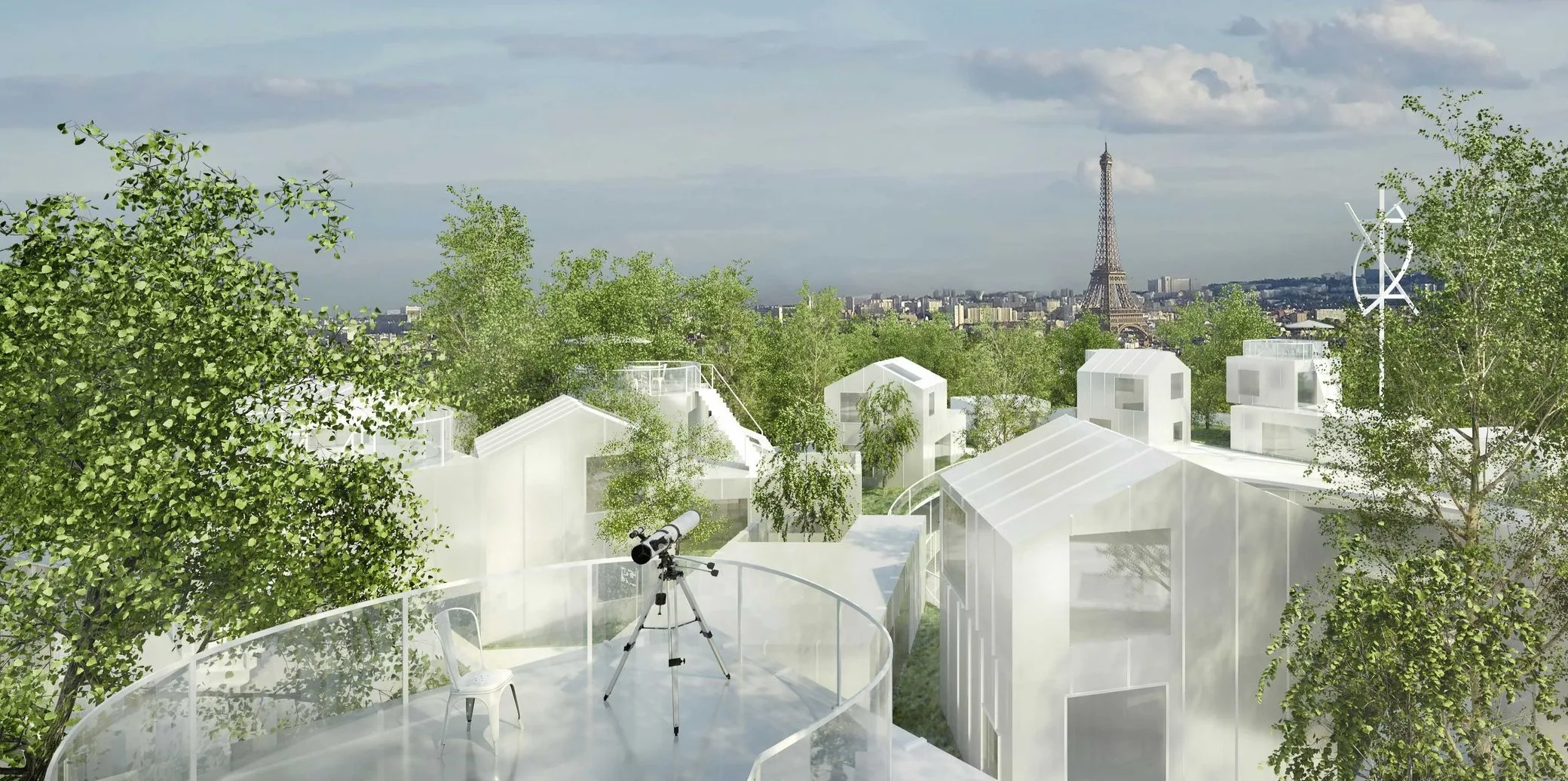
Mille Arbres is not an isolated object, it is a **fragment of vertical city**. We imagined interior circulations as streets in section, exterior walkways that extend public space into the floors. Residents do not merely inhabit an apartment: they also inhabit a suspended park, share common terraces, encounter workers, hotel guests, daycare children. This programmatic cohabitation is a richness, it produces social complexity and urban vitality. The building never closes completely, it remains animated, inhabited, traversed.
This project also raises the question of the **status of infrastructure** in the contemporary city. Can we build above highways, rail lines, parking lots? Can we recycle technical spaces to make them living places? Mille Arbres answers yes. The dense metropolis no longer has the luxury of wasting its footprints. Every square meter counts. Rather than sprawling the city ever further, we propose to thicken it, to superimpose uses, to make cohabit what was separated. This is not a high-tech utopia, it is a pragmatic strategy for a more compact, more intense, more sustainable city. Mille Arbres proves that a hostile infrastructure can become a support for nature and sociability, that a boundary can become a place.
The program is deliberately **hybrid**, mixing 56,000 m² of housing, offices, shops, hotel, daycare, and bus station. This mix is not merely functional, it is structural. We refuse the idea of the mono-program, the monofunctional building that dies as soon as usage changes. Mille Arbres must live at all hours, welcoming residents, workers, visitors, families. The bus station, often relegated to the basement or distant periphery, becomes here the project's base, assumed as necessary urban infrastructure. Above, functions are superimposed and dialogue. We designed each floor plate to allow mutation: offices into housing, hotel into residences, shops into facilities. This **reversibility** is a response to the unpredictable economic transformations of the metropolis. A building that cannot evolve is a condemned building.
The building's form derives directly from this programmatic and urban ambition. Its **inverted pyramid** silhouette liberates the ground to the maximum extent. Rather than occupying the entire available footprint and crushing the site under an opaque slab, we chose to concentrate the mass in height, thus creating a vast public space at ground level. This gesture allows us to return nearly one hectare of park accessible to all, a continuous ground that crosses the project from east to west, crosses the périphérique and connects Paris to Levallois without interruption. This park is not a landscaping amenity, it is the **central urban device** that makes the entire neighborhood function. By deploying the construction upward, we gained space for inhabitants, for trees, for pedestrian and bicycle flows. This inverted pyramid becomes a legible figure in the landscape, recognizable, capable of signaling the ongoing suture between two pieces of city.
The project's **materiality** rests on a hybrid timber-concrete structure and an envelope that assumes its complexity. We worked with Sou Fujimoto on the idea of a building-forest, where vegetation would not be simply placed on the façade but structurally integrated. Deep planting beds accommodate trees, shrubs, and perennials on all accessible terraces. These plantings are not cosmetic: they participate in the building's thermal management, stormwater retention, local biodiversity, and user comfort. We studied the solar orientation of each terrace to choose adapted species. The building becomes a **living support**, an infrastructure for vegetation as much as for humans. The façades are punctuated by metal frames that structure the plantings and visually unify the heterogeneous programs. These frames create a depth, an inhabited thickness that protects the housing from direct light and périphérique noise. They also form a continuous vegetal filter, a porous membrane between interior and exterior.
Our **environmental approach** is not limited to greening rooftops. It begins with economy of means and structural sobriety. Building above a highway imposes major technical constraints: long spans, vibrations, noise nuisances, atmospheric pollution. We designed a lightweight timber structure for the upper floors to limit loads on the main supports. Timber also significantly reduces the construction's carbon footprint compared to an all-concrete system. The vegetated roofs retain rainwater and reduce urban heat islands. Cross-ventilated housing benefits from natural ventilation. Planted buffer spaces create favorable microclimates in summer. We also conceived the reversibility of floor plates as a **sustainability** tool: a building that can change use without demolition is a building that will last. The city changes, needs evolve, architecture must be able to follow.
Mille Arbres is not an isolated object, it is a **fragment of vertical city**. We imagined interior circulations as streets in section, exterior walkways that extend public space into the floors. Residents do not merely inhabit an apartment: they also inhabit a suspended park, share common terraces, encounter workers, hotel guests, daycare children. This programmatic cohabitation is a richness, it produces social complexity and urban vitality. The building never closes completely, it remains animated, inhabited, traversed.
This project also raises the question of the **status of infrastructure** in the contemporary city. Can we build above highways, rail lines, parking lots? Can we recycle technical spaces to make them living places? Mille Arbres answers yes. The dense metropolis no longer has the luxury of wasting its footprints. Every square meter counts. Rather than sprawling the city ever further, we propose to thicken it, to superimpose uses, to make cohabit what was separated. This is not a high-tech utopia, it is a pragmatic strategy for a more compact, more intense, more sustainable city. Mille Arbres proves that a hostile infrastructure can become a support for nature and sociability, that a boundary can become a place.
- Lieu
- Paris
- Nature
- Mixte
- Surface
- 56 000 m²
- Budget
- 250 M€
- Concours
- 2016
- MOA
- Compagnie de Phalsbourg, OGIC
- Co-architectes
- Sou Fujimoto Architects
Distinctions