
Bondy Station
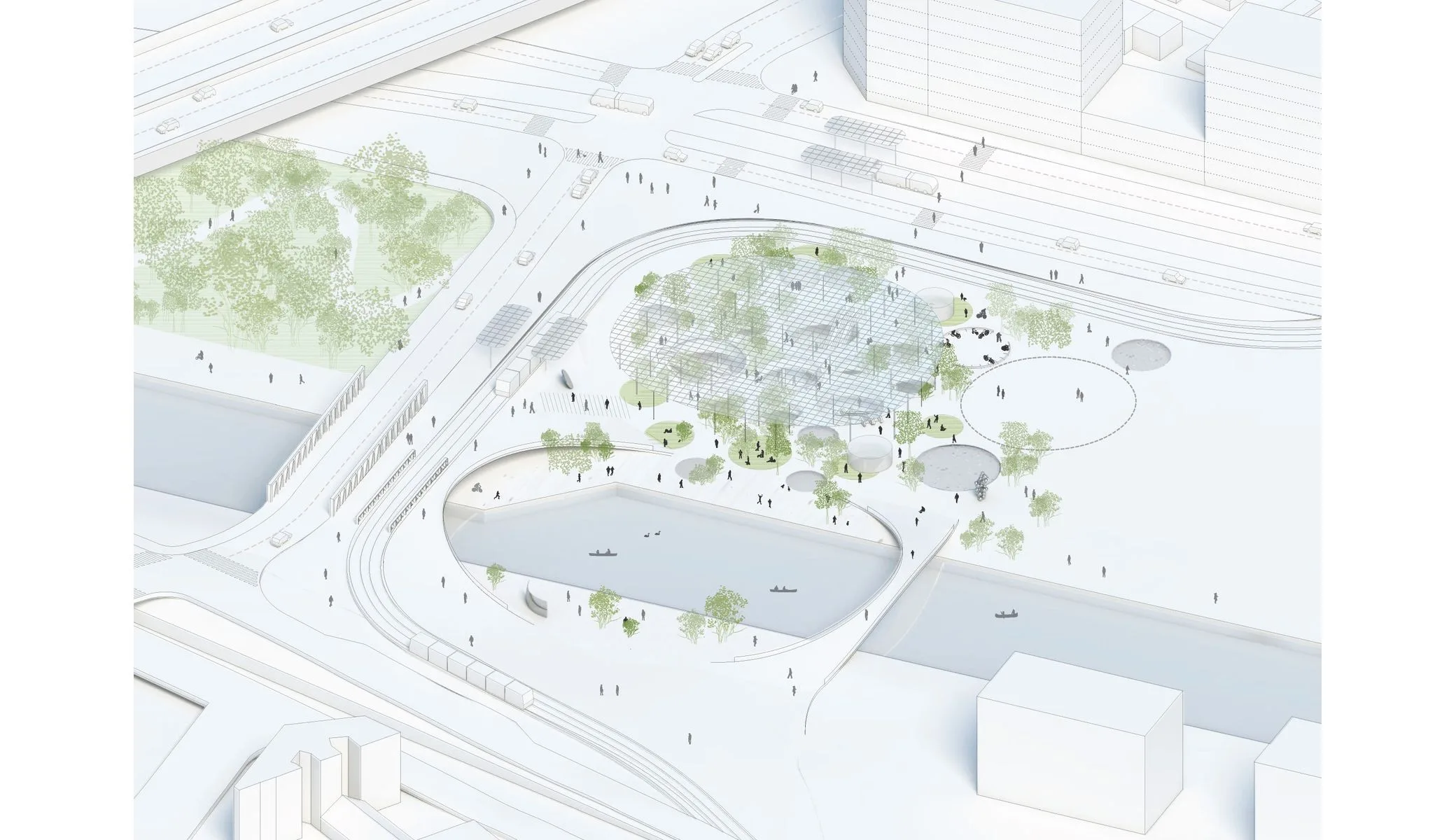
Bondy station is located at the exact meeting point of three municipalities: Bobigny, Bondy, and Noisy-le-Sec. This connection point forms the starting point of our project.
We approached the Bondy station competition with Sou Fujimoto Associés from a simple yet revealing geographical observation: the site is located exactly at the convergence of three municipalities, Bobigny, Bondy, and Noisy-le-Sec. This situation is far from insignificant. It makes the station much more than a simple stop on line 15 of the Grand Paris Express. It makes it a **place of crossing**, an interface between distinct urban territories, a space where multiple narratives intertwine. Our project starts from this reality to propose an architecture that does not merely fulfill a technical function but reinvents the relationship between ground and underground, between surface and depth, between movement and pause.
The program required the creation of an 8,000 m² underground station, a heavily frequented public facility destined to become one of the key points of the Grand Paris network. But we refused to treat this infrastructure as a simple buried object, invisible from the street. On the contrary, we sought to **reverse the usual logic** of metro stations, too often confined spaces, cut off from daylight, where travelers are plunged into a succession of technical airlocks before reaching the platforms. We proposed a spatial device that makes the descending journey a **continuous urban experience**, an extension of public space rather than a break from it.
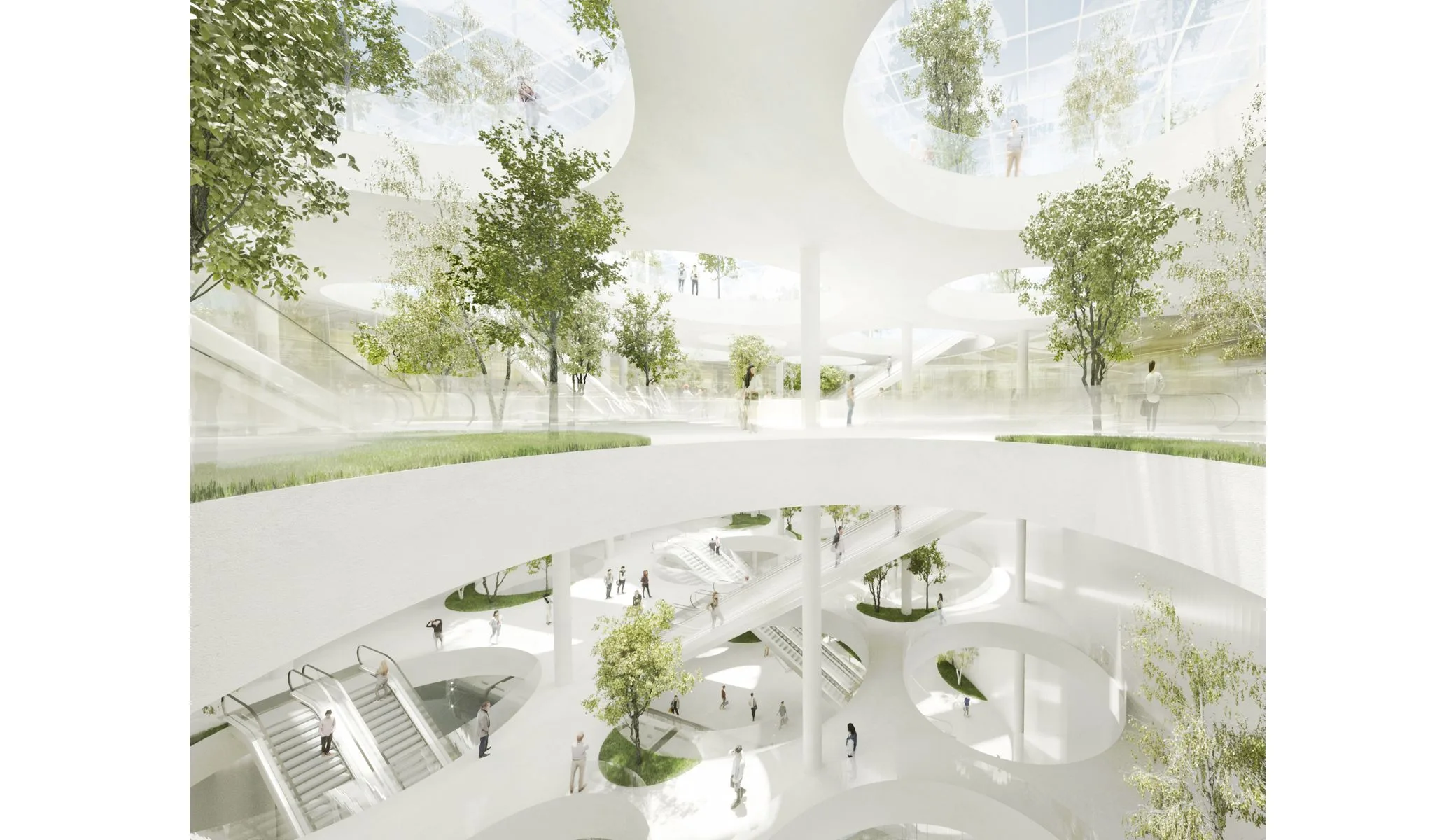
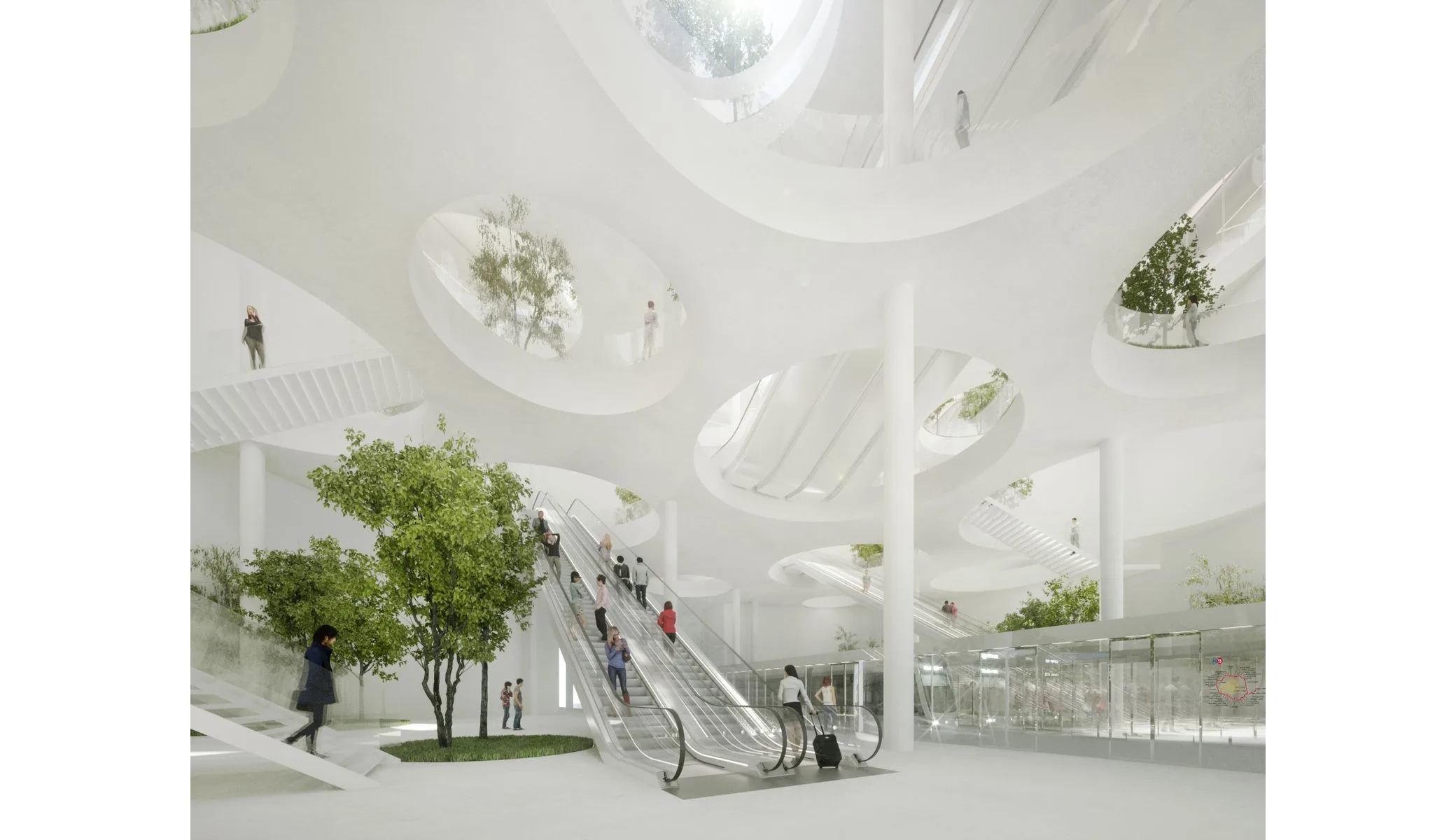
The central idea is that of the **inverted plaza**. Rather than designing a horizontal forecourt, we imagined a succession of superimposed small plazas, connected by ramps, stairs, and intermediate landings. These spaces form a vertical sequence that accompanies travelers in their descent to the platforms. Natural light plays a determining role in this device. It penetrates deeply through patios and light wells that sculpt the interior volume, creating varied atmospheres depending on the time of day. This light does not merely illuminate, it **orients, reassures, qualifies** the spaces traversed. It transforms a functional act, that of taking the metro, into a walk where the perception of time and space remains active.
This spatial continuity rests on a **strategy of porosity** between levels. We worked with Sou Fujimoto to create blurred thresholds, intermediate spaces that are neither entirely outside nor entirely inside, neither really halls nor really streets. These spaces play the role of breathing moments in the journey. They accommodate shops, rest areas, viewpoints onto lower levels. They also allow unprogrammed uses, those that emerge when architecture offers margins, nooks, unexpected situations. The traveler is not merely a flow, but becomes again a temporary inhabitant of public space.
On the architectural level, this idea of a vertical plaza translates into a **sober and legible materiality**. We favored materials capable of withstanding daily wear while maintaining a certain warmth, a certain humanity. Raw structural concrete alternates with softer coverings, wood or stone, depending on the zones. Railings, handrails, and integrated benches are designed to accompany the gesture of the body in movement. Artificial lighting, necessary in depth, dialogues with natural light without seeking to imitate it, creating a homogeneous atmosphere that avoids brutal ruptures between day and night.
The environmental dimension of this project lies primarily in this **economy of energy means** enabled by natural light input. Less artificial lighting during the day means reduced consumption over the long term, increased visual comfort, and better user orientation. But it is also a matter of thermal comfort: the patios create air chimneys that promote natural ventilation, limiting the use of mechanical air conditioning in intermediate spaces. We also conceived accessibility as a fundamental criterion, integrating elevators, gentle ramps, and clear signage from the design phase, so that this station would be truly open to all, including people with reduced mobility.
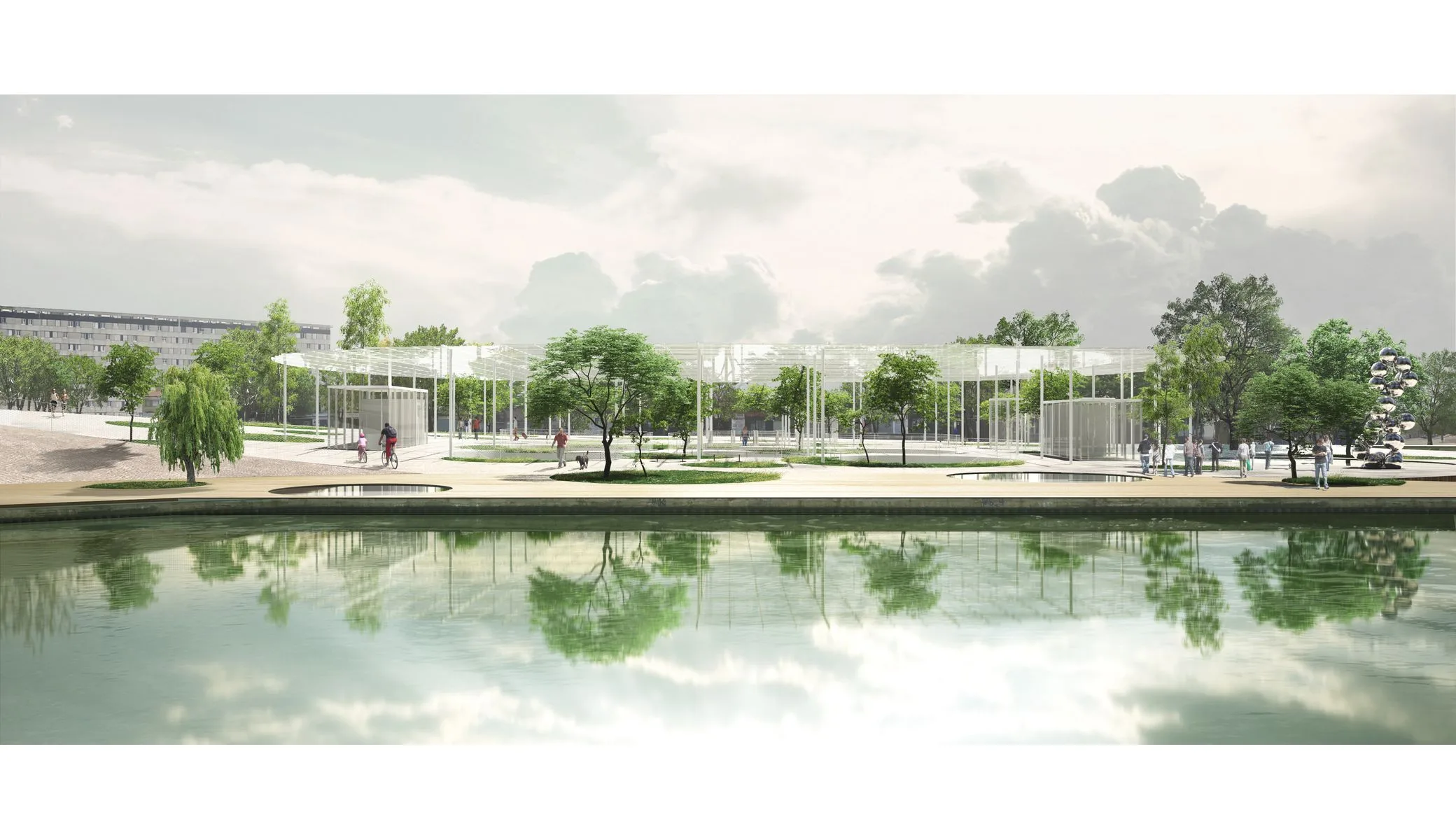
Dialogue with the site is at the heart of the approach. Bondy is not central Paris, it is a dense, composite suburban territory, where social housing, pavilions, industrial wastelands, and fragmented green spaces coexist. Our project does not seek to impose an iconic or spectacular form. It proposes instead an **active discretion**, a measured presence on the surface that unfolds in depth. The station becomes a convergence point not through its height or monumentality, but through its capacity to organize flows, to create new centralities, to offer quality public spaces where they are lacking. The upper forecourt is intended to be generous, planted, capable of accommodating varied uses beyond the sole transit function.
This project, although unrealized, remains for us an important reflection on how infrastructure architecture can participate in the making of the city. A station is not just a facility, it is an **urban catalyst**. It can be an opportunity to reweave connections, to give value to neglected spaces, to transform a transit point into a true place. With Sou Fujimoto, we sought to prove that even an underground project can be luminous, welcoming, urban. That descending into the metro can be something other than a suffered obligation, and become a moment of attention, an inhabited gesture, a conscious traversal of the thickness of the city.
The program required the creation of an 8,000 m² underground station, a heavily frequented public facility destined to become one of the key points of the Grand Paris network. But we refused to treat this infrastructure as a simple buried object, invisible from the street. On the contrary, we sought to **reverse the usual logic** of metro stations, too often confined spaces, cut off from daylight, where travelers are plunged into a succession of technical airlocks before reaching the platforms. We proposed a spatial device that makes the descending journey a **continuous urban experience**, an extension of public space rather than a break from it.
The central idea is that of the **inverted plaza**. Rather than designing a horizontal forecourt, we imagined a succession of superimposed small plazas, connected by ramps, stairs, and intermediate landings. These spaces form a vertical sequence that accompanies travelers in their descent to the platforms. Natural light plays a determining role in this device. It penetrates deeply through patios and light wells that sculpt the interior volume, creating varied atmospheres depending on the time of day. This light does not merely illuminate, it **orients, reassures, qualifies** the spaces traversed. It transforms a functional act, that of taking the metro, into a walk where the perception of time and space remains active.
This spatial continuity rests on a **strategy of porosity** between levels. We worked with Sou Fujimoto to create blurred thresholds, intermediate spaces that are neither entirely outside nor entirely inside, neither really halls nor really streets. These spaces play the role of breathing moments in the journey. They accommodate shops, rest areas, viewpoints onto lower levels. They also allow unprogrammed uses, those that emerge when architecture offers margins, nooks, unexpected situations. The traveler is not merely a flow, but becomes again a temporary inhabitant of public space.
On the architectural level, this idea of a vertical plaza translates into a **sober and legible materiality**. We favored materials capable of withstanding daily wear while maintaining a certain warmth, a certain humanity. Raw structural concrete alternates with softer coverings, wood or stone, depending on the zones. Railings, handrails, and integrated benches are designed to accompany the gesture of the body in movement. Artificial lighting, necessary in depth, dialogues with natural light without seeking to imitate it, creating a homogeneous atmosphere that avoids brutal ruptures between day and night.
The environmental dimension of this project lies primarily in this **economy of energy means** enabled by natural light input. Less artificial lighting during the day means reduced consumption over the long term, increased visual comfort, and better user orientation. But it is also a matter of thermal comfort: the patios create air chimneys that promote natural ventilation, limiting the use of mechanical air conditioning in intermediate spaces. We also conceived accessibility as a fundamental criterion, integrating elevators, gentle ramps, and clear signage from the design phase, so that this station would be truly open to all, including people with reduced mobility.
Dialogue with the site is at the heart of the approach. Bondy is not central Paris, it is a dense, composite suburban territory, where social housing, pavilions, industrial wastelands, and fragmented green spaces coexist. Our project does not seek to impose an iconic or spectacular form. It proposes instead an **active discretion**, a measured presence on the surface that unfolds in depth. The station becomes a convergence point not through its height or monumentality, but through its capacity to organize flows, to create new centralities, to offer quality public spaces where they are lacking. The upper forecourt is intended to be generous, planted, capable of accommodating varied uses beyond the sole transit function.
This project, although unrealized, remains for us an important reflection on how infrastructure architecture can participate in the making of the city. A station is not just a facility, it is an **urban catalyst**. It can be an opportunity to reweave connections, to give value to neglected spaces, to transform a transit point into a true place. With Sou Fujimoto, we sought to prove that even an underground project can be luminous, welcoming, urban. That descending into the metro can be something other than a suffered obligation, and become a moment of attention, an inhabited gesture, a conscious traversal of the thickness of the city.
- Lieu
- Bondy, France
- Nature
- ERP / Equipement
- Surface
- 8 000 m²
- Budget
- 107,6 M€
- Concours
- 2016-2017
- MOA
- Société du Grand Paris
- Co-architectes
- Sou Fujimoto Associés