
Linking Continents, Bering Strait
This is not about building a simple bridge or a commercial route to connect two continents. The scale of the site, its location, its geopolitical context as much as current ecological awareness justify a much more ambitious proposal, an active project sensitive to the site's conditions. Through its threshold position between two oceans, Pacific and Arctic, the Bering Strait has an extremely fragile climate linked to melting ice and is a strategic location for the global climate. A rare, fragile and varied ecosystem has established itself there.
We approached this ideas competition organized by the International Union of Architects in 2009 with the conviction that a project at the scale of the Bering Strait could not be reduced to a simple connecting infrastructure. It was not about tracing a commercial route or building a functional bridge between Siberia and Alaska. The scale of the site, its singular geopolitical position, the emerging ecological awareness of that era, everything commanded us to undertake a broader reflection, an **active and sensitive proposition** to the extreme conditions of this territory. The Bering Strait occupies a threshold position between two oceans, Pacific and Arctic, and constitutes a strategic location for global climate. A rare, fragile and varied ecosystem has established itself there, depending directly on the dynamics of ice and marine currents.
Our architectural approach stems from a **radical gesture**, even brutal, but assumed in its clarity. We imagined opening a trench in the shallow waters of the strait, making visible the original ground and thus connecting the two shores through a mineral emergence. This operation, almost telluric, evokes a kind of tearing of the marine surface, a gesture that could recall the mythical image of Moses parting the Red Sea. There is in this reference something of the order of marvel, but also of **controlled violence**, of respect for a force that surpasses us. We wanted the project to carry within it this ambivalence, this dialogue between human and natural, between technique and myth.
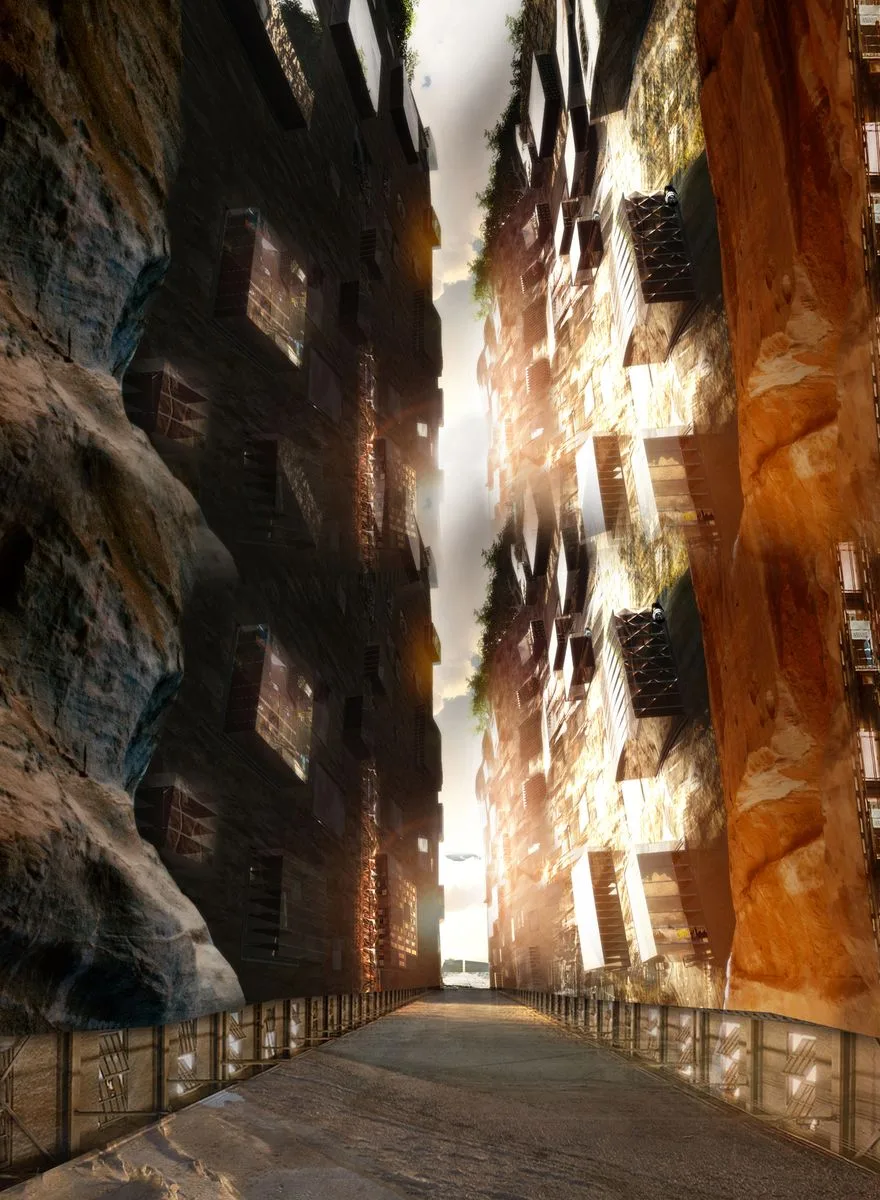
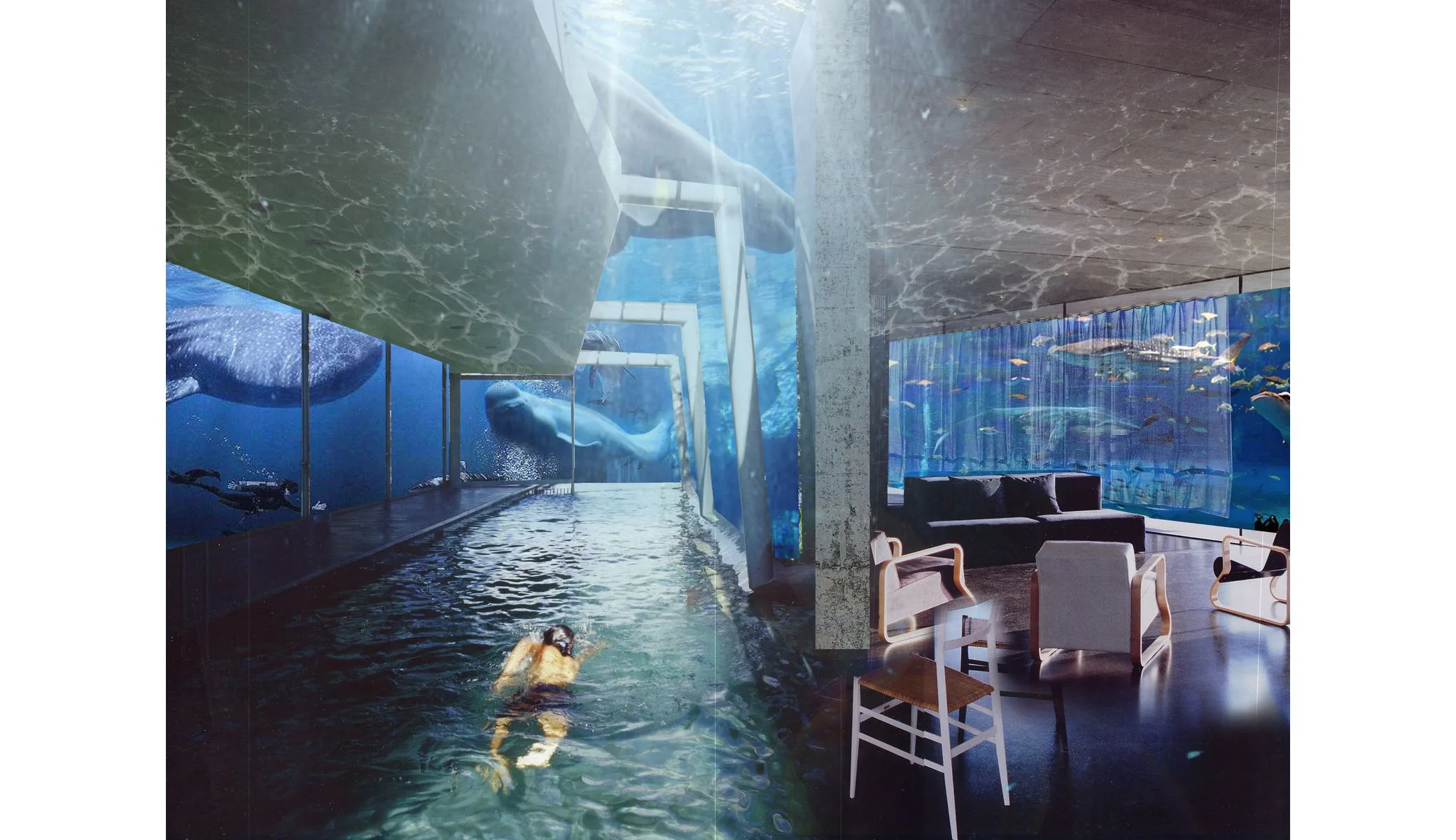
The structure consists of **two parallel walls** emerging a few meters above the sea surface. These walls, reinforced by a system of multiple braces, assume a plurality of functions. Some allow marine fauna to pass through, others capture energy from currents to produce electricity, still others accommodate varied programs, dwellings, hotels, research laboratories. The double wall acts as an **active filter**, regulating boat traffic, controlling passages, storing wave energy. We wanted this infrastructure to also be an environmental device, capable of responding to the climatic challenges of the strait, to the fragility of this ecosystem linked to melting ice.
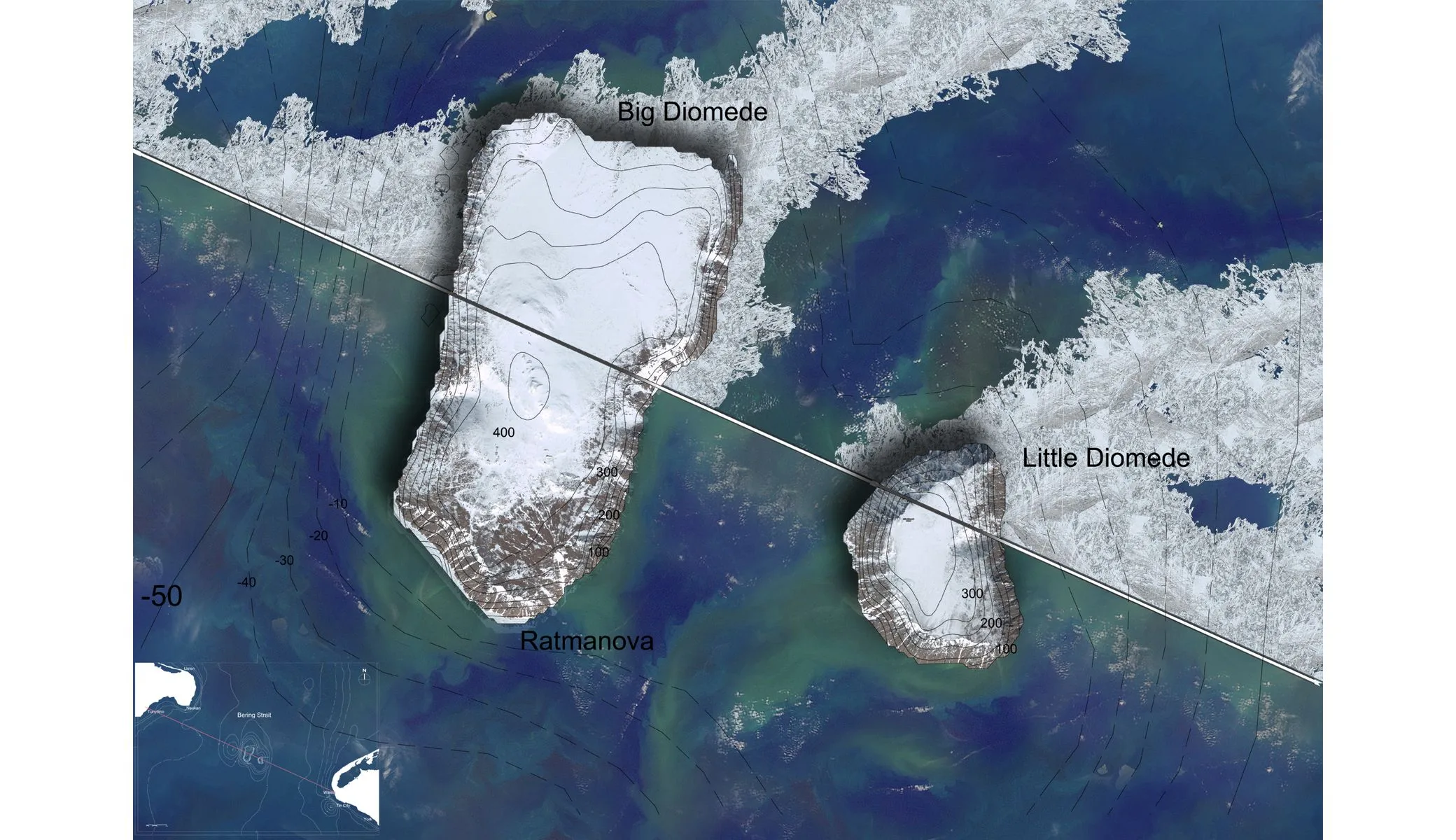
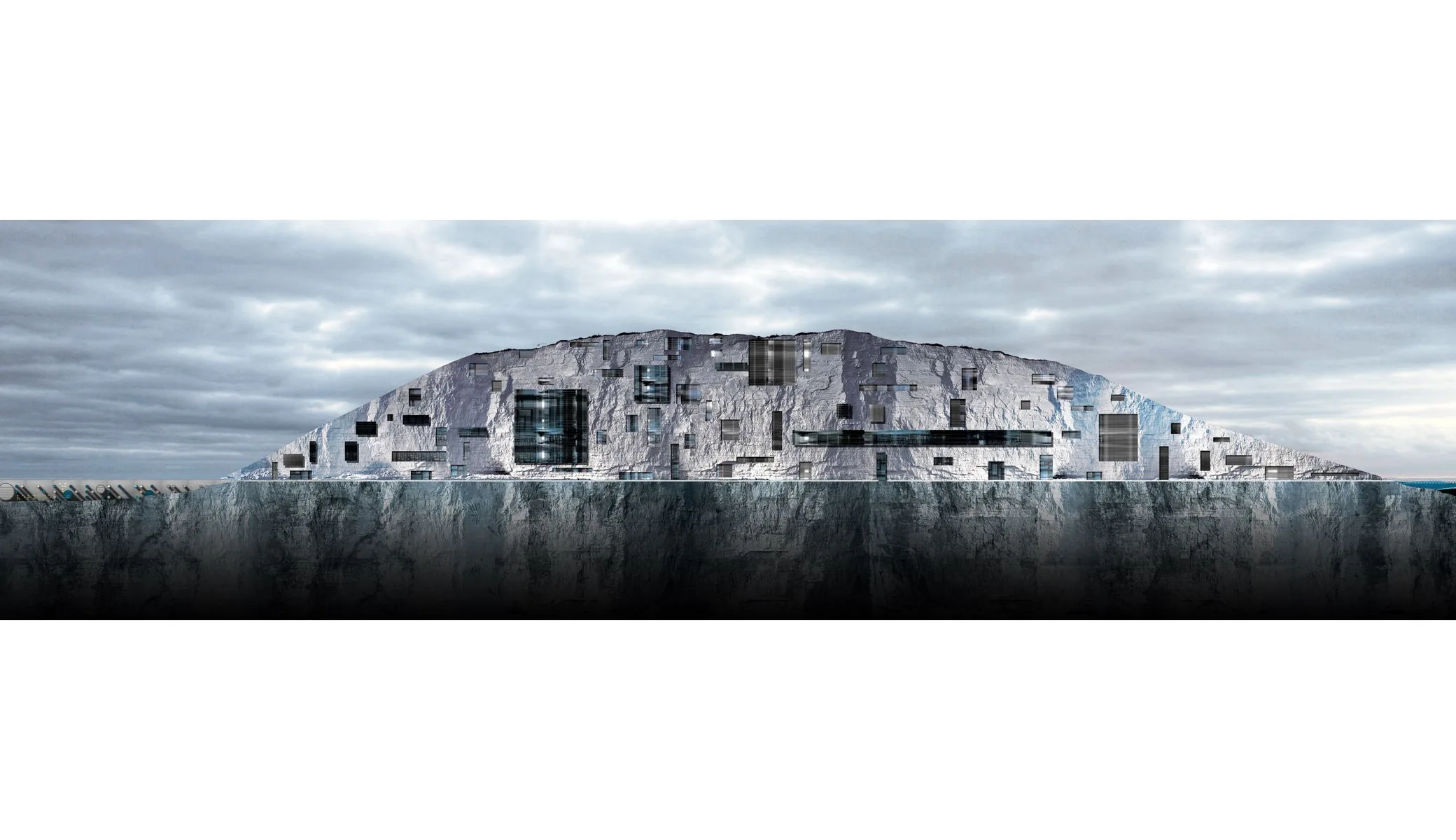
In its radicalism, the structure **slices through islands in its path**. Rather than circumventing emerging rock masses, we chose to cross through them, to inscribe the project deeply within them. This decision, which might seem violent, allowed us to maximize exploitation of the rock's thermal inertia, to install major equipment and dwellings there in optimized comfort conditions. The islands thus become anchor points, inhabited places where human presence can develop without contradicting extreme climatic conditions. The rocky ground offers stability, thermal mass, protection against winds and temperature variations. We housed the most sensitive functions there, those requiring environmental constancy, continuity of use.
The project also includes a **monument to peace**, located between the two main islands, materialized by a path of floating beacons. Each beacon is engraved with the name of a person who worked for peace, thus forming an open-air memorial gallery, exposed to the elements, mobile and fragile. This device evokes the unstable and incessant ballet of Pancakes Rocks, those circular ice formations that form and dissolve according to freeze and thaw cycles. The monument constantly replays ice formation and breakup, inscribing in its very materiality the memory of the strait's seasonal transformations. This is not a frozen monument, but a **living installation**, subjected to the site's forces, respectful of its natural dynamics.
We also integrated a reflection on the infrastructure's **ecological porosity**. The braces are not merely structural elements, they become passages, circulation chambers for fauna, energy capture devices. We conceived the project as a **hybrid ecosystem**, where technique and living things coexist, where infrastructure becomes a support for biodiversity. This approach, still uncommon in 2009, seemed necessary to us to respond to the scale and sensitivity of the place. The Bering Strait is not a neutral site, it is an active environment, a territory where biological, climatic and oceanic flows interweave in complex ways.
The project's materiality rests on an **architecture of emergence**, where ground and water constantly dialogue. The walls, made of reinforced concrete and metal structures, are designed to resist extreme constraints, ice pressures, current forces, storms. But they are also conceived to age, to gradually inscribe themselves in the landscape, to progressively become a natural element of the strait. We imagined that the project, over time, could become covered with algae, shells, become an artificial reef, a support for marine life. This slow transformation, this naturalization of infrastructure, seems essential to us for the legitimacy of the gesture.
This project received second prize in the competition. It remains for us a radical exploration of architecture's possibilities at territorial scale, a reflection on how an architectural gesture can embody both geopolitical ambition and ecological consciousness. The Bering Strait remains a place both real and mythical, and our proposal attempted to give form to this duality.
Our architectural approach stems from a **radical gesture**, even brutal, but assumed in its clarity. We imagined opening a trench in the shallow waters of the strait, making visible the original ground and thus connecting the two shores through a mineral emergence. This operation, almost telluric, evokes a kind of tearing of the marine surface, a gesture that could recall the mythical image of Moses parting the Red Sea. There is in this reference something of the order of marvel, but also of **controlled violence**, of respect for a force that surpasses us. We wanted the project to carry within it this ambivalence, this dialogue between human and natural, between technique and myth.
The structure consists of **two parallel walls** emerging a few meters above the sea surface. These walls, reinforced by a system of multiple braces, assume a plurality of functions. Some allow marine fauna to pass through, others capture energy from currents to produce electricity, still others accommodate varied programs, dwellings, hotels, research laboratories. The double wall acts as an **active filter**, regulating boat traffic, controlling passages, storing wave energy. We wanted this infrastructure to also be an environmental device, capable of responding to the climatic challenges of the strait, to the fragility of this ecosystem linked to melting ice.
In its radicalism, the structure **slices through islands in its path**. Rather than circumventing emerging rock masses, we chose to cross through them, to inscribe the project deeply within them. This decision, which might seem violent, allowed us to maximize exploitation of the rock's thermal inertia, to install major equipment and dwellings there in optimized comfort conditions. The islands thus become anchor points, inhabited places where human presence can develop without contradicting extreme climatic conditions. The rocky ground offers stability, thermal mass, protection against winds and temperature variations. We housed the most sensitive functions there, those requiring environmental constancy, continuity of use.
The project also includes a **monument to peace**, located between the two main islands, materialized by a path of floating beacons. Each beacon is engraved with the name of a person who worked for peace, thus forming an open-air memorial gallery, exposed to the elements, mobile and fragile. This device evokes the unstable and incessant ballet of Pancakes Rocks, those circular ice formations that form and dissolve according to freeze and thaw cycles. The monument constantly replays ice formation and breakup, inscribing in its very materiality the memory of the strait's seasonal transformations. This is not a frozen monument, but a **living installation**, subjected to the site's forces, respectful of its natural dynamics.
We also integrated a reflection on the infrastructure's **ecological porosity**. The braces are not merely structural elements, they become passages, circulation chambers for fauna, energy capture devices. We conceived the project as a **hybrid ecosystem**, where technique and living things coexist, where infrastructure becomes a support for biodiversity. This approach, still uncommon in 2009, seemed necessary to us to respond to the scale and sensitivity of the place. The Bering Strait is not a neutral site, it is an active environment, a territory where biological, climatic and oceanic flows interweave in complex ways.
The project's materiality rests on an **architecture of emergence**, where ground and water constantly dialogue. The walls, made of reinforced concrete and metal structures, are designed to resist extreme constraints, ice pressures, current forces, storms. But they are also conceived to age, to gradually inscribe themselves in the landscape, to progressively become a natural element of the strait. We imagined that the project, over time, could become covered with algae, shells, become an artificial reef, a support for marine life. This slow transformation, this naturalization of infrastructure, seems essential to us for the legitimacy of the gesture.
This project received second prize in the competition. It remains for us a radical exploration of architecture's possibilities at territorial scale, a reflection on how an architectural gesture can embody both geopolitical ambition and ecological consciousness. The Bering Strait remains a place both real and mythical, and our proposal attempted to give form to this duality.
- Lieu
- Sibérie, Alaska
- Nature
- Mixte
- Concours
- 2009
- MOA
- FPU organisé par l'UIA