
City Sand
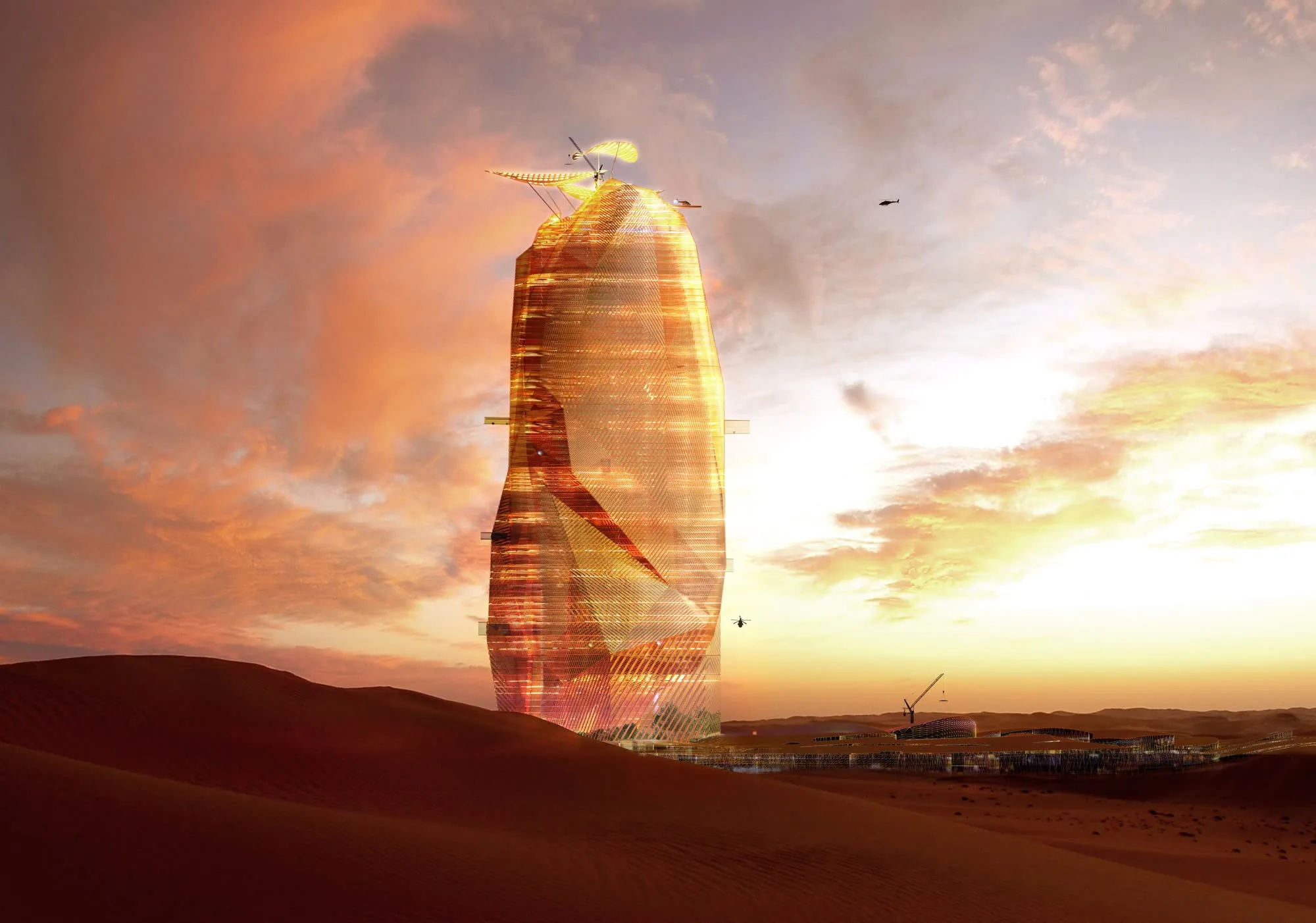
In this flat expanse, it is initially difficult to grasp its scale. From this distance, it appears to be nothing more than a rocky peak. As one approaches, the landscape hollows out, the climate softens thanks to shadows cast upon the ground. One enters a maze of streets reminiscent of oriental souks. People seem to have taken advantage of a fortunate predisposition of the terrain to settle there.
# City Sand
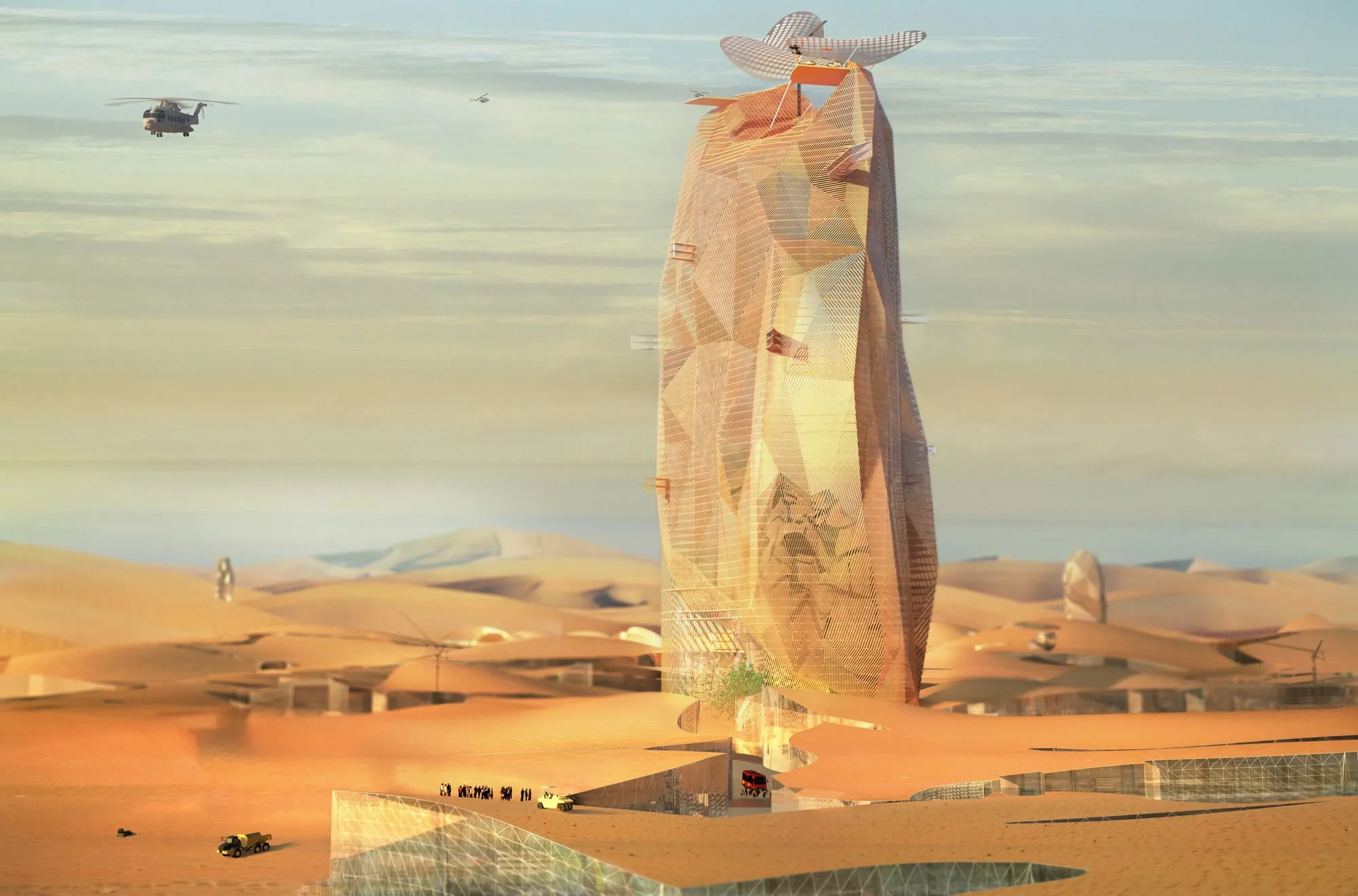
In the Moroccan Sahara, the desert stretches without apparent landmarks, a horizon where the gaze loses itself in mineral uniformity. It is in this vastness that we imagined **City Sand**, not as a brutal irruption into the landscape, but as a *telluric outgrowth*, a fragment of geography that would have emerged naturally from the ground. From a distance, the silhouette merges with a rocky accident, a peak that erosion would have sculpted. This initial ambiguity is not fortuitous: it reflects our desire to dialogue with the desert rather than deny it, to propose an architecture that inscribes itself in the **geological continuity** of the site before revealing its constructed nature.
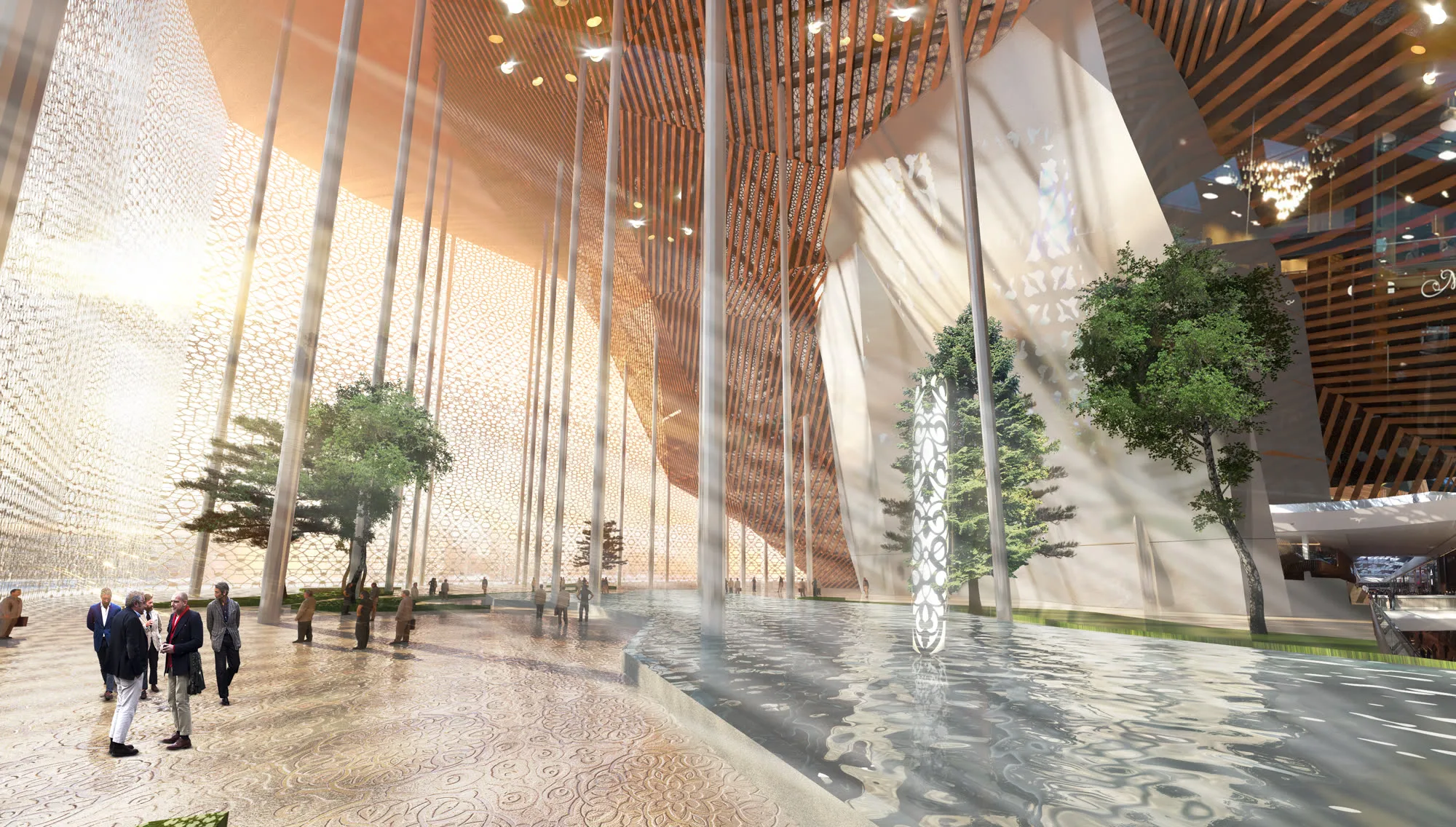
As one approaches, the landscape metamorphoses. The ground hollows out, shadows lengthen and trace pockets of coolness. One then enters a **maze of alleyways** that evokes the vernacular organization of medinas, those sinuous layouts where each turn offers climatic respite, where each nook becomes a place of collective life. This built base, a veritable horizontal city, accommodates shops, public facilities, and gathering spaces. It is not a simple pedestal for the tower: it constitutes the **urban matrix** of the project, an artificial topography that recreates the conditions of desert habitability by playing with shade, natural ventilation, and the porosity of spaces.
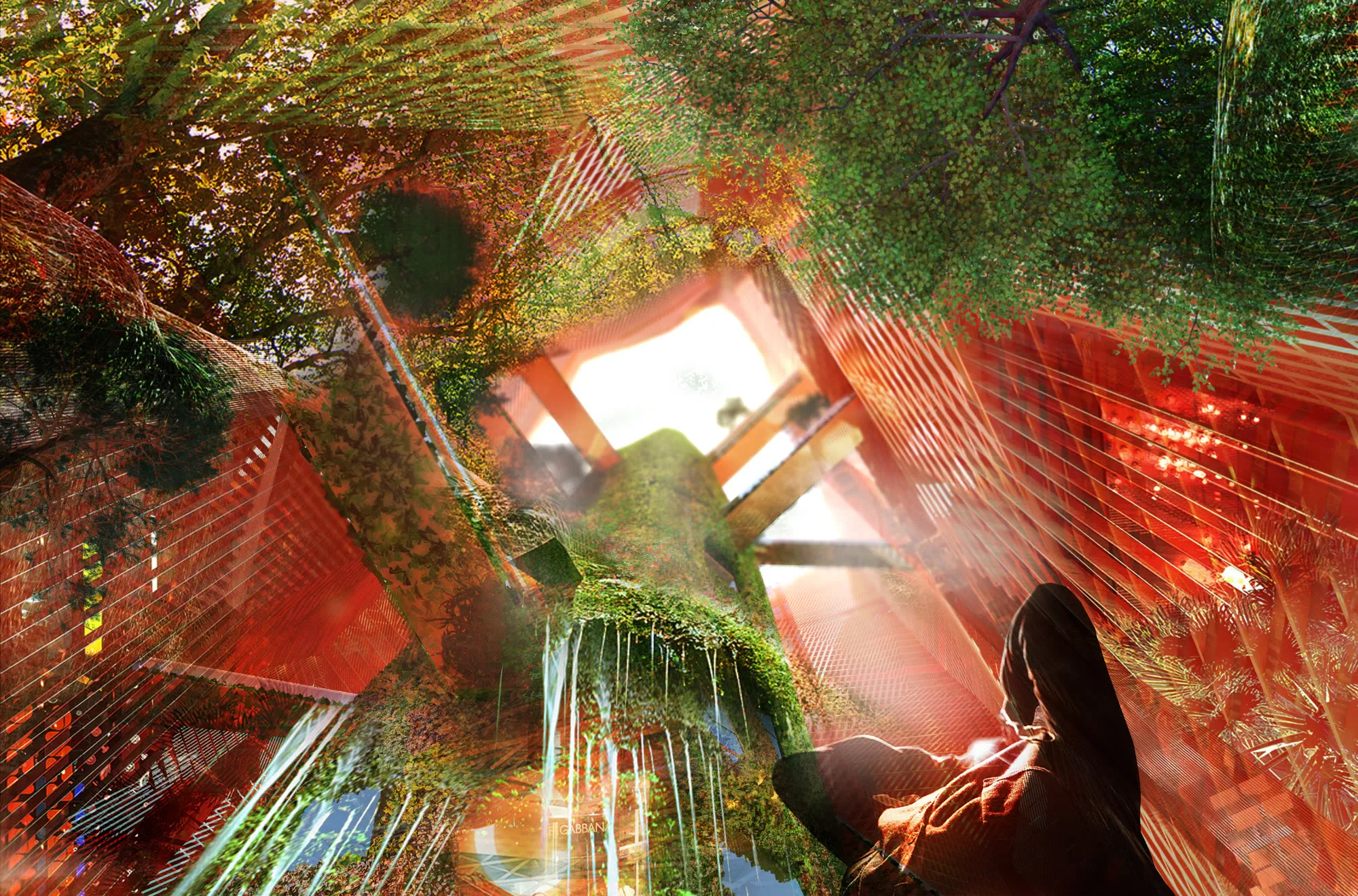
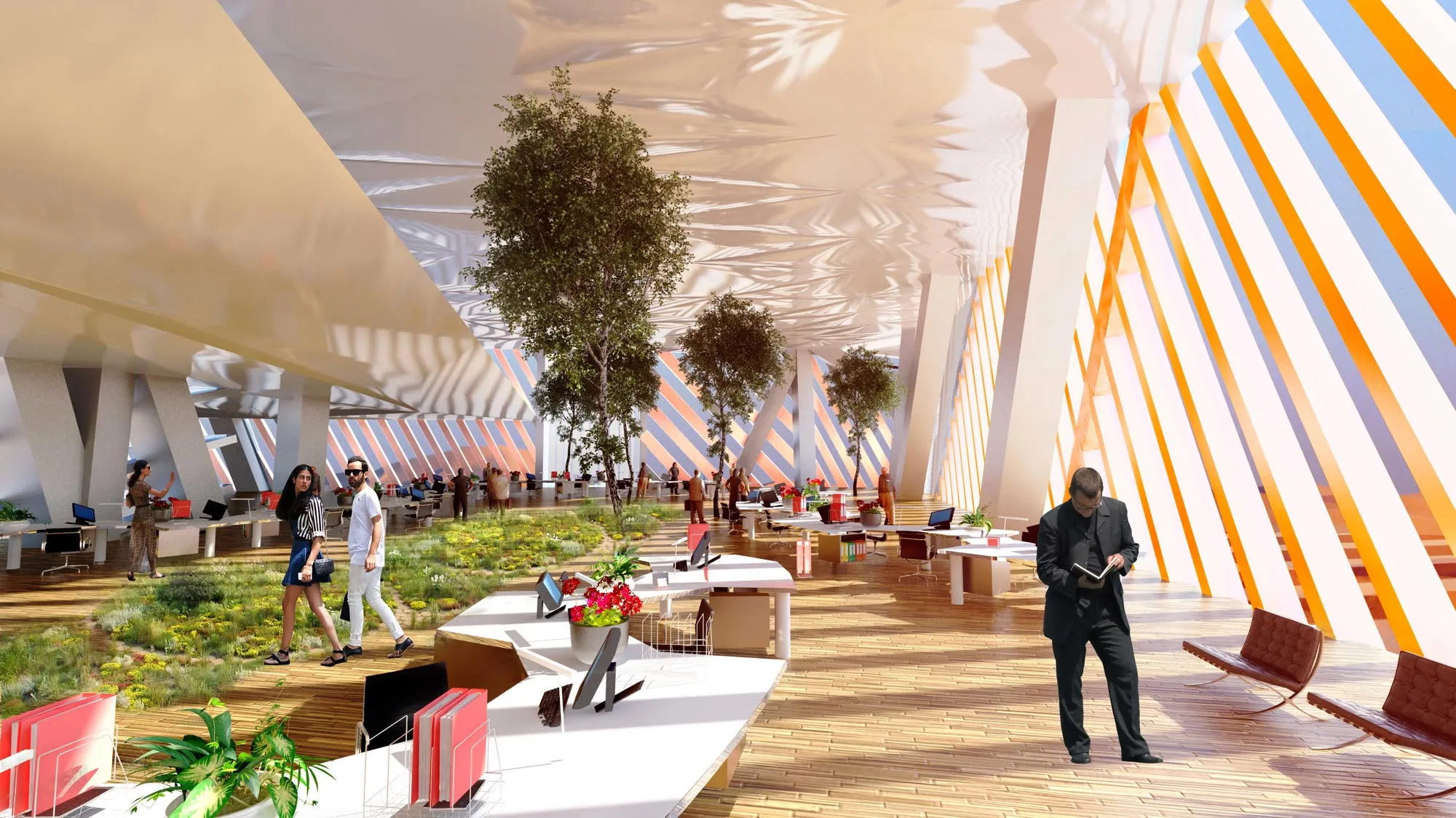
At the turn of an alley, the tower reveals itself in all its amplitude. It does not dominate, it *welcomes*. Its scale, which could intimidate, becomes reassuring through the immediate presence of a large water basin at the threshold. This liquid expanse, mirror of the sky and the atrium rising above, inverts the codes of the desert: here, water is not scarce, it is *manifested*, offered to sight and senses. It cools the air through evaporation, it reflects light, it signals the **programmatic generosity** of the place. Looking up, one discovers that a second vegetal tower seems to have germinated at the heart of the first, a vertical garden rising the entire height, creating an **interior microclimate** where humidity, temperature, and air quality are regulated by the photosynthesis and evapotranspiration of plants.
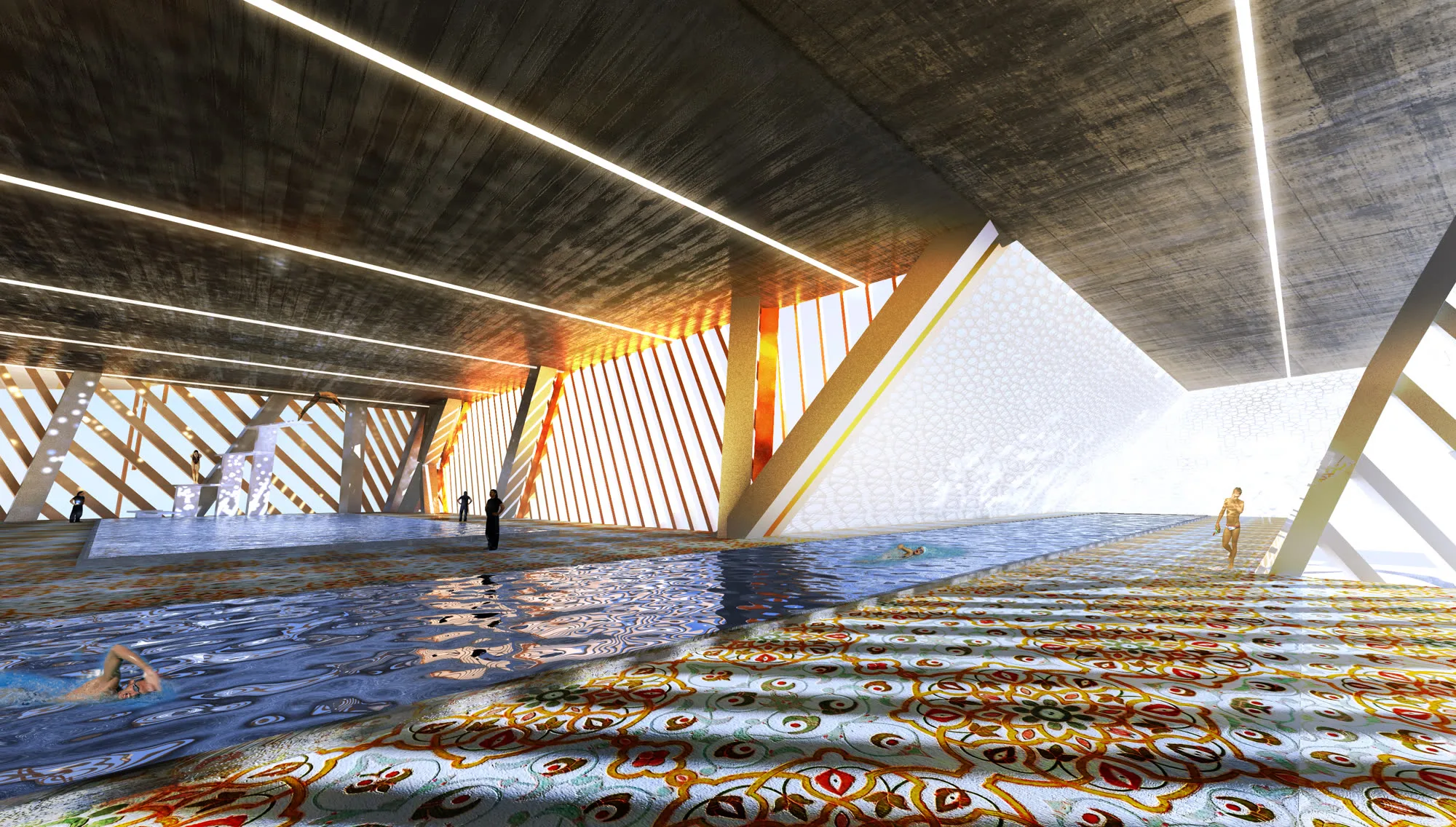
This spatial device, this tower *within* the tower, is not a gratuitous formal gesture. It structures the entire programmatic organization: hotel, residences, offices, shops, panoramic restaurant, meteorological observatory unfold around the perimeter, simultaneously benefiting from views of the desert immensity outside and the vertical garden inside. This **double orientation** creates temperate spaces, protected from thermal extremes, where inhabitants can live, work, relax. One can swim in a suspended pool, pray facing the purity of the sky, practice sports in controlled climatic conditions. Programmatic diversity becomes an absolute necessity here: for a vertical city to be viable in the middle of the Sahara, it must offer **functional self-sufficiency**, reduce travel, foster collective life.
The exterior façades, of a deep ochre, enter into **chromatic resonance** with the site. They do not seek to distinguish themselves from the desert, but to extend its materiality. This architectural skin is composed of adjustable sun breakers and solar collectors that produce the energy necessary for the tower's life and cooling. In an environment where solar radiation is extreme, we chose to transform this constraint into a resource. The envelope becomes an **energy interface**: it protects, it regulates, it produces. It filters light, reduces thermal gains, generates electricity. This autonomy strategy is not ideological, it is pragmatic: in the desert, energy independence is not a luxury, it is a condition of survival.
Inside, a vertical farm completes this self-sufficiency system. Integrated into the central garden, it produces part of the residents' food, reduces external supply needs, participates in climate regulation. This **agriculture in height** is not an ecological gadget: it responds to a logic of resilience, it inscribes the project in a circular economy where organic waste, rainwater (rare, but precious), and solar energy are recycled, valorized. In collaboration with the Laisné Roussel agency, we developed a rigorous technical approach, where each system (structural, climatic, energetic, hydraulic) articulates to maximize global efficiency.
City Sand is not a tower in the conventional sense. It is a **vertical city** that condenses in 780,000 m² all urban functions, all vital resources. It forms a landmark in the desert, a place where one can live, work, meet without depending on distant infrastructures. It transforms the extreme characteristics of the Sahara (heat, aridity, sunshine) into sources of energy and coolness. It proves that contemporary architecture can establish itself in a hostile environment without consuming it, without exhausting its resources, creating instead new conditions of habitability.
This project, which remained at the concept stage, poses an essential question: how to inhabit extreme territories without reproducing the energy-consuming urban models of temperate metropolises? By inventing new forms, **hybrid typologies** where nature and technique, tradition and innovation combine. City Sand remains for us a fertile exploration, an architectural manifesto where the desert is no longer a void to conquer, but a partner with which to compose.
In the Moroccan Sahara, the desert stretches without apparent landmarks, a horizon where the gaze loses itself in mineral uniformity. It is in this vastness that we imagined **City Sand**, not as a brutal irruption into the landscape, but as a *telluric outgrowth*, a fragment of geography that would have emerged naturally from the ground. From a distance, the silhouette merges with a rocky accident, a peak that erosion would have sculpted. This initial ambiguity is not fortuitous: it reflects our desire to dialogue with the desert rather than deny it, to propose an architecture that inscribes itself in the **geological continuity** of the site before revealing its constructed nature.
As one approaches, the landscape metamorphoses. The ground hollows out, shadows lengthen and trace pockets of coolness. One then enters a **maze of alleyways** that evokes the vernacular organization of medinas, those sinuous layouts where each turn offers climatic respite, where each nook becomes a place of collective life. This built base, a veritable horizontal city, accommodates shops, public facilities, and gathering spaces. It is not a simple pedestal for the tower: it constitutes the **urban matrix** of the project, an artificial topography that recreates the conditions of desert habitability by playing with shade, natural ventilation, and the porosity of spaces.
At the turn of an alley, the tower reveals itself in all its amplitude. It does not dominate, it *welcomes*. Its scale, which could intimidate, becomes reassuring through the immediate presence of a large water basin at the threshold. This liquid expanse, mirror of the sky and the atrium rising above, inverts the codes of the desert: here, water is not scarce, it is *manifested*, offered to sight and senses. It cools the air through evaporation, it reflects light, it signals the **programmatic generosity** of the place. Looking up, one discovers that a second vegetal tower seems to have germinated at the heart of the first, a vertical garden rising the entire height, creating an **interior microclimate** where humidity, temperature, and air quality are regulated by the photosynthesis and evapotranspiration of plants.
This spatial device, this tower *within* the tower, is not a gratuitous formal gesture. It structures the entire programmatic organization: hotel, residences, offices, shops, panoramic restaurant, meteorological observatory unfold around the perimeter, simultaneously benefiting from views of the desert immensity outside and the vertical garden inside. This **double orientation** creates temperate spaces, protected from thermal extremes, where inhabitants can live, work, relax. One can swim in a suspended pool, pray facing the purity of the sky, practice sports in controlled climatic conditions. Programmatic diversity becomes an absolute necessity here: for a vertical city to be viable in the middle of the Sahara, it must offer **functional self-sufficiency**, reduce travel, foster collective life.
The exterior façades, of a deep ochre, enter into **chromatic resonance** with the site. They do not seek to distinguish themselves from the desert, but to extend its materiality. This architectural skin is composed of adjustable sun breakers and solar collectors that produce the energy necessary for the tower's life and cooling. In an environment where solar radiation is extreme, we chose to transform this constraint into a resource. The envelope becomes an **energy interface**: it protects, it regulates, it produces. It filters light, reduces thermal gains, generates electricity. This autonomy strategy is not ideological, it is pragmatic: in the desert, energy independence is not a luxury, it is a condition of survival.
Inside, a vertical farm completes this self-sufficiency system. Integrated into the central garden, it produces part of the residents' food, reduces external supply needs, participates in climate regulation. This **agriculture in height** is not an ecological gadget: it responds to a logic of resilience, it inscribes the project in a circular economy where organic waste, rainwater (rare, but precious), and solar energy are recycled, valorized. In collaboration with the Laisné Roussel agency, we developed a rigorous technical approach, where each system (structural, climatic, energetic, hydraulic) articulates to maximize global efficiency.
City Sand is not a tower in the conventional sense. It is a **vertical city** that condenses in 780,000 m² all urban functions, all vital resources. It forms a landmark in the desert, a place where one can live, work, meet without depending on distant infrastructures. It transforms the extreme characteristics of the Sahara (heat, aridity, sunshine) into sources of energy and coolness. It proves that contemporary architecture can establish itself in a hostile environment without consuming it, without exhausting its resources, creating instead new conditions of habitability.
This project, which remained at the concept stage, poses an essential question: how to inhabit extreme territories without reproducing the energy-consuming urban models of temperate metropolises? By inventing new forms, **hybrid typologies** where nature and technique, tradition and innovation combine. City Sand remains for us a fertile exploration, an architectural manifesto where the desert is no longer a void to conquer, but a partner with which to compose.
- Lieu
- Sahara, Maroc
- Nature
- Mixte
- Surface
- 780 000 m²
- Budget
- Confidentiel
- Concours
- 2014-2015
- MOA
- Confidentiel
- Co-architectes
- Laisné Roussel