
Paul Éluard Cultural Center
The project's goal is to make the urban promenade more fluid and to expand the city center by creating an echo and a visual link between facilities. We attempt to build a strong visual hierarchy that provides landmarks on this site. The major constraint is to preserve the scale of the surroundings, neither reducing, increasing, nor breaking it. Today, the site is surrounded by row houses and pavilions lost amid dense vegetation.
In Cugnaux, a small town on the outskirts of Toulouse, the city center still seeks its coherence. Scattered pavilions, row houses, dense vegetation that absorbs built volumes: the urban fabric lacks structure, legible landmarks. It is in this fragile context, that of a territory searching for identity, that the Town Hall of Cugnaux launched a competition in 2010 for a 4,500 m² cultural center. We won this competition alongside Duncan Lewis and Tanguy Vermet, proposing not an isolated object, but an **urban device** capable of connecting, anchoring, revealing. A facility that does not impose itself, but that **reveals** the territory.
Our first intuition was to consider the project as a **productive thickness** rather than as a closed volume. It was not about adding yet another building to an already disconnected landscape, but about creating **continuity**, a **discreet signal** that structures the urban promenade and expands the city center through capillarity. We wanted to build a strong **visual hierarchy** without crushing the domestic scale of the surroundings. The question of **scale relationship** was, from the outset, the major constraint: not to reduce, not to increase, not to break what exists. Simply to **rearticulate**.
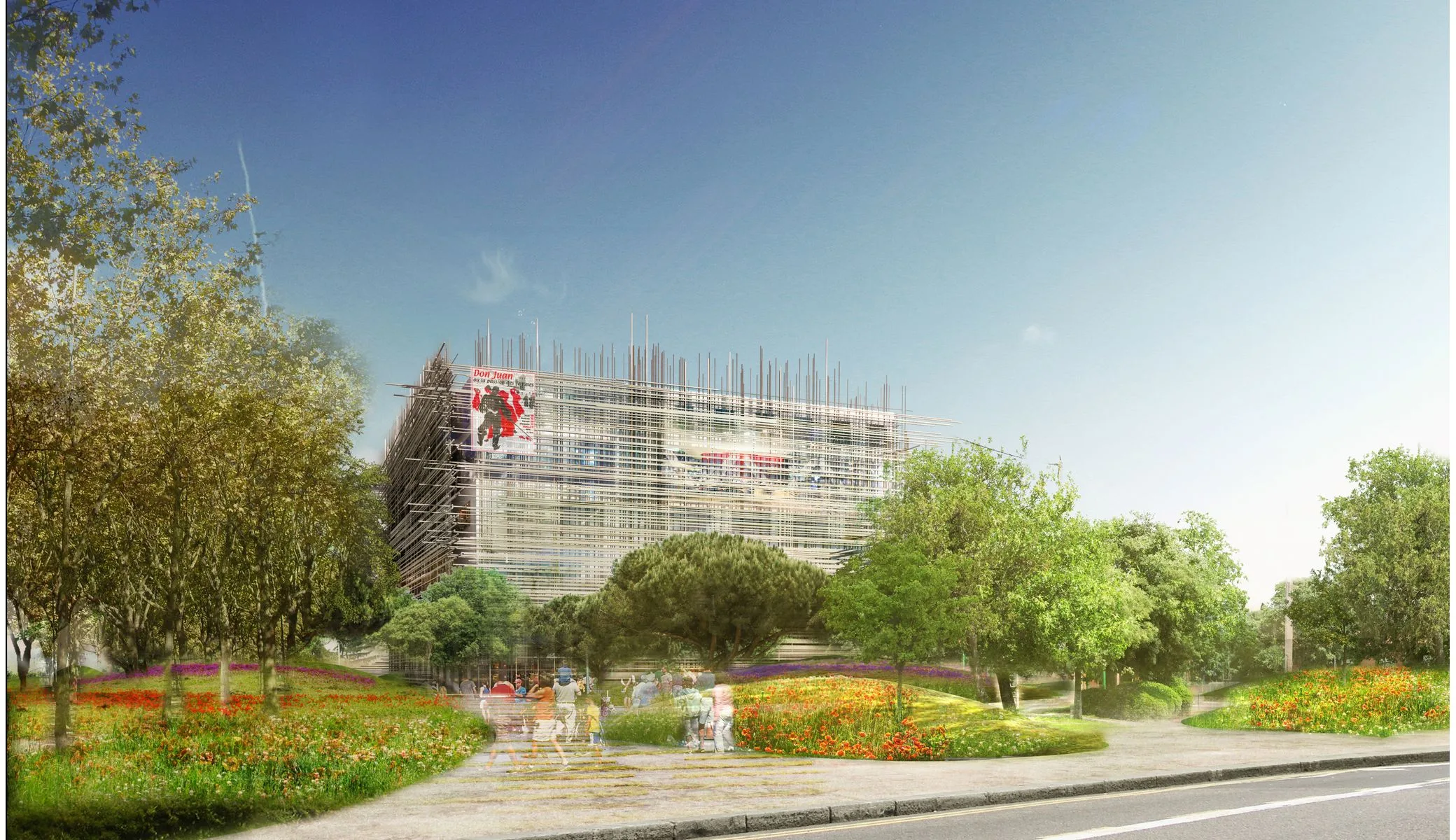
The architectural gesture flows directly from this reading of the site. Rather than placing a monolithic volume, we **cut** the building's scale with a **canopy of trees**, in the manner of what naturally occurs in the local church square. This phenomenon of **vegetal filtering**, observed in Cugnaux itself, allows softening the presence of a large facility while giving it a **measured presence**. The building slips beneath the foliage, it borrows from the logic of the garden, it becomes **porous architecture**. This porosity is at the heart of our approach: it organizes flows, views, uses, without ever closing the space upon itself.
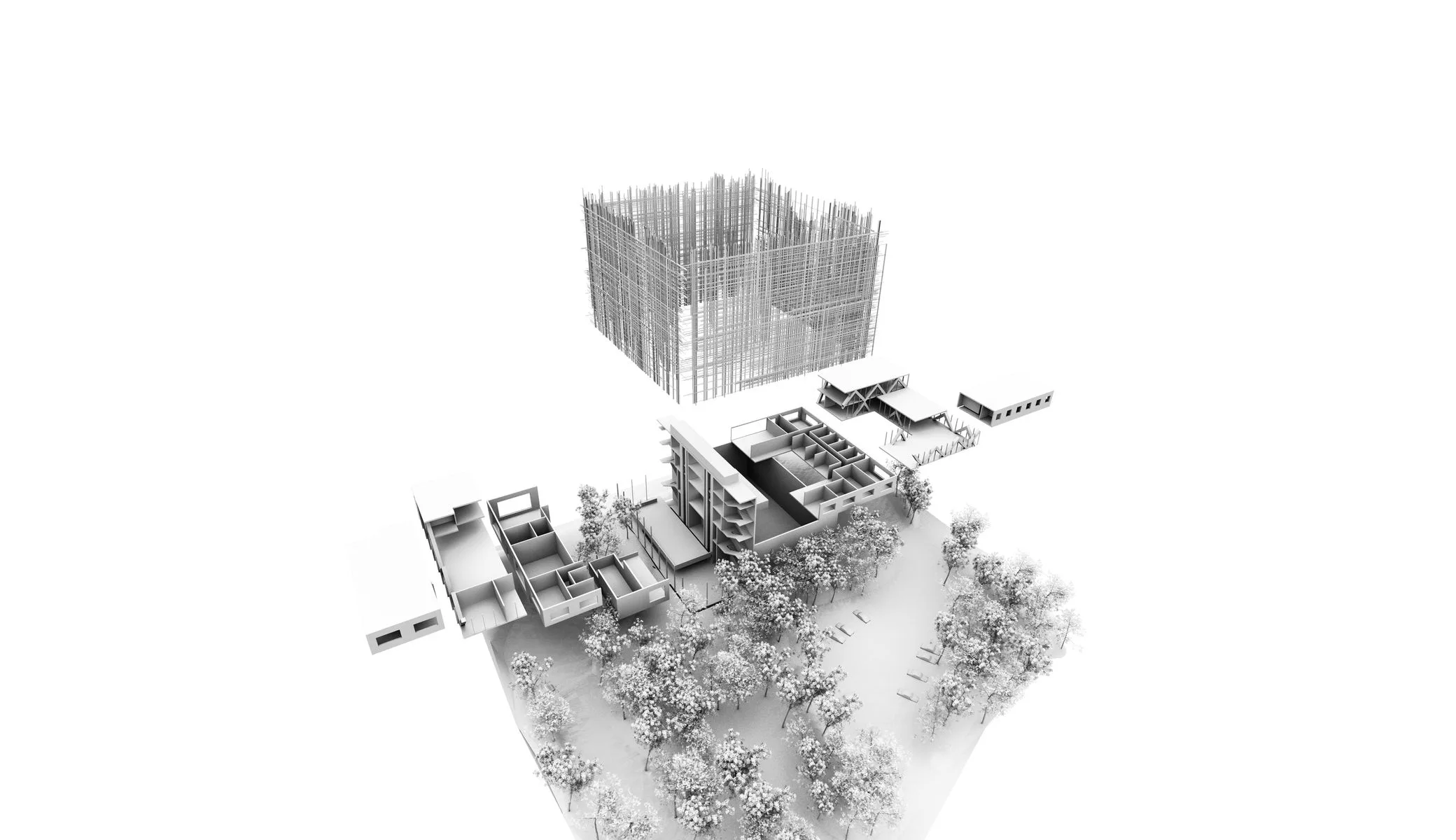
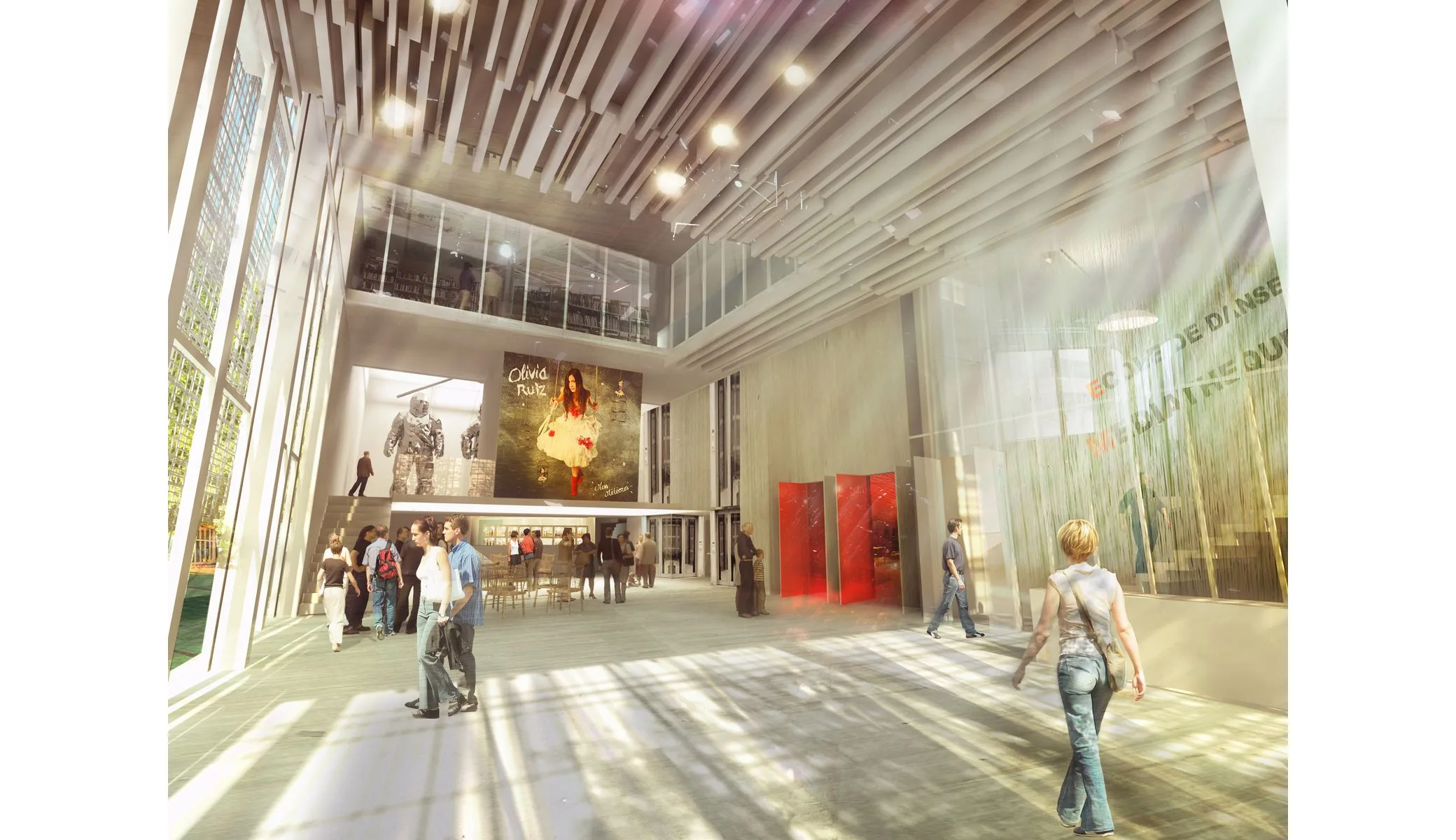
The program of the Paul Éluard Cultural Center is dense and multiple: a two-level library, municipal archives, an exhibition space, a flexible auditorium, and a vast lobby conceived as a place of **convergence and fluidity**. This lobby is not a simple entrance hall, it is an **interior public space**, an extension of the street, a meeting place before being a passage. We worked on its **generous spatiality** to make it friendly, welcoming, capable of absorbing informal events, waiting, wandering. It is the **beating heart** of the project, the one that links different functions and the interior and exterior.
The library, for its part, is organized around an **intimate patio**, an interior garden that brings natural light and serenity. This spatial device creates a **luminous double height** at the heart of the building, while offering cross views and varied reading spaces. The patio is a **lung**, a breathing place, a counterpoint to programmatic density. It participates in this logic of **dissolution** of built mass, by introducing an inhabited, planted, living void. The shelving unfolds around this void, consultation spaces benefit from multiple perspectives, the library becomes an **interior landscape** in itself.
The auditorium, conceived as a **flexible** volume, can accommodate conferences as well as screenings, chamber music concerts or theatrical performances. This versatility is essential for a local cultural facility, which must adapt to the multiple uses of a medium-sized town. We worked on the **acoustics** and **modularity** of this space, in dialogue with Duncan Lewis and Tanguy Vermet, so that it is both **intimate and generous**, capable of accommodating 150 people in various configurations.
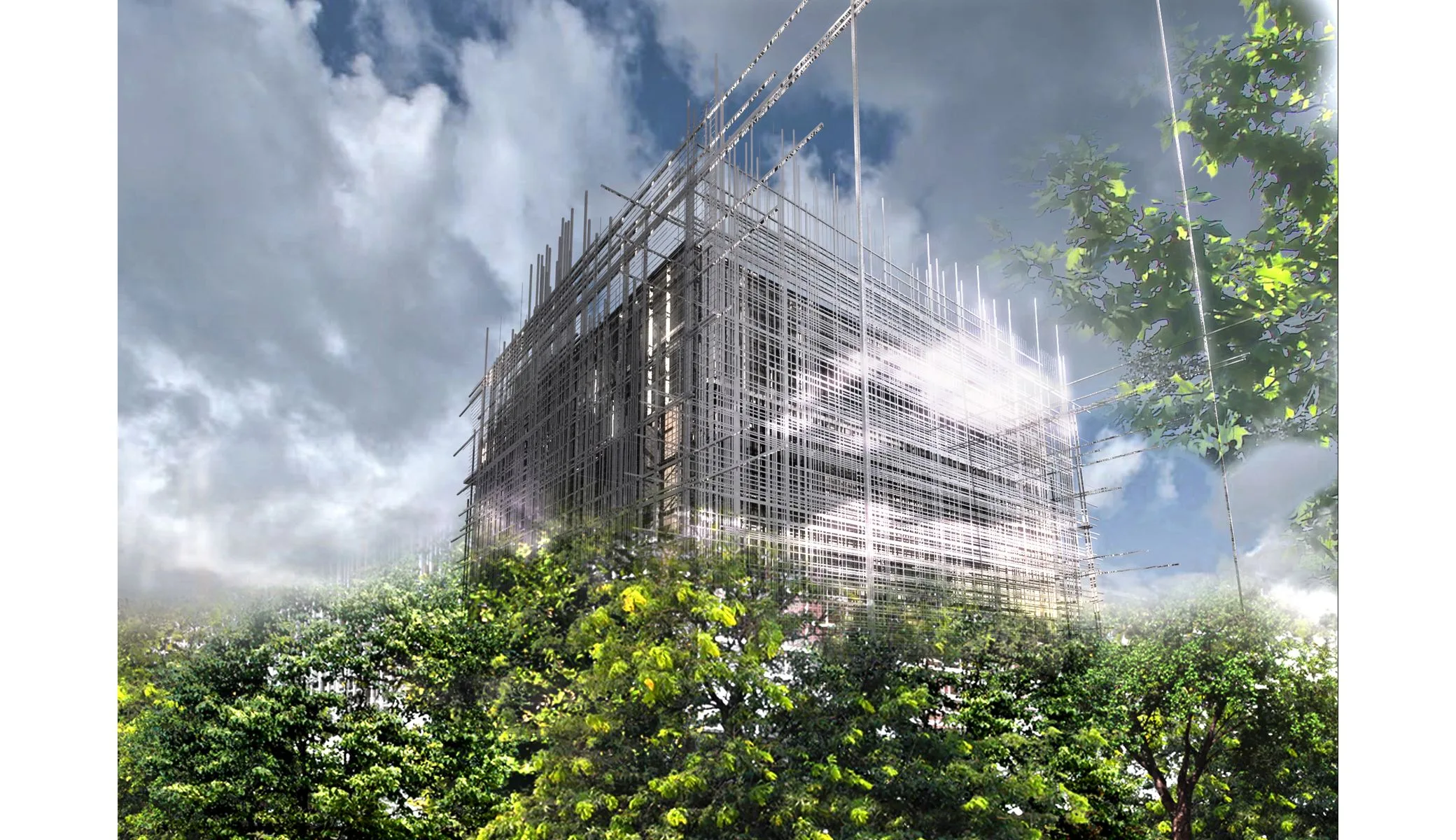
The project's **materiality** participates in this idea of **dissolution** and **continuity**. We favored sober materials, textures that dialogue with the vegetal context, a discreet **chromatic palette**. Wood, light concrete, glass: materials that **absorb light** more than reflect it, that are part of an **economy of means** and **constructive sobriety**. The facade is not an opaque screen, it is **porous**, punctuated by transparencies and opacities that reveal the building's interior life. This **visual permeability** contributes to the cultural center's inscription in the urban fabric: uses are glimpsed, presences perceived, encounters anticipated.
On the **environmental** level, our approach relied on a logic of **compactness** and **natural ventilation**. The central patio plays a role as **thermal regulator**, favoring cross air currents and providing passive summer comfort. The trees, planted in continuity with the landscape context, create a favorable **microclimate**, reduce heat islands, participate in **stormwater management**. We also worked on the orientation of spaces, optimization of solar gains, reduction of energy needs. This project, competition winner but not realized, carried within it a **discreet ecological ambition**, based on **constructive common sense** rather than spectacular technical devices.
The Paul Éluard Cultural Center could have become an **urban catalyst** for Cugnaux, a place capable of structuring the city center, creating landmarks, connecting inhabitants. It could have embodied a way of **inhabiting the intermediate scale**, that of a public facility inserted into a residential fabric, without rupture or domination. This project remains for us a **fertile hypothesis**, a demonstration that it is possible to build the collective without crushing the domestic, to create identity without imposing form. It testifies to a conviction we have carried from the beginning: public architecture must be **generous, open, porous**, it must serve inhabitants before putting itself on stage.
Our first intuition was to consider the project as a **productive thickness** rather than as a closed volume. It was not about adding yet another building to an already disconnected landscape, but about creating **continuity**, a **discreet signal** that structures the urban promenade and expands the city center through capillarity. We wanted to build a strong **visual hierarchy** without crushing the domestic scale of the surroundings. The question of **scale relationship** was, from the outset, the major constraint: not to reduce, not to increase, not to break what exists. Simply to **rearticulate**.
The architectural gesture flows directly from this reading of the site. Rather than placing a monolithic volume, we **cut** the building's scale with a **canopy of trees**, in the manner of what naturally occurs in the local church square. This phenomenon of **vegetal filtering**, observed in Cugnaux itself, allows softening the presence of a large facility while giving it a **measured presence**. The building slips beneath the foliage, it borrows from the logic of the garden, it becomes **porous architecture**. This porosity is at the heart of our approach: it organizes flows, views, uses, without ever closing the space upon itself.
The program of the Paul Éluard Cultural Center is dense and multiple: a two-level library, municipal archives, an exhibition space, a flexible auditorium, and a vast lobby conceived as a place of **convergence and fluidity**. This lobby is not a simple entrance hall, it is an **interior public space**, an extension of the street, a meeting place before being a passage. We worked on its **generous spatiality** to make it friendly, welcoming, capable of absorbing informal events, waiting, wandering. It is the **beating heart** of the project, the one that links different functions and the interior and exterior.
The library, for its part, is organized around an **intimate patio**, an interior garden that brings natural light and serenity. This spatial device creates a **luminous double height** at the heart of the building, while offering cross views and varied reading spaces. The patio is a **lung**, a breathing place, a counterpoint to programmatic density. It participates in this logic of **dissolution** of built mass, by introducing an inhabited, planted, living void. The shelving unfolds around this void, consultation spaces benefit from multiple perspectives, the library becomes an **interior landscape** in itself.
The auditorium, conceived as a **flexible** volume, can accommodate conferences as well as screenings, chamber music concerts or theatrical performances. This versatility is essential for a local cultural facility, which must adapt to the multiple uses of a medium-sized town. We worked on the **acoustics** and **modularity** of this space, in dialogue with Duncan Lewis and Tanguy Vermet, so that it is both **intimate and generous**, capable of accommodating 150 people in various configurations.
The project's **materiality** participates in this idea of **dissolution** and **continuity**. We favored sober materials, textures that dialogue with the vegetal context, a discreet **chromatic palette**. Wood, light concrete, glass: materials that **absorb light** more than reflect it, that are part of an **economy of means** and **constructive sobriety**. The facade is not an opaque screen, it is **porous**, punctuated by transparencies and opacities that reveal the building's interior life. This **visual permeability** contributes to the cultural center's inscription in the urban fabric: uses are glimpsed, presences perceived, encounters anticipated.
On the **environmental** level, our approach relied on a logic of **compactness** and **natural ventilation**. The central patio plays a role as **thermal regulator**, favoring cross air currents and providing passive summer comfort. The trees, planted in continuity with the landscape context, create a favorable **microclimate**, reduce heat islands, participate in **stormwater management**. We also worked on the orientation of spaces, optimization of solar gains, reduction of energy needs. This project, competition winner but not realized, carried within it a **discreet ecological ambition**, based on **constructive common sense** rather than spectacular technical devices.
The Paul Éluard Cultural Center could have become an **urban catalyst** for Cugnaux, a place capable of structuring the city center, creating landmarks, connecting inhabitants. It could have embodied a way of **inhabiting the intermediate scale**, that of a public facility inserted into a residential fabric, without rupture or domination. This project remains for us a **fertile hypothesis**, a demonstration that it is possible to build the collective without crushing the domestic, to create identity without imposing form. It testifies to a conviction we have carried from the beginning: public architecture must be **generous, open, porous**, it must serve inhabitants before putting itself on stage.
- Lieu
- Cugnaux, France
- Nature
- Equipement culturel
- Surface
- 4 500 m²
- Budget
- 7,5 M€ HT
- Concours
- 2010
- MOA
- Mairie de Cugnaux
- Co-architectes
- Duncan Lewis, Tanguy Vermet