
Calabria Bridge
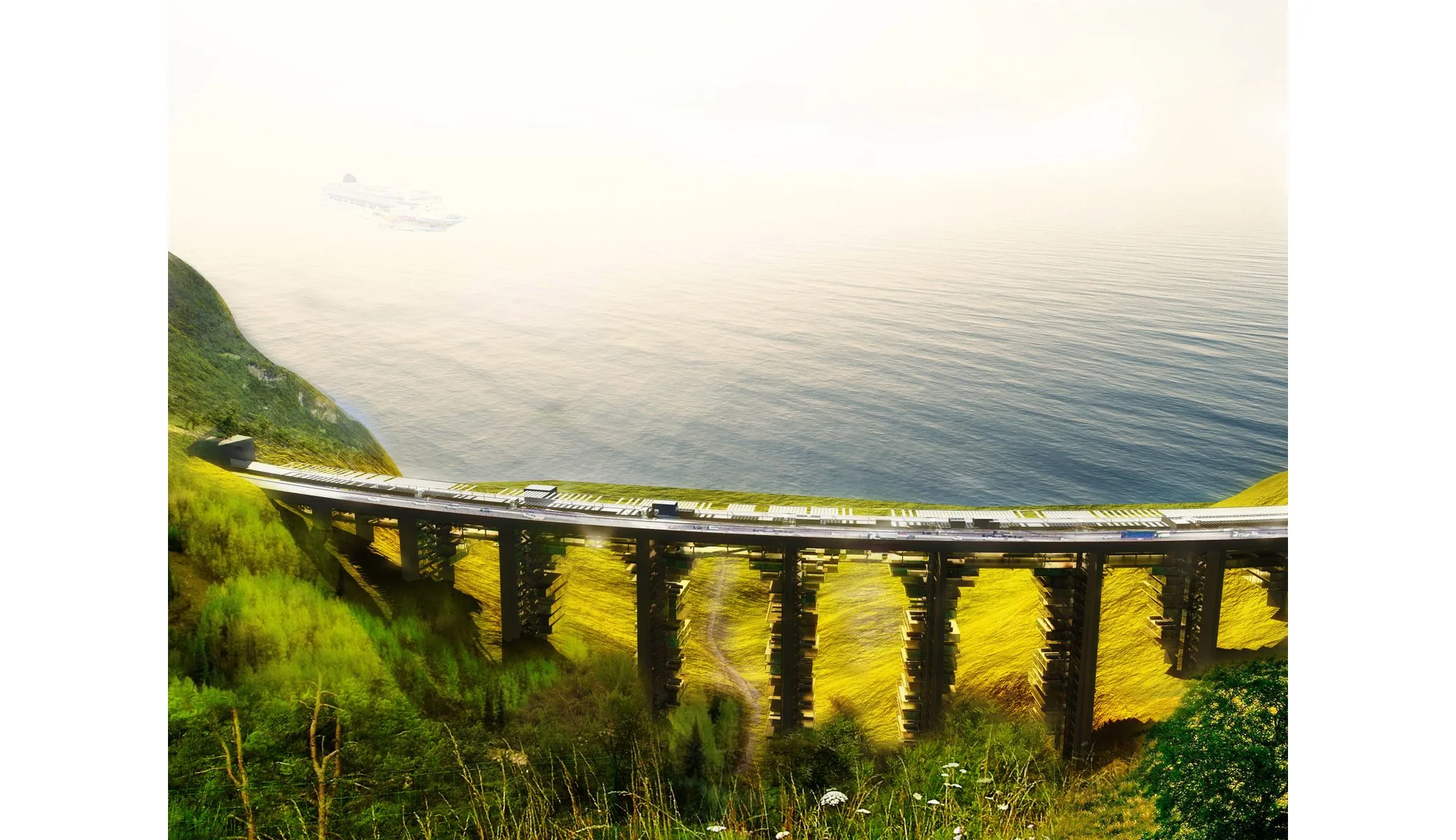
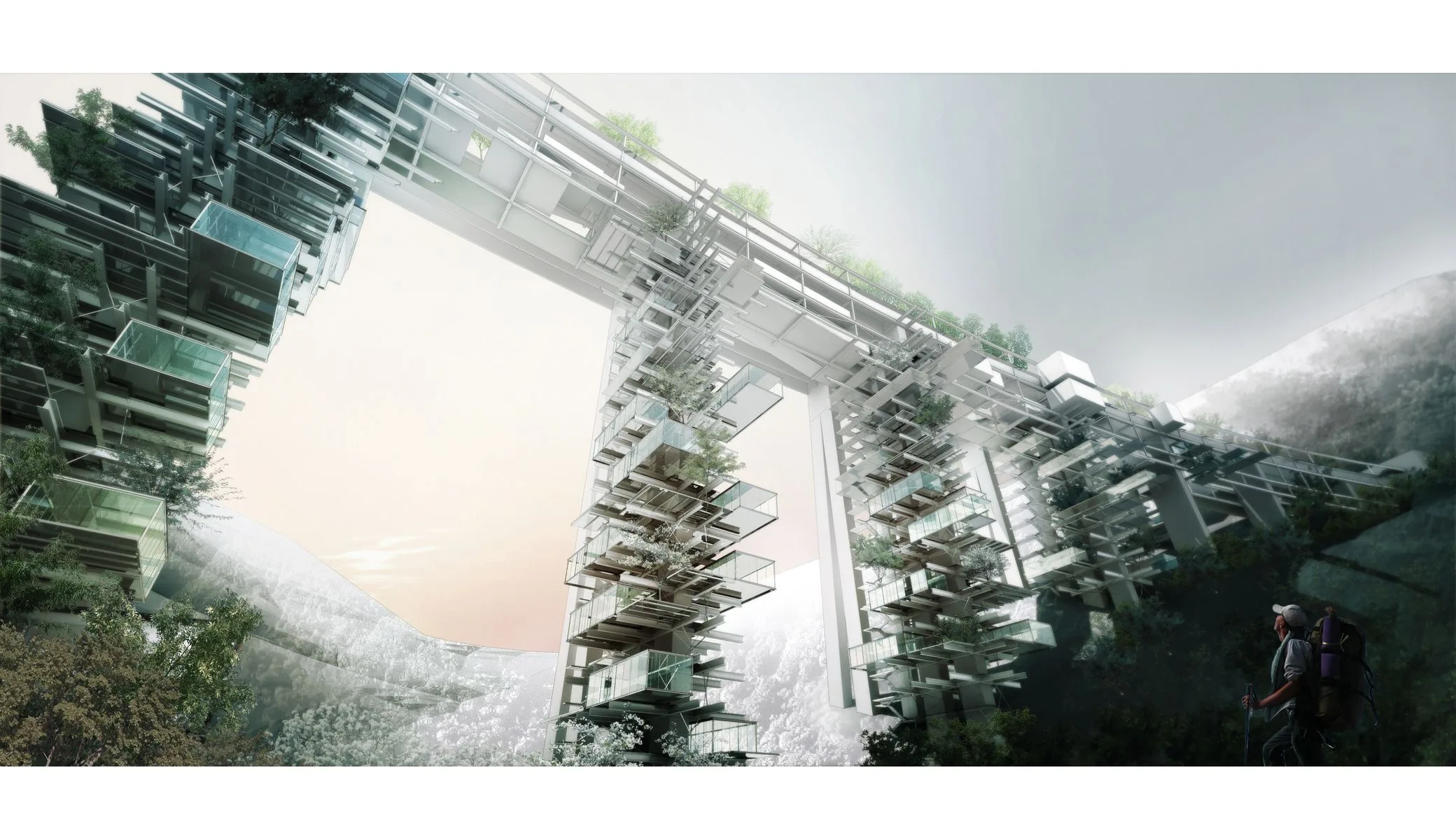
Bridges allow for limited impact on the landscape. The local cultivation of bergamot demonstrates perfectly that the region is temperate (8° to 30°C), the volcanic zone reveals strong energy potential. The climate and site inspire vertical villages for European migrant retirees (housing, medical facilities, entertainment, shops). They are already connected by paths to the sea and by highways to surrounding cities. The system is autonomous regarding water and main energy resources thanks to rainwater and geothermal energy.
# Extended Text: Calabria Bridge
We imagined the Calabria Bridge in 2010, in response to a competition launched by the Regione Calabria, as an attempt to reconcile infrastructure and habitation, technique and territory. Southern Italy, this volcanic and Mediterranean Calabria, carries within itself a fertile contradiction: it is crossed by highway flows that fracture the landscape, while offering an exceptional temperate climate, precious geothermal resources, and a millennial agricultural culture. Bergamot, this rare citrus fruit that grows almost nowhere else, testifies to this climatic mildness. We wanted our architectural project to fit into this dual reality, proposing not a simple crossing, but an **infrastructural habitat** capable of weaving a link between migration, European demographic aging, and the site's energy potential.
The program combines housing, medical facilities, shops, and entertainment venues, designed to accommodate European retirees attracted by the Calabrian quality of life. This is not a groundless utopia: the region is already connected, by highways and coastal paths, to surrounding cities and the sea. We worked with OFF, Philippe Rizzotti and Samuel Nageotte to design a hybrid device that fully assumes its status as infrastructure while offering an unprecedented **vertical urbanity**. The idea was not to mask the existing highway bridge, nor to bypass it, but to colonize it, to densify it, to make it the foundation of a new community.
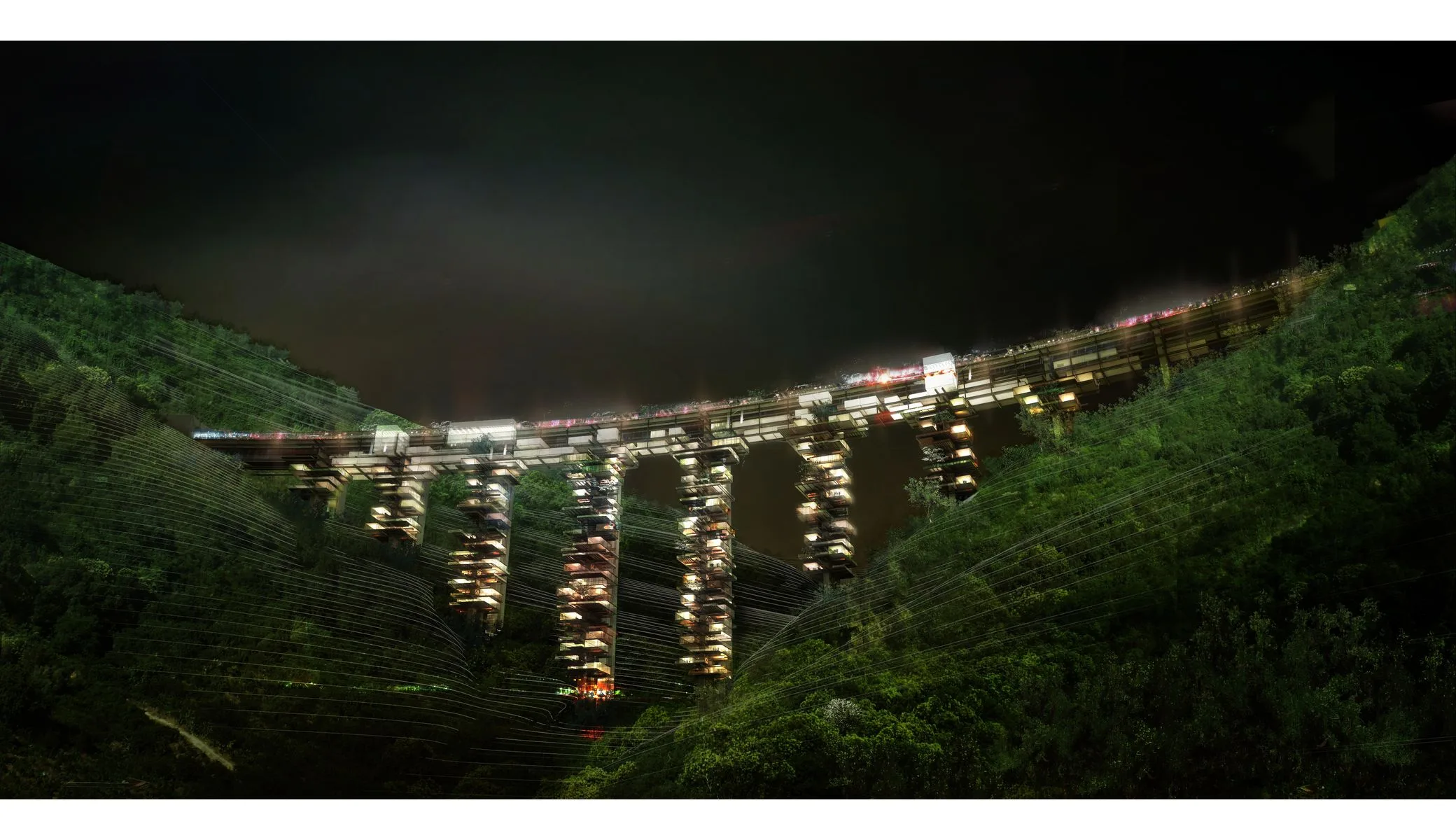
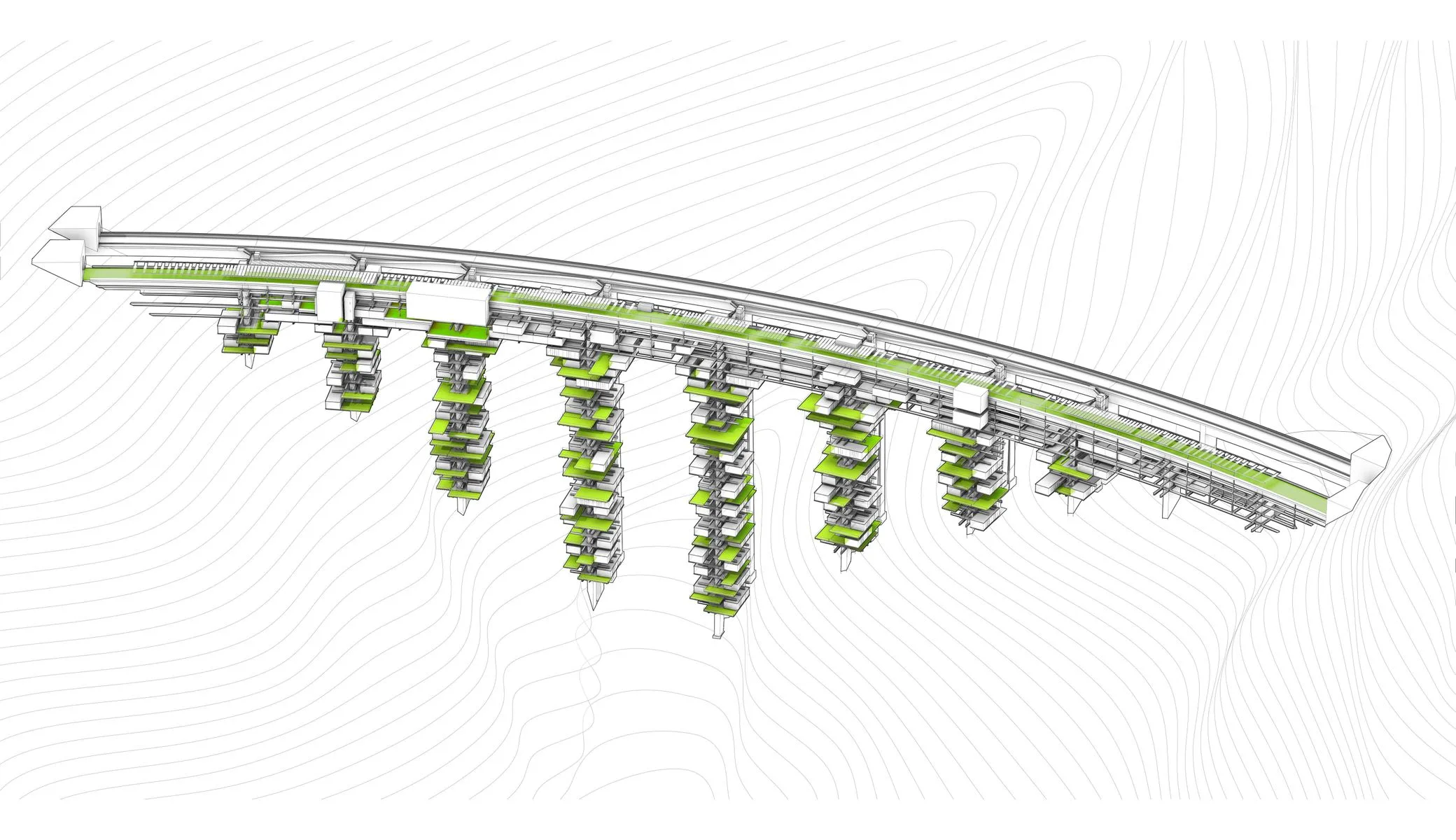
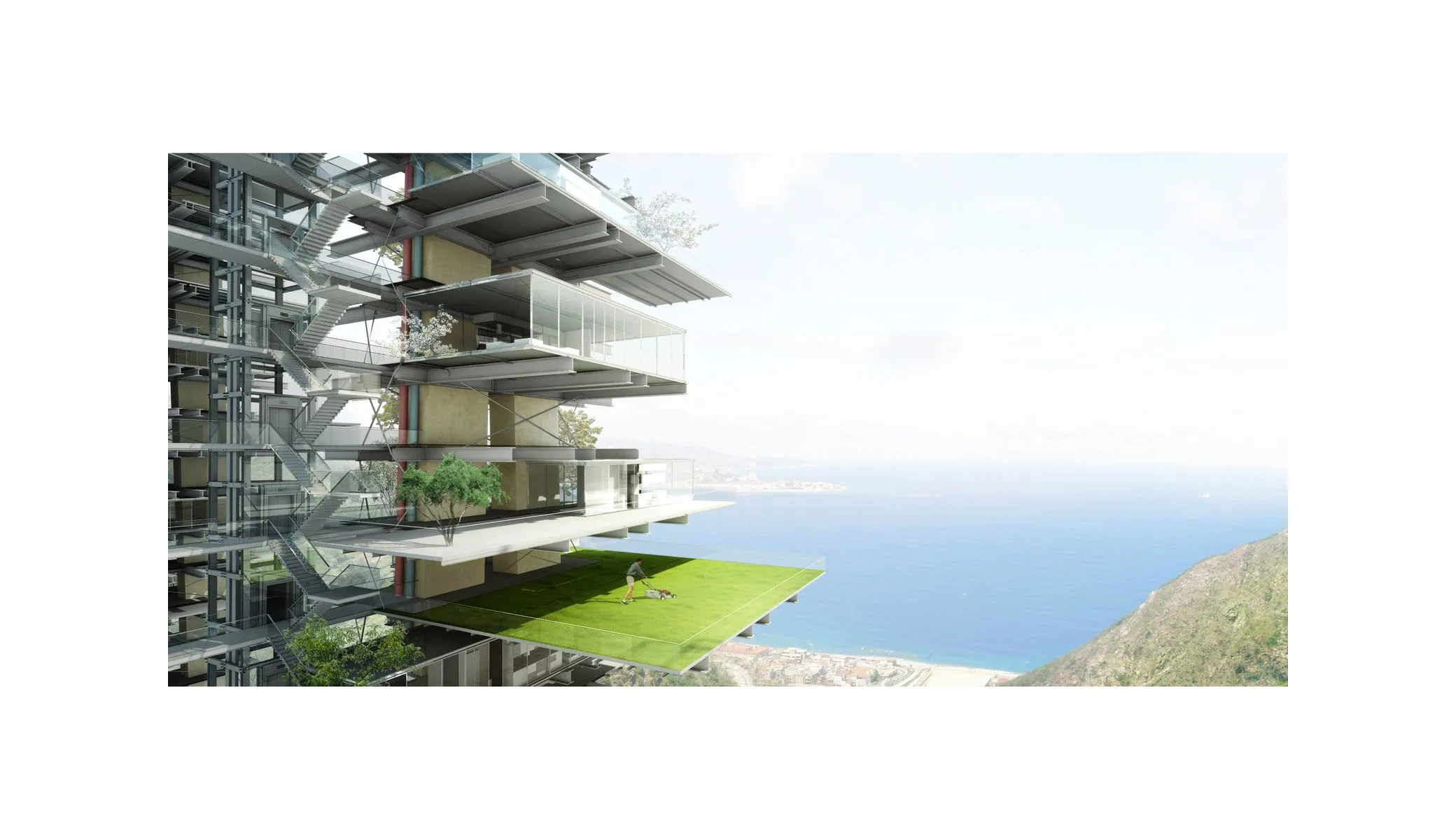
The architectural gesture rests on a deliberate contamination between the **horizontality of the bridge** and the **verticality of the habitat**. We chose to graft residential volumes onto the bridge's pillars, transforming these structural elements into supports for private life. Each pillar becomes an inhabited core, around which spirals a sequence of dwellings offset by two meters at a time, generating a twisted form that improves thermal inertia and creates unobstructed 360-degree views. This helical geometry avoids the monotony of conventional vertical stacking, while optimizing solar exposure and natural ventilation. All housing units benefit from a unique panorama of the sea, mountains, or valley, without overlook. Private life inhabits the pillars, horizontal sociability extends across the bridge's widened decks.
Because the bridge itself, instead of being reduced to a simple circulation platform, is **thickened, inhabited, landscaped**. We transformed the decks into generous public spaces: planted promenades, squares, suspended gardens, meeting and commercial places. These horizontal strata connect the vertical towers to each other, creating a continuous network of sociability at altitude. The infrastructure thus becomes the support for a shared urbanity, where the project's collective dimension is fully expressed. This contemporary archaeology, this bridge upon bridge, results from a process of contamination between urbanity that descends and nature that climbs it. Technical flows (water networks, energy, waste treatment) are integrated into the very thickness of the decks, invisible but omnipresent.
The environmental question is not a moral supplement, it is constitutive of the project. Calabria offers considerable energy resources, and we wanted the Calabria Bridge to be **autonomous in water and energy**. Rainwater is collected on roofs and horizontal surfaces, then stored in reservoirs located in tunnels and underground infrastructure. This water serves both domestic consumption, irrigation of suspended gardens, and energy production through microhydraulics. Organic waste produced by residents is methanized locally, generating domestic gas that supplies kitchens and supplementary heating.
The site's true energy potential lies in geothermal energy. Calabria, a volcanic region, possesses a hot subsoil accessible by *hot dry rock* process, a technology that allows exploiting the heat of deep rocks without requiring underground water tables. We integrated this renewable energy source into the very design of the pillars, which become vertical geothermal conduits. The complex's electricity and heating are thus produced locally, drastically reducing the project's carbon footprint and guaranteeing long-term energy autonomy. This combination of infrastructure and environment is efficient enough to establish a high and eco-responsible quality of life.
Materially, the project combines concrete, steel, and wood, in a logic of **structural sobriety and thermal efficiency**. The pillars are reinforced concrete, natural extensions of the existing bridge, while the spiral structures surrounding them are lightweight steel, allowing rapid assembly and flexibility. The dwellings themselves are designed with wood frames and high-performance insulation, taking advantage of the thermal inertia of the concrete cores. The facades, oriented to capture sea breezes and protect from summer sun, integrate natural ventilation systems and mobile solar protections. The landscape is not decorative: it is cultivated, productive, therapeutic. The suspended gardens host plantings of bergamot, citrus fruits, olive trees, recalling local agricultural culture and offering residents a tangible link with the Calabrian territory.
We conceived this project as a working hypothesis on the future of European infrastructures. What should we do with bridges, viaducts, highways that stripe our landscapes? Should we demolish them, bypass them, hide them? We propose a third way: to **inhabit them, densify them, transform them into living places**. The Calabria Bridge remains an unbuilt project, but it continues to question our relationship to infrastructure, energy, demographic aging, and the Mediterranean territory. It proposes a vertical, suspended, autonomous urbanity, where architecture does not erase technique but feeds on it, where the bridge is no longer a cut but a place, a community, a village.
We imagined the Calabria Bridge in 2010, in response to a competition launched by the Regione Calabria, as an attempt to reconcile infrastructure and habitation, technique and territory. Southern Italy, this volcanic and Mediterranean Calabria, carries within itself a fertile contradiction: it is crossed by highway flows that fracture the landscape, while offering an exceptional temperate climate, precious geothermal resources, and a millennial agricultural culture. Bergamot, this rare citrus fruit that grows almost nowhere else, testifies to this climatic mildness. We wanted our architectural project to fit into this dual reality, proposing not a simple crossing, but an **infrastructural habitat** capable of weaving a link between migration, European demographic aging, and the site's energy potential.
The program combines housing, medical facilities, shops, and entertainment venues, designed to accommodate European retirees attracted by the Calabrian quality of life. This is not a groundless utopia: the region is already connected, by highways and coastal paths, to surrounding cities and the sea. We worked with OFF, Philippe Rizzotti and Samuel Nageotte to design a hybrid device that fully assumes its status as infrastructure while offering an unprecedented **vertical urbanity**. The idea was not to mask the existing highway bridge, nor to bypass it, but to colonize it, to densify it, to make it the foundation of a new community.
The architectural gesture rests on a deliberate contamination between the **horizontality of the bridge** and the **verticality of the habitat**. We chose to graft residential volumes onto the bridge's pillars, transforming these structural elements into supports for private life. Each pillar becomes an inhabited core, around which spirals a sequence of dwellings offset by two meters at a time, generating a twisted form that improves thermal inertia and creates unobstructed 360-degree views. This helical geometry avoids the monotony of conventional vertical stacking, while optimizing solar exposure and natural ventilation. All housing units benefit from a unique panorama of the sea, mountains, or valley, without overlook. Private life inhabits the pillars, horizontal sociability extends across the bridge's widened decks.
Because the bridge itself, instead of being reduced to a simple circulation platform, is **thickened, inhabited, landscaped**. We transformed the decks into generous public spaces: planted promenades, squares, suspended gardens, meeting and commercial places. These horizontal strata connect the vertical towers to each other, creating a continuous network of sociability at altitude. The infrastructure thus becomes the support for a shared urbanity, where the project's collective dimension is fully expressed. This contemporary archaeology, this bridge upon bridge, results from a process of contamination between urbanity that descends and nature that climbs it. Technical flows (water networks, energy, waste treatment) are integrated into the very thickness of the decks, invisible but omnipresent.
The environmental question is not a moral supplement, it is constitutive of the project. Calabria offers considerable energy resources, and we wanted the Calabria Bridge to be **autonomous in water and energy**. Rainwater is collected on roofs and horizontal surfaces, then stored in reservoirs located in tunnels and underground infrastructure. This water serves both domestic consumption, irrigation of suspended gardens, and energy production through microhydraulics. Organic waste produced by residents is methanized locally, generating domestic gas that supplies kitchens and supplementary heating.
The site's true energy potential lies in geothermal energy. Calabria, a volcanic region, possesses a hot subsoil accessible by *hot dry rock* process, a technology that allows exploiting the heat of deep rocks without requiring underground water tables. We integrated this renewable energy source into the very design of the pillars, which become vertical geothermal conduits. The complex's electricity and heating are thus produced locally, drastically reducing the project's carbon footprint and guaranteeing long-term energy autonomy. This combination of infrastructure and environment is efficient enough to establish a high and eco-responsible quality of life.
Materially, the project combines concrete, steel, and wood, in a logic of **structural sobriety and thermal efficiency**. The pillars are reinforced concrete, natural extensions of the existing bridge, while the spiral structures surrounding them are lightweight steel, allowing rapid assembly and flexibility. The dwellings themselves are designed with wood frames and high-performance insulation, taking advantage of the thermal inertia of the concrete cores. The facades, oriented to capture sea breezes and protect from summer sun, integrate natural ventilation systems and mobile solar protections. The landscape is not decorative: it is cultivated, productive, therapeutic. The suspended gardens host plantings of bergamot, citrus fruits, olive trees, recalling local agricultural culture and offering residents a tangible link with the Calabrian territory.
We conceived this project as a working hypothesis on the future of European infrastructures. What should we do with bridges, viaducts, highways that stripe our landscapes? Should we demolish them, bypass them, hide them? We propose a third way: to **inhabit them, densify them, transform them into living places**. The Calabria Bridge remains an unbuilt project, but it continues to question our relationship to infrastructure, energy, demographic aging, and the Mediterranean territory. It proposes a vertical, suspended, autonomous urbanity, where architecture does not erase technique but feeds on it, where the bridge is no longer a cut but a place, a community, a village.
- Lieu
- Calabre, Italie
- Nature
- Logements
- Surface
- 15 600 m²
- Budget
- Confidentiel
- Concours
- 2010
- MOA
- Regione Calabria
- Co-architectes
- OFF, Philippe Rizzotti, Samuel Nageotte