
Sorbonne Université Innovation Hub
How can we create a meaningful connection between campus and city life in a hyperdense context? As a form of urban experimentation, the Sorbonne Université Innovation Hub bears the imprint of pressure from its urban context. The Sorbonne Université Innovation Hub is conceived as a chain reaction responding to the various internal and external forces acting upon it.
We have always believed that university architecture should not isolate itself in an ivory tower, but rather engage in dialogue with the city that hosts it. When Sorbonne Université and BIG brought us on board to design the Innovation Hub, the central question was not simply to draw another building on the Jussieu campus, but to understand how **a facility dedicated to research and innovation could become a true connection point** between academic life and the Parisian urban fabric.
The site itself embodied this ambition. Located at the hinge between the esplanade of the Institut du Monde Arabe and the park along the Seine, this piece of hyperdense city demanded reflection on porosity. How, in a saturated environment where every square meter counts, could we create space rather than subtract it? How could we respect the views and light of neighboring buildings, student residences, classrooms, while asserting the presence of a program as dense as fifteen thousand seven hundred square meters of laboratories, offices, and public spaces?
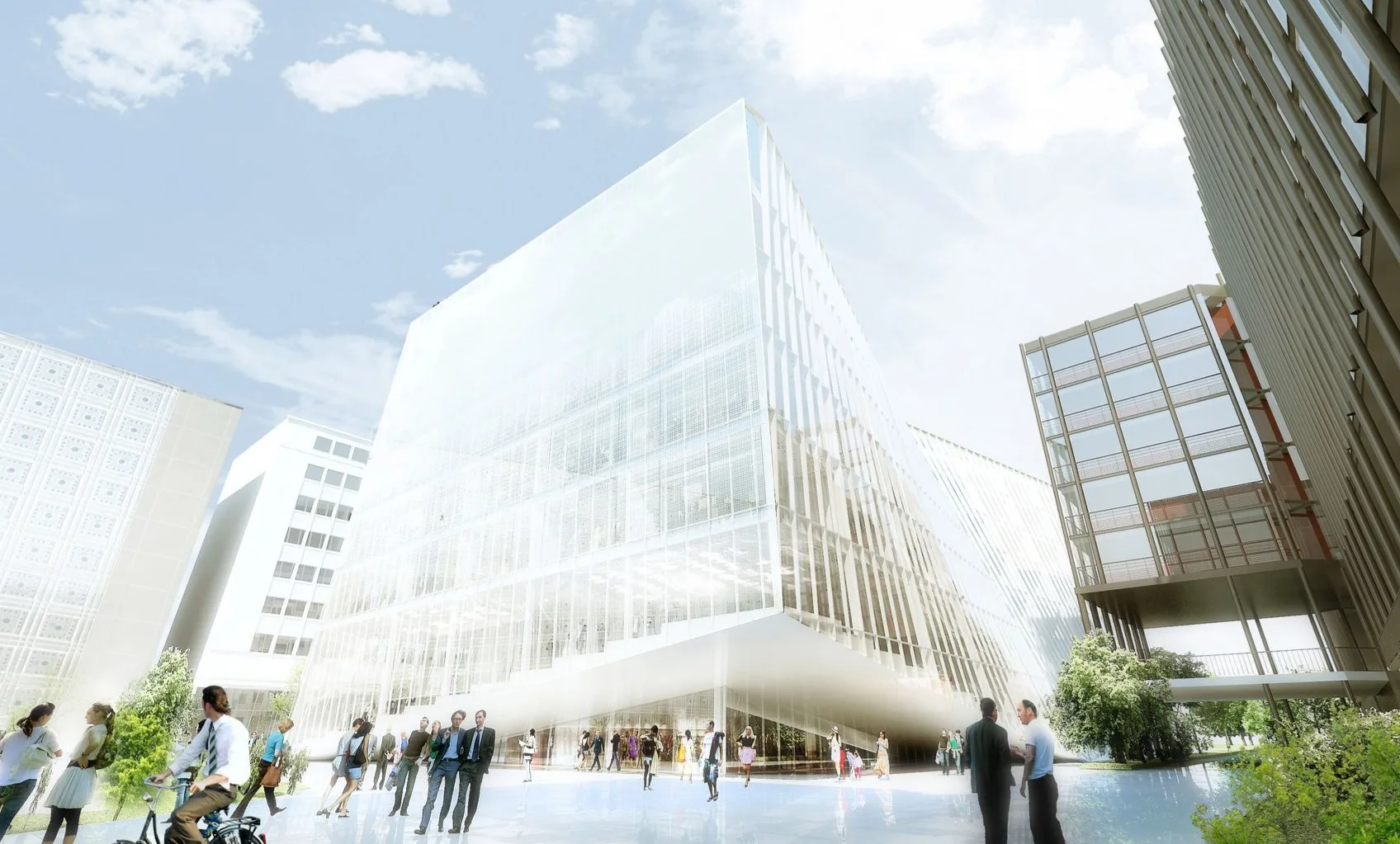
We conceived **the Innovation Hub as a reactive form**, literally sculpted by the forces surrounding it. This is not a metaphor: the building's volume is the result of a series of pressures and decompressions, as if the urban context had physically shaped its silhouette. The building swells in certain places to allow natural light and air to penetrate the heart of its mass, compresses elsewhere to preserve views and sunlight for adjacent structures. This approach allowed us to move beyond the sterile opposition between singular architectural object and continuous urban background.
The most radical gesture undoubtedly lies in **the central gorge**, this fissure that traverses the building from end to end. By carving into the volume, we created a green axis connecting the IMA esplanade to the park, in continuity with the original intention of the campus master plan. This space is not a simple residual void: it is a public passage, an urban breath, a place where park and plaza merge. The building does not sit on the ground like a barrier; it opens and invites movement, wandering, encounter.
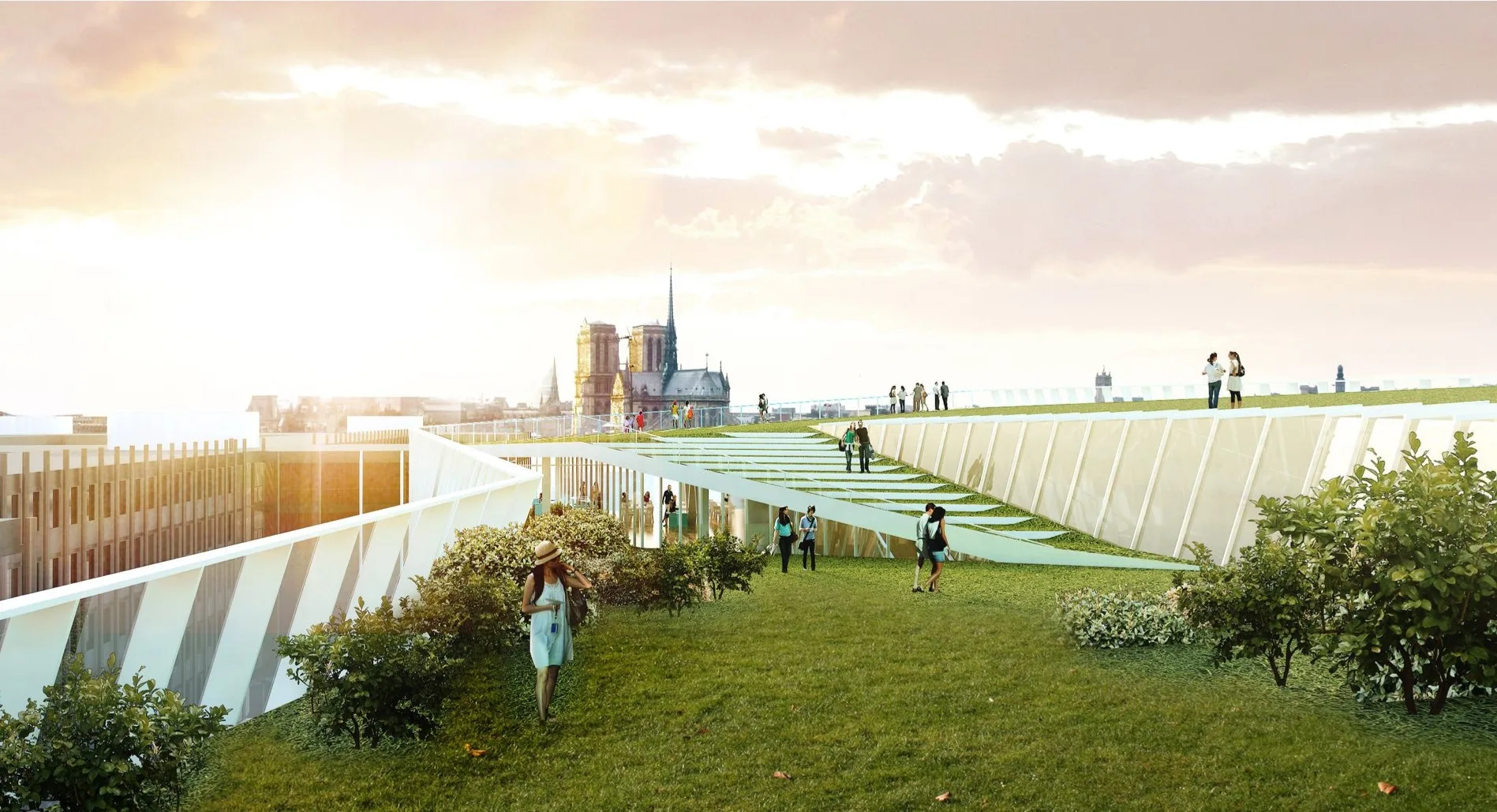
The question of ground footprint was crucial. In such a constrained context, every square meter taken from public space must be compensated, returned in another way. We therefore **gave back on the roof the surface occupied on the ground**, creating a vast accessible terrace. This fifth facade is not merely a technical roof: it is a new ground plane, an extension of the public realm at altitude. The gentle, vegetated slope allows users to rise progressively, offering views that blend into the Parisian panorama. Two covered outdoor spaces accommodate the restaurant, transforming the lunch break into a spatial and landscape experience.
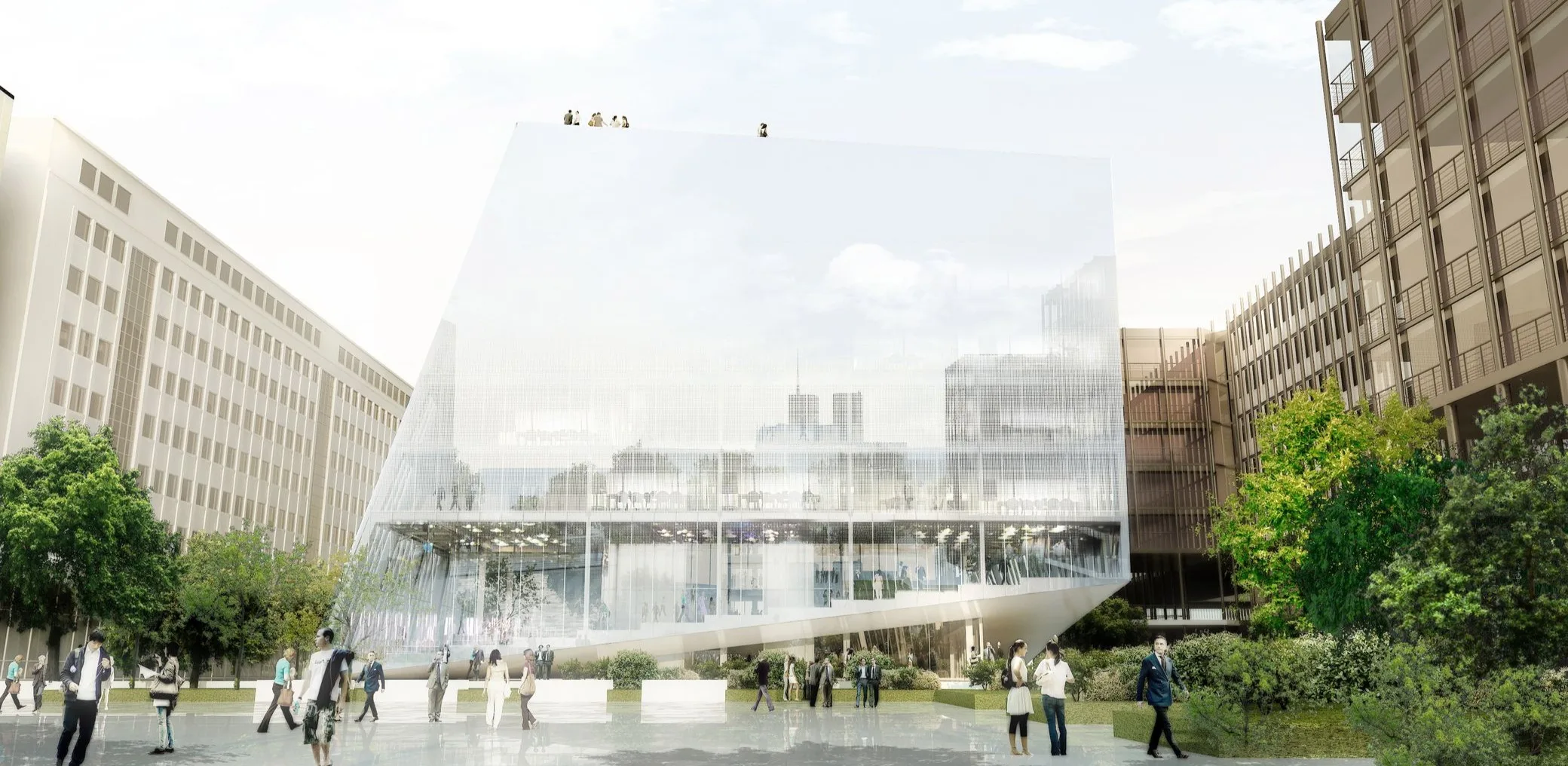
The inclination of the facade oriented toward the IMA plaza participates in this strategy of **visual dialogue with heritage**. By slightly tilting the volume, we created a reflective surface that captures and returns the image of Notre-Dame de Paris. This is not a gratuitous effect: it makes visible, from the plaza, an emblematic monument that nonetheless lies outside the direct field of vision. Architecture thus becomes an urban mirror, an optical device that enriches the perception of the site. The large panoramic windows on the ground floor amplify this relationship, offering spectacular framings of the cathedral from within.
The ground floor was conceived as **a true interface**, a transitional space where boundaries between campus and city dissolve. We gathered the public functions there: conference rooms, café, bookstore. These programs, accessible to all, whether student, researcher, or casual passerby, weave continuity with the IMA plaza. The idea was to create an active base, where urban life enters naturally, without barriers or excessive control.
The project's materiality responds to this dual requirement of **transparency and density**. Large glass facades generously open work and research spaces to the outside, affirming that innovation does not happen in isolation but in connection with the world. Simultaneously, the volume's compactness and surface treatment allow control of solar and thermal gains, essential for a program as energy-intensive as a laboratory complex. We employed natural ventilation where the program allowed, creating cross-ventilation flows that reduce dependence on mechanical systems.
The vegetated roofing and certain terraces participate in this environmental approach. It is not limited to a cosmetic gesture: it contributes to stormwater management, thermal regulation of the building, and creation of microclimates favorable to users. In a mineral district, every island of greenery counts.
Today, as construction nears completion, we appreciate the relevance of having conceived this project as an **urban experiment** as much as an architectural one. The Innovation Hub is not only a place where research is conducted; it is a reinvented piece of city, a space that proves it is possible, even in extreme Parisian density, to create generosity, openness, connection. We wanted a building that does not merely occupy its site, but activates it, reveals it, transforms it into a meeting place between knowledge and society.
The site itself embodied this ambition. Located at the hinge between the esplanade of the Institut du Monde Arabe and the park along the Seine, this piece of hyperdense city demanded reflection on porosity. How, in a saturated environment where every square meter counts, could we create space rather than subtract it? How could we respect the views and light of neighboring buildings, student residences, classrooms, while asserting the presence of a program as dense as fifteen thousand seven hundred square meters of laboratories, offices, and public spaces?
We conceived **the Innovation Hub as a reactive form**, literally sculpted by the forces surrounding it. This is not a metaphor: the building's volume is the result of a series of pressures and decompressions, as if the urban context had physically shaped its silhouette. The building swells in certain places to allow natural light and air to penetrate the heart of its mass, compresses elsewhere to preserve views and sunlight for adjacent structures. This approach allowed us to move beyond the sterile opposition between singular architectural object and continuous urban background.
The most radical gesture undoubtedly lies in **the central gorge**, this fissure that traverses the building from end to end. By carving into the volume, we created a green axis connecting the IMA esplanade to the park, in continuity with the original intention of the campus master plan. This space is not a simple residual void: it is a public passage, an urban breath, a place where park and plaza merge. The building does not sit on the ground like a barrier; it opens and invites movement, wandering, encounter.
The question of ground footprint was crucial. In such a constrained context, every square meter taken from public space must be compensated, returned in another way. We therefore **gave back on the roof the surface occupied on the ground**, creating a vast accessible terrace. This fifth facade is not merely a technical roof: it is a new ground plane, an extension of the public realm at altitude. The gentle, vegetated slope allows users to rise progressively, offering views that blend into the Parisian panorama. Two covered outdoor spaces accommodate the restaurant, transforming the lunch break into a spatial and landscape experience.
The inclination of the facade oriented toward the IMA plaza participates in this strategy of **visual dialogue with heritage**. By slightly tilting the volume, we created a reflective surface that captures and returns the image of Notre-Dame de Paris. This is not a gratuitous effect: it makes visible, from the plaza, an emblematic monument that nonetheless lies outside the direct field of vision. Architecture thus becomes an urban mirror, an optical device that enriches the perception of the site. The large panoramic windows on the ground floor amplify this relationship, offering spectacular framings of the cathedral from within.
The ground floor was conceived as **a true interface**, a transitional space where boundaries between campus and city dissolve. We gathered the public functions there: conference rooms, café, bookstore. These programs, accessible to all, whether student, researcher, or casual passerby, weave continuity with the IMA plaza. The idea was to create an active base, where urban life enters naturally, without barriers or excessive control.
The project's materiality responds to this dual requirement of **transparency and density**. Large glass facades generously open work and research spaces to the outside, affirming that innovation does not happen in isolation but in connection with the world. Simultaneously, the volume's compactness and surface treatment allow control of solar and thermal gains, essential for a program as energy-intensive as a laboratory complex. We employed natural ventilation where the program allowed, creating cross-ventilation flows that reduce dependence on mechanical systems.
The vegetated roofing and certain terraces participate in this environmental approach. It is not limited to a cosmetic gesture: it contributes to stormwater management, thermal regulation of the building, and creation of microclimates favorable to users. In a mineral district, every island of greenery counts.
Today, as construction nears completion, we appreciate the relevance of having conceived this project as an **urban experiment** as much as an architectural one. The Innovation Hub is not only a place where research is conducted; it is a reinvented piece of city, a space that proves it is possible, even in extreme Parisian density, to create generosity, openness, connection. We wanted a building that does not merely occupy its site, but activates it, reveals it, transforms it into a meeting place between knowledge and society.
- Lieu
- Paris
- Nature
- ERP
- Surface
- 15 700 m²
- Budget
- 58 M€ HT
- Concours
- 2011
- Livraison
- 2026
- MOA
- Sorbonne Université
- Co-architectes
- BIG
- Photographe
- Pierre Chatel-innocenti/ oxo