

«When architecture breathes with nature» — Manal Rachdi's sensitive universe
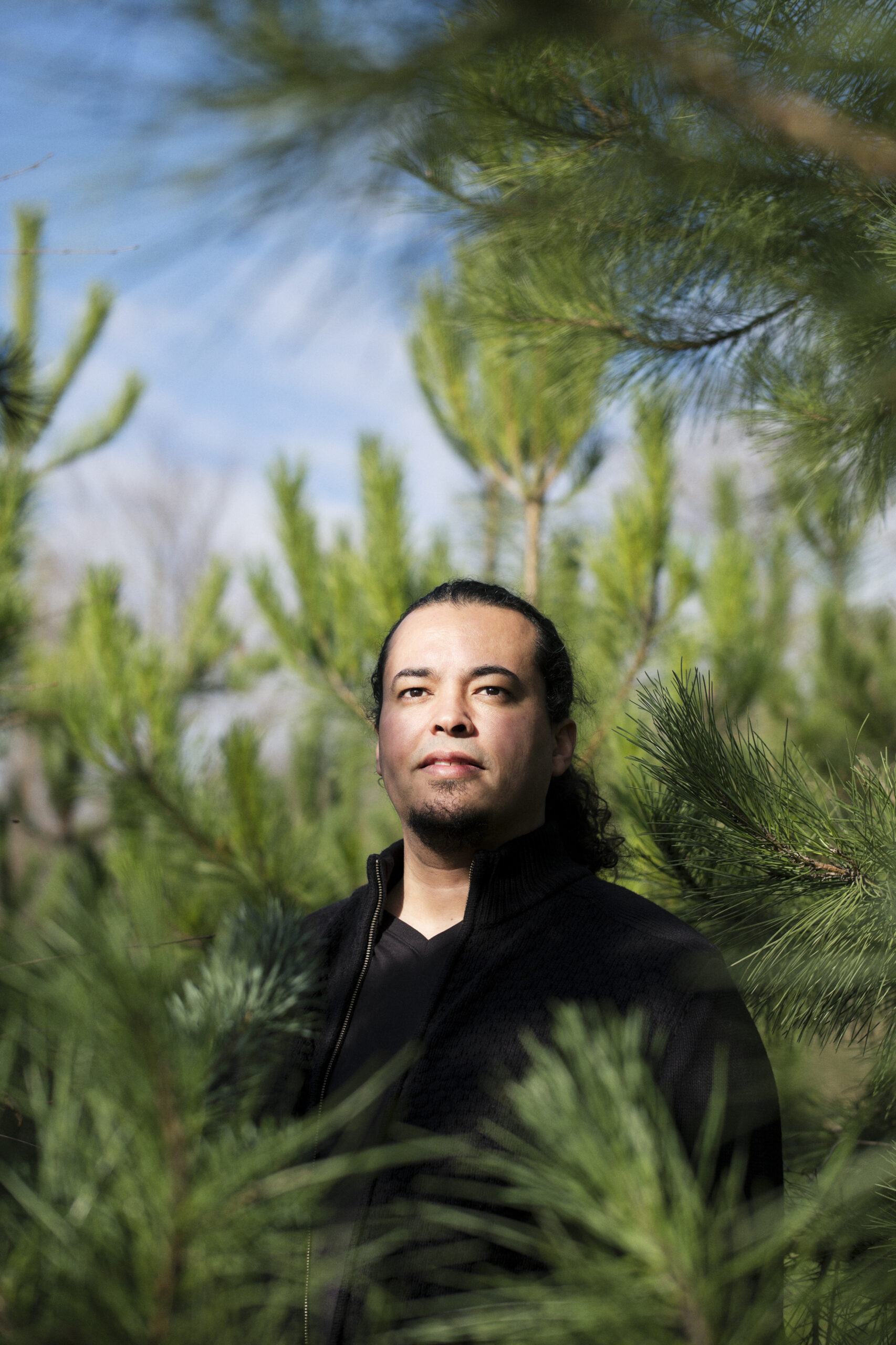
A+E // You grew up between Moroccan landscapes and European cities. What childhood images, what founding places still nourish your architect's imagination today?
Manal Rachdi: "My architect's imagination was born in forests, medinas, metropolises and science fiction."
I grew up wandering through the Ibn Sina forest in Rabat, where light filters through eucalyptus trees. This universe taught me early on the value of shadow, the power of scents and the protective role of trees. The landscapes of Beni Mellal, with their abrupt reliefs and arid lands, transmitted to me respect for water, rare and vital, as well as the intensity of natural contrasts.
The winding paths of the medinas of Fès, Rabat and Kénitra introduced me to a more intimate urbanity: sinuous alleys, secret passages, hidden patios, where shadow, silence and surprise become a true architecture of the senses. Then I discovered the urban jungle of Paris, Brussels and New York, with their verticality, their density and their continuous energy, where every threshold and every square becomes a theatre of life. These landscapes – the forest, the mountain, the medina and the metropolis – are today the roots of my imagination. They explain why I always seek to create dialogue between nature and city, light and shadow, grand landscape and everyday details.
But my imagination was also nourished by mental and fictional territories: Derrida's destructured spaces, which question our spatial certainties, or Philip K. Dick's hallucinated worlds, where reality blurs and opens new perceptions.
Similarly, William Gibson's prospective cities and cinematographic visions that deconstruct space taught me that architecture is not only built, but also mental, philosophical and narrative. These invisible dimensions dialogue with my founding landscapes and enrich my way of conceiving places where the real and imaginary meet.
A+E // You describe architecture as an encounter between the infinitesimally small and the infinitely large, between biology and urbanity. How does this idea translate concretely in your projects?
M.R.: "Matter, form and ecosystem are my three scales of work: cellular, territorial and living."
Through a permanent back-and-forth between the intimate scale and the territorial scale. At the micro scale, the cellular state of materials sometimes reveals unprecedented structural responses that pave the way for biomimetic solutions more effective than simple technical gestures. At the macro scale, the observation of dominant winds, urban forms and landscape continuities provides functionings that architecture can integrate to increase its performance and appropriateness. And sometimes, it is the replication of existing ecosystems that offers the most relevant answers, because they have already demonstrated their effectiveness over the long timescale of living things.
L'Arbre Blanc illustrates this approach well: its large balcony-leaves, up to 7 meters in cantilever, capture light and breeze, create shadow and extend living space outdoors. Like large protective branches, they shelter the façade, reduce the need for mechanical cooling and promote natural air circulation. Morphology thus becomes a climatic tool as much as an architectural gesture.
A+E // Beyond landscapes, which masters, artists or encounters marked your journey and shaped your practice?
I had the opportunity to learn from Jean Nouvel, whose conceptual precision and narrative force continue to nourish my practice. Then my companions on the road, Sou Fujimoto and Nicolas Laisné, with whom I shared several adventures including L'Arbre Blanc, allowed me to confront and refine my intuitions about the relationship between architecture and landscape.
But my imagination was also enriched by encounters outside the strictly architectural field. Fashion designer Azzedine Alaïa conveyed to me the idea that matter can be both rigorous and sensual. Artist and friend Pascal Haudressy explores the boundaries between art and science, between fixity and movement, and made me aware of this vibrant dimension of space. With digital artwork creator Zaki Jawhari, alias Urban Drone, it's another way of looking at digital landscapes through immersion and aerial perspective, a shift in perspective and the capturing of flows. On a register more directly linked to living things, collaboration with botanist Patrick Blanc opened the door for me to make vegetation not a decoration but a truly constructive, structuring and identity-based material.
Finally, dialogue with psychologist Marie Danet (my partner) allowed me to deepen my reflection on the emotional and cognitive impact of spaces, on how architecture influences our behaviors, our well-being and our relationships.
These intersecting paths, between architecture, fashion, art, science, psychology, nature, form common ground where my work takes root and renews itself.
A+E // Your approach to "sensitive archaeology" invites digging into the site, its climate, its uses, its memories. Can you share a project where this reading of place profoundly transformed your initial design?
M.R.: "Reading a site means understanding its memories to invent its future."
Écotone Antibes is a clear example. Initially conceived as a simple tertiary campus, the project shifted when we read the site as an ecological edge, an ecotone in the biological sense: a fertile transition zone between city and nature. This discovery transformed the project's logic. Rather than placing a fixed architectural object, we designed an inhabited, porous and stepped mountain that extends the existing landscape, captures winds for natural ventilation, and welcomes biodiversity on its terraces and façades. Architecture becomes a productive ecosystem, capable of returning more nature than it takes.
But this transformation is not merely formal: it is the result of in-depth research work that we conduct ahead of each project. We study climate and its seasonal variations, solar orientation and winds, the economic and cultural history of the territory, collective memories and daily uses. This process of sensitive archaeology consists of probing the visible and invisible layers of a place, like a palimpsest that reveals its fragilities and strengths.
In Antibes, this approach allowed us to understand that the site was not a void to fill but a living environment to extend. By reading it as an interface between Sophia Antipolis, the city of Antibes and the Mediterranean landscape, we were able to invent an architecture that does not deny the past but actualizes it.
It fits into a historical continuity (that of cultivated hills, Mediterranean terraces), while projecting itself toward future challenges: climate change, resource scarcity, the necessity to produce comfort differently.
Thus, Écotone is not merely a building but a narrative and climatic response: it connects the site's heritage to upcoming challenges, and proposes a new way of inhabiting the city where architecture and nature are no longer dissociated but conceived as a whole.
A+E // In your emblematic achievements: L'Arbre Blanc in Montpellier, Art'chipel in Marseille, or Ecotone; vegetation is not decoration but a driver. How do you make nature become structure, use, identity?
M.R.: "I am an evolutionist: for me, architecture must learn from nature its capacity to transform permanently, to change with seasons and atmospheres, while remaining a stable and vital foundation for humanity." For me, nature is a structuring element. It is not a supplement or an ornament, but the very basis of design. In our projects, it enables the development of truly inhabited ecosystems, where architecture is no longer separated from the living but conceived as a fertile support.
Vegetation is also a tool for climatic performance. It helps control cool islands, naturally protects and cools façades, filters light, promotes ventilation and improves inhabitants' comfort. Nature, in this sense, must be considered as a highly evolved technology, perfected over millions of years of adaptation: it knows how to respond to seasons, absorb excesses, regulate microclimates and protect architecture better than any mechanical device.
But it is also a space of use: in Montpellier, the large balconies of L'Arbre Blanc are true outdoor living spaces, designed to welcome daily life as much as vegetation. In Marseille, Art'chipel offers an urban oasis where inhabitants meet amid trees and suspended gardens. In Antibes, Écotone organizes its morphology as a vegetated mountain, where terraces become shared spaces and supports for biodiversity. Finally, vegetation is identity: it gives a silhouette, an atmosphere and a memory to the projects. It is not merely visual decoration, it is a way of inscribing the building in continuity with its territory and climate.
The question that interests me most in architecture is that of transformation and evolution. Nature, through its capacity to renew itself, to transform with the seasons and to generate changing atmospheres, brings permanence in change. It is this dialectic – being in constant mutation while remaining faithful to an equilibrium – that inspires me. In this sense, I consider myself an evolutionist: I believe that architecture must learn from the living, from its adaptability and resilience. This vision is nourished by authors who profoundly influence me, whether they come from science, philosophy or literature, and who constantly question our relationship to time, to the living and to metamorphoses.
A+E // You emphasize morphology as a performance tool. Would you have an example where the very shape of the building allowed you to reduce technical or energy devices?
M.R.: Mille Arbres is very telling: its inverted pyramidal morphology optimizes sunlight for housing, acts as a natural barrier against pollution and noise, and installs a roof canopy that regulates microclimate. Here, performance comes first from geometry, before technique.
A+E // You also speak of evolving buildings, capable of changing over time. How do you anticipate these metamorphoses and what place do you leave for the chance of life and nature?
M.R.: We design open frameworks and fertile soils that allow buildings to adapt to future uses and needs. Vegetated roofs and façades evolve over time, and inhabitants appropriate spaces in their own way. Chance, the growth of living things, appropriations: all of this is part of the project. The unforeseen is wealth, it gives life to architecture.
A+E // The so-called "smart" city increasingly relies on technologies. How do you imagine a balance between digital innovation and the presence of nature?
M.R.: "A city is not intelligent because it is digital, but because it is alive."
I believe in a bio-compatible city more than a techno-centric one. Digital innovation must remain discreet and useful – sober management, comfort, predictive maintenance – while true intelligence comes from light, climate, bio-sourced materials and the presence of the living. For me, tomorrow's city will not be merely "connected" by cables and sensors, but especially connected to the living: to water cycles, to fertile soils, to ecological corridors, to human behaviors. High technology must fade behind a low-tech inspired by the living, where architecture acts as a sensitive interface between nature and society. It is in this subtle alliance, between digital tools, climatic forms and urban ecosystems, that the true intelligence of future cities resides.
Science fiction and prospective science authors remind us that too much technology can cause humanity to lose its reason. This is why I advocate for cities that rely on technical and artificial intelligence not to depend on it, but to design the lowest-tech environments possible. The objective is clear: to use these tools as discreet allies to make our world more just, simpler and more inhabitable.
A+E // If you had to make a promise to the city or its inhabitants through your architecture, what would it be?
M.R.: "Offer more nature than what architecture consumes."
Each project must return in biodiversity, climatic comfort and quality of life more than what it has taken. It is a form of pact that I make with territories and their inhabitants: if a building takes soil, it must give back shadow, coolness, fertile soils, ecological continuities, shared spaces.
This promise goes beyond ecology as constraint: it is a positive and regenerative vision. Architecture must not only limit its impacts, but become an agent of the living. It can produce purer air, promote pollinators, improve health, generate social bonds. In an urban world seeking meaning, I believe our role is to design places capable of healing the city, of calming it and of restoring inhabitants' sensory relationship with their environment.
A+E // What horizons would you like to explore tomorrow, whether new programs, materials or territories?
M.R.: I want to develop hybrid programs mixing housing, work, urban agriculture and health; deepen the use of bio-sourced materials and reuse; and invest in edge territories, peripheral areas, metropolitan fringes, port zones, to transform them into inhabited and fertile landscapes.
Beyond these directions, my vision is that of a city-ecosystem, where the massive presence of nature is not a luxury but a vital necessity. A city where one lives daily in a constant relationship with the living, where every street, every rooftop, every façade can become fertile. This immersion in nature has nothing decorative about it: it provides calm, improves health, regulates microclimates and restores a quality of life lost in contemporary metropolises.
This involves generous and accessible shared public spaces, cultural projects rooted in the city and open to all, and hybrid living places that break down usage barriers. Living, working, learning, cultivating oneself, healing and meeting should be able to coexist in the same urban ecosystem. The projects we design seek to embody this mixing, where architecture no longer separates but connects, where it becomes a complete living environment.
A+E // Finally, when one enters one of your buildings, what would you most like them to feel?
M.R.: My buildings are not objects, they are inhabited landscapes. I would like people to feel the sensation of entering an inhabited landscape rather than a simple building. That air circulates there as in a clearing, that light filters as through foliage, that materials and the presence of vegetation provide immediate calm.
My projects do not merely seek to protect but to offer a sensory experience: the coolness of shadow, the softness of a material, the scent of a plant, the sound of water or wind. These are places of resonance, where everyone finds something intimate, the memory of a garden, a medina, a horizon.
More than an architectural gesture, I wish to create spaces that calm and connect: connecting inhabitants with one another through shared places, connecting the city to nature through fertile continuities, and connecting each person to their own emotions. If people leave with the sensation of having experienced a moment of calm, beauty and connection to themselves, to others and to the living, then architecture has achieved its goal.