

Manifesto — The Carbon Right
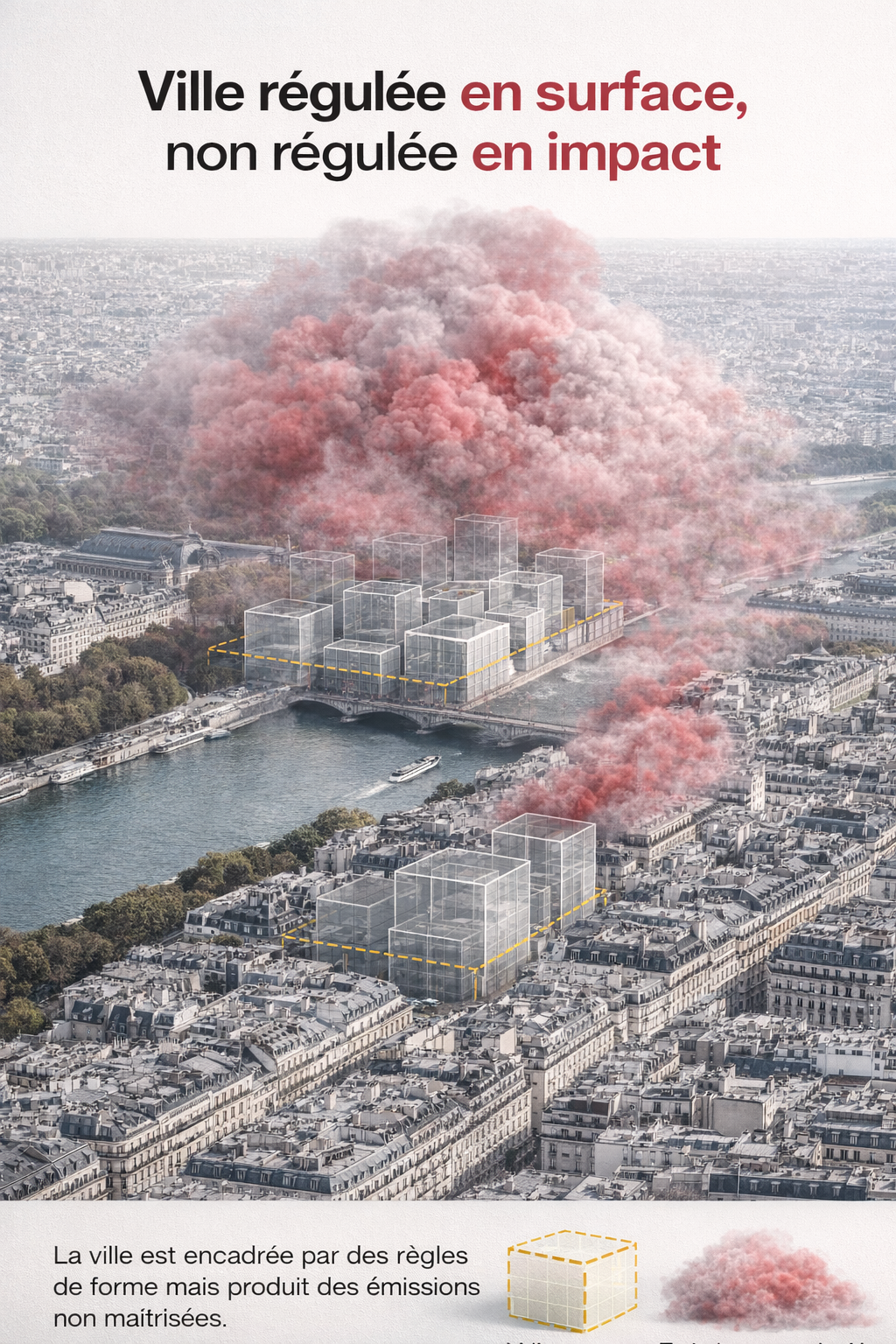
Carbon rights represent a continuation of environmental policies aimed at reducing greenhouse gas emissions, but propose a decisive evolution. Where carbon tax acts as an economic signal applied to activities, carbon rights introduce structural regulation integrated directly into the fabrication of territory. The goal is no longer simply to incentivize emission reductions, but to organize their control at the source, at the very level where they are produced: the plot.
For several decades, climate policies have been based on the recognition of negative externalities, theorized as early as the 19th century by Pigou. The principle is well known: any activity generating an environmental impact must bear its cost. Yet despite the widespread adoption of these tools, emissions continue to reach levels incompatible with the trajectories set by international agreements. This situation reveals a structural limitation: as long as carbon remains a peripheral variable, it cannot fundamentally guide production and development decisions.
Carbon rights propose to cross this threshold by making carbon a fundamental unit of urban projects. Each plot is assigned a maximum emission volume, defined in advance and maintained over time. This ceiling constitutes a real constraint, comparable to development rights, but applied to environmental impact. Building no longer consists solely of mobilizing land or surface area, but of inscribing an operation within a determined carbon budget. This approach transforms how projects are conceived, arbitrated, and realized.
In this framework, the plot becomes the relevant unit of accountability. It is both sufficiently precise to allow fine-grained measurement of emissions, and sufficiently operational to be integrated into design and decision-making processes. Each project must then balance density, uses, materials, and temporality, no longer solely according to immediate economic criteria, but in compliance with a collectively defined impact ceiling.
Carbon rights also introduce a dynamic dimension at the territorial scale. Emission rights can be traded between plots, within the same block or between contiguous blocks, allowing local adjustments to balance. This logic draws inspiration from mechanisms existing in other regulatory contexts, notably transfers of development rights, while applying them to environmental impact. It allows for reconciling flexibility and rigor, avoiding excessive rigidity while guaranteeing a controlled overall trajectory.
The entire system rests on a capacity for continuous measurement and monitoring. Each plot is equipped with an emissions monitoring system, a "carbon health record," which aggregates data related to energy performance, CO₂ emissions, and biodiversity. This monitoring allows for regular assessments, integrating bonus and penalty mechanisms, and inscribing projects within a long-term trajectory. Smoothing over several years ensures consideration of the actual temporalities of construction and operation. Ecology thus ceases to be a punctual state and becomes a measured and managed process over time.
At the municipal level, carbon rights constitute a governance tool. They allow for orienting development policies according to precise environmental objectives, prioritizing certain zones, and steering decarbonization in differentiated ways according to urban contexts. The role of public actors is reinforced, not through the accumulation of additional norms, but through the establishment of a legible and operational framework allowing for arbitration and regulation.
This approach is part of a broader logic of transforming value. Until now, urban production has primarily relied on valorizing surface area and buildability. Carbon rights introduce a new hierarchy, in which the capacity to control and reduce emissions becomes a determining factor. This mutation is not solely ecological, but represents a profound reorganization of economic models linked to the city.
The building sector, as a major contributor to global emissions, finds itself at the heart of this transformation. By placing the plot as the unit of measurement and action, carbon rights make possible a direct articulation between international objectives and local decisions. They offer a framework in which each project concretely participates in a collective trajectory of emission reduction.
Carbon rights thus constitute a regulatory infrastructure adapted to contemporary challenges. They do not rest on a declarative logic, but on a measurable, verifiable, and adjustable organization of impacts. By making carbon legally binding, they durably transform the conditions of urban production and inscribe ecology into the reality of decisions, on the same level as economic or regulatory constraints.
— منال الراشدي