

LE MONDE: The Graslin theatre in Nantes, a «public space building»
Trained under Duncan Lewis, Dominique Lyon and then Jean Nouvel in the early 2000s, the French-Moroccan architect Manal Rachdi founded his practice, OXO Architectes, in 2009. He has developed numerous collaborations, notably with the BIG office, Jean Nouvel, Sou Fujimoto, Nicolas Laisné and Dimitri Roussel. After delivering the residential tower L'Arbre blanc in Montpellier in 2019, he is now completing, among other things, a building project for the École polytechnique in Saclay (Essonne) and housing in Marseille.
"When I was a student in Nantes, I spent a lot of time on Place Graslin. I lived right next door, in a 15 m² room. The steps of the theatre were a bit like my living room. The place I went when I wanted to breathe. I could spend hours there, watching people. How they behave in public space, the postures they adopt… It's one of the first things you learn as an architecture student."
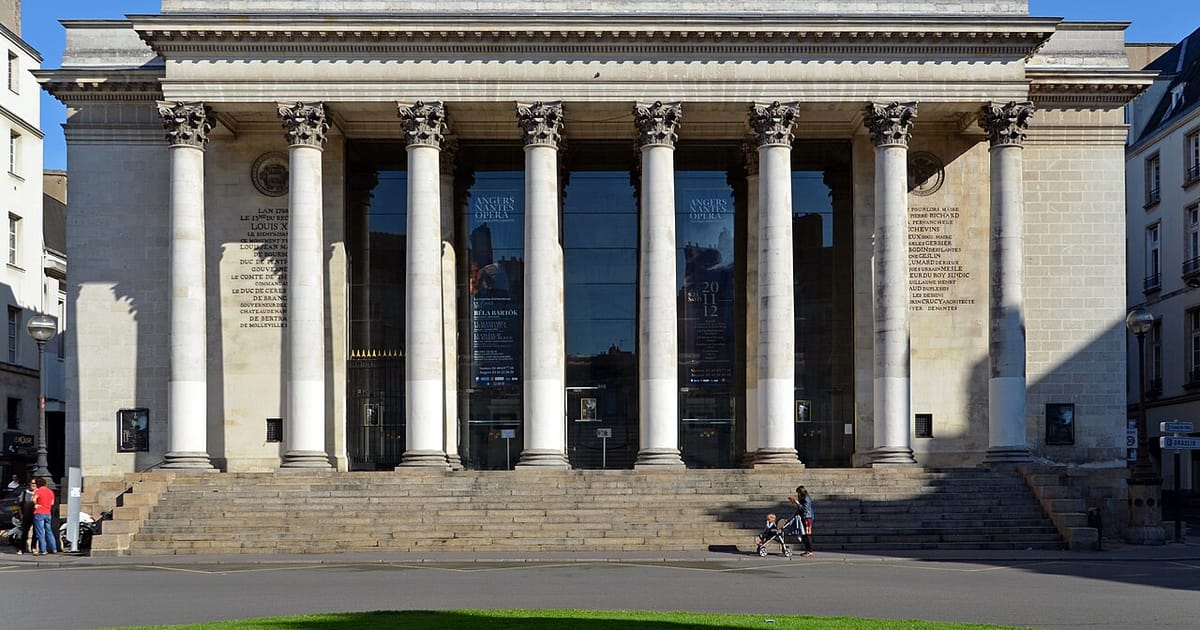
For the architect, these granite steps (thirteen in all), directly connected to the square, are a place of culture open to appropriation. They brought him a great many encounters, both professional and friendly. It was there that he attended his first operas, which eventually led him, in 2013, to design with Jean Nouvel the sets for The Marriage of Figaro at the Walt Disney Concert Hall in Los Angeles (costumes by Azzedine Alaïa).
A place for exchange
These steps have strong sentimental value for Manal Rachdi. To him, they have the power of a public square. This is not unrelated to the fact that his projects feature many staircases: in the BEM of the École polytechnique in Saclay, they become amphitheatres, places of transition, meeting places. At L'Arbre blanc in Montpellier, they wander across the façade, New York style. "Generosity is, after all, what brings places to life."
The Graslin theatre is a very well-proportioned neoclassical building, built between 1784 and 1788 by Mathurin Crucy. Its façade recalls that of the Odéon-Théâtre de l'Europe in Paris (1782). The building's strength really comes from the outside: its lobby, which opens onto the city, has something very generous about it, something rarely found in public buildings today. "I really see it as a 'public space building'!"
An obvious harmony
Between Place Royale and Rue Crébillon, which leads to Cours Cambronne, there is an obvious harmony. You can feel that real thought went into the spatial and urban layout. "What is urban planning, if not a matter of harmony and structure?"
Looking at the square from the steps is a pleasure, and that pleasure reflects on the theatre. The building and the public space truly work in concert. So much so that the square ended up being pedestrianised. "It feels as if the theatre was calling for this pedestrianisation. I really like the idea that buildings can impose urban uses.", Interview by Isabelle Regnier, Le Monde, 28 July 2021