

The Eiffel Tower
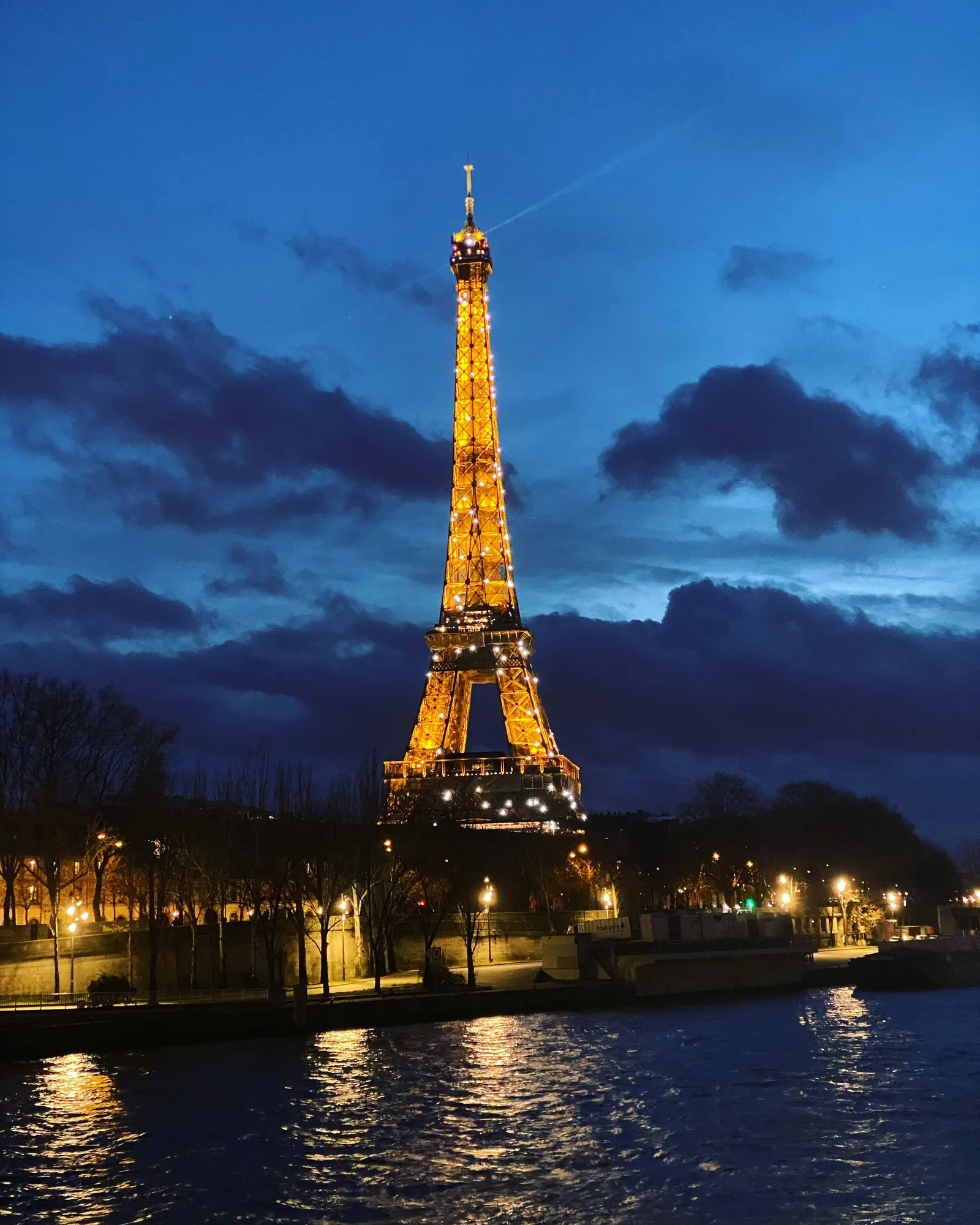
I was twenty-one the first time I saw it. Not an image, not a postcard, the thing itself, standing in the Paris sky, with its four feet seemingly barely touching the ground. And my first reaction, I must confess, was unease. I took it for an imperfection. A calculation error left there through negligence, like scaffolding someone had forgotten to dismantle.
Coming from Rabat, where architecture was made of thickness. Rammed earth walls that kept the coolness, patios enclosed within themselves, Almohad ramparts whose mass seemed to have grown from the ground itself, lime whiteness that repelled the sun instead of letting it in. To build, in my childhood, was to put distance between outside and inside, to carve out a refuge, to oppose a mass to the world. And there, before me, a thing that closed nothing. Iron, void, and sky passing through. A landmark without primary function, a silhouette that sheltered no one and yet held the entire city in its orbit.
I think my architecture began there, in that misunderstanding of a young man. I didn't understand the Tower that day, I endured it. But something settled in me, a question I couldn't formulate for years: why did this structure, which contradicted everything I knew about building, seem more right to me than the walls among which I had grown up? Why did this inhabited void attract me more than the solids of my childhood?
It took me time to understand that the Tower said the opposite of what my native city had taught me: one can stand upright while letting everything pass through. Structure is not the enemy of landscape, it can be its framework. Building doesn't have to rise against the world, it can inscribe itself within it, filter it, carry it. And the landscapes themselves, I no longer wanted merely to contemplate them as one contemplates a view from a window. I wanted them to work with the building, to be productive, to participate in the architecture instead of serving as its backdrop.
Arbre Blanc, in Montpellier, is a belated response to that first shock. Twenty years exactly separate the young man from Rabat dazzled before the Champ-de-Mars from the architect who delivered this co-creation in 2019. A verticality that doesn't oppose the sky but dissolves into it. The balconies are branches, air circulates between levels, the inhabitants' gazes cross in the void. It's no longer a wall raised against the exterior, it's an inhabited tree, a permeable structure where one clings, where one leans, where one projects oneself toward the grand landscape of the city and the river. An architecture that doesn't possess its site, that lets it enter and returns it. An architecture open to all, not only to those who inhabit it.
With time, I finally formulated what I had glimpsed at twenty-one without being able to name it. There are two families of architectures, I believe, two fundamental ways of responding to gravity and the world. That of mass—pyramid, cathedral, fortress, medina—which accumulates matter, hollows out thickness, opposes to the sky a volume that must be circumvented. And that of framework—tower, timber frame, branching, bridge—which hierarchizes structure, voids matter, lets pass what must pass. Mass says *I protect you*. Framework says *I carry you*. These are two postures, almost two ethics, two different relationships to what architecture owes the world.
For a long time I believed I had chosen framework against mass. It was a youthful error, or rather a reaction—Rabat had overloaded me with solids, I needed void to breathe. But as I aged, as I built, as I looked at the works I admire, I understood that the architectures that endure are almost always the marriage of both. A mass that knows how to void itself with a patio, a fissure, a light. A framework that knows how to weigh, anchor, reassure the body. The Tower itself, if I look at it today with the eyes of the architect I have become, is not only framework, it has the gravity of a monument, the symbolic weight of a mass, even when sky passes through it. Perhaps that's why it has stood for more than a hundred thirty years: because it is both at once.
The depth of field between dreamed architecture, built architecture, and lived architecture perhaps lies in this tension. Mass reassures memory, framework opens the future, and it's in the back-and-forth between the two that the craft resides. To build is to negotiate constantly between what must weigh and what must fade, between what protects and what lets pass. And between mass and framework, there is the architect's gesture, extending a structure just enough, held enough, fine enough for life to settle there without deforming it.
I realized this recently while scrolling through the gallery on my phone. The object that returns there constantly, without my awareness, is it. Thousands of photos, taken over the years, at all hours, under all lights, from all angles of the city. An obsession of which I was not fully conscious. And I believe I understand the reason today: the Eiffel Tower was supposed to be dismantled twenty years after its inauguration. It was conceived as a parenthesis, an ephemeral demonstration for a world's fair. It's its very structure, its utility, its beauty, its obviousness, that made it eternal. An ephemeral architecture become unsurpassable. For me, to build is to strive toward that: to approach as closely as possible that minimum that makes the maximum, that economy of matter that manages to shelter the living and to endure.
That's what a silhouette of iron, seen at twenty-one from the Champ-de-Mars, ended up deciding for my life. I became a builder that day, without knowing it. Not a builder of walls, a builder of frameworks for the living.
— Manal Rachdi