

Faire Design 2019 — Bike Parc
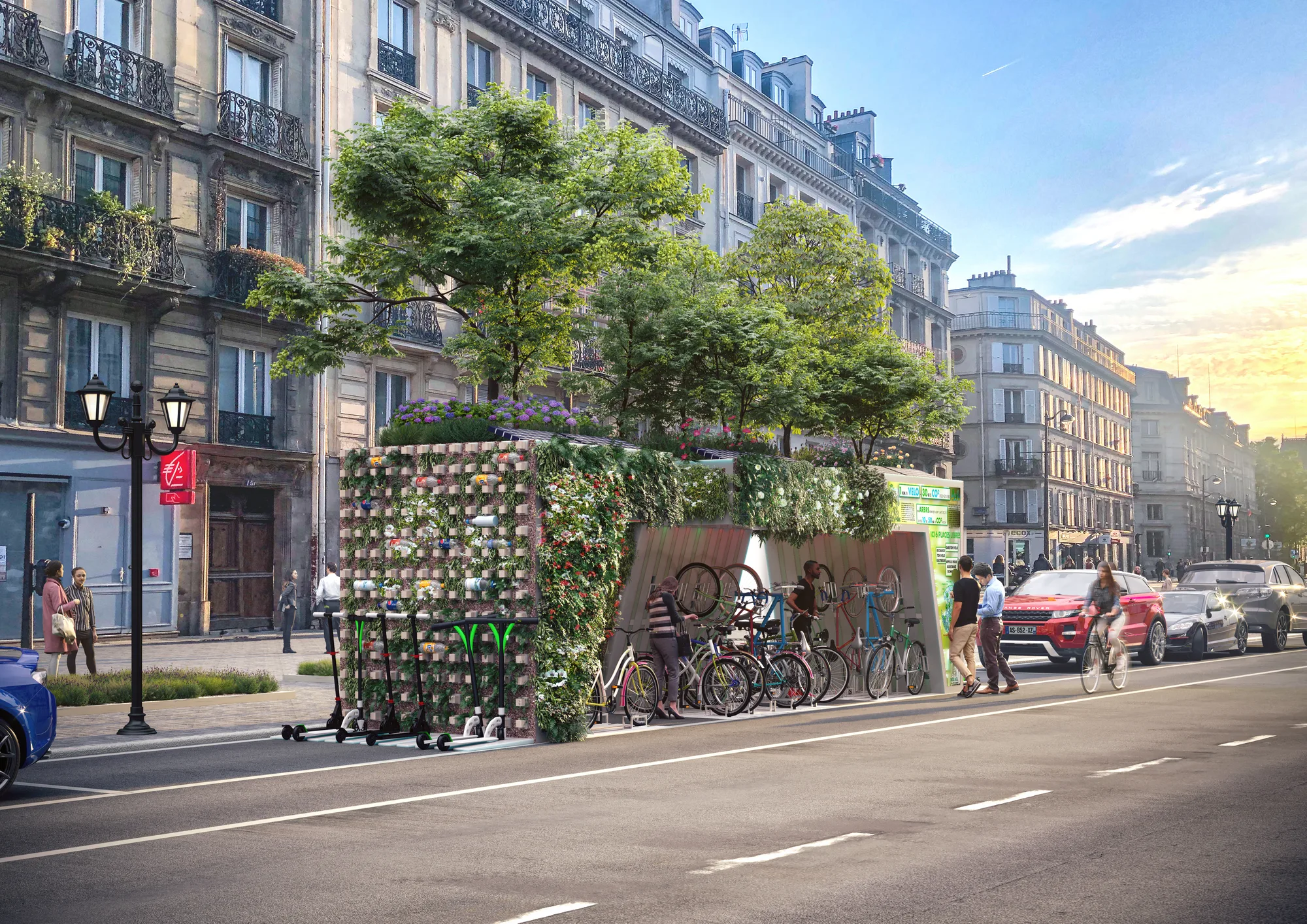
Converting the mineral city into living infrastructure.
Paris is changing models. The place of the car is diminishing, but the surfaces it frees up remain underutilized. These fragments of roadway, inherited from another use, today constitute strategic potential. Bike Parc starts from a simple observation: each parking space can become an active ecological unit, capable of producing environmental, social, and energy value.
Bike Parc thus proposes a targeted and replicable transformation of public space. The project converts parking spaces into hybrid micro-architectures, simultaneously serving as shelters for soft mobility, vegetation supports, and autonomous energy devices. This is not about adding one more object to the city, but introducing a new functional layer, capable of responding simultaneously to multiple urban challenges.
In terms of use, Bike Parc offers clear and secure infrastructure for bicycles and scooters. It structures an identifiable anchor point in the city, facilitating the adoption of soft mobility. Its capacity optimizes space by concentrating up to 18 bicycles and 25 scooters on the equivalent of two parking spaces.
On the ecological level, each module acts as a micro-ecosystem. Vegetation, integrated into the facade and roof, contributes to improving air quality, reducing heat islands, and bringing biodiversity back to urban environments. The project is not limited to a symbolic gesture: it produces oxygen, captures CO₂, and creates favorable conditions for hosting insects, birds, and microfauna. Rainwater harvesting and urban agriculture devices reinforce this logic of short cycles and local resilience.
On the energy level, Bike Parc functions as an autonomous micro-unit. Integrated solar panels power lighting and recharge electrical equipment. The module's performances—energy production, carbon capture, environmental data—are measurable and accessible, inscribing the project in a logic of transparency and education.
The project also rests on a participatory dimension. Part of the device is left for local residents to appropriate, through plant interventions or evolving uses. This openness transforms each installation into a local variation, adapted to its context. Bike Parc is not a fixed object, but a system capable of evolving over time.
At the scale of a module, the impact is targeted. At the scale of a network, it becomes structural. Deployed at large scale, Bike Parc constitutes a diffuse infrastructure that contributes to sustainably transforming the urban landscape. It accompanies the transition toward a more breathable, more frugal, and more inhabited city.
Key project data
Each Bike Parc module is designed as an autonomous, measurable, and replicable unit:
• Capacity: 9 secured bicycles and 10 scooters
• Vegetation: 15 m² of vegetated facade
• Planting: 2 trees (5 to 10 m) and 2 shrubs (3 to 5 m)
• Energy: 2 m² of integrated solar panels
• Production: powers lighting and recharges electric mobility devices
• Materials: approximately 25 m² of recycled materials
• Urban agriculture: up to 150 reused containers
• Water: rainwater harvesting and storage
• Environmental impact: 60 to 120 kg of oxygen produced per year, approximately 30 kg of CO₂ sequestered per year
These data position Bike Parc as an active environmental micro-infrastructure, whose performances can be monitored, aggregated, and optimized at the urban scale.
Team
OXO Architectes — OXO Architectes ensures the design and overall vision of the project. The agency develops an integrated approach that articulates architecture, ecology, and uses, with particular attention paid to transforming urban constraints into project opportunities.
Patrick Blanc — Biologist, botanist, and researcher at CNRS, Patrick Blanc is the pioneer of the vertical garden. Specialist in tropical plants and vertical ecosystems, he brings to the project his expertise in designing high-performance vegetated devices, capable of sustainably integrating into constrained urban environments.
Bollinger + Grohmann — Recognized international engineering firm, Bollinger + Grohmann intervenes on structural and construction issues. Their approach aims to develop optimized solutions that are simultaneously robust, economical, and adapted to the specificities of each project.
Jawhari Zaki – Urbandrone — Architect and designer of interactive devices, Jawhari Zaki develops the sensory and digital dimensions of the project. He designs interfaces that make environmental performances visible and enrich the user experience in public space.